


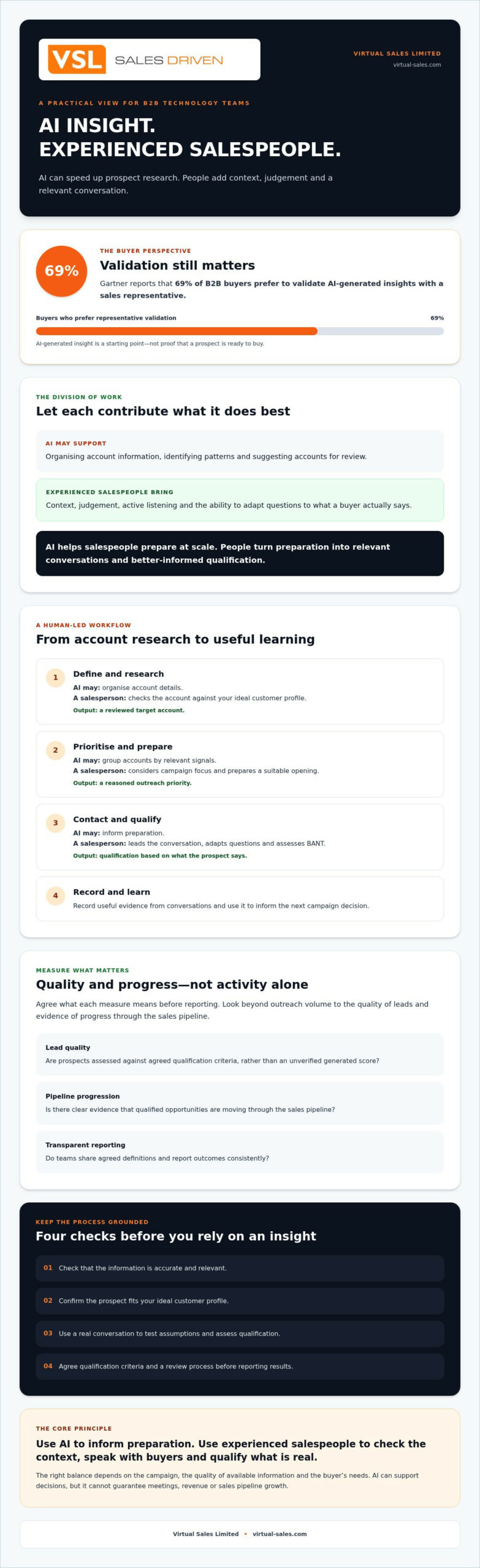
Gartner reports that 69% of B2B buyers prefer to validate AI-generated insights with a sales representative. That points to The Competitive Advantage of Combining AI With Experienced Salespeople: AI can speed up prospect research, but an experienced salesperson brings context, judgement and a relevant conversation. More activity alone won’t guarantee qualified opportunities or a healthier pipeline.
If you’re leading sales or marketing in a technology, SaaS or IT services business, you’ll recognise the pressure. Your team needs to prioritise prospects and prepare well, yet researching every account takes time. You also need clear evidence that campaigns are creating sales-qualified leads, not simply generating more outreach.
This guide explains where AI can support preparation and where human judgement makes the difference. You’ll learn how to connect prospect insight to qualification, build a practical workflow for better sales conversations, and assess results using agreed definitions and transparent reporting. The focus is measurable pipeline outcomes, not unverified claims about what AI can achieve.
Key Takeaways
- See how The Competitive Advantage of Combining AI With Experienced Salespeople can turn prospect research into more relevant, human-led conversations.
- Map AI-supported preparation to each stage of your sales workflow, from account research through outreach and qualification.
- Choose measures that show quality and pipeline progress, not just outreach volume, and agree what each metric means before reporting.
- Apply a five-step framework to put AI-informed prospect insights in the hands of experienced salespeople.
- Check whether your ideal customer profile, data, qualification criteria and review process are ready to support this approach.
Why combining AI with experienced salespeople matters in B2B
Technology sales teams need to reach more of the right prospects without turning every interaction into a generic message. Research and account prioritisation take time, particularly when a product involves technical, commercial and operational considerations. AI can support preparation, but a useful sales conversation still depends on people who can listen, test assumptions and respond to what a buyer actually says.
AI helps salespeople prepare at scale; experienced salespeople turn that preparation into relevant conversations and better-informed qualification.
What does combining AI with experienced salespeople mean?
It means using a human-led workflow. Depending on the campaign, AI may assist with organising prospect information, identifying patterns or suggesting accounts for review. A salesperson then checks whether those signals make sense, prepares an appropriate approach and leads the conversation. The purpose is to inform judgement, not to treat a generated summary or score as proof that a prospect is ready to buy.
This is different from simply automating sales outreach or relying on fully automated selling. B2B buyers can raise questions that a data pattern won’t answer: how a change affects existing systems, who needs to approve it, or what is driving the decision now. An experienced person can ask follow-up questions and adjust the discussion in real time. The right division of work depends on the campaign, the quality of available information and the buyer’s needs.
Why does the combination matter to technology sales teams?
Sector knowledge makes research more useful. A signal that looks relevant for a technology account may mean little without understanding the organisation’s priorities, buying process and existing environment. Salespeople can put account information into context, while AI-supported research may help them decide where to focus preparation time. For a closer look at how research can inform sales planning, see why market and competitor research matters to sales.
Buying decisions can also involve different stakeholders. IT may focus on compatibility and security; Finance may assess budget and business value; HR may consider effects on people and processes; Procurement may review supplier requirements. A relevant opening conversation recognises these different concerns rather than assuming one message will fit every decision-maker.
When teams agree what counts as a qualified lead, human conversations can test AI-informed assumptions against the buyer’s actual Budget, Authority, Need and Timeline (BANT). That makes qualification clearer and helps teams record useful evidence as prospects move through the sales pipeline. It also gives managers a more grounded view of outreach quality and pipeline progression. AI can support decisions, but it can’t guarantee meetings, revenue or sales pipeline growth.
How AI and experienced salespeople work together across the sales workflow
A useful workflow connects preparation to a real prospect conversation, then feeds what the salesperson learns back into the next campaign decision. AI-supported tasks should be assessed against your process and data; don’t assume a particular tool has accurate information or suits every campaign.
Where can AI support sales preparation?
Start with your ideal customer profile. AI may help organise account information, flag potential buying signals or suggest which accounts merit closer review. These are possible applications, not a substitute for checking the underlying information. A person should confirm that each prospect fits the ideal customer profile, that the insight is relevant and that the account is worth contacting.
From there, map the hand-offs:
1. Define and research: AI may help organise account details. A salesperson checks fit against the ideal customer profile. Output: a reviewed target account.
2. Prioritise and prepare: AI may help group accounts by relevant signals. A salesperson considers the campaign’s focus and prepares a suitable opening. Output: a reasoned outreach priority.
3. Contact and qualify: AI may inform preparation. The salesperson leads the conversation, adapts questions and assesses BANT. Output: qualification based on what the prospect says.
4. Record and learn: The team records agreed outcomes and feedback. Campaign owners review patterns and refine targeting or messaging. Output: clearer next steps and a better-informed sales pipeline.
The workflow is a guide, not a fixed automation recipe. Keep human review at the points where an inaccurate assumption could lead to irrelevant outreach or poor qualification.
Where does experienced sales judgement change the conversation?
Preparation can suggest what to ask, but listening determines what to ask next. A prospect may reveal that a technical requirement is still being assessed, that another stakeholder owns the decision, or that the timing has changed. An experienced caller can follow up, distinguish an active need from a passing interest and adapt the message without losing sight of the campaign’s purpose.
BANT provides a consistent structure for exploring Budget, Authority, Need and Timeline. It should guide a natural discussion, not turn it into a checklist delivered without regard for the buyer. The salesperson captures useful evidence, flags gaps and agrees an appropriate next step. That gives the sales team a more meaningful basis for deciding whether a lead is ready to progress.
For an overview of how this approach can support AI-powered B2B lead generation and appointment setting, consider how preparation and human-led qualification can fit your campaign. You can also review VSL’s appointment-setting profile and client feedback as part of your assessment.
How to assess the competitive advantage: quality, meetings and pipeline evidence
Assess the process from first activity to sales pipeline progression. A high volume of calls or messages shows effort, not whether the right prospects engaged or opportunities advanced. Before a B2B marketing campaign starts, sales and marketing should agree what each measure means, how it will be recorded and who will validate it.
Which measures show whether the approach is working?
Separate activity from outcomes. Track outreach attempts and contacts, then assess conversation relevance and qualification. Define a booked meeting separately from a meeting held, and agree what makes a meeting accepted by sales. Record qualified BANT leads, sales-qualified leads (SQLs) and movement through the sales pipeline. Weekly reports are more useful when both teams use the same definitions.
Activity shows what your team did; agreed quality measures and pipeline tracking show whether it created a commercially relevant opportunity.
For context, a September 2026 research brief cites Konsyg and Lunas Consulting benchmarks of 15-20% lead-to-meeting conversion for top-performing cold outbound teams using accurate data and personalised outreach. The same brief reports that VSL’s Clutch profile lists 10-15 qualified meetings per month as a typical result. These are reference points, not a forecast or guarantee for your campaign; compare results only when definitions and measurement periods align.
Common mistakes that weaken the evidence
- Counting outreach volume as proof of lead quality or pipeline impact.
- Changing the definition of a qualified lead or accepted meeting during reporting.
- Treating AI-generated account signals as confirmed facts without human review.
- Ignoring sales feedback when meetings fail to progress or qualification gaps emerge.
What can an illustrative campaign scenario show?
Illustrative scenario, not a VSL case study: A technology company targets organisations that may be reviewing an operational process. AI-supported research helps organise account information and suggest a possible reason for outreach. A salesperson checks the account against the ideal customer profile and treats the signal as a question to explore, not a confirmed fact.
During the call, the salesperson asks about the prospect’s current process and whether a change is under consideration. Follow-up questions explore need, decision roles, budget and timing. The caller records the answers against agreed BANT criteria and captures a suitable next step, or the reason there is no fit. The team can then review qualification, meeting acceptance and later pipeline progression without claiming the conversation produced a sale.

A five-step framework for putting AI insight into experienced salespeople’s hands
The Competitive Advantage of Combining AI With Experienced Salespeople depends on a clear hand-off: research informs preparation, people validate it in conversation, and campaign feedback guides the next decision. The following VSL 5-Step Method is a practical framework for organising that work, not a proprietary product claim or a promise of specific results.
The VSL 5-Step Method
- Define your ideal customer profile. Agree which organisations and decision-maker roles the campaign should target. Set shared BANT qualification criteria so sales and marketing have the same view of a suitable opportunity.
- Review the research. Treat AI-supported account insights as prompts for human review. Check relevance, accuracy and fit before using them to shape prospect priorities.
- Build relevant messaging. Create an opening from approved key points and the prospect’s verified context. Give callers direction, not a script to read word for word. Keep the conversation consultative and responsive.
- Test the outreach. Begin with agreed audiences and messaging. Callers should note the questions, objections and needs they hear, and record qualification against the agreed criteria.
- Measure and refine weekly. Review outreach, qualified conversations, meetings and next steps using shared definitions. Use the findings to adjust messaging, targeting or campaign priorities.
If AI-supported research suggests that a technology prospect may be reviewing a process, the caller should check that signal and ask an open question rather than present it as fact. A useful next step might be to clarify the prospect’s need or decision process. It could also be to record that the timing or fit isn’t right.
Make the process accountable and adaptable
Assign ownership before activity begins. Decide who reviews research, who leads prospect conversations, who confirms qualification and who manages follow-up. A caller can bring direct feedback from conversations; a Project Manager can review campaign patterns and recommend adjustments. VSL’s weekly reporting and feedback can support this review, with the client and campaign team agreeing any changes together.
Set pilot objectives before launch. Agree the audience, qualification rules, measures, review period and what evidence would justify continuing or changing the approach. Don’t judge success on outreach volume alone, and don’t treat an AI-generated signal as a qualified opportunity until a person has checked it.
For further context, explore AI-powered B2B lead generation and appointment setting and VSL’s article on lead scoring and building a sales pipeline.
Combining AI & Expert Sales: The Next Steps
The Competitive Advantage of Combining AI With Experienced Salespeople is most relevant when your team needs to reach the right technology, SaaS or MSP decision-makers with informed, human-led conversations. It can suit complex B2B buying processes where several stakeholders have different priorities. But before choosing tools or a partner, agree what the campaign should achieve and what qualifies as a worthwhile lead.
When is a human-led, AI-informed approach a good fit?
Start with readiness, not software. Check that you have:
- A defined ideal customer profile and target decision-maker roles.
- Usable, reviewed prospect data and clear ownership for checking its relevance.
- Agreed lead criteria, including how BANT informs qualification.
- A named owner for follow-up and a plan to review campaign outcomes.
AI may support research, but it can’t replace data review, sales judgement or timely follow-up. If qualification criteria are unclear, or nobody owns the next step, more activity may simply make the process harder to assess.
How can you assess an appointment-setting partner?
Ask how the partner’s callers will learn about your offer and represent your brand. Look for relevant sector experience, consultative conversations, dedicated project management and transparent feedback. Establish how the partner defines a qualified BANT lead, what campaign information will be reported and how caller feedback can inform changes to targeting or messaging.
Check the practical hand-off, too. Confirm how campaign outcomes will reach your sales team and whether CRM integration fits your requirements. VSL pairs dedicated callers with a Project Manager, with weekly reporting and feedback. The aim is to work as an integrated extension of your team, with agreed objectives and clear reporting. Explore the B2B appointment-setting service to understand how the service may fit your campaign.
Before proceeding, agree a pilot’s objectives and review criteria. Assess relevance, qualification and progression using measures both teams understand. Treat the results as evidence for a decision, not a guaranteed outcome.
🚀 Want to discover how AI-powered insight combined with experienced UK appointment setters can generate more qualified B2B sales opportunities? Learn more about VSL’s appointment-setting approach.
25+ Years Helping Technology Companies Generate Qualified Sales Meetings
Every successful campaign starts with a conversation
#OneStepCloser 🚀
UK technology appointment setting
#AI #B2BLeadGeneration #AppointmentSetting #SalesOutsourcing #SaaS #VirtualSalesLimited
Put AI insight to work in your sales process
AI can help your team prepare and prioritise, but experienced salespeople bring context to the conversation. Agree your ideal customer profile and qualification criteria first, then measure progress through relevant conversations, qualified meetings and sales pipeline movement, not activity alone.
The Competitive Advantage of Combining AI With Experienced Salespeople comes from connecting those steps. Use AI-supported insight to guide preparation, and let people check assumptions, explore BANT and agree a relevant next step with the prospect. Review the evidence regularly so you can refine targeting and messaging with purpose.
VSL assigns dedicated caller support and a Project Manager to each client. This provides a point of partnership for consultative prospect conversations, campaign feedback and transparent reporting, aligned with your team’s goals.
Start with clear criteria and a practical review plan. With the right people and process in place, you can build more relevant conversations and make better-informed decisions about your pipeline.
Frequently Asked Questions
Can AI replace experienced B2B salespeople?
No. AI can support tasks such as organising research or helping prioritise accounts, but it can’t replace relationship-building, contextual judgement or human qualification. A salesperson listens, asks follow-up questions and responds to the buyer’s specific situation. The Competitive Advantage of Combining AI With Experienced Salespeople comes from pairing preparation with those human skills, not removing people from the conversation or treating AI-generated information as a guarantee of sales results.
How do AI and experienced salespeople work together in lead generation?
AI may help organise prospect research and suggest accounts for review. A salesperson checks each prospect’s fit with the ideal customer profile, then leads relevant outreach and explores the buyer’s needs. They can assess Budget, Authority, Need and Timeline using BANT, record agreed outcomes and pass qualified opportunities to the sales team. Regular feedback on conversations can then inform changes to targeting and messaging, closing the loop between preparation and campaign learning.
What can AI do in B2B sales prospecting?
Potential applications include organising account information, surfacing patterns for review and helping teams prioritise prospects. These are examples to assess against your campaign, not claims about any particular tool or its data access. A salesperson should check whether an insight is accurate, relevant and consistent with the ideal customer profile before using it. Treat AI output as a prompt for preparation, not proof of buyer intent or a reason to contact someone automatically.
How can you measure the results of AI-supported sales outreach?
Agree definitions before reporting, including what counts as a qualified lead, a meeting booked and a meeting accepted by sales. Track qualified BANT leads, meetings, sales-qualified leads (SQLs) and movement through the sales pipeline alongside outreach activity. Review results over an agreed period and record where prospects progress or stall. This gives sales and marketing a shared view of quality and outcomes, rather than treating a rise in activity as evidence of pipeline impact.
Is AI-generated prospect data accurate enough for sales outreach?
Not without review. Check key details for accuracy and relevance, maintain Data hygiene, and confirm that each account and contact fits your ideal customer profile. A signal may be incomplete, outdated or unrelated to a prospect’s current priorities. Ask a person to verify the information before it shapes an opening message or call. If an important detail can’t be confirmed, avoid presenting it as fact; use it as a question to explore instead.
How can a sales team introduce AI without making outreach feel generic?
Keep people responsible for the final message and conversation. Ask them to review AI-supported research, use approved key messages and adapt their questions to the prospect’s role and responses. Avoid copying generated text unchanged across an entire audience. After outreach, collect feedback on what prospects asked, challenged or found relevant, then refine the messaging. This keeps preparation consistent while allowing the caller to respond naturally to each buyer’s context.
When should a business use an external appointment-setting team alongside AI?
Consider an external team when your business needs more prospecting capacity, relevant sector experience or consistent campaign execution alongside AI-supported preparation. Set clear objectives and lead criteria first, including how the team should assess BANT. Check that the partner offers consultative conversations, clear ownership and transparent reporting. VSL assigns dedicated caller support and a Project Manager to each client, helping the team work as an extension of your sales and marketing operation.


Disclaimer
Disclaimer: Content is for general information only and does not constitute professional advice. Results may vary. Virtual Sales Limited accepts no liability for actions taken based on this content.