


In 2026, 81% of sales teams have adopted AI, yet many continue to waste hours on “coffee meetings” that never convert into revenue. You’ve likely felt the frustration of high SDR turnover due to cold calling burnout, whilst struggling to prove the ROI of expensive intent data tools. This guide, AI Sales Signals: How to Know Which Prospects Are Actually Ready to Talk, addresses the fundamental disconnect between digital noise and genuine buying intent. We agree that your sales team’s time is too valuable to spend on leads that aren’t currently in a buying window.
We promise to show you how to identify high-velocity triggers that indicate a prospect is ready to sign, ensuring your team only speaks with qualified decision-makers. This article provides a clinical overview of signal-based selling, from defining core components to implementing a structured framework for scalable growth. We will preview the specific methodologies required to streamline your pipeline, increase meeting conversion rates, and achieve sustainable expansion without increasing your internal headcount.
Key Takeaways
- Transition from broad, inefficient prospecting to a signal-based model that identifies specific buying triggers within the IT and software sectors.
- Master the application of AI Sales Signals: How to Know Which Prospects Are Actually Ready to Talk to eliminate low-value meetings and focus on high-intent accounts.
- Avoid the “automation trap” by ensuring your response to digital signals remains personalised, human-led, and delivered within a critical 48-hour window.
- Implement a structured framework for data verification that secures between 10–20 qualified meetings per month without increasing your internal headcount.
- Protect your sales ROI and SDR morale by replacing high-volume cold calling with a clinical, intent-driven approach to pipeline development.
What are AI Sales Signals? Defining Buying Intent in 2026
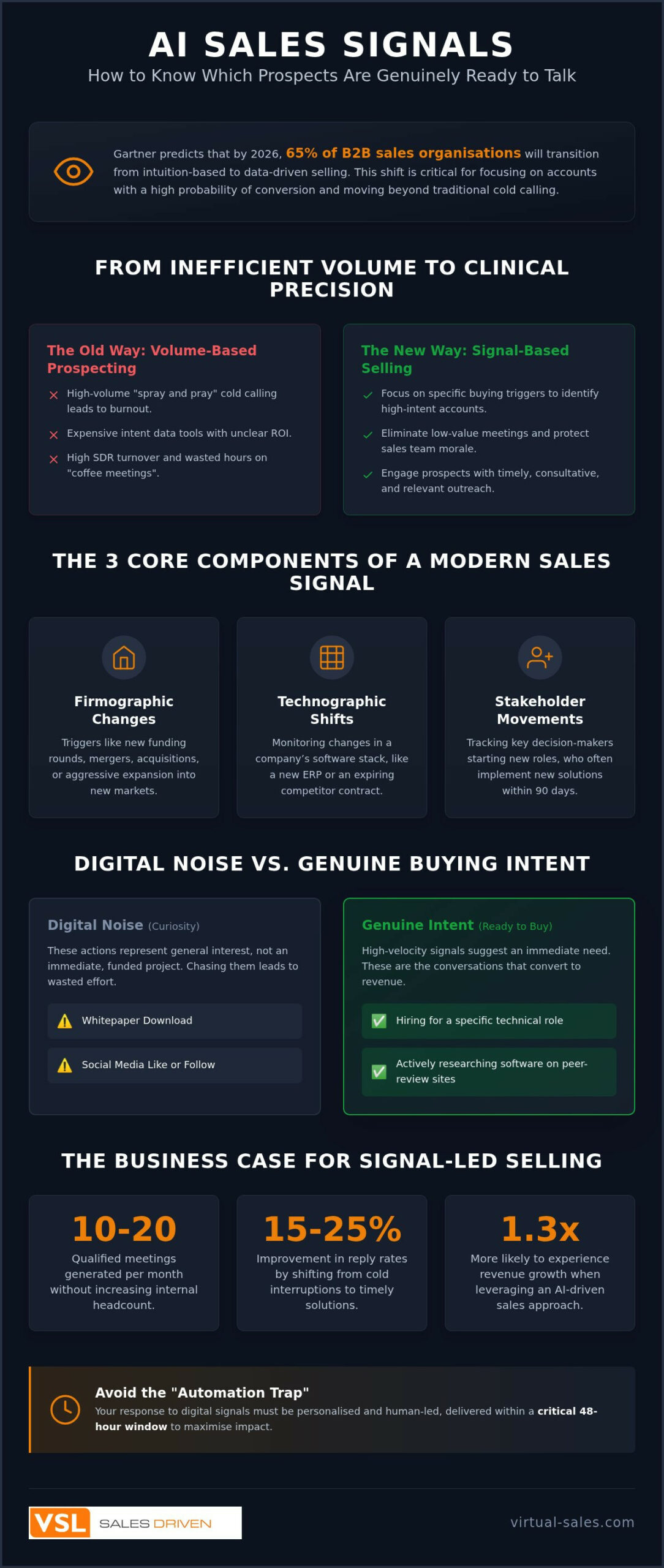
AI sales signals are dynamic data points that indicate a prospect is actively moving through a buying cycle. Unlike static marketing lists, these signals provide a real-time view of company behaviour and intent. Gartner predicts that by 2026, 65% of B2B sales organisations will transition from intuition-based to data-driven selling. This shift is essential for businesses that want to move away from the “spray and pray” approach of traditional cold calling and focus on accounts with a high probability of conversion.
The core of this technology relies on Predictive analytics, which allows systems to process vast amounts of unstructured data at a scale impossible for human SDRs. Modern AI monitors earnings calls, job boards, and industry news to identify patterns that suggest a documented need. Understanding AI Sales Signals: How to Know Which Prospects Are Actually Ready to Talk means identifying these “buying windows” before your competitors even know the prospect exists.
The Core Components of a Modern Sales Signal
Identifying a qualified prospect requires looking beyond basic contact information. Effective signals are usually categorised into three distinct pillars that, when combined, create a compelling reason to reach out:
- Firmographic changes: This includes new funding rounds, mergers, acquisitions, or aggressive expansion into new geographic territories; these high-intent triggers are often surfaced by platforms like SellAnyBiz.com | AI-Powered Business Marketplace & M&A Platform.
- Stakeholder movements: Tracking when key decision-makers in IT, Finance, or HR start new roles, as they often look to implement new solutions within their first 90 days.
Digital Noise vs. Genuine Buying Intent
Differentiating between noise and intent is the hallmark of a mature sales operation. A whitepaper download or a social media like often represents curiosity rather than a commitment to buy. Genuine intent is found in high-velocity signals, such as a company hiring for a specific technical role whilst simultaneously researching software categories on peer-review sites. These actions suggest an immediate, funded project rather than general interest.
Identifying these patterns requires rigorous data cleansing to ensure your team isn’t chasing stale leads. This level of precision is why many firms outsource to a specialist AI-powered B2B lead generation partner who can filter the noise effectively. By mastering AI Sales Signals: How to Know Which Prospects Are Actually Ready to Talk, your team avoids the “coffee meeting” trap and focuses exclusively on accounts with a verified need for your services.
Why Intent-Based Signals Matter: The Business Case for ROI
Adopting a signal-led strategy is a fundamental shift from volume-based prospecting to a clinical, value-driven operation. For many technology firms, the traditional model of high-volume cold calling results in an unsustainably high cost per acquisition (CPA). By focusing on AI Sales Signals: How to Know Which Prospects Are Actually Ready to Talk, businesses can direct their resources toward accounts already in a buying window, ensuring that every pound spent on business development yields a higher return. Research indicates that sales teams leveraging AI are 1.3 times more likely to experience revenue growth, as they move away from the “spray and pray” approach that clogs pipelines with low-intent leads.
Operational efficiency is further enhanced through the reduction of SDR turnover. Rejection fatigue is a primary driver of staff churn in B2B sales departments, costing UK companies thousands in recruitment and retraining fees. When outreach is triggered by a genuine intent signal, the conversation shifts from a cold interruption to a timely, consultative solution. This relevance improves reply rates to between 15–25%, significantly boosting morale and ensuring your best talent remains focused on high-value activity rather than dead-end dialling.
Maximising the Value of Your Sales Pipeline
Strategic alignment between marketing data and sales execution is the cornerstone of sustainable growth. Signals allow your team to prioritise high-value accounts over generic leads, ensuring your most experienced closers engage with the most lucrative opportunities at the perfect moment. This precision is vital for effective lead generation for technology companies, where reaching a prospect before the competition can be the difference between a won deal and a lost quarter. Implementing proven B2B lead generation strategies ensures that your pipeline is not just full, but functional.
Measurable Outcomes and Financial Benefits
The financial benefits of an intent-driven model extend to a shortened sales cycle. By identifying prospects who are already researching solutions or hiring for specific technical roles, you bypass the early awareness stages of the funnel. This acceleration increases your team’s capacity to manage more deals without increasing internal headcount. To maintain total transparency throughout this process, VSL utilises a cloud-based CRM and can output all activity data directly to popular CRMs such as HubSpot and Salesforce, providing a clear view of your ROI.
Focusing on qualified B2B sales leads reduces the time wasted on “coffee meetings” that never close. Instead, you build a predictable revenue engine backed by clinical data and human-led verification. For businesses looking to scale, the move to a signal-based model represents the most efficient path to measurable commercial success. You can review specific sector metrics and performance benchmarks by visiting the VSL Clutch profile.
Avoiding the “Automation Trap”: Common Mistakes in Signal Response
Deploying intent data without a human strategy often leads to the “automation trap.” Many organisations treat AI triggers as a green light for aggressive, automated email sequences. This approach backfires. It turns a sophisticated insight into digital spam. Understanding AI Sales Signals: How to Know Which Prospects Are Actually Ready to Talk requires more than just a software subscription; it demands a clinical approach to timing and relevance.
Speed is critical, yet many firms act on stale signals. If your outreach occurs more than 48 hours after a trigger, you’ve likely missed the window of maximum relevancy. By the time an automated sequence finally lands, your competitor has already engaged the prospect through a more direct, human-led channel. Reaching out too late makes your brand appear reactive rather than proactive.
The Personalisation Paradox
There’s a fine line between being relevant and being intrusive. Simply stating, “I saw you were hiring,” isn’t a value proposition. It’s a statement of fact that any bot can scrape. Over-reliance on AI-generated data can make outreach feel “creepy” if it isn’t tempered with professional maturity. Use signals as a conversation starter to bridge the gap to a real business problem. Don’t treat them as a rigid script. Your goal is to demonstrate that you’ve done your homework, not that you’re just reading a dashboard.
The Human-in-the-Loop Necessity
AI is exceptional at detecting patterns, but it’s blind to nuance. It cannot recognise the tone of a prospect’s voice or identify hidden objections that could derail a deal. This is the gap between a raw digital signal and a qualified B2B appointment. Whilst 81% of sales teams use AI in some capacity, research shows that 69% of B2B buyers still prefer to validate AI-generated insights with a human representative before making a decision. This persistent human requirement is at the heart of the B2B pipeline bottleneck AI alone can’t solve, where technology generates lead volume but fails to deliver the trust required for high-value conversions.
Another common failure is ignoring the organisational hierarchy. A valid company signal doesn’t tell you exactly who to call. Without an experienced caller who understands the IT sector hierarchy, you’ll likely waste time pitching to the wrong stakeholder. Effective signal response requires a consultative approach where an expert verifies the intent through a real conversation, ensuring your sales team only speaks with those who have the authority and budget to move forward.

The VSL Framework: Turning Signals into Qualified Meetings
The VSL Framework provides a clinical, five-step methodology to transform raw data into revenue. Most competitors treat AI triggers as a “set and forget” automation task, which inevitably leads to the “automation trap” discussed earlier. We take a different approach. By combining advanced detection with human-led verification, we ensure your team only engages with prospects in an active buying window. Understanding AI Sales Signals: How to Know Which Prospects Are Actually Ready to Talk is only the first step; the execution determines the final ROI.
Our framework follows a rigorous path to qualification:
- Step 1: Detection — We utilise AI to monitor specific triggers across the IT and Tech sectors, identifying events such as new funding, mergers, or infrastructure shifts.
- Step 2: Verification — Our team cleans the raw data and sources direct-dial (DID) or mobile numbers via LinkedIn to ensure high connectivity and data accuracy.
- Step 3: Consultative Outreach — We deploy experienced UK callers to conduct human-led, non-scripted conversations that explore the “why” behind the signal.
- Step 4: BANT Qualification — We verify the Budget, Authority, Need, and Timeline to ensure every meeting meets our high standard of quality.
- Step 5: CRM Integration — We push all lead data seamlessly into your Salesforce or HubSpot instance for immediate follow-up by your closing team.
Strategy and Project Management
Every campaign is assigned a dedicated Project Manager who refines signal criteria based on real-world feedback. We don’t operate in a vacuum. Through our cloud-based CRM, we provide total transparency, delivering weekly reporting and analytics to track your signal-to-meeting conversion rates. This allows us to pivot quickly if certain triggers aren’t yielding the expected results, ensuring your budget is always directed towards the most effective signals. This level of oversight makes us a natural, integrated part of your own internal team.
Consultative Conversation over Scripted Calling
We prioritise professional maturity over call volume. Our callers are “best-of-breed” professionals, many from IT backgrounds, who understand the nuances of the tech landscape. They don’t use scripts. Instead, they build rapport through market intelligence collection, positioning themselves as an expert extension of your workforce. For campaigns spanning Europe and the USA, we utilise native speakers to ensure cultural nuances are respected and gatekeepers are bypassed effectively. This human-led expertise verifies the digital signal, turning a data point into a genuine business opportunity. Learn how this process works end-to-end in our detailed guide on turning AI sales intelligence into qualified meetings.
Results and Performance Benchmarks: The Data Behind Signal-Based Selling
Success in intent-driven outreach is measured by the quality of the conversation, not just the volume of the dials. When you implement AI Sales Signals: How to Know Which Prospects Are Actually Ready to Talk, your primary benchmark shifts to the meeting conversion rate. Most technology organisations find that a clinical, signal-led approach delivers between 10–20 qualified meetings per month. This range reflects the variable nature of market sectors, yet it consistently outperforms traditional cold calling by focusing only on accounts with a verified need.
Transparency is a core component of how we report these results. Every campaign is managed through our cloud-based CRM, which provides real-time visibility into the status of every lead. We can output this data directly to your internal HubSpot or Salesforce instances, ensuring your closing team has the context they need to move forward. For a deeper look at sector-specific metrics and real-world outcomes, you can review the VSL Clutch profile, where our human-led methodology is documented by our clients’ success stories.
When to Use Signal-Based Selling: Strategic Deployment
Determining the right time to scale your outreach depends on your specific target audience and market maturity. For SMEs looking to disrupt a category, acting on high-velocity signals like recent job changes or new funding allows for a nimble, aggressive growth strategy. In contrast, Enterprise-level campaigns require a more patient approach, using signals to identify long-term infrastructure shifts that suggest a major procurement window is opening. Both strategies benefit from the precision that AI-powered insights provide.
We provide the flexibility of month-to-month pilot campaigns to help you identify which signals yield the highest ROI for your specific offering. This allows you to test new markets or software products without the risk of a long-term commitment. By combining these digital triggers with experienced B2B telemarketing, you ensure that every opportunity is qualified through a consultative human conversation. This is especially critical when navigating complex IT hierarchies where a digital signal alone cannot bypass a sophisticated gatekeeper or handle nuanced technical objections. The full methodology for turning AI sales intelligence into qualified B2B meetings explores how to bridge this gap between raw data and high-value dialogue.
Securing Your Advantage in the Intent-Driven Market
You now have the blueprint to move beyond blind prospecting. By mastering AI Sales Signals: How to Know Which Prospects Are Actually Ready to Talk, you can stop wasting resources on tyre-kickers and focus exclusively on high-intent accounts. Technology identifies the window, but your success depends on the human-led, consultative dialogue that follows. A structured framework ensures that every signal is verified and every meeting is qualified before it reaches your closers.
VSL brings 25+ years of technology sales experience, providing dedicated UK-based callers who act as an elite extension of your team. Our flexible monthly subscriptions allow you to test these methodologies without long-term risk or increased internal headcount. It’s time to turn digital noise into a clinical engine for growth and revenue predictability.
Your pipeline is too valuable to leave to chance. Start prioritising genuine intent today and transform your sales operation into a clinical operation that delivers measurable outcomes every month.
🚀 Want to discover how AI-powered insight combined with experienced UK appointment setters can generate more qualified B2B sales opportunities? Learn more: https://www.virtual-sales.com/ai-powered-b2b-lead-generation-appointment-setting/ #AI #B2BLeadGeneration #AppointmentSetting #SalesOutsourcing #SaaS #VirtualSalesLimited
25+ Years Helping Technology Companies Generate Qualified Sales Meetings. Every successful campaign starts with a conversation. #OneStepCloser 🚀
Frequently Asked Questions
What are the most effective AI sales signals for the IT sector?
The most effective signals for the IT sector include technographic shifts, such as a company adopting a new cloud platform, and firmographic triggers like Series B funding rounds. Monitoring job boards for specific technical hires also indicates a project is underway. By understanding AI Sales Signals: How to Know Which Prospects Are Actually Ready to Talk, you can identify when a legacy contract is expiring or when a firm is expanding its digital infrastructure. This allows for a clinical, timely approach to outreach.
How much does it cost to implement an intent-based calling campaign?
Implementation costs vary based on the volume of signals and the complexity of your target market. Whilst we don’t provide fixed pricing without a consultation, we offer flexible month-to-month subscriptions that remove the risk of long-term commitments. This allows businesses to test the ROI of intent-based calling without a significant upfront capital expenditure. Every campaign is supported by a dedicated Project Manager to ensure your budget is utilised efficiently to drive growth.
Can VSL integrate with my existing Salesforce or HubSpot CRM?
Yes, VSL maintains a cloud-based CRM designed for seamless integration with major platforms. We can output all qualified lead data and call notes directly into Salesforce or HubSpot, ensuring your internal sales team has immediate access to every opportunity. This integration maintains total transparency and allows you to track the progress of meetings from the initial signal through to the final contract signature within your own ecosystem. It ensures a smooth transition from our callers to your closers.
How quickly can we expect to see results from a signal-led pilot?
Results are typically visible within the first two to four weeks of a pilot campaign. Because we act on high-velocity triggers, our UK-based callers can secure qualified meetings almost as soon as the signal is detected. We aim for a consistent output of 10–20 meetings per month for most tech clients. This rapid turnaround ensures you can evaluate the effectiveness of specific buying triggers and refine your strategy in real-time to maximise your sales pipeline.
Why is human verification necessary if the AI signal is accurate?
Human verification is essential because AI cannot detect the nuance of a prospect’s tone or identify hidden internal objections. Whilst technology identifies the “buying window,” our experienced callers verify the “why” behind the interest. This consultative approach ensures that every lead meets strict BANT criteria. It prevents your team from wasting time on automated leads that lack the budget or authority to make a purchasing decision. This precision drives higher conversion rates.
Do I need to provide the database, or can VSL source the signals?
You don’t need to provide a database. VSL specialises in sourcing and monitoring AI Sales Signals: How to Know Which Prospects Are Actually Ready to Talk using our own advanced toolsets. We identify triggers, source direct-dial details via LinkedIn, and verify data before calling. This end-to-end service allows you to scale your pipeline without investing in expensive, fragmented data subscriptions. It ensures your team only speaks with prospects ready to convert.
What happens if a prospect is not ready to talk despite a signal?
If a prospect isn’t ready for an immediate meeting, we treat the interaction as a valuable data enrichment exercise. We gather intelligence on their current infrastructure and contract renewal dates, then feed this information back into your CRM. This builds a robust sales pipeline for the future. We don’t force “coffee meetings” that won’t convert; instead, we nurture the relationship until the prospect is genuinely ready to engage. This maintains the integrity of your sales process.


Disclaimer
Disclaimer: Content is for general information only and does not constitute professional advice. Results may vary. Virtual Sales Limited accepts no liability for actions taken based on this content.