


A prospect has attended a strong first meeting, then goes quiet. The opportunity remains in your CRM, but nobody knows whether the buyer is comparing options, waiting for internal approval or no longer interested. When a sales cycle stalls, more activity won’t necessarily create progress. The next step should be based on evidence from the buyer, not an arbitrary deadline.
If you lead sales, marketing or business development at a UK technology company, you’ll recognise the challenge. B2B deals involve changing priorities, several stakeholders and decisions that don’t always follow a straight line. It can be hard to connect outreach and follow-up to qualified pipeline progress, especially when early prospecting competes with later-stage deal work.
This guide explains the main stages of a B2B sales cycle and how they relate to the buyer’s decision. You’ll learn what evidence to review when an opportunity slows, how to agree a useful next step and how to manage prospects according to their needs rather than pushing every deal through the same process. It also covers a practical framework for bringing qualified conversations into the pipeline and maintaining clear visibility as opportunities progress.
- Separate the sales cycle, sales process and sales pipeline so your team can discuss opportunity progress clearly.
- Use shared stage definitions to improve handovers and focus sales time on qualified prospects.
- Move deals forward by resolving unclear ownership and next steps, not by pressuring buyers or bypassing evaluation.
- Review buyer feedback and qualification evidence to identify where an opportunity is slowing down.
- Use consultative appointment setting to add qualified B2B opportunities while your team leads later-stage sales conversations.
What Is a Sales Cycle? Define the Stages Before Improving Them
A sales cycle is the repeatable set of activities that moves a potential buyer from initial identification towards a purchase decision. For a technology business, that may mean finding a company with a relevant operational need, understanding how it evaluates solutions, and agreeing what evidence or discussion is needed to make a decision.
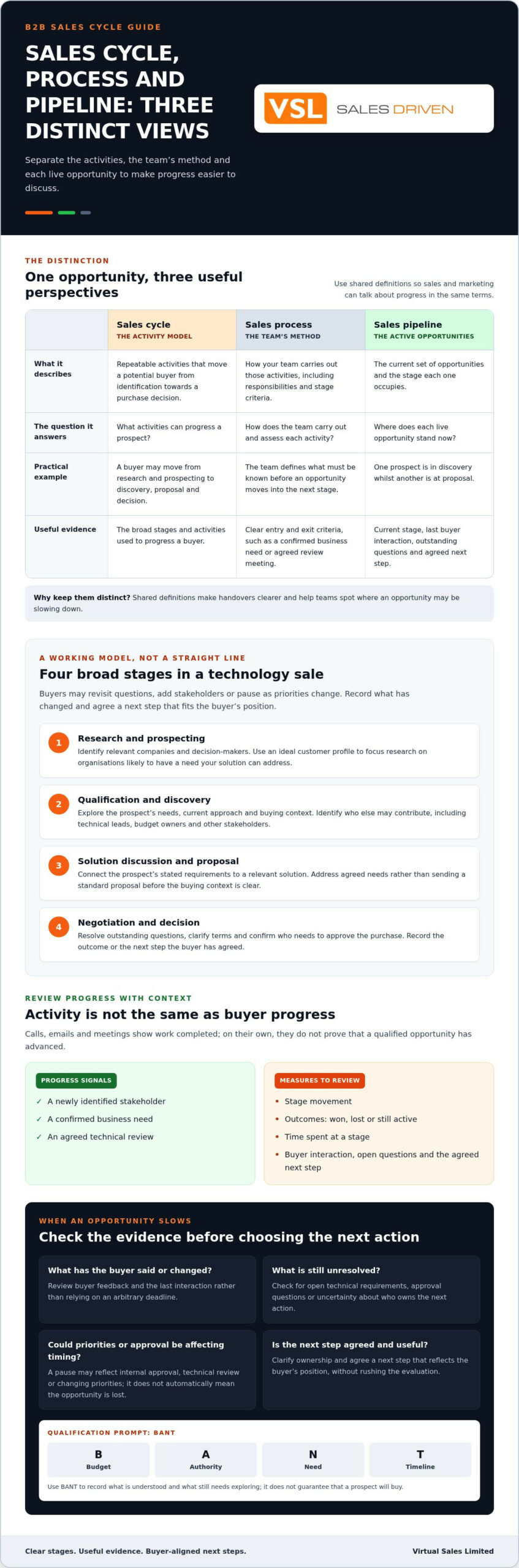
Keep three related terms distinct. The sales cycle describes the activities used to progress a prospect. The sales process is the team’s chosen method for carrying out those activities, including responsibilities, guidance and criteria for moving between stages. The sales pipeline shows the active opportunities and the stages each currently occupies. The terms can be used interchangeably in some contexts, as the neutral overview of the sales process reflects, but separating them helps teams discuss performance more clearly.
What are the main stages of a B2B sales cycle?
Stages give your team a practical map, not a promise that every buyer will follow a straight line. A typical technology sale may include:
- Research and prospecting: Identify relevant companies and decision-makers. An ideal customer profile helps focus research on organisations likely to have a need your solution can address. VSL’s article on market and competitor research explores how this work can inform targeting.
- Qualification and discovery: Test whether there is a genuine fit. Explore the prospect’s needs, current approach, buying context and who else may contribute to the decision. In a complex purchase, a technical lead may assess suitability while budget owners and other stakeholders weigh risk, timing or implementation.
- Solution discussion and proposal: Connect the prospect’s stated requirements to a relevant solution. Present a proposal that addresses agreed needs, rather than sending a standard document before the buying context is clear.
- Negotiation and decision: Resolve outstanding questions, clarify terms and confirm who needs to approve the purchase. Close means recording the outcome, whether the buyer proceeds, declines or agrees a defined next step.
These stages are a working model. Buyers may return to technical questions after reviewing a proposal, involve another stakeholder or pause while priorities change. That doesn’t automatically mean the opportunity is lost. Record what has changed and agree a next step that reflects the buyer’s position.
How does a sales cycle differ from a sales pipeline?
The cycle is the repeatable activity model; the pipeline is the current set of opportunities, each recorded at a stage. A prospect might be in discovery in your pipeline while another is at proposal, although both are moving through the same broad cycle. Use clear entry and exit criteria for each stage, such as a confirmed business need or an agreed review meeting. Shared definitions help sales and marketing discuss progress using the same terms, spot stalled opportunities and make handovers more useful.
Why Sales Cycle Management Matters for Technology Businesses
Technology deals can involve separate conversations about technical fit, security, implementation, budget and approval. Without agreed stage definitions, one salesperson may treat a proposal as a sign of strong progress, while another sees unresolved questions that still need attention. Shared criteria give teams a clearer basis for handovers and pipeline reviews, especially when several stakeholders influence the decision.
Good management makes the sales cycle easier to examine without assuming every delay has the same cause. A prospect may be waiting for internal approval, reviewing technical requirements or reassessing priorities. Stage-level visibility helps you ask what has changed, what evidence supports the current stage and who owns the next action. Salesforce also outlines sales cycle stages as a way to understand and manage progression, but your team’s definitions should reflect its buyers and sales process.
Which sales cycle measures help identify progress?
Track a small set of measures consistently. Stage movement shows whether opportunities are progressing; outcomes show whether they are won, lost or still active; elapsed time indicates how long opportunities remain at a stage. Pair these measures with context, such as the last buyer interaction, outstanding questions and the agreed next step.
Separate activity from progress. Calls, emails and meetings show work completed, but they don’t by themselves prove that a qualified opportunity has advanced. A meaningful signal might be a newly identified stakeholder, a confirmed business need or an agreed technical review. Define how your team records each signal before comparing results across periods or teams. Otherwise, differences in stage definitions can make conversion and timing measures misleading. Avoid adopting generic benchmark figures as targets unless their source and methodology are clear and relevant to your market.
How does qualification support a healthier pipeline?
Early qualification helps salespeople focus their time on prospects whose needs and buying context merit further discussion. BANT assesses Budget, Authority, Need and Timeline. It provides a structured way to record what’s understood and what still needs to be explored; it doesn’t guarantee that a prospect will buy. In technology sales, note which stakeholders are involved and whether technical or approval questions remain open.
Use qualification to guide the next conversation, not to force an opportunity into a stage. For a deeper look at pipeline practices, see this guide to business development and sales pipeline growth. Clear records help colleagues pick up an opportunity with the buyer context intact and agree a relevant next action.
Can You Shorten a Sales Cycle Without Rushing the Buyer?
Yes, by removing avoidable friction rather than pushing prospects to decide before they’re ready. Clear ownership, timely answers and agreed next steps can help a deal progress. Skipping qualification or pressuring a buyer can do the opposite: it risks creating mismatched expectations and advancing an opportunity without the evidence your team needs.
There’s no single ideal duration for every sale. A buyer assessing a defined software requirement may be able to decide with a smaller group, while a technology purchase involving technical review, budget approval and several stakeholders may require more evaluation. Judge progress against the buyer’s decision process, your offer and the quality of the opportunity, not speed alone.
What causes a B2B sales cycle to stall?
Start with the foundations. Is the ideal customer profile clear enough to identify suitable companies and relevant decision-makers? Has discovery established a specific need, or is the conversation still centred on a broad product overview? In technology sales, an opportunity may appear active while technical, security or implementation questions remain unanswered.
Look for practical warning signs: actions recorded without an owner, repeated follow-ups without a response, no agreed next meeting, or uncertainty about how the buyer will make a decision. These are prompts to investigate, not proof that the prospect has lost interest. Ask what has changed and whether priorities, stakeholders or evaluation requirements have shifted. Treat prospect feedback as evidence; don’t label every pause an objection or assume the cause before asking.
How can teams improve progress without compromising qualification?
After each substantive conversation, confirm a next step that makes sense to the buyer. Agree who will do what, and by when, without turning a suggested date into pressure. If the prospect raises a technical question, share information that answers it. If another stakeholder needs to assess the proposal, establish what that person needs to review and how the discussion will continue.
Then review stage movement alongside qualification evidence. A deal that advances in your CRM but has no confirmed need, decision context or buyer action may not represent genuine progress. Equally, a prospect taking time to complete a defined evaluation may still be moving forward. Compare like with like: use consistent stage definitions, record elapsed time in the same way and distinguish buyer-led review from delays your team can address.
The aim is a clearer, more responsive sales cycle, not an artificially faster one. When a prospect’s next step is unclear, focus the conversation on resolving that uncertainty. That gives your team a practical action while respecting the buyer’s process.

Real Insight: Apply a Sales Cycle Framework to a Technology Campaign
Illustrative scenario only: this is not a VSL client result or a measured outcome.
Illustrative scenario: learning from early prospect conversations
A technology firm is testing a new target market for its software. Before outreach begins, the team defines the types of companies it wants to reach, the roles likely to understand the relevant business challenge and a clear proposition. Early conversations then test those assumptions. Prospects may confirm the need but explain that another role owns approval, or reveal that timing depends on a planned internal review.
That feedback should shape the next action. The team can refine its ideal customer profile, update prospect data, adjust how it explains the offer and identify which stakeholder conversations are still needed. In a weekly review, compare what prospects said with what the campaign set out to test. Reporting only activity, such as calls made, misses the useful learning. Weak follow-through can waste it: record the buyer’s context, assign an owner and agree a relevant next step.
A practical five-step framework for sales-cycle progress
Use this framework to connect early outreach with the wider buying decision. Each step should produce usable evidence for the next, rather than simply moving a record through a CRM.
- Define the target: Set the ideal customer profile and identify the decision-makers most relevant to the offer.
- Develop the conversation: Explain the business proposition clearly and use consultative discussion, not scripted calling.
- Engage prospects: Explore whether the stated need fits the solution and identify the people involved in evaluating it.
- Qualify the opportunity: Assess Budget, Authority, Need and Timeline (BANT) as a minimum. Record what is known, what remains unclear and the buyer’s own priorities.
- Review and refine: Examine outcomes and prospect feedback, then adjust targeting, campaign activity and handovers. Carry forward clear ownership and a specific next step.
Watch for three common missteps: targeting a broad market without a clear fit, treating activity volume as proof of pipeline progress, and failing to follow up on what prospects have shared. A disciplined review connects conversation evidence to qualification and next actions. It helps teams adapt the approach without mistaking every pause for rejection or pushing buyers through stages prematurely.
How VSL Supports the Sales Cycle with Qualified B2B Opportunities
External B2B appointment setting can support your team when you’re entering a market, testing a new audience or building qualified pipeline alongside other sales priorities. The aim is to create relevant conversations with business decision-makers and pass useful buyer context to your sales team. Your people retain ownership of solution evaluation, proposals, negotiation and closing.
Virtual Sales Limited (operating as VSL) works as an extension of your sales and marketing team. Each campaign has a dedicated UK-based caller and campaign manager. Conversations are consultative, and leads are qualified to BANT criteria as a minimum: Budget, Authority, Need and Timeline. Weekly campaign reporting and 360-degree feedback help your team review prospect responses, refine targeting and agree suitable follow-up.
What evidence can support a sales-cycle decision?
Use campaign feedback to understand whether you’re reaching the right roles, addressing a relevant need and agreeing meaningful next steps. Virtual Sales Limited was founded in March 2001, and its campaign managers have over 20 years of telemarketing experience. These are company facts, not claims about a specific campaign outcome. Any client result should be based on published, approved evidence and attributed clearly.
VSL uses a cloud-based CRM to manage campaign activity and can output campaign data for use with popular CRM platforms such as HubSpot and Salesforce. This supports visibility across outreach and follow-up without implying a direct integration.
When might VSL support suit a technology sales team?
This approach may suit UK or US technology companies seeking qualified conversations with relevant decision-makers, particularly when entering a market or building pipeline without shifting the closing work away from their own team. Virtual Sales Limited offers flexible monthly subscriptions, with no set-up fees, no commissions and no long-term tie-ins. For preparation, explore market and competitor research for sales.
If you’re considering specialist support for early-stage prospect engagement, learn more about B2B appointment setting for technology companies.
25+ Years Helping Technology Companies Generate Qualified Sales Meetings
Every successful campaign starts with a conversation.
Build a Sales Cycle Around Buyer Evidence
Effective sales cycle management isn’t about pushing every opportunity towards a quick close. Define what progress looks like, record buyer evidence and agree a relevant next step. Review stage movement alongside qualification so your team can spot delays without confusing activity with genuine opportunity progress.
When you need more qualified conversations, VSL can support early-stage pipeline development as an extension of your sales and marketing team, while your internal team leads later-stage evaluation and closing. Founded in March 2001, VSL works with technology companies in the UK and USA. Experienced UK-based callers use consultative, script-free conversations; opportunities are qualified to BANT criteria as a minimum, with dedicated campaign management and weekly reporting.
If you’re considering support to build qualified opportunities and improve visibility into prospect feedback, a conversation can help you explore an approach suited to your market and sales team.
Keep the buyer’s decision at the centre of each next step, and give your team a clearer route from first conversation to qualified opportunity.
Frequently Asked Questions
What is a sales cycle?
A sales cycle is the repeatable set of activities that moves a prospect towards a potential purchase. It can begin with identifying a suitable company and decision-maker, then progress through qualification, discovery, solution discussion, proposal and a buying decision. Treat the stages as a guide, not a fixed sequence: buyers may revisit questions, involve other stakeholders or pause while they assess priorities.
What are the stages of a B2B sales cycle?
Common stages include research and prospecting, qualification and discovery, solution discussion, proposal, negotiation and a decision. Research identifies relevant companies and roles. Qualification tests fit, need and buying context, while discovery clarifies the prospect’s requirements and decision process. The later stages address how the solution meets those needs, resolve outstanding questions and establish whether the buyer will proceed or take another agreed step.
How is a sales cycle different from a sales pipeline?
A sales cycle is the repeatable set of activities used to progress prospects towards a potential purchase. A sales pipeline is the current collection of opportunities and the stages they occupy. For example, one opportunity may be in discovery while another is at proposal. Define each stage consistently so colleagues can share accurate updates, make clearer handovers and identify opportunities that may need follow-up.
Can a sales cycle be shortened without reducing lead quality?
Yes. Focus on removing avoidable delays, not pressuring buyers or skipping qualification. Clarify who owns each action, respond to stated questions and agree a useful next step after substantive conversations. A buyer’s technical review or internal approval may be a necessary part of the decision, rather than a problem to remove. Assess progress against buyer evidence and opportunity fit, not speed alone.
How do you measure sales-cycle performance?
Track stage movement, opportunity outcomes and elapsed time using consistent definitions. Review these alongside qualification evidence, buyer feedback and the next agreed action. Calls, emails and meetings measure activity, but don’t prove that a qualified opportunity has progressed. Before comparing periods or teams, confirm that everyone records stage entry, exit and outcomes in the same way. Interpret patterns in context rather than relying on unsupported benchmarks.
How does BANT qualification fit into the sales cycle?
BANT assesses Budget, Authority, Need and Timeline. It helps sales teams record a prospect’s buying context and identify what still needs to be understood. For instance, a conversation may establish a clear need but leave budget approval or the decision timeline unresolved. Qualification supports relevant follow-up and handovers, but it doesn’t guarantee a purchase or replace ongoing discovery as the buyer’s situation develops.


Disclaimer
Disclaimer: Content is for general information only and does not constitute professional advice. Results may vary. Virtual Sales Limited accepts no liability for actions taken based on this content.