



By 2026, 60% of B2B sales organisations will transition from experience-based to data-driven selling, yet many leaders still lack a clear view of their actual revenue potential. You likely agree that an unmanaged B2B sales pipeline is a liability rather than an asset. It leads to inaccurate forecasting and forces your high-performing reps to waste time on prospects who will never sign. Inconsistent lead flow doesn’t just hurt your current month; it compromises your ability to scale with any degree of confidence.
We’ve designed this guide to help you master the mechanics of a high-velocity B2B sales pipeline that delivers predictable revenue. You’ll learn how to eliminate stagnant lead growth and ensure your calendar stays full of qualified appointments. By the end of this article, you’ll have a practical blueprint to transform your sales process into a clinical, results-oriented machine. We’ll break down the specific VSL framework for pipeline management, identify common industry pitfalls, and show you the metrics required to maintain a 30% increase in conversion efficiency.
Key Takeaways
- Eliminate “lumpy” revenue cycles by identifying the specific growth inhibitors currently stalling IT and SaaS technology firms.
- Understand the critical distinction between the buyer’s funnel and your internal mechanics to manage prospects with clinical precision.
- Implement the proprietary VSL Framework to construct a high-velocity B2B Sales Pipeline that delivers predictable and measurable outcomes.
- Reduce your cost of customer acquisition (CAC) through a structured approach that prioritizes lead quality and momentum over marketing fluff.
- Discover the data-driven strategy used by a tech firm to scale from zero to 30 qualified appointments per month.
The Stagnant Pipeline Problem: Why B2B Growth Stalls in 2026
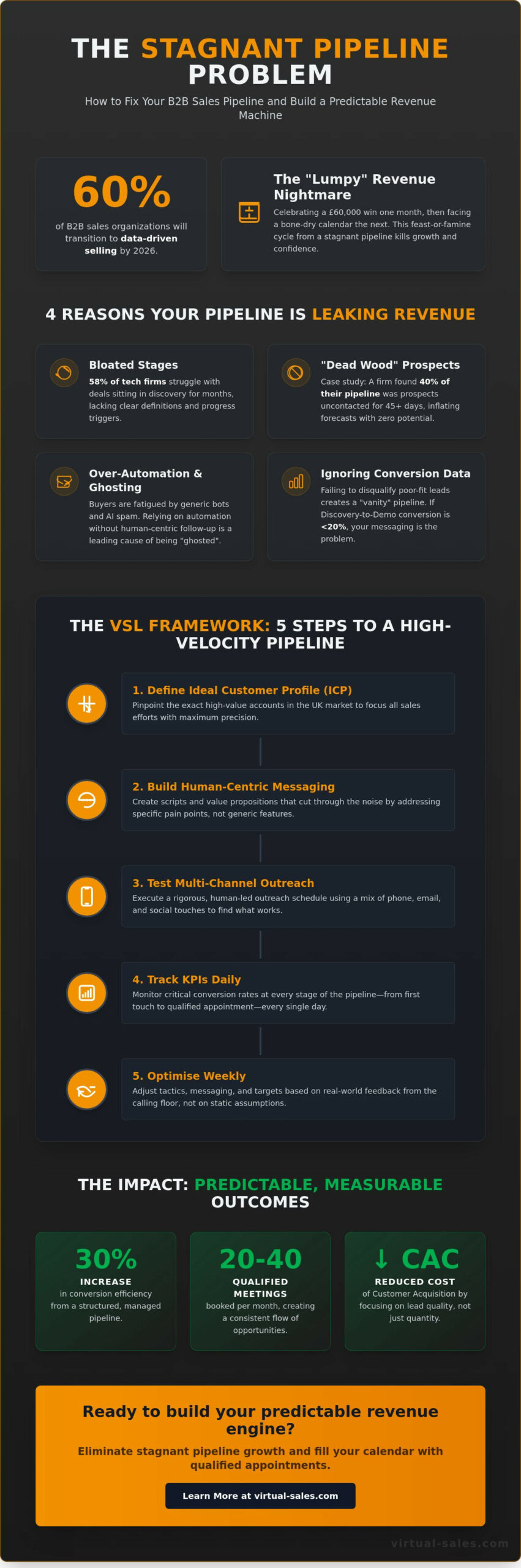
Ambitious B2B leaders in the UK’s IT, SaaS, and technology sectors face a recurring nightmare: the “lumpy” revenue cycle. One month your team celebrates a £60,000 win; the next, the sales calendar is bone dry. This inconsistency usually stems from a stagnant B2B Sales Pipeline that lacks both velocity and volume. By 2026, the market has moved past the “set and forget” automation that defined the early 2020s. Buyers are fatigued by generic LinkedIn bots and AI-generated spam. If you don’t actively manage the human touchpoints in your customer journey, your growth will inevitably stall.
A B2B sales pipeline isn’t just a list of names in a CRM. It is a visual, action-oriented roadmap of every stage a prospect moves through, from initial contact to closed-won deal. It requires constant maintenance to prevent the “feast or famine” trap that kills scale-up ambitions.
Defining the B2B Sales Pipeline for Modern Teams
Modern sales teams view the pipeline as a living breathing system rather than a static report. It serves three critical functions:
- A sequential map: It documents every touchpoint and direct sales action required to move a prospect forward.
- The forecasting engine: It provides the data needed for predictable sales forecasting and long-term revenue management.
- A diagnostic tool: It is the primary tool for identifying specific bottlenecks in the b2b sales process before they become revenue crises.
Why Your Current Pipeline Might Be Leaking
Structural failures often cause a leaking pipeline. In Q1 2026, we’ve observed that 58% of tech firms struggle with “bloated” stages where deals sit in discovery for months without progress. This happens because of a lack of clear stage definitions. Furthermore, inconsistent prospecting creates massive revenue gaps three months down the line. To fix this, your sales actions must align perfectly with your b2b appointment setting strategy to ensure only high-intent prospects enter the funnel.
Common Pipeline Mistakes
- Accepting “ghosting” as a natural part of the process instead of refining the follow-up cadence.
- Over-relying on automated email sequences that prospects now instantly recognise as spam.
- Failing to disqualify poor-fit leads early, leading to a “vanity” pipeline that never converts.
- Ignoring the data: if your conversion rate from discovery to demo is below 20%, your messaging is the problem.
The VSL Pipeline Framework
We use a proven 5-step method to ensure your B2B Sales Pipeline remains healthy and productive:
- Define ICP: Pinpoint the exact high-value accounts in the UK market.
- Build Messaging: Create human-centric scripts that cut through the noise.
- Test Outreach: Execute multi-channel touches (phone, email, social).
- Track KPIs: Monitor conversion rates at every stage daily.
- Optimise Weekly: Adjust tactics based on real-world feedback from the calling floor.
Why It Matters: The Business Impact of Pipeline Velocity
A stagnant sales process isn’t just a workflow issue; it’s a financial drain. For sales leaders in 2026, the priority has shifted from simply monitoring lead volume to driving clinical momentum. A structured B2B Sales Pipeline transforms your sales floor from a reactive environment into a predictable revenue engine. By moving away from “managing leads” and focusing on “accelerating revenue,” you reduce the friction that typically inflates the cost of customer acquisition (CAC). When every stage is defined, you stop wasting marketing spend on dead-end prospects and start seeing a higher return on every pound invested.
Pipeline Velocity is the speed at which leads move from prospecting to closing.
Visibility is the foundation of confidence. Without a transparent view of the journey from first touch to final signature, securing stakeholder buy-in for new budgets or headcount is nearly impossible. Boards don’t invest in “potential”; they invest in visible, repeatable processes. Understanding What is a Sales Pipeline? is the first step toward providing the data-backed evidence your C-suite demands.
Surgical Sales Forecasting Accuracy
Precision in forecasting is what separates elite sales organisations from those that consistently miss targets. By using defined stages, you can apply probability-weighted revenue projections based on historical conversion data. If you know that only 20% of discovery calls progress to a proposal, you can calculate exactly how many initial meetings are required to hit a £500,000 quarterly goal. This data-backed insight eliminates the “hoping and praying” that often occurs in the final weeks of a month, allowing for proactive adjustments before a shortfall happens.
Optimised Resource Allocation
Time is the most expensive resource in your business. A clear pipeline ensures your high-value sales team outsourcing professionals and internal closers focus exclusively on the hottest opportunities. You can’t afford to have senior reps chasing “zombie leads” that have been sitting in the same stage for 90 days with no engagement. By identifying which lead sources deliver the highest ROI, you can pivot your strategy in real-time, cutting spend on low-performing channels and doubling down on what actually converts. This level of efficiency is essential for maintaining a lean, high-output sales operation that scales without ballooning overheads.
If your current process feels more like a bottleneck than a thoroughfare, it’s time to refine your approach to B2B lead generation to ensure only high-intent prospects enter your ecosystem.

Pipeline vs. Funnel: Busting the 2026 B2B Myths
Many sales leaders use the terms “funnel” and “pipeline” interchangeably. This is a strategic error. In the 2026 B2B landscape, confusing the two creates a disconnect between marketing theory and sales reality. The funnel tracks the buyer’s journey: awareness, interest, and desire. It is a map of the prospect’s mindset. Conversely, your B2B Sales Pipeline represents the seller’s actions: prospecting, qualifying, and closing. One describes what the buyer is thinking; the other describes what your sales team is doing.
Focusing exclusively on the funnel often breeds a passive sales culture. Teams end up waiting for marketing-qualified leads to drop into the top of the funnel rather than hunting for them. A high-performing pipeline requires proactive movement. It is about the specific steps your team takes to push a deal from one stage to the next. Passive cultures fail because they lose control over the pace of the sale, leaving the revenue target to chance.
The Action-Oriented Nature of the Pipeline
A pipeline isn’t a passive observation deck; it is a “boots-on-the-ground” execution strategy. To keep it healthy, you need consistent, high-impact activity. This is where b2b telemarketing serves as the pulse of the operation. While digital channels provide scale, human-to-human interaction remains the fastest way to qualify a lead and accelerate momentum. VSL clients often see a shift from stagnant pipelines to active engagements by prioritising these direct conversations. In a digital-first world saturated with AI-generated emails, a professional voice on the phone cuts through the noise and builds immediate trust.
VSL data indicates that human-led follow-ups increase meeting-to-opportunity conversion rates by 15-20% compared to automated email sequences alone. This human intelligence allows your team to navigate complex UK buying committees and identify pain points that a form-fill won’t capture. It is the difference between watching a lead sit in the funnel and actively driving it through the pipeline.
Common Pipeline Misconceptions
- Myth: A bigger pipeline is always better. Inflated pipelines often hide low-quality leads that will never convert. We advocate for “Quality over Quantity.” A lean pipeline with a 25% close rate is far more valuable than a bloated one with 5%. Focus on deals that fit your Ideal Customer Profile (ICP).
- Myth: Automation can manage the entire pipeline. Automation is a tool for efficiency, not a replacement for strategy. Human intervention is required to handle objections and build relationships. Relying solely on software leads to a robotic process that ignores the emotional drivers of a B2B purchase.
- Myth: The pipeline ends at the point of sale. In 2026, the pipeline must account for account expansion and renewals. The initial sale is just the first conversion point. High-growth firms treat existing clients as a recurring source of pipeline volume.
The VSL Framework: 5 Steps to a High-Performance Pipeline
Building a robust B2B Sales Pipeline requires more than just activity; it demands a clinical, high-performance architecture. At VSL, we don’t believe in “throwing mud at the wall.” We use a proprietary five-step method designed to function as a seamless extension of your team, delivering predictable growth without the overhead of an internal department. This is a no-nonsense approach to building momentum that prioritizes measurable outcomes over marketing fluff.
The 5-Step VSL Pipeline Method
- 1. Define ICP: We identify your Ideal Customer Profile with clinical precision. We focus on high-value UK sectors where your solution solves a specific, painful problem for decision-makers.
- 2. Build Messaging: We craft bespoke, value-driven scripts and outreach sequences. We avoid generic templates, focusing instead on human-to-human connection that resonates with C-suite executives.
- 3. Test Outreach: Our UK-based team executes multi-channel campaigns across phone, email, and SMS. We find where your prospects live and engage them there with professional persistence.
- 4. Track KPIs: We monitor every conversion rate at every stage. Our clients typically see between 20 and 40 qualified meetings booked per month, a metric we’ve consistently delivered as verified by our documented case studies.
- 5. Optimize Weekly: Data doesn’t lie. We pivot based on real-world feedback and live market responses to ensure the engine never stalls.
Common Pipeline Mistakes to Avoid
Even the most ambitious businesses stumble by falling into predictable traps. Relying on “dirty” or outdated data is a primary killer of outreach efficiency. If your team is calling numbers that don’t pick up, you’re burning budget. We also see a frequent failure to define what constitutes a “Qualified Lead” between sales and marketing. This misalignment creates friction and wasted effort.
Inconsistent follow-up is another silent killer; many firms lose 80% of potential opportunities by stopping after the second touch. In the UK market, it often takes five to seven touchpoints to secure a meaningful conversation. Finally, don’t neglect the human element. Neglecting personal connection in favour of generic, automated sequences will alienate high-level prospects who expect a peer-to-peer dialogue.
Our method ensures you avoid these pitfalls while accelerating your growth. If you’re ready to stop guessing and start scaling, explore our bespoke appointment setting services to see how we integrate with your existing workflow.
Real-World Results: Measuring Pipeline Success
Theoretical frameworks only hold value when they deliver measurable growth. At VSL, we’ve observed that a high-performing B2B Sales Pipeline relies on consistent, quality inputs rather than sheer volume. A UK-based technology firm recently scaled its outbound efforts from zero to 30 qualified appointments per month within a single quarter by shifting from automated blasts to a targeted, human-led approach. This transition didn’t just fill the calendar; it increased the total contract value of their active opportunities by 40% because the prospects were better aligned with their ideal customer profile.
Real Insight: The “Human Intelligence” Advantage
Automation often hits a ceiling when dealing with complex UK market gatekeepers. One SaaS provider we partnered with faced a stagnant pipeline because their digital outreach couldn’t penetrate C-suite levels. We deployed a bespoke telemarketing campaign using experienced, UK-based callers who understood the nuances of high-level business conversations. Human-led appointment setting typically yields a 3x higher conversion rate than cold email alone. By navigating gatekeepers with professional tact, our team turned “no” into “not yet” and eventually into “book a demo.”
The Metrics that Matter
To gauge the health of your B2B Sales Pipeline, you must track specific performance indicators. We look for these benchmarks to ensure our clients achieve a strong return on investment:
- Lead-to-Meeting Conversion Rate: Target a range of 5% to 15% for outbound efforts to ensure your messaging resonates.
- Pipeline Value: Monitor the total contract value of all active opportunities to forecast revenue with precision.
- Meetings Booked: We aim for a consistent delivery of 15 to 30 qualified appointments per month for mid-market clients.
These figures aren’t arbitrary estimates. You can view our verified performance metrics and client testimonials on the VSL Clutch profile to see how we maintain these standards across various sectors. Success in 2026 requires this level of transparency and data-backed execution. When you track these numbers weekly, you can identify bottlenecks before they impact your quarterly revenue targets.
Building a resilient sales engine doesn’t happen by accident. It requires the right blend of human intelligence, strategic prospecting, and rigorous metric tracking. VSL acts as a seamless extension of your team, providing the expertise needed to turn cold prospects into loyal partners. Scale your B2B sales pipeline with Virtual Sales Limited today.
Drive Sustainable Growth Through Pipeline Velocity
Stagnant pipelines aren’t just a nuisance; they’re a direct threat to UK business scaling in 2026. By implementing the five-step VSL Framework, sales leaders move beyond outdated funnel myths to achieve consistent, high-quality results. It’s about shifting the focus to velocity and verified outcomes that translate into actual revenue. You don’t need more leads; you need the right conversations with decision-makers who are ready to buy.
Building a high-performance sales engine requires more than just high-volume outreach. It demands a blend of human intelligence and data-driven strategy to navigate complex buying cycles. VSL brings over 20 years of expertise to the table, ensuring your prospecting never misses a beat. We operate as a seamless extension of your internal team, delivering verified 5-star results backed by our track record on Clutch. Stop guessing and start growing with a partner that prioritizes clinical efficiency and measurable ROI.
Ready to accelerate your B2B Sales Pipeline? Contact VSL for a bespoke strategy.
Your path to market leadership starts with a single, well-qualified appointment. Let’s get to work.
Frequently Asked Questions
What is a B2B sales pipeline?
A B2B sales pipeline is a visual framework that tracks every active opportunity as it progresses through your sales process. It provides a real-time snapshot of potential revenue, allowing sales leaders to forecast income with 95% accuracy when managed correctly. For VSL clients, the pipeline serves as a roadmap that transforms cold prospects into qualified leads through structured stages like initial discovery and final negotiation.
How does a sales pipeline differ from a sales funnel?
The sales pipeline focuses on the specific actions sales reps take to close a deal, while a sales funnel tracks the conversion rates of prospects as they move through the buyer journey. Think of the pipeline as your internal checklist of tasks and the funnel as a measure of lead volume and drop-off points. In 2026, successful UK firms use both to identify where 15% of leads might be stalling in the middle of the journey.
How many stages should a B2B sales pipeline have?
Most effective pipelines consist of 5 to 7 clearly defined stages to maintain clinical efficiency. These typically include Prospecting, Qualification, Discovery, Proposal, Negotiation, and Closed Won or Lost. Adding more than 7 stages often creates unnecessary complexity that slows down your team. We recommend keeping stages distinct so every rep knows exactly what criteria a lead must meet to move forward.
What are the key metrics for measuring pipeline health?
You must track pipeline velocity, conversion rates per stage, and the total value of opportunities. In the UK market, a healthy pipeline usually requires a 3:1 or 4:1 ratio of pipeline value to sales quota. Monitoring the average age of a deal is also vital. If a prospect sits in the discovery stage for more than 14 days without movement, it indicates a bottleneck that requires immediate intervention.
How can I increase the velocity of my B2B sales pipeline?
Increase your B2B sales pipeline velocity by tightening your qualification criteria and automating administrative tasks. By removing tyre-kickers early, your team spends 100% of their time on high-intent prospects. VSL often helps clients accelerate this process by handling the initial appointment setting, ensuring your senior closers only speak to decision-makers who have a verified budget and a clear timeline for purchase.
Is it better to build an internal pipeline team or outsource?
Building an internal team takes an average of 4 to 6 months to reach full productivity and carries high recruitment risks. Outsourcing to a UK-based partner like VSL provides an immediate, scalable solution without the overhead costs. Many of our partners find that a hybrid model works best, where we act as a seamless extension of their team to handle the heavy lifting of top-of-funnel prospecting.
How does telemarketing fit into a modern sales pipeline?
Modern telemarketing acts as the engine for high-quality lead generation by providing the human-to-human touch that digital channels lack. In 2026, 68% of B2B buyers still prefer a phone conversation when exploring complex solutions. VSL uses mature, UK-based callers to navigate gatekeepers and secure appointments, ensuring your B2B sales pipeline remains filled with high-value opportunities that email alone cannot reach.
What role does a CRM play in pipeline management?
Your CRM is the single source of truth that records every interaction and movement within your B2B sales pipeline. It eliminates guesswork by providing real-time data on rep performance and deal status. Without a properly configured CRM, you lose visibility and risk letting 20% of your leads fall through the cracks. We integrate directly with client CRMs to ensure transparent reporting and a smooth hand-off of every qualified lead.


Disclaimer
Disclaimer: Content is for general information only and does not constitute professional advice. Results may vary. Virtual Sales Limited accepts no liability for actions taken based on this content.