


Did you know that the average B2B buying group now consists of approximately 10 unique decision-makers? For UK tech leaders, this complexity often translates into inconsistent lead quality and “coffee meetings” that never actually close. If you’re tired of seeing deals stall after the first proposal, it’s time to refine your B2B sales pipeline stages to reflect the realities of the 2026 market.
We understand that predictable monthly revenue relies on more than just activity; it requires a standardised process that your reps actually follow. By mastering the essential stages of your pipeline, you’ll eliminate friction and gain clear visibility into exactly where your revenue is leaking. This practical guide provides the tactical framework needed to transform your sales operation into a high-performing, data-driven engine.
We’ll break down the specific methodologies for identifying qualified BANT leads and show you how to improve forecasting accuracy for your technology business. From defining your ideal customer profile to weekly optimisation, you’re about to build a pipeline that delivers measurable outcomes and sustainable growth.
Key Takeaways
- Understand why modern B2B sales pipeline stages must adapt to a 2026 landscape where buyers complete more research independently before engaging.
- Learn how to apply rigorous BANT qualification to eliminate “coffee meetings” and focus your sales team on high-intent, revenue-generating opportunities.
- Discover the tactical 5-step framework used by leading UK tech firms to build and nurture a high-velocity outbound sales engine.
- Identify the common mistakes that cause deals to stall and learn how to implement a standardised process that improves forecasting accuracy.
- Explore how integrating a specialised lead generation partner as an extension of your team can accelerate your path to predictable monthly revenue.
What are B2B Sales Pipeline Stages and Why do They Matter in 2026?
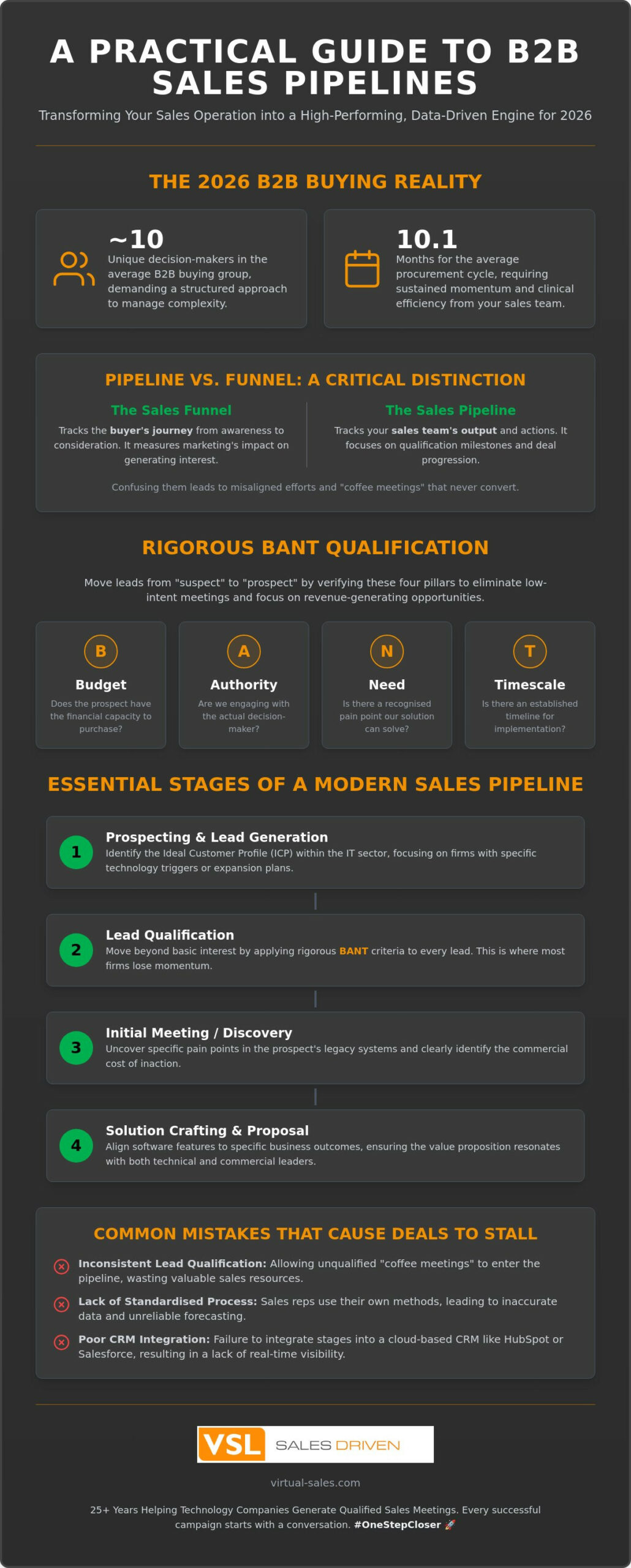
A B2B sales pipeline acts as the visual engine room of your commercial operation. It maps every active opportunity against specific milestones within your sales process, providing a clear view of revenue health. For UK technology leaders, this visibility is no longer a luxury. With the average B2B buying group now involving 10 unique decision-makers, tracking progress through distinct B2B sales pipeline stages is the only way to manage complexity and ensure no deal falls through the cracks.
The 2026 tech market demands clinical efficiency. Procurement cycles have stabilised at around 10.1 months, meaning your team must maintain momentum over long periods. Without a structured pipeline, deals often stall in the “no man’s land” between an initial meeting and a formal proposal. Accurate, data-driven forecasting is now essential to secure internal budget approval. CFOs in the technology sector increasingly require granular evidence of conversion probability before committing resources to scale.
Pipeline vs Funnel: Clearing the Confusion
We often see tech leaders conflate the “pipeline” with the “sales funnel”, but they serve different purposes. Your funnel tracks the buyer’s journey; it measures awareness and consideration. Conversely, the pipeline tracks your team’s output. It focuses on the “how” of B2B lead generation, such as outbound calling, qualification milestones, and contract negotiations.
Confusing these two leads to misaligned marketing efforts and “coffee meetings” that never convert. In 2026, the most critical metric is pipeline velocity. This measures how quickly a prospect moves from the initial touchpoint to a closed deal. You cannot identify the bottlenecks slowing your growth without clearly defined stages. If you don’t know where the friction exists, you can’t fix it.
The Strategic Importance of Standardised Stages
Standardising your stages creates a shared language across your organisation. When sales, marketing, and the C-suite all agree on what constitutes a “qualified lead”, forecasting becomes a science rather than guesswork. This alignment ensures that everyone is pulling in the same direction, reducing the wasted effort spent on low-intent prospects.
Effective B2B sales pipeline stages allow you to track stage-specific conversion rates with precision. If you know that 20% of your proposals convert to closed-won deals, you can work backwards to determine exactly how many discovery meetings are required to hit your revenue targets. To maintain this level of accuracy, these stages must be integrated into a cloud-based CRM like HubSpot or Salesforce. This ensures your data is accessible, transparent, and actionable in real-time.
The 7 Essential Stages of a Modern B2B Sales Pipeline
Effective B2B sales pipeline stages provide a blueprint for consistent revenue. We categorise these stages based on objective customer actions rather than sales rep intuition. This ensures your data remains clean and your forecasting remains accurate. In the tech sector, where legacy systems often create deep-seated friction, your stages must reflect the reality of a complex, multi-stakeholder environment.
- Stage 1: Prospecting & Lead Generation. We identify the Ideal Customer Profile (ICP) within the IT sector, focusing on firms with specific technology triggers or expansion plans.
- Stage 2: Lead Qualification. We move beyond basic interest. This stage requires a transition from a “suspect” to a “prospect” using rigorous BANT criteria.
- Stage 3: Initial Meeting/Discovery. Your team uncovers specific pain points in the prospect’s legacy systems and identifies the cost of inaction.
- Stage 4: Solution Crafting & Proposal. We align software features to specific business outcomes, ensuring the value proposition resonates with both technical and commercial leaders.
Top-of-Pipeline: Prospecting and BANT Qualification
The transition from a raw lead to a qualified opportunity is where most tech firms lose momentum. We use intent-based calling to verify Budget, Authority, Need, and Timescale (BANT) before any deal progresses. As highlighted in The New Sales Imperative, the modern B2B purchase process is often so complex that buyers need a prescriptive approach to navigate it. VSL deliberately avoids “coffee meetings” that lack a clear commercial agenda. This protects your senior sales team’s time, ensuring they only engage with high-intent prospects ready for a serious conversation.
Middle-of-Pipeline: Needs Discovery and Positioning
Once a lead is qualified, the focus shifts to consultative discovery. This stage isn’t about rigid scripts; it’s about mapping the Decision-Making Unit (DMU). In tech sales, this often includes Finance and Procurement alongside the CTO. You must position your solution as a strategic investment rather than a mere cost. Understanding the nuances of a B2B sales pipeline allows your reps to tailor their messaging to different stakeholders, increasing the likelihood of consensus. If you’re looking to refine your qualification process, see how we’ve helped others achieve top-tier results in the UK market.
Bottom-of-Pipeline: Closing and Account Expansion
The final stages involve negotiation and the formal “Closed-Won” handoff. For high-value software retainers, negotiation tactics must focus on long-term partnership value rather than just price. Once the contract is signed, the account development phase begins. We recommend using CRM stat tracking to identify where deals drop off most frequently in these late stages. If proposals are stalling at the 90% mark, it often indicates a failure to address procurement’s specific compliance or security requirements earlier in the cycle.
Real Insight and Common Mistakes in Pipeline Execution
Many tech firms mistakenly believe that a “full” pipeline is a healthy one. However, over-filling the top of your B2B sales pipeline stages with low-quality data is a recipe for operational failure. It clogs your CRM with “ghost” opportunities and forces your best closers to waste time on prospects who have no intention of buying. We see a clear contrast between the “spray and pray” automated approach and targeted, conversational telemarketing. One generates noise; the other generates revenue.
Real Insight: The £50k Discovery
We recently worked with a UK SaaS provider that was struggling with a low conversion rate. They assumed their senior sales team had a “closing” problem and were considering expensive sales training. After an audit, we discovered the issue was actually at Stage 2 (Qualification). Their pipeline was packed with leads that lacked Budget or Authority. By outsourcing the initial qualification to VSL, they ensured that only BANT-qualified prospects reached their senior team. This refinement increased their proposal-to-win ratio by 15%, as their reps were finally focused on genuine opportunities. In this sector, we typically generate between 10–20 qualified meetings per month, providing a consistent baseline for growth.
Common Mistakes in Pipeline Management
Managing complex sales requires clinical discipline. Avoid these frequent errors to keep your revenue engine running smoothly:
- Lack of clear “Exit Criteria”: If you don’t define exactly what must happen to move a deal to the next stage, your reporting becomes subjective. Every stage needs a hard requirement, such as a signed NDA or a confirmed budget range.
- Failing to clean and enrich the database: Outdated information leads to wasted effort and poor morale. Regular B2B data cleansing is essential to maintain outreach efficiency and ensure your team is calling the right decision-makers.
- Treating all leads as equal: Not every lead deserves the same resources. You must prioritise based on BANT status to maximise your ROI and protect your sales team’s capacity.
- Neglecting the “Nurture” stage: For long-term IT contracts, the sales cycle can be extensive. If a prospect isn’t ready today, you must have a structured process to stay top-of-mind without being intrusive.
Success in the technology sector isn’t about the number of names in your database. It’s about the quality of the conversations you’re having. By avoiding these common pitfalls, you ensure that your sales efforts are always directed towards the most profitable outcomes.

The VSL Framework: A 5-Step Method for High-Velocity Outbound Pipelines
Building a high-velocity outbound engine requires more than just activity; it demands a clinical focus on precision. Our framework ensures that your B2B sales pipeline stages are populated with high-intent opportunities rather than speculative leads. We act as a proactive insider, integrating directly with your team to deliver measurable outcomes through a structured, five-step methodology.
- Step 1: Define the ICP. We profile your ideal technology buyer with surgical precision. This goes beyond job titles to include specific technology triggers, sector-specific pain points, and the professional maturity of the target organisation.
- Step 2: Data Enrichment. We don’t rely on generic lists. We cleanse and build a bespoke database, ensuring your outreach is directed at the correct decision-makers within the UK tech landscape.
- Step 3: Consultative Engagement. Our staff use human-led, non-scripted calling to build genuine rapport. This approach is essential for complex tech sales where prospects value expertise over a robotic sales pitch.
- Step 4: BANT Qualification. Every prospect undergoes rigorous vetting. We verify Budget, Authority, Need, and Timescale to ensure every meeting has genuine ROI potential.
- Step 5: Weekly Optimisation. We maintain a constant feedback loop. By analysing campaign data in real-time, we refine our tactics to ensure your pipeline remains healthy and productive.
Integrating the Framework with Your CRM
Seamless data transfer is the backbone of a successful partnership. VSL utilises a cloud-based CRM to manage every interaction, providing you with total transparency. We don’t just book meetings; we ensure the data is ready for your team to act upon. Our system allows us to export qualified leads directly into your internal platforms, such as Salesforce or HubSpot. This integration minimises administrative friction and allows your closers to focus on what they do best. If you want to accelerate this process, our appointment setting services provide the bridge between initial outreach and a closed deal.
Measuring Success: Metrics that Matter
We move beyond vanity metrics like call volume. In 2026, tech leaders must focus on meeting quality and total pipeline value. With the average B2B buying group now consisting of 10 unique decision-makers, the depth of qualification is more important than the breadth of outreach. We use industry benchmarks to measure your conversion rates, ensuring your team is performing at or above standard levels. Your dedicated Project Manager plays a vital role here, refining the framework weekly based on granular performance data. This proactive management ensures that your investment translates into predictable revenue growth. See how our UK-based team delivers qualified meetings for technology leaders looking to scale with confidence.
Leveraging VSL to Scale Your B2B Sales Pipeline Stages
Scaling your commercial operation requires more than just internal hiring. It requires an integrated approach to your B2B sales pipeline stages. VSL acts as a high-performing extension of your internal sales and marketing team, removing the burden of top-of-funnel management. We don’t just book meetings; we build and nurture a pipeline that delivers sustainable revenue growth. This allows your senior reps to focus on closing whilst we handle the complex, resource-heavy task of lead identification and qualification.
The VSL Advantage for Technology Companies
Our team consists of best-of-breed professionals who understand the nuances of tech hierarchies. We know how to navigate complex decision-making units, from the CTO to the Procurement lead. This deep-seated expertise is crucial for lead generation for technology companies. With multilingual capabilities and a global reach spanning the UK, Europe, and the USA, we provide the scalability your business needs to expand into new markets with clinical efficiency. You benefit from elite, human-led expertise that automated systems simply cannot replicate.
We prioritise flexibility because we understand that in the 2026 business environment, agility is a primary differentiator. We don’t lock you into long-term contracts. This allows you to scale your outreach up or down based on your current capacity and market conditions. You gain access to 25+ years of experience without the overheads or risks associated with permanent recruitment. Our dedicated Project Managers ensure that every campaign is aligned with your strategic goals and integrated seamlessly into your existing workflows.
Next Steps: Starting Your Pilot Campaign
We recommend a low-risk pilot approach to test our methodology. This allows you to experience the quality of our BANT-qualified leads first-hand before committing to a larger subscription. During this phase, we work closely with you to define your specific requirements and refine your B2B sales pipeline stages for maximum impact. We output all data to your preferred platforms, including HubSpot and Salesforce, ensuring total transparency and ease of follow-up for your team.
Mastering your pipeline is the definitive path to predictable growth. It eliminates the friction of inconsistent lead quality and provides the visibility you need to hit your revenue targets. Book a consultative call with our team today to see how we can help you achieve a high-performing outbound engine and drive long-term ROI. We help you move beyond the “coffee meeting” culture and focus on genuine, revenue-generating opportunities.
25+ Years Helping Technology Companies Generate Qualified Sales Meetings. Every successful campaign starts with a conversation. #OneStepCloser 🚀
Driving Sustainable Revenue through Pipeline Precision
Success in the UK tech sector now requires a clinical approach to lead qualification and stage management. By implementing standardised B2B sales pipeline stages, you move away from subjective forecasting and towards a data-driven commercial operation. We’ve explored how identifying the right ICP and enforcing strict BANT criteria eliminates the friction of stalled deals and refocuses your closers on high-value opportunities.
VSL provides the elite expertise you need to scale this process without the risk of long-term contracts. With 25+ years of IT sales expertise and dedicated project management, we act as a seamless extension of your internal team. We’re ready to help you build a high-velocity engine that delivers measurable outcomes and predictable monthly revenue. It’s time to stop guessing and start growing with a partner that understands the nuances of the modern technology buyer.
Book a Consultative Call to Optimise Your Sales Pipeline and discover how we can transform your outbound results.
25+ Years Helping Technology Companies Generate Qualified Sales Meetings. Every successful campaign starts with a conversation. #OneStepCloser 🚀
Frequently Asked Questions
What are the 7 stages of a B2B sales pipeline?
The seven essential B2B sales pipeline stages consist of prospecting, lead qualification, discovery, proposal crafting, negotiation, closing, and account expansion. Each stage represents a specific milestone where the prospect takes a concrete action, such as agreeing to a discovery meeting or signing a non-disclosure agreement. Standardising these milestones ensures your sales team follows a repeatable process that reduces friction and improves forecasting accuracy.
How is a sales pipeline different from a sales funnel?
A sales pipeline focuses on the tactical actions your sales team performs to move a deal forward, whilst a sales funnel represents the buyer’s journey from awareness to purchase. Tech leaders must maintain this distinction to ensure operational clarity. Your pipeline tracks the “how” of your outbound activity, such as calling and qualifying, whereas the funnel tracks the “who” and their progression through the consideration phase.
What is the average conversion rate between pipeline stages in the IT sector?
Conversion rates in the IT sector vary based on subscription levels, but a healthy benchmark from discovery to proposal typically ranges between 20% and 30%. High-performing tech firms often achieve better velocity by enforcing rigorous exit criteria at every stage. Tracking these metrics allows you to work backwards from revenue targets to determine the exact volume of prospecting activity required to hit your monthly goals.
How do I know if my B2B sales pipeline is healthy?
You can determine the health of your B2B sales pipeline by analysing three key metrics: velocity, balance, and data accuracy. A healthy pipeline shows steady movement between stages without significant bottlenecks at the proposal phase. If your CRM is cluttered with stagnant leads or “coffee meetings” that don’t progress, it indicates a qualification problem that needs immediate tactical correction to protect your sales team’s time.
What is BANT qualification and why is it essential for tech leads?
BANT stands for Budget, Authority, Need, and Timescale, and it serves as the gold standard for qualifying complex technology leads. In the tech sector, where procurement involves approximately 10 unique decision-makers, BANT ensures your senior sales team only spends time on prospects with the commercial capacity to buy. This rigorous vetting prevents your pipeline from becoming over-filled with low-intent suspects who cannot sign off on high-value software retainers.
Can I outsource specific stages of my sales pipeline?
Yes, many technology firms successfully outsource the prospecting and lead qualification stages to specialised partners like VSL. Outsourcing these resource-heavy tasks allows your internal senior sales reps to focus exclusively on discovery and closing. By using an integrated component of your team for outbound outreach, you maintain high standards of professional maturity whilst scaling your pipeline capacity without the overheads or risks of permanent hiring.
How often should I cleanse my sales pipeline data?
You should cleanse your sales pipeline data at least once a quarter to maintain outreach efficiency and reporting accuracy. In the fast-moving UK tech landscape, decision-makers frequently change roles, and legacy contact information can quickly become a liability. Regular data enrichment and cleansing ensure your team is always targeting the correct stakeholders, reducing wasted effort on “ghost” opportunities that will never move to the closing stage.
What CRM tools are best for managing B2B sales pipeline stages?
Cloud-based platforms such as HubSpot and Salesforce are the best-of-breed tools for managing B2B sales pipeline stages with clinical efficiency. These systems provide the transparency and real-time reporting necessary for accurate revenue forecasting. VSL utilises a cloud-based CRM that integrates seamlessly with these popular platforms; you can explore HubSpot Implementation and compare it with other market leaders to ensure that every BANT-qualified lead is exported directly into your internal workflow for immediate follow-up and action.


Disclaimer
Disclaimer: Content is for general information only and does not constitute professional advice. Results may vary. Virtual Sales Limited accepts no liability for actions taken based on this content.