


The cheapest appointment-setting option can cost more in lost sales time if meetings don’t fit your ideal customer profile. For B2B appointment setting for UK technology companies in 2027, compare pricing models by what they include, how they define a qualified meeting and who carries the risk when volume or fit falls short. There’s no single figure that makes sense without those details.
It’s reasonable to want a clear view of spend before committing. For SaaS and technology sales, though, the useful comparison is how campaign scope, prospect research, qualification, reporting and meeting relevance support your pipeline.
This article explains how pricing structures differ, what to agree before a campaign starts and how to assess performance beyond meetings booked. It also covers the demands of technology outreach, where precise targeting and credible conversations matter as much as the commercial model. Use these points to decide whether outsourced appointment setting fits your sales team and growth plans.
Key Takeaways
- Define what counts as a qualified meeting before a campaign starts, including how cancellations, no-shows and rejected appointments will be handled.
- Assess a pilot through meeting relevance, attendance and progress after handoff, not just the number of appointments booked.
- Compare pricing models by who carries the volume risk and what work is included, from prospect research to reporting.
- Choose between appointment setting and broader lead generation based on whether you need sales meetings or a wider flow of qualified opportunities.
- Technology outreach works best when targeting, buyer knowledge and UK calling requirements are built into the campaign from the outset.
How much does it cost to hire an appointment setter?
There is no single UK fee for every appointment-setting campaign. Costs depend on the scope, target-account research, data requirements, qualification depth, reporting and duration. A focused SaaS campaign aimed at one buyer role takes different preparation from outreach across several sectors and decision-making groups. Define those requirements before comparing proposals, or different scopes can make fees difficult to assess fairly.
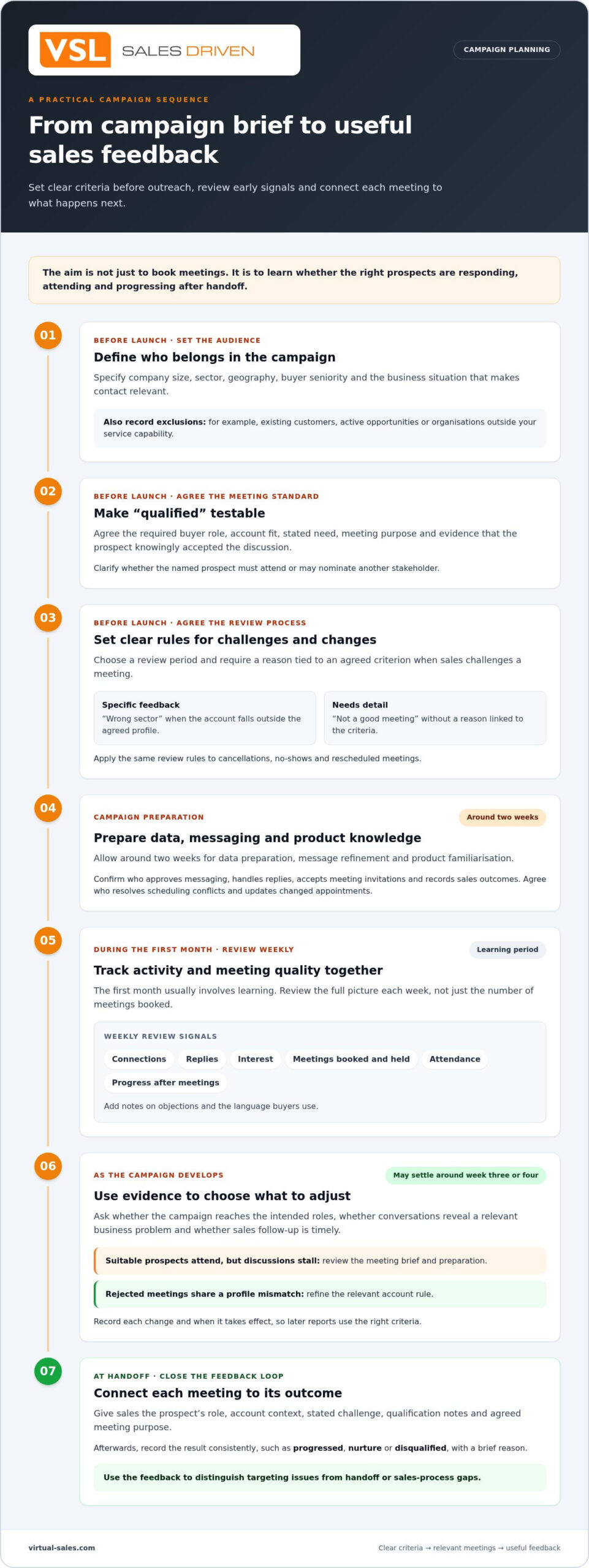
Start by defining your audience: company size, sector, geography, buyer seniority and the business situation that makes contact relevant. List exclusions too, such as existing customers, active opportunities or organisations outside your service capability. A software firm, for example, might prioritise companies facing a particular operational challenge while excluding accounts already in procurement. This brief gives the appointment-setting team a clear basis for selecting and qualifying prospects.
Next, agree what your sales team considers a valid appointment. Specify the required buyer role, account fit, stated need, meeting purpose and evidence that the prospect accepted the discussion knowingly. Clarify whether the prospect must attend personally or may nominate another stakeholder. These details make qualification testable instead of leaving appointment acceptance open to interpretation after the meeting.
Agree a review period and rejection process before outreach begins. Give sales a defined window to flag meetings that fail the criteria, and require a reason tied to a specific rule. For example, “wrong sector” is useful when an account falls outside the agreed profile; “not a good meeting” needs more detail. Apply the same process to cancellations, no-shows and rescheduled meetings.
Performance accountability should cover more than bookings. A practical review can assess:
- Whether appointments meet the agreed account and buyer-role criteria.
- Whether sales accepts or challenges each meeting, and why.
- Whether the prospect attends and understands the meeting’s purpose.
- What happens after handoff, including follow-up or opportunity creation.
Use these findings to distinguish targeting problems from handoff or sales-process gaps. If suitable prospects attend but discussions stall, review the meeting brief and preparation. If rejected meetings repeatedly share the same profile mismatch, refine that account rule. Record each change and when it takes effect, so later reports use the right criteria.
Handoff quality also matters. Before the meeting, give sales the prospect’s role, account context, stated challenge, qualification notes and agreed purpose. Afterwards, ask the representative to record the outcome using consistent categories, such as progressed, nurture or disqualified, with a brief reason. This creates a traceable link between outreach, meeting quality and pipeline contribution.
For UK technology businesses, technology company prospect targeting works best when account selection, appointment rules and sales feedback use the same definitions. Review those definitions together before launch, then adjust only when recorded evidence shows a consistent mismatch.
What are the benefits of B2B appointment setting services?
A managed campaign gives sales leaders dedicated prospecting capacity and a structured way to test market response. For a UK SaaS company entering a new sector, this can open buyer conversations while account executives focus on active opportunities and customer discussions.
A pilot helps reveal whether the target market, message and handoff process work together. Allow around two weeks for data preparation, message refinement and product familiarisation. The first month usually involves learning, and campaigns may settle into a rhythm around week three or four. Use this period to understand patterns, not to judge performance from one early result.
Before launch, agree what the pilot should help the business learn. Choose a defined audience, one proposition to test and clear review measures. For example, a software provider could test whether finance or operations leaders respond more to a particular workflow problem. Keep other campaign variables stable where practical, so the team can interpret responses and make focused adjustments.
Review performance weekly. Reporting should show activity and outcomes, including connections, replies, interest, meetings booked and held, attendance, and what happens after meetings. Pair these measures with brief notes on objections and buyer language. If prospects understand the proposition but see no reason to act, revisit the trigger rather than simply changing the channel.
Use pilot reviews to make decisions, not just inspect a dashboard. Ask whether the campaign reaches the intended roles, whether conversations reveal a relevant business problem and whether sales follow-up is timely. Then decide whether to refine the audience, adjust the message, improve the handoff or continue as planned. Record the decision and its rationale for the next review.
Campaign preparation needs clear ownership. Confirm who approves messaging, handles replies, accepts meeting invitations and records sales outcomes. Set out the calendar process too, including who resolves scheduling conflicts and updates changed appointments. A clear owner for each action helps prevent interested prospects from waiting for a response.
A cloud-based CRM can manage campaign activity, with data exported for use in platforms such as HubSpot or Salesforce. Sales engagement tools can organise follow-up tasks; AI tools can assist with research or prioritisation, while people assess context and buyer relevance. These systems work best when fields, ownership and reporting definitions are agreed before launch.
Weekly campaign management gives sales and marketing a regular point to review evidence and make measured changes. If your team is assessing this approach, UK technology appointment setting can help frame the campaign around its sales priorities.
Cost-per-meeting, cost-per-opportunity and hourly-retainer pricing
UK appointment-setting agreements commonly use hourly or calling-day fees, a retainer, or payment tied to appointments. Some combine a retainer with a performance element. Compare each model by the work it covers, not its label. Account research, prospect data, qualification, meeting confirmation and reporting can all affect campaign scope.
Hourly arrangements tie spend to time worked, so clarify which tasks count as campaign hours. A calling-day model gives you a caller’s working day, while your business carries the volume risk. Retainers support ongoing campaign activity and review. If an arrangement includes a performance element, define the outcome clearly.
With cost per meeting, the appointment is the chargeable unit. It may seem straightforward, but a booking alone says little about buyer fit or sales relevance. Agree the criteria before launch: target account, decision-maker role, stated business need and meeting purpose. Define how cancellations, no-shows and appointments outside the agreed criteria are handled. Without these rules, volume can outweigh quality.
Cost per opportunity focuses further down the sales process, after a meeting has been assessed for potential. This measure depends on consistent opportunity definitions and timely sales feedback. For example, agree whether an opportunity requires a confirmed project, an identified need or a next step. If representatives apply different standards, the reports won’t provide a fair comparison.
With in-house appointment setting, your company manages hiring, training, daily priorities and continuity. An outsourced agency provides an external team and campaign management, while your sales leaders still contribute product knowledge and feedback. In-house activity can suit teams that need close daily control; outsourcing can suit businesses seeking dedicated prospecting capacity without building every campaign function internally.
Compare proposals against the same scope. Ask whether research, data, CRM administration, reporting and rescheduling are included. Assess how each provider records conversations, confirms meetings and shares qualification notes. A useful commercial review separates activity, qualified meetings and resulting opportunities, so your team can see where performance changes.
Before agreeing a model, put these measures in writing:
- What counts as a qualified meeting and a sales opportunity.
- How booked and held meetings are reported separately.
- How rejected appointments and no-shows affect the assessment.
- Which campaign tasks and account-management responsibilities are included.
This gives UK technology companies a consistent basis for comparing commercial models. Choose the structure that matches the work required and keeps appointment quality visible, rather than choosing on meeting volume alone.

Appointment setting compared with lead generation
Lead generation builds and qualifies prospective customer interest; appointment setting focuses on arranging relevant sales meetings. In the UK, UK GDPR governs personal-data handling, while PECR governs direct marketing activity, including calls and marketing emails.
Separating appointments from lead generation
Lead generation involves identifying and engaging potential business customers, then developing qualified opportunities. Appointment setting has a narrower handoff: engage a suitable decision-maker, establish a relevant reason to talk and arrange a sales meeting.
For a software company, lead generation might identify IT directors at target firms and record their interest in a cloud migration project. Appointment setting then books a discussion with the sales team. Choose the approach based on the outcome you need: a broader flow of qualified prospects or meetings with named buyers.
Outsourced activity can cover either function, but the scope should distinguish prospect research, initial contact, qualification and calendar booking. That makes reporting clearer: a lead is not automatically a qualified meeting, and a meeting alone does not establish a sales opportunity.
Using calls and email outreach
Calls and email can support both lead generation and appointment setting. A conversation may reveal a prospect’s priorities; a relevant follow-up email can add context and propose a meeting. Choose channels according to the buyer’s role and the purpose of the contact, rather than sending the same message to every account.
For UK B2B marketing calls, screen numbers against both the TPS and CTPS registers and your own do-not-call list, according to the Information Commissioner’s Office. UK GDPR and the Data Protection Act 2018 govern outbound personal-data handling, while PECR governs the outreach activity.
For marketing emails, PECR allows messages to limited companies, LLPs and public bodies without prior consent when the sender is identified and each email offers an easy opt-out. Sole traders and most partnerships generally require consent or the soft opt-in. Keep the recipient type clear in your prospect data before choosing an email approach.
Direct marketing also requires respect for objections. Requests not to be contacted again must be suppressed across channels. Record the request, update the relevant suppression list and prevent further outreach to that person.
Choose the channel mix after defining the ideal customer profile and the buyer problem. For example, research may show that a prospect’s role owns a specific operational challenge; a consultative call can test relevance, while a concise email can confirm the agreed next step. Review responses by channel and buyer role, then refine the message and targeting. B2B telemarketing is consultative telephone outreach to business decision-makers, not simply a volume of calls. The useful measure is whether conversations generate qualified interest and progress towards the intended handoff.
Appointment setting for technology and SaaS
B2B appointment setting engages business decision-makers and arranges relevant sales meetings. For B2B appointment setting for UK technology companies, what works in 2027 is a campaign that connects a buyer’s business context to a credible reason for speaking with sales.
Prioritise accounts by fit and timing, not sector labels alone. A software firm might rank prospects by their operating model, current systems and a business change that makes its solution relevant. Keep a brief rationale beside each priority account, such as a known process challenge or a product category the company already uses. This helps callers explain relevance without assuming every organisation has the same need.
Map buying roles to decisions. In a SaaS purchase, a day-to-day user may explain workflow friction, an IT stakeholder may assess technical fit and a budget holder may shape approval. Decide which role is best for the first conversation, then identify other stakeholders sales may need to involve. This also helps sales prepare questions suited to each person’s responsibilities.
Explain technical value clearly without oversimplifying the proposition. For an IT consultancy, an effective opener might focus on a specific operational risk or service gap. For software, it could centre on a workflow the product changes. Keep product claims tied to evidence the business can explain, and record prospects’ own words so future conversations reflect how buyers describe the issue.
Campaign learning should lead to a deliberate change. If the right accounts respond but the wrong roles engage, adjust contact priorities. If prospects understand the product but see no current reason to act, revisit the trigger or business case. A focused technology prospect-targeting approach can help teams distinguish useful account signals from broad data volume. For SaaS teams, SaaS lead generation planning can also inform how account selection supports growth aims.
For B2B marketing calls, screen numbers against both the TPS and CTPS registers and your own ‘do not call’ list, according to the Information Commissioner’s Office. Include this check in campaign preparation, and record contact preferences so future activity reflects them.
Close the loop with sales after each handoff. Ask whether the conversation revealed a relevant project, a new stakeholder or a reason to revisit the account later. Use those observations to refine account priorities and discussion points while keeping the original qualification criteria consistent. This gives the next campaign review practical evidence of buyer interest and what to test next.
Book A 15-MINUTE DISCOVERY CALL.
Virtual Sales Limited: B2B Appointment Setting
Virtual Sales Limited supports technology companies that need qualified conversations with relevant business decision-makers. Its B2B Appointment Setting and B2B Lead generation can suit teams building a sales pipeline, entering a new market or adding prospecting capacity.
Each campaign has a dedicated caller and campaign manager, working as an extension of your sales and marketing team. Experienced UK-based callers, each with at least five years’ experience, use a consultative approach without rigid scripts. Leads are qualified to BANT criteria as a minimum: Budget, Authority, Need and Timeline. Weekly reporting helps your team review campaign activity and prospect feedback.
If your target audience and qualification criteria are clear, contact Virtual Sales Limited to discuss a campaign tailored to your goals.
Turn your sales priorities into a campaign brief
Make the next step a shared decision between sales and marketing. Agree which market segment to focus on, what buyer problem your proposition addresses and what evidence would show that outreach is working. A concise campaign brief gives everyone a common reference point before activity begins.
For B2B appointment setting for UK technology companies in 2027, the useful question is not simply how many meetings can be booked. It is whether the campaign can engage the right decision-makers, surface relevant needs and create conversations your sales team can progress. Use that standard to shape your target profile and assess the campaign’s contribution to growth.
Virtual Sales Limited can discuss how its B2B appointment setting approach may fit your technology sales priorities. A focused conversation can help clarify the audience, qualification criteria and desired handoff for your next campaign.
BOOK A 15-MINUTE DISCOVERY CALL
Set a clear direction, connect your measures to buyer fit and give your team a stronger basis for its next growth decision.
Frequently Asked Questions
How is the quality of booked appointments ensured?
Quality improves when appointment feedback is recorded and acted on after each sales conversation. Ask representatives to classify outcomes, such as relevant need, wrong buyer, poor account fit or no current project. Review those reasons with the campaign team and adjust the account list or qualification questions. For example, repeated meetings with users who lack budget influence may indicate that targeting should shift towards a buying stakeholder.
How many appointments can you book per month?
Campaign performance depends on the target market, proposition, decision-maker accessibility and qualification criteria. VSL focuses on generating relevant, BANT-qualified sales opportunities rather than promising a fixed number of appointments.
What do I need to prepare before a campaign starts?
Prepare a clear proposition, customer examples, common objections and the next step you want prospects to take. Give the campaign team plain-language product details, including the problem solved, the users who benefit and relevant buying triggers. Share exclusions too, such as existing customers or accounts already in active sales discussions. Name a sales contact to brief callers and receive qualified prospects.
Which appointment-setting channels work best for UK tech firms in 2027?
The best channel mix depends on your buyer’s role and the conversation required. Calls can test a prospect’s priorities in real time; email can provide context or support follow-up. LinkedIn may help identify relevant professional roles and accounts. For example, a complex IT services offer may need a direct conversation before a buyer accepts a meeting. Compare responses by channel and buyer group.
What appointment-setting conversion rates and benchmarks do UK technology companies achieve?
There is no single conversion rate that fairly benchmarks every UK technology campaign. Calculate your own rates at each stage: targeted accounts to conversations, conversations to bookings, bookings to meetings held, and meetings to sales-accepted opportunities. Compare like with like by using the same buyer profile, channel and reporting period. This shows whether the constraint is reach, qualification, attendance or sales follow-up.
How should UK tech companies define and qualify a sales appointment?
Define an appointment as a confirmed discussion with a relevant buyer, a clear business purpose and an agreed next step. Record the prospect’s role, organisation, stated challenge and reason for accepting the meeting. For a SaaS provider, that might mean noting which workflow the buyer wants to improve and who else needs to assess the solution. These details help account executives prepare a focused conversation.
What are the steps for building an effective B2B appointment-setting campaign?
Choose a defined market segment, identify its likely buying roles and business trigger, then shape a proposition around that trigger. Prepare qualification questions and agree how sales will follow up. Launch with a focused account group, review prospect responses and refine the targeting or message using what you learn. This creates a clear learning loop instead of changing several campaign elements at once.
How should appointment-setting campaigns target UK technology buyers by sector and region?
Segment by business problem and buying context, then use sector and geography to sharpen the account profile. A SaaS firm might prioritise financial services organisations with a specific workflow need, while an MSP may focus on companies seeking external IT support. Decide whether to target the UK nationally or selected areas, then compare engagement across groups to guide your next targeting decision.


Disclaimer
Disclaimer: Content is for general information only and does not constitute professional advice. Results may vary. Virtual Sales Limited accepts no liability for actions taken based on this content.