


What if your most expensive sales asset isn’t your software, but a miscalculated pipeline? While many firms fixate on the upfront cost of an SDR, the real drain on your capital is often the invisible gap between a booked meeting and a closed deal. Successfully calculating roi of appointment setting services in 2026 requires you to look beyond surface level metrics and focus on net pipeline contribution. You likely already know that hiring an internal team brings heavy overheads in recruitment and training, often without the consistency needed to scale.
It’s frustrating when previous agencies deliver high volume but low conversion, leaving your account executives chasing ghosts in the CRM. This guide changes that. You will master the exact financial framework required to measure the profitability of your outsourced sales outreach and scale your pipeline with confidence. We’ll provide a repeatable ROI formula, reveal 2026 conversion benchmarks, and show you how to target a strong 3:1 to 5:1 return. We’ll also explain how to integrate these results directly into your HubSpot or Salesforce workflows for total transparency.
Key Takeaways
- Identify why traditional “Cost Per Lead” metrics fail to capture the true value of high-ticket B2B sales and how to pivot toward net pipeline contribution.
- Master the VSL 5-Step Framework for calculating roi of appointment setting services to ensure every £1 invested delivers a clear, traceable return.
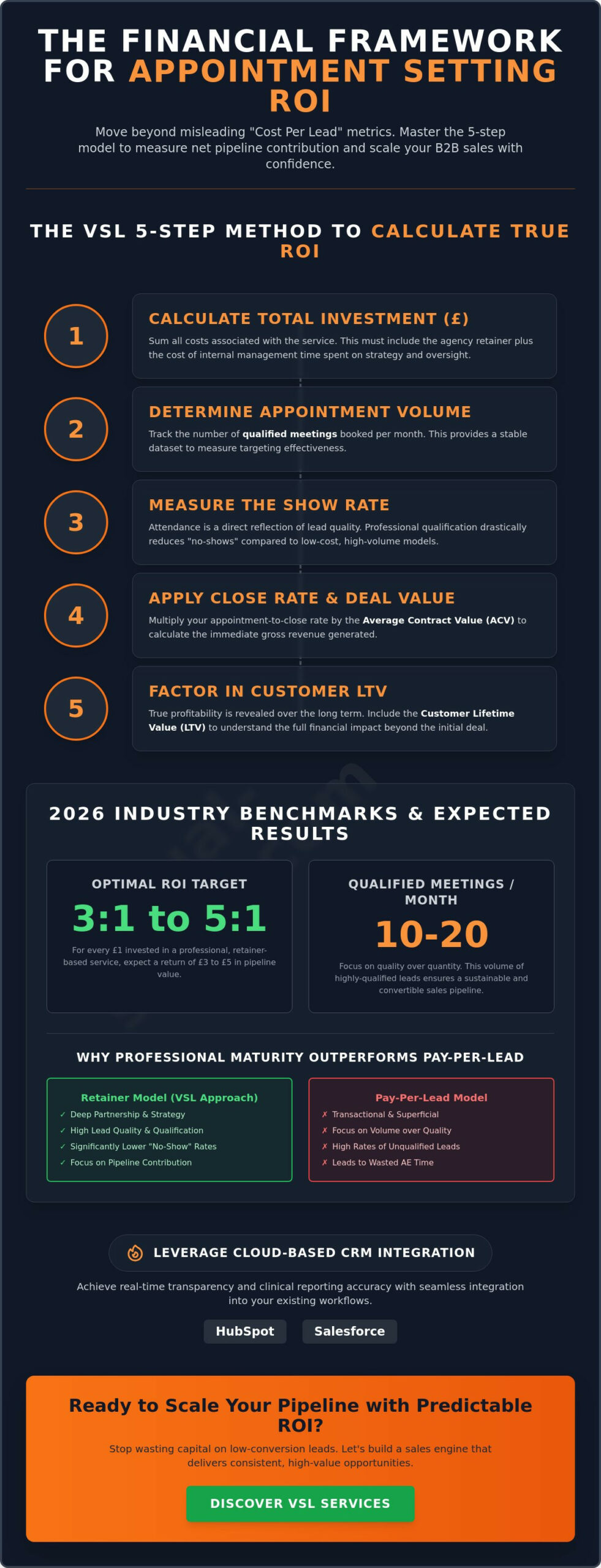
- Utilise 2026 industry benchmarks to target 10–20 qualified meetings per month and achieve an optimal ROI range of 3:1 to 5:1.
- Evaluate the impact of professional maturity on lead quality, specifically how retainer models significantly reduce the “no-show” rates common in pay-per-lead schemes.
- Learn how to leverage cloud-based CRM integrations with HubSpot and Salesforce to achieve real-time transparency and clinical reporting accuracy.
The Fundamentals of Appointment Setting ROI in 2026
Profitability isn’t a byproduct of activity; it’s the result of precise measurement. In the B2B landscape, Return on Investment (ROI) serves as the ultimate arbiter of campaign success. It isn’t just about how many calls were made. It’s about the net profit generated relative to your total investment. When calculating roi of appointment setting services, you must strip away vanity metrics to find the clinical reality of your sales pipeline. True success is defined by revenue in the bank, not just entries in a call log.
Traditional “Cost Per Lead” metrics often mislead stakeholders in high-ticket IT and SaaS sectors. A low CPL looks attractive on a spreadsheet but often hides a trail of unqualified prospects and “no-show” meetings. True ROI ignores the volume of raw leads and focuses on the conversion of those leads into revenue-generating assets. If an agency delivers 100 leads that result in zero closed deals, the ROI is negative, regardless of how low the initial cost appeared. Professional maturity in your outreach team ensures that every conversation is qualified against strict criteria, directly driving higher conversion rates at the bottom of the funnel.
Consider the “Cost of Inaction.” This is the revenue you bleed when your internal team is bogged down in manual prospecting instead of closing deals. Every hour your senior Account Executives spend hunting for names is an hour they aren’t selling. This friction reduces your overall commercial velocity and represents a significant opportunity cost. Most businesses fail to account for this lost revenue when weighing their options, but it’s a critical variable in any realistic financial model.
Why 2026 Requires a New ROI Perspective
The 2026 sales environment demands a move toward intent-based calling. We no longer live in an era where high-volume tactics work. Data quality is now the primary driver of outbound efficiency. High-performing b2b appointment setting strategies now leverage intent signals to reach buyers during their active decision-making windows. This precision reduces wasted spend and ensures that your investment builds a sustainable, long-term pipeline rather than a flash-in-the-pan list of contacts.
The Problem with In-House vs. Outsourced Math
Calculating the fully loaded cost of an in-house SDR team is complex. You aren’t just paying a salary. You’re covering National Insurance contributions, desk space, expensive software licenses, and significant management time. Calculating roi of appointment setting services becomes much clearer when you contrast these variable internal burdens with the fixed-cost transparency of outsourced lead generation. Outsourcing also mitigates the risk of SDR turnover. When an internal rep leaves, your pipeline stalls for months during the re-hire and ramp-up period. An integrated partner ensures your momentum remains constant and your results stay predictable.
The VSL Framework: 5 Steps to Calculating True ROI
Most commercial leaders stop at the cost per appointment. This is a strategic error. To achieve clinical accuracy when calculating roi of appointment setting services, you must follow a structured financial model that accounts for the entire lifecycle of a lead. This framework ensures you aren’t just measuring activity, but actual wealth creation.
- Step 1: Calculate Total Investment (£). Your calculation must include the agency retainer plus the internal management time required to sync with the partner. If your Head of Sales spends two hours a week on strategy, factor that cost in.
- Step 2: Determine Appointment Volume. Use a baseline of 10–20 qualified meetings per month. This volume provides enough data to identify trends and measure the effectiveness of the targeting criteria.
- Step 3: Measure the Show Rate. Attendance is a direct reflection of lead quality. Professional qualification ensures the prospect understands the value of the meeting, which significantly reduces “no-shows” compared to low-cost volume models.
- Step 4: Apply Close Rate and Average Deal Value. In the IT and SaaS sectors, focus on the Annual Contract Value (ACV). Multiplying your appointment-to-close rate by this value reveals the immediate revenue impact.
- Step 5: Factor in Customer Lifetime Value (LTV). True profitability often reveals itself in year two or three. A 3:1 to 5:1 ROI is the standard benchmark for a high-performing B2B campaign when LTV is correctly applied.
Step-by-Step Formula for B2B Success
To find your net return, use this formula: ((Total Revenue from Deals – Total Investment) / Total Investment) x 100. When applying this to the IT sector, you must adjust for long sales cycles. A deal initiated in January might not close until September. Use pound sterling (£) for all projections to maintain alignment with UK overheads and tax structures. This long-term view prevents you from abandoning a campaign that is building significant future equity. You can benchmark your expectations against verified performance data to ensure your targets are realistic.
Common Mistakes in ROI Tracking
Precision is often lost in the details. Many firms ignore “nurture” leads; these are prospects who aren’t ready to buy today but close 12 months later. If you don’t attribute these to the original campaign, your ROI will look artificially low. Another common failure is poor CRM attribution. Leads often get lost in the shuffle between different departments. Finally, many leaders overestimate internal SDR productivity. When you compare the fixed costs of appointment setting firms against the fully loaded cost of an in-house rep, the outsourced model almost always delivers a higher net margin.
Results and Data: Benchmarking Success in 2026
Data is the only antidote to uncertainty in a competitive market. Gartner research indicates that the cost of internal B2B customer acquisition continues to rise as traditional outreach methods lose their edge. This shift makes calculating roi of appointment setting services even more critical for firms that want to remain lean. You can’t rely on guesswork when your competitors are using clinical data to refine their pipelines. To understand where you stand, look at VSL’s Clutch rankings, which provide a verified benchmark for agency performance in the current UK landscape.
When you analyze your results, aim for an appointment-to-opportunity rate of 15–25% for qualified IT leads. If your conversion is lower, your qualification criteria are likely too broad. Integrating intent data into your strategy is a game-changer; industry reports suggest this can increase ROI by up to 30% by identifying buyers exactly when they’re researching solutions. This precision ensures your outreach team spends time on prospects with a high propensity to buy, rather than cold contacts with no immediate need.
Quantifiable Metrics for Your Dashboard
A dedicated retainer should consistently deliver 10–20 high-quality meetings per month. While the cost per meeting is a useful indicator, the metric that truly matters is the average cost per closed deal. In the enterprise software sector, this typically ranges between £2,000 and £5,000. You should also track “Pipeline Velocity.” This measures how quickly an appointment transitions to a formal proposal. High velocity indicates that the meetings booked are with decision-makers who have the authority and budget to move forward immediately.
The Role of Industry-Specific Expertise
ROI isn’t uniform across all sectors. IT and software campaigns often show a higher return because of the significant Annual Contract Values involved. For instance, a lead generation for fintech campaign might see a different return profile compared to general manufacturing due to regulatory complexities and longer buying cycles. Regardless of the sector, database cleansing is non-negotiable. Clean data prevents wasted effort on defunct contacts, keeping your outreach efficiency high and your ROI protected from the “data decay” that plagues many internal sales teams.

Real Insight: Why Professional Maturity Outperforms Pay-Per-Lead
A UK-based SaaS provider recently learned that the cheapest lead is often the most expensive mistake. They initially contracted a Pay-Per-Lead (PPL) agency, attracted by the perceived low risk of only paying for booked meetings. The result was a clinical failure: a 40% “no-show” rate that wasted their senior sales team’s time. The agency’s incentives were misaligned; they prioritised volume over qualification to hit their own billing targets. When calculating roi of appointment setting services under this model, the provider found that while the cost per meeting was low, the cost per closed deal was unsustainable.
The lesson here is clear: ROI is higher when you pay for quality conversations, not just “booked slots.” By switching to a dedicated retainer model, the provider ensured their outreach team was incentivised to find genuine business fit. This shift in strategy resulted in a 25% increase in average deal size. The callers weren’t just checking boxes; they were identifying complex pain points that justified higher-tier software packages. True profitability stems from the professional maturity of the person representing your brand on the phone.
Case Study: IT Services Growth
One IT services firm managed to scale from a standing start to a £1M sales pipeline in just six months by abandoning volume-based tactics. They transitioned to an integrated b2b lead generation approach that focused on high-value accounts. By using senior outreach specialists, they bypassed complex gatekeepers and engaged directly with C-suite stakeholders who typically ignore generic sales calls. This transition didn’t just fill the calendar; it provided the sales team with deep intelligence on every prospect before the first meeting even began. This level of preparation is what separates a high-performing pipeline from a list of hopeful contacts.
The “Integrated Partner” Advantage
We act as a natural extension of your internal workforce to reduce the friction common in traditional outsourcing. This integration ensures that the handoff from appointment setter to account executive is seamless. High-level B2B sales require significant emotional intelligence to navigate delicate corporate hierarchies and build trust quickly. Professional Maturity is the ability to handle senior-level objections with clinical efficiency. This expertise ensures your brand is protected and your pipeline is built on solid foundations, not just optimistic call notes. You can verify how this approach translates into measurable growth by reviewing our verified performance benchmarks.
Maximising ROI Through CRM Integration and Technology
Transparency is the bedrock of commercial accountability. If your sales data exists in a silo, calculating roi of appointment setting services becomes a subjective exercise rather than a mathematical certainty. We integrate directly with cloud-based CRMs like Salesforce and HubSpot to ensure every interaction is logged in real-time. This level of technical synergy allows for closed-loop reporting, where we track a lead from the initial discovery call to the final signed contract. It eliminates the guesswork and provides a single source of truth for your commercial performance.
Choosing a partner that values sustainable revenue over short-term metrics is vital. A high-performing partner doesn’t just book meetings; they provide the data infrastructure needed to prove their value. Closed-loop reporting creates a feedback loop between our outreach and your closed deals. It allows us to identify exactly which campaigns produce the highest quality opportunities. If a specific vertical is yielding a higher conversion rate, we shift our focus there immediately. This dynamic optimization ensures your budget is always directed toward the highest-yielding activities.
Salesforce and HubSpot Integration
Automatic lead syncing is the only way to prevent lead leakage. When a lead is manually transferred, there’s a high risk of it being forgotten or mismanaged, which represents lost revenue. By using custom fields to track Source and Campaign ROI, you can see exactly which outreach efforts are driving your bottom line. This level of granularity is essential for calculating roi of appointment setting services with clinical accuracy. It also significantly reduces the administrative burden for internal Sales Managers, allowing them to focus on high-level coaching and strategy rather than manual data entry.
Future-Proofing Your Sales Strategy
The sales landscape is evolving, and AI-assisted research is now a standard tool for prepping high-value calls. This technology allows our team to enter conversations with deep insights into a prospect’s specific challenges. However, technology is only as good as the data it sits on. Continuous B2B lead generation and database refinement remain the foundations of long-term ROI. By building a clean, intent-driven database, you ensure your pipeline remains healthy for years to come. We position ourselves as an elite, integrated component of your internal team, ensuring that our technical capabilities and human expertise work in tandem to drive growth.
Final Summary: Success in 2026 requires more than just a high volume of calls. It requires a strategic partner that acts as a natural extension of your own workforce. Reach out to Virtual Sales Limited to calculate your bespoke ROI projection and begin scaling your pipeline with confidence.
Scaling Your Pipeline with Clinical Precision in 2026
Profitability in the B2B landscape no longer depends on the volume of calls; it relies on the clinical quality of the resulting pipeline. You’ve seen how professional maturity and intent-based targeting outperform high-volume, low-quality models. By shifting your focus from vanity metrics to net pipeline contribution, you protect your commercial margins and ensure your sales team spends their time on high-propensity deals. Calculating roi of appointment setting services is the only way to transform your outreach from a variable overhead into a predictable growth engine.
Integrating your campaign directly into your CRM provides the transparency required to scale with confidence. Backed by 20 years of expertise as specialists in the IT and Software sectors, VSL delivers the professional maturity and transparent, integrated reporting your business deserves. Don’t leave your growth to chance or inconsistent agency results. Take the next step toward a data-driven sales strategy and book a consultation with VSL to build a high-ROI sales pipeline. Your future pipeline is ready for construction.
Frequently Asked Questions
How long does it take to see a positive ROI from appointment setting?
Expect to see a positive return within three to six months for high-ticket B2B services. This timeline accounts for the standard sales cycles in the IT and software sectors, where initial outreach requires time to nurture prospects from intent to a closed contract. While early meetings build your pipeline value immediately, the clinical revenue results typically manifest once your first batch of appointments completes your specific buying cycle.
What is a good cost-per-appointment for B2B IT services in the UK?
A competitive cost-per-appointment in the UK generally ranges from £150 to £400 depending on the seniority of the stakeholders. While targeting SMBs might sit at the lower end of this scale, enterprise-level outreach to C-suite decision-makers requires a higher investment to ensure professional qualification. Prioritise the quality of the conversation over the lowest price to avoid the “no-show” trap that kills campaign profitability.
Should I calculate ROI based on closed deals or pipeline value?
You must track both to gain a complete view of your commercial velocity. Pipeline value acts as a leading indicator of future growth, while closed deals provide the lagging data required for final calculating roi of appointment setting services. Monitoring how quickly appointments move to the proposal stage allows you to adjust your strategy in real-time before the final deal even closes.
Is it better to hire an internal SDR or outsource to an agency for ROI?
Outsourcing usually provides a faster and more consistent ROI by eliminating the overheads of recruitment, training, and National Insurance. An integrated partner offers immediate professional maturity and a fully functional technology stack including HubSpot or Salesforce. This removes the ramp-up risks associated with internal hires, who often take months to reach peak productivity levels.
How does lead quality affect my ROI calculation?
Lead quality is the primary driver of your net profit. High-quality, intent-based leads ensure your senior sales staff spend their time closing instead of prospecting, which reduces your overall cost of acquisition. When quality is low, your ROI suffers from the “Cost of Inaction,” as your internal team wastes expensive hours on meetings that were never destined to convert.
Can I use a simple ROI calculator for complex SaaS sales?
Simple calculators often fail because they ignore the nuances of Customer Lifetime Value (LTV) and multi-year contracts. Calculating roi of appointment setting services for SaaS requires a framework that accounts for long-term retention and the high Annual Contract Values typical of the sector. Use a structured 5-step method to ensure your projections reflect the clinical reality of your sales funnel.
What happens to my ROI if the appointment show rate is low?
A low show rate causes your ROI to collapse by inflating your cost-per-closed-deal. This issue is often a symptom of volume-based models where callers are incentivised to book slots rather than qualify prospects. Ensuring your outreach team has the professional maturity to handle objections and confirm fit is the only way to maintain the high attendance rates required for a 3:1 to 5:1 return.


Disclaimer
Disclaimer: Content is for general information only and does not constitute professional advice. Results may vary. Virtual Sales Limited accepts no liability for actions taken based on this content.