


A verified email address isn’t necessarily a relevant prospect. For UK technology sales teams, data verification services for sales teams can help identify inaccurate contact and company records, but clean data alone won’t show whether a business fits your ideal customer profile or whether the contact can influence a buying decision.
If outdated details are wasting prospecting time, you’re right to look for a more dependable process. The challenge is separating record accuracy from prospect relevance, then making sure someone owns regular checks rather than relying on occasional database clean-ups.
This guide explains how to assess verification options, distinguish verification from enrichment, and build a repeatable approach to sales data quality. It also looks at how to use campaign outcomes and feedback from real prospect conversations to review your targeting. You’ll come away with practical steps for maintaining clearer records and connecting accurate data to more relevant conversations with B2B decision-makers.
- Separate contact accuracy from company fit, decision-maker relevance and buying readiness before prioritising a prospect.
- Define your ideal customer profile and required data fields before reviewing records or starting outreach.
- Compare verification options by their evidence, update process, CRM workflow and provision for human review.
- Use prospect feedback and campaign outcomes to identify targeting gaps, without treating them as automatic proof of every record detail.
- Assign ownership and schedule regular reviews to connect accurate records with more relevant B2B conversations.
What Do Data Verification Services for Sales Teams Actually Check?
Sales data verification is the process of checking whether prospect and company records are accurate, current and usable for sales activity. For sales teams, that means looking beyond whether an email address appears to work. A valid contact detail can still belong to someone at a company that does not fit your ideal customer profile, or to a person with no relevant role in a buying decision.
Data verification provides a general introduction to checking information for accuracy. In sales, the practical test is whether each record gives your team a sound basis for deciding who to contact and why. This supports the broader principle of prioritising sales prospects over data volume.
Which sales data fields should teams assess?
Start with the account. Check the company’s identity, sector and size, then compare those details with your ideal customer profile. A record may be accurate but still be a poor fit if the business falls outside your target market.
Next, review the contact: their name, current role, seniority and likely relationship to the buying decision. Check available contact channels, such as business email or telephone details, and record when the information was last reviewed. There’s no universal freshness threshold for every field; set review intervals according to how quickly your target market and contact details change.
How is verification different from enrichment and qualification?
Verification checks information already held. Enrichment adds relevant information to an existing prospect record. For example, confirming that a contact still holds a stated role is verification; adding a company’s technology focus to its profile is enrichment. Enriched information may still need checking before your team relies on it.
Qualification answers a different question: is there a relevant business opportunity? BANT assesses Budget, Authority, Need and Timeline through engagement. A database check can help confirm contact details or flag a possible decision-maker, but it can’t establish that the prospect has a current need, available budget or a suitable buying timeframe.
Keep these judgements distinct in your CRM. Mark contact validity, account fit, decision-maker relevance and qualification separately. That gives salespeople a clearer view of what’s been checked, what remains uncertain and which records merit further engagement. Data verification services for sales teams are most useful when their checks support this decision process, rather than treating every accurate record as a sales-ready prospect.
How Can Sales Teams Check Prospect Data Before Acting on It?
A repeatable workflow helps your team decide whether to use a record, review it or hold it back. Start with your ideal customer profile (ICP), then check the fields that affect account fit and contactability before adding prospects to an outreach queue. VSL’s guide to defining a relevant ideal customer profile can help sharpen those criteria.
What should a practical sales-data verification workflow include?
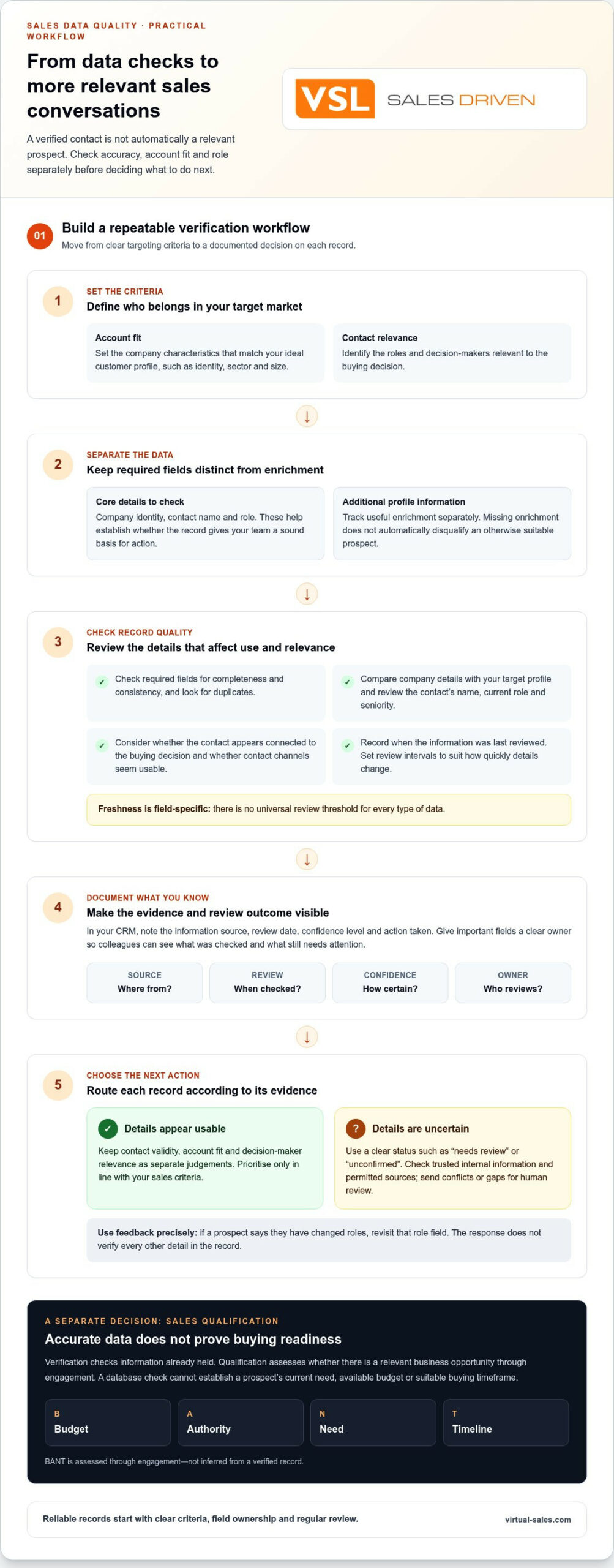
Build the process around the decisions your team needs to make. An ordered workflow can help:
- Set the criteria. Define target account characteristics and relevant decision-maker roles before sourcing or reviewing records.
- Separate required fields from useful enrichment. Make core details, such as company identity, contact name and role, mandatory. Track additional profile information separately so its absence doesn’t automatically disqualify a suitable prospect.
- Check record quality. Review whether required fields are complete, details are consistent, duplicates exist and contact channels appear usable.
- Document the review. Record the source, review date, confidence level and action taken in your CRM. This helps colleagues see what was checked and what still needs attention.
Agree who owns each field and what to do when information conflicts. A verification workflow only stays useful when every important field has a clear owner and a recorded review outcome. For practical advice on focusing sales effort, see this guide to prioritising prospects over data volume.
How should teams handle uncertain or outdated records?
Use clear status labels such as “needs review” or “unconfirmed” rather than leaving a doubtful field to look current. Check records against trusted internal information and sources your organisation is permitted to use. If evidence is incomplete or contradictory, route the record to a person for review instead of treating a tool result as proof.
Prospect responses and campaign outcomes can inform the next review. For example, a response that a contact has changed roles is a reason to revisit that detail, but it doesn’t confirm every other item in the record. Keep feedback linked to the specific field it concerns.
Data verification services for sales teams work best when checks sit within a process with clear ownership, review notes and a route for uncertain records. If you’re considering how campaign activity could contribute prospect feedback and structured outcomes to your sales process, explore VSL’s appointment-setting reviews.
How Should You Compare Data Verification Services for Sales Teams?
The right approach depends on what your team needs to decide. A tool, specialist data service or campaign-led process may each help with a different part of the job. Compare them by the evidence they provide and how well that evidence supports sales decisions, not by contact volume alone.
Which evaluation criteria matter beyond data coverage?
Look past how many records a provider can supply or process. Check whether its method assesses company fit and decision-maker relevance, or only whether contact details are available. Ask what supports each result: a field-level source, a status label, a confidence rating or simply a broad coverage claim. Testimonials can describe a customer’s experience, but they aren’t the same as evidence that specific data fields are accurate.
Then consider how the information will reach the people who need it. Can your team review exceptions, export useful outcomes and act on records within its existing CRM workflow? Are the source, review date and status visible? Clear reporting helps sales leaders distinguish records ready for outreach from those that need human review.
A larger database doesn’t automatically create qualified opportunities. More names can increase volume without improving account fit, access to decision-makers or evidence of a buying need. Judge an approach by whether it helps your team prioritise relevant prospects and learn from the outcomes of its activity.
When do tools, data services or live feedback fit best?
Tools can suit repeatable field checks or enrichment across a large set of records. Specialist data services may help when sourcing or cleansing needs focused support. Neither option should be treated as proof of business relevance unless the method also assesses your ICP and decision-maker criteria.
Live conversations add a different kind of context. A prospect may clarify their role, point to the right colleague or explain that a need is not current. That feedback can guide follow-up and data review, but it doesn’t independently verify every field. Keep conversation insights linked to the relevant record and distinguish them from externally checked data.
VSL’s B2B lead generation service includes campaign data sourcing and management, with weekly reporting and outcome analysis to inform recommendations. VSL uses a cloud-based CRM and can output campaign data for use with platforms such as HubSpot and Salesforce. For a view of client feedback, explore VSL’s published appointment-setting reviews.
Data verification services for sales teams are easier to compare when you define the decision each check must support, then assess source evidence, workflow fit and human review against that need.

What Common Mistakes Undermine Sales Data Verification?
Data checks can be thorough and still fail to help sales if teams don’t know which prospects matter. A vague ideal customer profile (ICP) leads to inconsistent targeting: one person may prioritise company size, whilst another focuses on sector or job title. Define target accounts and relevant decision-makers first, so everyone assesses records against the same criteria.
Which data-quality mistakes create avoidable sales friction?
- Importing records without review. A new list can contain duplicate, incomplete or inconsistent entries. Check imported data against your required fields before adding it to active sales outreach.
- Treating contact validity as commercial fit. A working email address or phone number doesn’t show that the company fits your ICP, that the contact has authority, or that there’s a current need and buying timeline.
- Prioritising volume over usable outcomes. A growing record count says little about whether salespeople can reach relevant decision-makers or progress suitable opportunities. Track record status, prospect feedback and meaningful campaign outcomes as well.
- Leaving CRM notes and review dates incomplete. Without a record of what was checked, when, and what happened next, colleagues can’t tell whether information remains reliable or needs another look.
For practical guidance on deciding which prospects deserve attention, see VSL’s sales data prioritisation guidance. The aim is not to process every record in the same way. It’s to focus review effort on information that supports a relevant sales conversation.
How can teams turn data checks into a repeatable framework?
Use a simple cycle: define, source, engage, qualify and review. Define the ICP and the fields needed for a meaningful conversation. Source and review prospect records against those criteria, then engage suitable contacts through consultative conversations. Qualify opportunities to BANT criteria as a minimum: Budget, Authority, Need and Timeline.
Close the loop with regular review. Weekly reporting can help campaign teams examine call metrics and outcome classifications, identify patterns and recommend adjustments. For example, repeated redirection to another role may suggest that the target contact criteria need review. Treat that feedback as a prompt to assess the record or targeting, not as automatic confirmation of every field.
Used this way, data verification services for sales teams support a managed process rather than a one-off database tidy-up. VSL works alongside clients’ sales and marketing teams, with a dedicated caller and campaign manager for each campaign.
BOOK A 15-MINUTE DISCOVERY CALL →
How Does VSL Connect Sales Data to Qualified B2B Conversations?
Accurate records help sales teams decide who to approach, but prospect conversations add context that a data check alone can’t provide. VSL brings data sourcing, consultative outreach and campaign reporting into a managed process, helping technology businesses connect target accounts with relevant decision-makers.
What does VSL’s campaign data feedback loop involve?
Campaign work begins with a briefing to define the target market, decision-maker criteria and proposition. VSL sources campaign data and aligns the caller with the client’s offer. Each campaign has a dedicated UK-based caller and campaign manager, so outreach and review have clear ownership.
Callers use consultative, script-free conversations to understand a prospect’s requirements. These discussions can surface useful feedback, such as a contact’s role, a referral to another decision-maker or whether a need is current. That feedback can prompt a record review or targeting adjustment, but it doesn’t automatically verify every field.
Weekly reports include call metrics and outcome classifications. CRM outcomes include Warm Lead and Future Opp, alongside statuses such as Call Back, Warmer Contact and Not Interested. Reviewing these outcomes helps the campaign manager assess progress and make recommendations based on activity and prospect feedback.
VSL uses a cloud-based CRM to manage campaign activity and can output campaign data for use with platforms such as HubSpot and Salesforce. This is campaign-data output, not a claim of direct integration. For teams assessing B2B appointment setting, this process links data sourcing and outreach to opportunities qualified to BANT criteria as a minimum.
When should a technology sales team consider this approach?
This approach can suit a business entering a market, testing a new ideal customer profile or building pipeline capacity without relying only on its internal team. It can also help when an existing prospect database needs campaign activity to reveal which contacts merit further review and which account segments warrant closer attention.
VSL works as an extension of the client’s sales and marketing team. Weekly reporting and outcome analysis give both teams a basis for reviewing targeting and next steps. Published Clutch reviews of VSL provide a place to read client feedback; no specific result or metric should be inferred without checking the review itself.
Data verification services for sales teams are one part of a wider process: accurate records support targeting, while consultative conversations help establish relevance and qualification. A discussion can help you consider whether this campaign approach fits your sales priorities.
Build a Sales Data Process Your Team Can Act On
Reliable prospecting depends on more than valid contact details. Data verification services for sales teams are most useful when checks sit within a repeatable process: define your ideal customer profile, record what has been reviewed, and keep contact accuracy separate from account fit and buying qualification.
Use clear field ownership and review dates so your team can see what is known and what still needs attention. Then use prospect feedback and campaign outcomes to guide future checks, not as automatic proof that every record detail is correct.
VSL has supported technology-sector campaigns since 2001. Dedicated callers and campaign managers provide weekly reporting and campaign recommendations, helping your sales and marketing team review activity and shape next steps. You can also explore VSL’s published Clutch reviews to assess client feedback directly.
Turn better data practices into more focused outreach and more relevant B2B conversations. A consistent process gives your team a stronger basis for deciding who to contact and how to prioritise the next opportunity.
With clear records, thoughtful qualification and regular review, your team can move forward with greater confidence.
Frequently Asked Questions
What do data verification services for sales teams check?
Data verification services for sales teams check whether prospect and company records are accurate, current and usable for sales activity. Checks may cover company identity, sector, size, contact name, role and available contact details. Teams should also assess account fit and decision-maker relevance separately. A verified email address confirms neither that the company matches the ideal customer profile nor that the contact has buying authority or a current need.
How often should sales teams verify prospect data?
There’s no single review interval that suits every field or target market. Set a regular review cadence based on how quickly your company and contact details change, and check key records before using them in a campaign. Review them again when prospect feedback or campaign outcomes suggest a role, company detail or contact channel may have changed. Record the review date and flag uncertain information rather than treating it as current.
What is the difference between data verification and data enrichment?
Data verification checks whether information already held is accurate and usable. Data enrichment adds relevant details to an existing prospect record, such as additional company information or contact context. The two processes can work together, but adding information doesn’t prove it’s correct. Keep verified fields distinct from newly sourced details, and record their sources and review status so salespeople can judge what’s suitable to act on.
Can data verification services improve sales lead quality?
They can support better lead quality by helping teams identify incorrect details and focus on records that fit their target criteria. Verification alone can’t establish buying intent, budget or timing. Pair record checks with a clear ideal customer profile and qualification through engagement. VSL qualifies leads to BANT criteria as a minimum: Budget, Authority, Need and Timeline. This helps distinguish usable contact information from a qualified sales opportunity.
How can a sales team verify B2B contact details?
Start by checking the contact’s name, current role and seniority against trusted internal records and sources your organisation is permitted to use. Review whether the listed business email or telephone detail appears usable, and note where the information came from and when it was checked. If sources conflict or a detail remains uncertain, mark it for human review. A prospect’s response can prompt a check, but doesn’t verify every field.
Do sales teams need a data verification tool if they already use a CRM?
Not necessarily. A CRM stores and organises prospect records, but the presence of a record doesn’t confirm that its details remain accurate or that the account fits your target profile. First assess whether your current process can flag duplicates, missing fields, review dates and uncertain details. A separate tool may help with repeatable checks, whilst clear CRM ownership and human review remain useful parts of data hygiene.
How should teams measure whether sales data verification is working?
Track whether required fields are complete, how often records are flagged as outdated or duplicated, and whether review outcomes are recorded consistently. Then connect those checks to sales activity: assess whether teams can reach relevant decision-makers, how prospects respond and how many opportunities meet your qualification criteria. Review results by account segment, not just total records processed. This shows whether better data supports more relevant conversations and qualified pipeline activity.


Disclaimer
Disclaimer: Content is for general information only and does not constitute professional advice. Results may vary. Virtual Sales Limited accepts no liability for actions taken based on this content.