


A busy lead pipeline can hide a targeting problem. For MarTech companies, generating sales leads for martech companies means more than attracting interest in a platform: it means reaching organisations with a relevant need and engaging the people involved in evaluating a purchase. Marketing activity can create plenty of responses without giving sales a clear route to a qualified conversation.
If you lead sales, marketing or business development, you’ll recognise the challenge. Your ideal customer profile may be difficult to pin down, and a buying committee can span marketing, sales, data and IT. Meanwhile, internal teams still need time to research accounts, make relevant approaches and follow up consistently.
This guide sets out a practical way to build a lead-generation approach around MarTech buyers. You’ll learn how to define target accounts and decision-makers, turn prospect interest into sales-ready conversations, and assess opportunities against clear qualification criteria. It also covers how consultative outreach and regular campaign feedback can help refine your targeting and messaging, so sales teams can focus on prospects with a credible fit, need and next step.
Key Takeaways
- Define your ideal customer profile around the MarTech problem you solve, then map the roles involved in assessing and buying the solution.
- Make generating sales leads for martech companies a structured process, from accurate account data and relevant outreach to qualification and review.
- Choose an approach that matches your team’s capacity, while keeping ownership of buyer feedback and lead qualification clear.
- Use consultative conversations to explore a prospect’s requirements and assess Budget, Authority, Need and Timeline.
- Review campaign evidence and prospect responses to refine targeting and give sales a clearer picture of qualified opportunities.
What does generating sales leads for MarTech companies involve?
B2B lead generation means identifying and engaging prospective business customers to create qualified opportunities. For a MarTech provider, that means finding organisations whose marketing, sales or revenue operations needs fit the solution, then starting relevant conversations with the people who can assess those needs. A contact record is a starting point, not proof of buyer interest or sales potential. For a foundational overview of the term, see lead generation.
MarTech purchases can involve several functions. A marketing leader may own the problem, while revenue operations assesses how a platform fits existing processes and systems. Sales leaders may influence requirements, finance may review budget, and company leadership may approve a broader investment. The right mix depends on the product, intended use and organisation.
Which MarTech buyers should a campaign reach?
Set the ideal customer profile before building a prospect list. Specify company traits such as sector, size, existing technology environment and the use case your product supports. Add the buying context: for example, a business launching a new product, reviewing its marketing stack or exploring a particular vertical.
Then map relevant roles. Distinguish the day-to-day user from internal influencers and budget holders where the buying process requires it. A campaign for a campaign-management platform may need to reach marketing operations, while a solution affecting lead routing could also involve revenue operations and sales leadership. This keeps outreach relevant to each person’s responsibilities rather than relying on a generic message to one job title.
How do leads differ from qualified opportunities?
A name, email address or content download doesn’t establish that a prospect has a live need, authority to act or a reason to consider a solution now. Lead generation develops potential opportunities through relevant engagement and qualification. B2B appointment setting has a more specific purpose: securing a qualified sales appointment with a business decision-maker.
A qualified BANT lead has been assessed against Budget, Authority, Need and Timeline. These criteria help sales understand whether there is a potential business requirement, who is involved, whether budget is relevant and what timing the prospect has in mind. BANT is an initial qualification framework, not a substitute for the deeper discovery a sales team may need.
An appointment is appropriate when a prospect’s requirements align with the solution and there is a clear reason for a sales conversation. The handover should give the sales team useful context, including the prospect’s role, stated need and relevant timing. That is the difference between adding names to a database and generating sales leads for martech companies that sales can assess and follow up effectively. See how lead generation for technology companies can support this work.
How to generate qualified sales leads for MarTech companies
A repeatable process helps turn a MarTech proposition into relevant conversations, rather than a list of contacts with little context. Start with the use case and buyer problem, then prepare account data, engage suitable prospects, qualify what you learn and review the results. This gives marketing and sales a shared basis for deciding which accounts merit follow-up.
Build the ICP and buying-role map
An ideal customer profile describes the target companies and decision-makers most relevant to a campaign. Group accounts by factors such as sector, size, product fit and the business need your platform addresses. Then map likely users, influencers and budget holders. A new analytics product, for instance, may interest marketing operations, while a product focused on lead routing may also matter to revenue operations and sales.
Use this sequence to put the profile into practice:
- Define the use case. State the problem the product solves and the business situation that makes it relevant, such as a product launch or expansion into a target vertical.
- Prepare the data. Build and check account and contact records against the ICP. Remove poor-fit organisations and note gaps that need research before outreach.
- Shape the proposition. Connect the use case to each audience’s priorities. A marketing leader may focus on campaign visibility; a revenue operations contact may want to understand how the solution fits existing processes.
- Start a relevant conversation. Use consultative outreach to understand the prospect’s requirements, current approach and interest in addressing the stated problem. Harvard Business Review’s The New Rules of B2B Lead Generation offers a useful strategic perspective on adapting B2B lead generation to buyer behaviour.
- Qualify and review. Assess Budget, Authority, Need and Timeline, record the outcomes and agree the appropriate next step. Review prospect feedback to refine account selection, messaging and follow-up priorities.
Move from outreach to BANT qualification
BANT should guide a business conversation, not turn it into a rigid checklist. Explore whether a relevant need exists, who contributes to the decision, how budget is considered and what timing makes sense. Capture what the prospect actually says, including uncertainties, so the sales team can prepare for a useful follow-up rather than repeat discovery from the beginning.
A clear hand-off includes the contact’s role, relevant business context, qualification findings and agreed next step. VSL uses a cloud-based CRM and can output campaign data for use with popular CRM platforms such as HubSpot and Salesforce. To see how VSL’s technology lead generation can support this process, explore the service. You can also view VSL’s Clutch appointment-setting profile.
Which MarTech lead-generation approach fits, and how can you protect lead quality?
The right route depends on your target market, the conversations needed and the time your team can commit. Internal prospecting offers direct control, marketing-led activity builds interest through content and campaigns, and specialist outbound support adds dedicated capacity for proactive conversations. These approaches can work together, but each needs clear ownership of qualification and sales follow-up.
Compare the operating fit
| Approach | Control | Team capacity | Buyer feedback | Qualification ownership |
|---|---|---|---|---|
| Internal prospecting | High direct control over targeting and outreach. | Uses existing sales or business development time. | Sales hears responses directly and can adjust quickly. | Internal team defines and applies criteria. |
| Marketing-led demand creation | Marketing controls content, channels and nurture. | Requires ongoing campaign and content resource. | Engagement signals can inform follow-up, though they may not reveal the full buying context. | Marketing and sales need agreed handover criteria. |
| Specialist outbound support | Shared through an agreed ICP, proposition and campaign brief. | Adds dedicated prospect engagement capacity. | Conversation feedback can inform targeting and messaging. | Set qualification standards and handover with the sales team. |
Before selecting a route, assign an owner for prospect research, outreach, qualification, reporting and follow-up. For external support, VSL assigns a dedicated caller and campaign manager to each campaign, with weekly reporting. The caller uses consultative, script-free conversations, and leads meet BANT criteria as a minimum.
Does specialist support need deep MarTech knowledge from day one? A clear proposition and campaign briefing are the starting point. Explain the product’s use case, suitable accounts, buyer roles, common questions and disqualifying conditions. This gives the campaign team a practical basis for relevant conversations, while prospect feedback can sharpen the brief over time. No channel or provider can promise a fixed volume of qualified leads, meetings or revenue; results depend on the market, proposition, data and buying context.
Real Insight: an illustrative MarTech scenario
This scenario is illustrative, not a VSL client result or verified case study. A platform provider begins with a broad proposition for marketing teams. Early conversations suggest that the message is unclear and some target accounts lack the specific need the product addresses. The team narrows the ICP to companies with a defined use case, then adapts the message for marketing operations and revenue operations. Feedback helps exclude poor-fit accounts and identify prospects ready for a relevant sales discussion. That learning, not contact volume alone, is what improves campaign focus.
If you’re assessing specialist support, read VSL’s appointment-setting reviews on Clutch to understand client feedback.

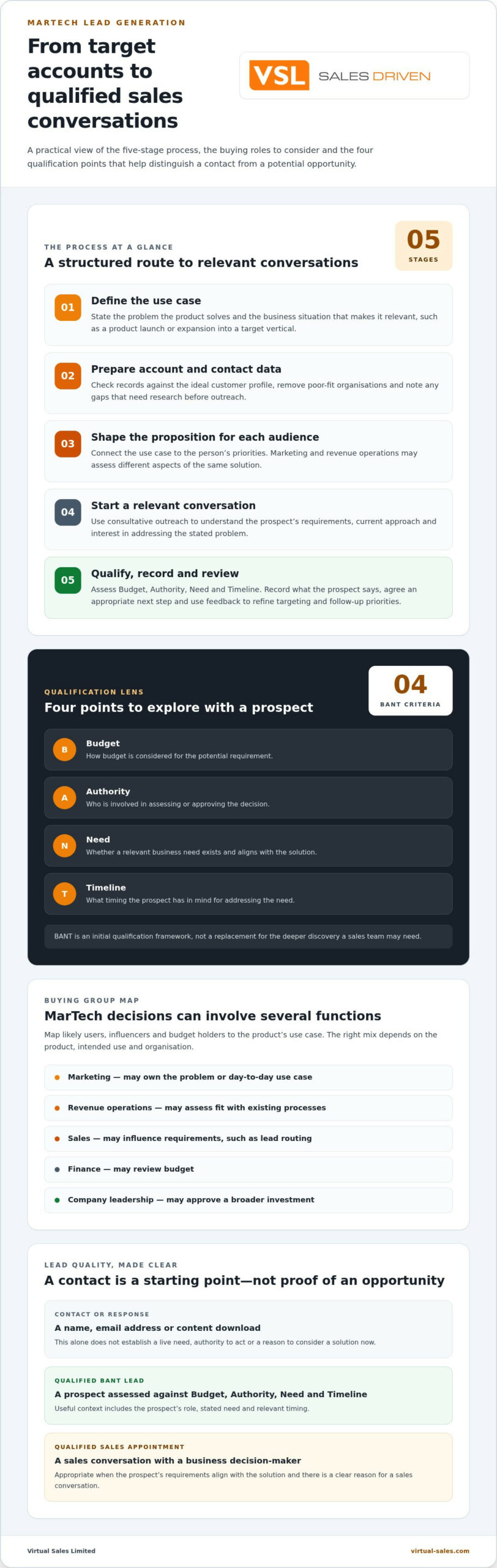
Practical VSL Framework for MarTech Sales Leads
Generating sales leads for MarTech companies takes more than a strong product proposition. It needs a clear target, conversations grounded in the buyer’s requirements and a consistent way to assess what happens next. VSL’s campaign approach is tailored to the project, with a dedicated caller and campaign manager working as an extension of your sales and marketing team.
The five steps: define, develop, engage, qualify and review
- Define: Set the ideal customer profile around the product’s use case, relevant company traits and decision-makers. A platform aimed at improving campaign operations, for example, may call for a different buyer map from a tool focused on sales processes.
- Develop: Agree a clear proposition and consultative conversation approach. Focus on the business problem the product addresses, then shape the discussion to explore how prospects handle that requirement.
- Engage: Experienced UK-based callers start consultative, script-free conversations with relevant business decision-makers. The campaign manager oversees caller activity and supports data sourcing.
- Qualify: Assess Budget, Authority, Need and Timeline as a minimum. BANT guides the conversation, helping establish whether there is a relevant requirement and a suitable next step for sales.
- Review: Examine campaign outcomes and prospect feedback with the campaign manager. Use what buyers say to adjust account priorities, refine the proposition and inform follow-up.
Make reporting and CRM data useful to sales
Weekly reports give your team visibility into campaign metrics and classified outcomes, while buyer feedback adds context to the figures. For example, repeated questions about how a platform fits existing processes may point to a messaging gap or a need to clarify the use case. The campaign manager reviews activity and shares recommendations, helping the team make considered changes rather than treating every response as the same signal.
VSL uses a cloud-based CRM and can output campaign data for use with popular CRM platforms such as HubSpot and Salesforce. This helps your sales team work from campaign outcomes and qualification context when following up. To strengthen account selection, explore precise targeting in AI lead generation. For SaaS teams considering external campaign support, see this guide to outsourced lead generation for SaaS.
Learn how VSL supports lead generation for technology companies.
Results, evidence and next steps for MarTech lead generation
Assess lead generation by the opportunities sales can act on, not by contact totals alone. For a MarTech campaign, useful measures may include qualified opportunities, appointment outcomes, prospect feedback and progression through the sales pipeline, where data is available. Agree definitions with sales before a campaign begins so everyone can interpret the results consistently.
Which evidence should MarTech leaders assess?
Check the source and context behind every published result. A credible case study or review should identify who provided the feedback, what work it relates to and what was measured. Keep third-party research separate from VSL campaign evidence, and don’t treat a general industry finding as proof of a specific campaign outcome.
VSL’s published Clutch profile and client reviews provide a place to assess client feedback. For campaign reporting, consider qualification outcomes, prospect responses and the next steps agreed with sales. Don’t infer guaranteed performance from a testimonial or present an illustrative scenario as a verified result.
When could specialist lead-generation support fit?
Specialist support may suit your team when internal prospecting is inconsistent, sales needs more qualified conversations or you’re entering a new market. It may also help when introducing a product or testing a target vertical. As agencies like Stratagon note when evaluating external partners, moving from a tactical vendor to true strategic alignment requires setting clear qualification standards and agreeing how campaign activity supports the wider sales process.
VSL works as an extension of your sales and marketing team, with a dedicated caller and campaign manager, consultative conversations and weekly reporting. Explore lead generation for technology companies to see how campaign support can be shaped around your target buyers. For SaaS-specific planning, read this guide to optimising SaaS lead generation.
Generating sales leads for MarTech companies calls for ongoing attention to account fit, buyer feedback and the quality of the sales handover. Review what prospects tell you and whether the information passed to sales supports a useful next conversation. These findings can guide your next campaign decisions.
Build a MarTech pipeline around buyer fit
Generating sales leads for martech companies works best when your target accounts, buyer roles and product use case align. Define the companies you want to reach, prepare accurate prospect data, and shape outreach around the business needs of each audience. Then assess opportunities against Budget, Authority, Need and Timeline, and give sales clear context for follow-up.
Protect lead quality by reviewing more than activity counts. Consider qualification, campaign outcomes, prospect feedback and pipeline progression where data is available. These signals can help refine your targeting and messaging as you enter a market, launch a product or test a new vertical.
Founded in March 2001, VSL works as an extension of your sales and marketing team. Each campaign has a dedicated caller and campaign manager, with weekly reporting. Outreach is consultative and script-free, and leads are qualified to BANT criteria as a minimum.
With a clear ICP and useful feedback from real buyer conversations, your team can take a more focused, informed approach to building MarTech sales opportunities.
Frequently Asked Questions
How can MarTech companies generate qualified sales leads?
MarTech companies can generate qualified sales leads by defining a clear ideal customer profile, identifying relevant buyer roles and engaging prospects around a specific business need. Prepare accurate account data, tailor the proposition to the product’s use case, then qualify responses against agreed criteria. For generating sales leads for martech companies, review prospect feedback regularly and use it to refine targeting, messaging and sales follow-up priorities.
What is the difference between MarTech lead generation and appointment setting?
MarTech lead generation identifies and engages prospective business customers to develop qualified opportunities. Appointment setting focuses on arranging a qualified sales appointment with a relevant decision-maker. Lead generation may include account research, outreach and qualification; appointment setting is a defined outcome within that process. Both work best when the prospect’s business need and the reason for a sales conversation are clear to the team handling the follow-up.
Which decision-makers should a MarTech lead-generation campaign target?
Target the roles linked to the product’s use case and buying process. Depending on the solution, this may include marketing leaders, marketing operations, revenue operations, sales, finance, procurement or company leadership. Map users, influencers and budget holders rather than assuming every organisation has the same buying committee. For example, a platform affecting lead management may involve both marketing and sales operations, alongside whoever approves the investment.
How does BANT qualification help MarTech sales teams?
BANT gives sales teams a consistent way to assess Budget, Authority, Need and Timeline. In a MarTech conversation, it can clarify whether a prospect has a relevant requirement, who influences the decision, how funding is considered and when they may act. It should guide a natural discussion, not become a rigid checklist. The resulting context helps sales decide whether to progress the opportunity and what to explore next.
Can outsourced lead generation work for a specialist MarTech product?
Yes, outsourced lead generation can support a specialist MarTech product when the campaign team has a clear briefing on its use case, target accounts, buyer roles and qualification criteria. Consultative conversations can explore prospects’ requirements and capture useful market feedback. VSL works with technology companies through tailored campaigns, experienced UK-based callers and a dedicated campaign manager, with BANT qualification as a minimum for leads.
How should a MarTech company measure lead-generation results?
Measure whether activity creates opportunities sales can assess and follow up, not just how many contacts were reached. Agree definitions for qualified leads and appointments, then review qualification outcomes, campaign results, prospect feedback and progression through the sales pipeline where data is available. Keep activity measures distinct from commercial outcomes. Regular reviews can show whether account selection, the proposition or follow-up priorities need adjustment.
Does VSL integrate directly with HubSpot or Salesforce?
VSL uses a cloud-based CRM to manage campaign activity and can output campaign data for use with popular CRM platforms such as HubSpot and Salesforce. This does not mean a direct integration is in place. Your team can use the campaign information to support its own CRM records and follow-up processes. Clarify the data fields and handover requirements during campaign planning so the output is useful to sales.
When should a MarTech company consider outsourced lead generation?
Consider outsourced lead generation when internal teams need more consistent prospect engagement, want to develop qualified conversations or lack time for ongoing research and follow-up. It may also fit when launching a product, entering a market or testing a target vertical. VSL can work as an extension of your sales and marketing team, supporting technology lead generation with consultative outreach, campaign management and weekly reporting.


Disclaimer
Disclaimer: Content is for general information only and does not constitute professional advice. Results may vary. Virtual Sales Limited accepts no liability for actions taken based on this content.