


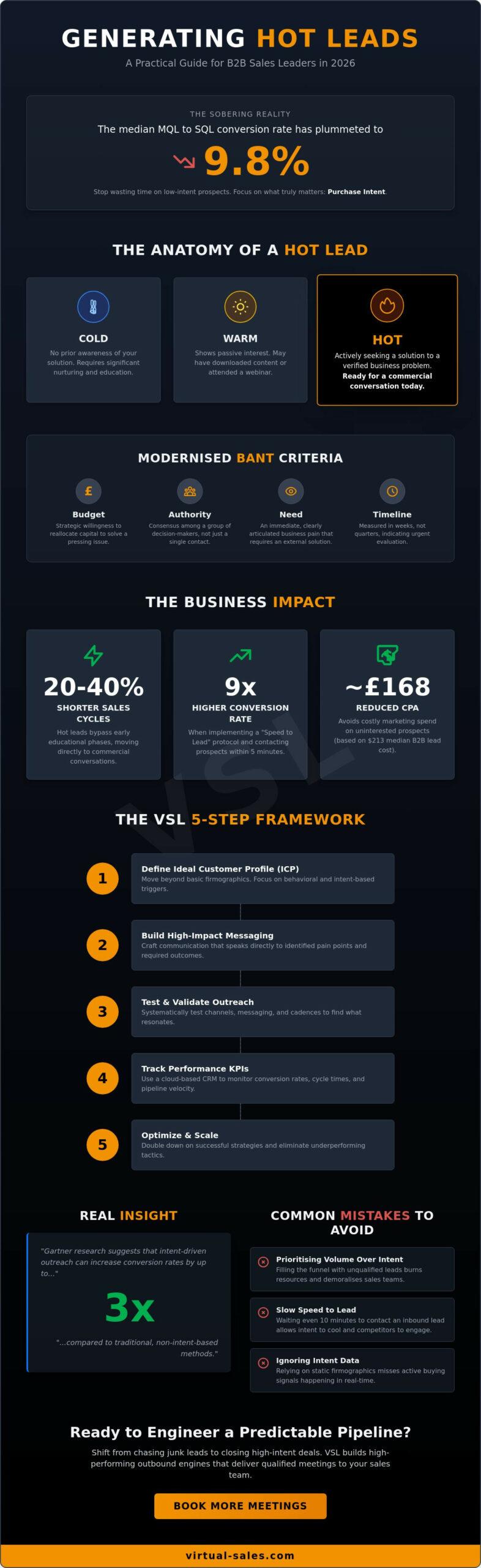
Did you know the median conversion rate from MQL to SQL has plummeted to just 9.8% in 2026? It’s a sobering figure that confirms what most sales leaders already feel. Your reps are likely wasting hours on low-intent prospects while your sales cycles continue to stretch. We agree that an inconsistent revenue forecast isn’t just a reporting issue; it’s a fundamental threat to your ability to scale. You need a predictable pipeline of hot leads that are ready to engage right now.
This guide will teach you how to identify, generate, and convert high-intent prospects into closed revenue using proven B2B frameworks. We’ll move beyond the noise of volume-based marketing to focus on clinical efficiency. You’ll learn how to shift from chasing junk to engineering a system that delivers higher conversion rates from lead to meeting. We’ll preview the tactical steps for building an elite outbound engine, including how to leverage intent data and professional qualification to increase the ROI on your marketing spend.
Key Takeaways
- Master the modern BANT criteria to distinguish high-intent prospects from mere enquiries.
- Accelerate your sales cycle by implementing a Speed to Lead protocol that engages hot leads within minutes of identified intent.
- Deploy the VSL 5-step framework to engineer a predictable pipeline using cloud-based CRM integration and intent data.
- Identify and eliminate common prospecting mistakes, such as prioritising lead volume over genuine purchase intent.
- Learn how to seamlessly integrate outsourced lead generation as a high-performing extension of your internal sales team.
What are Hot Leads? Defining High-Intent B2B Prospects in 2026
The definition of a lead has undergone a radical transformation. In 2026, volume is no longer the metric for success; intent is the only currency that matters. A hot lead represents a prospect who has moved past the research phase and is actively seeking a solution to a verified business problem. Unlike cold leads, who require significant education, or warm leads, who show passive interest, hot leads are ready for a commercial conversation today. They aren’t just interested in your category; they’re evaluating your specific value proposition.
Ambitious sales leaders must prioritise these high-intent prospects to maintain a healthy, predictable pipeline. The distinction between lead tiers is clear and actionable. Cold outreach targets those with no prior awareness. Warm leads might have interacted with a piece of content or attended a webinar. However, a hot lead demonstrates active buying signals, often involving multiple stakeholders within an organisation. Identifying these individuals requires a blend of sophisticated data analysis and human-led qualification to ensure no time is wasted on “tyre-kickers.”
The broader process of lead generation now relies on modernising the traditional BANT framework. Budget is no longer just about having allocated funds; it’s about the strategic willingness to reallocate capital to solve a pressing issue. Authority now often rests with a consensus of C-suite executives rather than a single person. Need must be immediate, and Timeline is usually measured in weeks, not quarters. If a prospect doesn’t meet these heightened criteria, they aren’t a hot lead.
The Anatomy of a Hot Lead
A hot lead carries specific markers that signal readiness. They don’t ask general questions; they ask about implementation timelines, API integrations, and specific pricing models. You’ll notice engagement from several decision-makers simultaneously. This multi-threaded interest suggests the organisation is reaching a consensus. Most importantly, they can articulate a clear, immediate business pain point that requires an external solution to fix. They aren’t just browsing; they’re evaluating your fit for their internal team.
Why Intent Trumps Traditional Demographics
Relying solely on firmographics like company size or industry is an outdated strategy that leads to wasted effort. Behavioral triggers provide far more accurate predictions of a closed deal. This is where lead generation for technology companies has evolved. By focusing on intent-based calling, sales teams can surface hidden opportunities before a formal RFP is even issued. Gartner research suggests that intent-driven outreach can increase conversion rates by up to 3x compared to traditional methods. Surfacing these triggers allows your team to act with clinical efficiency, ensuring your reps spend their time where the ROI is highest.
Why Hot Lead Generation Matters: Driving Measurable Business Outcomes
Efficiency drives revenue. In a market where the median B2B cost per lead has risen to $213 in 2026, failing to convert high-intent prospects is an expensive mistake. Ambitious sales leaders recognise that generating hot leads isn’t just about filling the top of the funnel; it’s about protecting the bottom line. By focusing on prospects with verified intent, you naturally reduce your cost per acquisition and create a more resilient, predictable revenue stream. This shift from volume to value is the foundation of sustainable growth.
Speed to Lead is no longer a competitive advantage; it’s a baseline requirement. Research confirms that contacting a B2B lead within five minutes of their inquiry increases the conversion rate by nine times compared to waiting just ten minutes. Every second of delay allows interest to cool and competitors to intervene. Implementing a rigorous 5-Step Lead Generation Framework ensures your team captures these windows of opportunity with clinical precision. This proactive approach transforms your sales operation from a reactive cost centre into a high-velocity engine.
Accelerating the Sales Cycle
Hot leads bypass the traditional educational phases that often stall momentum. Because these prospects have already identified their pain points and researched potential solutions, your reps can move directly to technical fit and commercial terms. This compression of the funnel often reduces sales cycles by 20% to 40%. It eliminates the “wait and see” periods that plague inconsistent pipelines. By using a cloud-based CRM that outputs directly to HubSpot or Salesforce, your team maintains total visibility over these fast-moving opportunities.
Maximising Sales Rep Productivity
Nothing kills morale faster than a week of “ghosting” and low-intent conversations. When you provide your internal team with appointments that have confirmed budgets and C-suite buy-in, you increase the value of every hour spent on the phone. This psychological boost is significant. High-performing reps stay engaged when they’re closing deals rather than chasing shadows. You can see the impact of this professional maturity by reviewing our verified UK appointment setting results, which highlight the ROI of human-led qualification. This integrated approach ensures your expensive internal resources are always focused on the highest-value activities, securing the future of your commercial operation.
The VSL Framework: A 5-Step Method for Generating Hot Leads
Engineering a predictable pipeline requires more than just reactive lead scoring; it demands a proactive, tactical engine. The VSL Framework is designed to generate hot leads through a combination of high-level strategy and granular operational execution. Before initiating outreach, we ensure the foundation is secure. Effective prospecting is impossible with decayed or inaccurate data, which is why we consider b2b data cleansing a non-negotiable prerequisite for any successful campaign.
Step 1 & 2: Defining the ICP and Building Targeted Messaging
We begin by identifying “sweet spot” accounts using real-time intent signals. This isn’t about broad industry categories. It’s about pinpointing businesses currently experiencing specific growth pains, regulatory shifts, or technological transitions. Our team then crafts punchy, active-voice scripts that speak directly to these triggers. Whether we’re positioning B2B appointment setting or complex IT SaaS solutions, the messaging must be immediate, relevant, and designed to move the prospect closer to a decision.
Step 3 & 4: Intent-Based Calling and CRM Integration
The core of our methodology is intent-based calling. We deploy professionally mature staff who engage in high-level commercial conversations to qualify intent manually. This human element ensures that every lead passed to your team has been vetted for genuine readiness, budget, and authority. We eliminate pipeline leakage through real-time data synchronisation. Our cloud-based CRM outputs directly to popular platforms like HubSpot and Salesforce, ensuring your internal team has the full context of every interaction without manual data entry.
Step 5: Track, Optimise, and Scale
Success is measured by the transition from meeting to revenue. We continuously monitor conversion rates and gather direct feedback from your Account Executives to ensure the quality remains elite. Our process includes:
- Monitoring meeting-to-opportunity conversion metrics to verify lead quality.
- Adjusting qualification criteria based on direct internal sales feedback.
- Testing new messaging angles against control scripts to refine results.
- Scaling campaign volume once the ROI is clearly documented and proven.
Once the hot leads formula is proven, we scale the campaign to drive the consistent, ambitious growth your business requires. This iterative approach ensures that your outreach remains clinical, efficient, and aligned with your evolving commercial objectives.

Common Mistakes and Real Insight: Lessons from the Sales Frontline
Success in lead generation is often defined by what you choose to ignore. Many sales leaders fall into the trap of measuring success by the sheer number of entries in their CRM. This approach is fundamentally flawed. When you prioritise volume over intent, you dilute your team’s focus and increase your cost per acquisition. Our experience at VSL shows that hot leads are rare, valuable, and require a surgical approach to uncover. Avoid these common tactical errors to protect your pipeline health:
- Prioritising volume over intent: Flooding the funnel with “interest” rather than “intent” creates a bottleneck of low-value conversations.
- Slow follow-up: Every minute of delay after a behavioral trigger reduces the likelihood of conversion.
- Poor data quality: Outreach based on outdated or unverified information is a waste of expensive professional resources.
- Reliance on “Pay per lead” models: These models incentivise vendors to pass through any contact details they find, often resulting in “junk” leads that frustrate your internal team.
Mistake: The Volume Trap
It’s a simple mathematical reality. Ten hot leads with confirmed budgets and C-suite authority are worth significantly more than one hundred lukewarm enquiries. The hidden cost of chasing unqualified prospects is the opportunity cost of not speaking to ready-to-buy customers. We encourage clients to set realistic expectations based on their specific subscription levels. High-standard output requires time and professional maturity; it isn’t a commodity that can be mass-produced without sacrificing the clinical efficiency your business requires.
Real Insight: Turning a Software Pipeline Around
Consider the case of a UK-based SaaS provider struggling with a pipeline of unresponsive prospects. Their internal team was spent chasing “lukewarm” whitepaper downloads that never converted into commercial discussions. By integrating VSL’s intent-based calling, we focused on high-level objection handling and professional qualification. The result was a 25% increase in meetings booked within the first quarter. More importantly, they transitioned from a stagnant pipeline to over £50,000 in new, qualified opportunities. This wasn’t achieved through more calls, but through higher quality interactions led by mature staff.
This level of performance is consistent with our verified UK appointment setting results, where we maintain a high standard of human-led expertise. By avoiding the common pitfalls of automated, low-cost alternatives, you ensure your sales engine remains clinical, results-oriented, and integrated with your growth strategy.
Integrating Hot Leads into Your 2026 Growth Strategy
Scaling a B2B operation in 2026 requires a seamless bridge between external prospecting and internal closing. High-performing businesses no longer view lead generation as a detached silo. Instead, they treat elite providers as a natural, integrated component of their own workforce. This partnership model ensures that hot leads move through the pipeline without friction, maintaining the momentum generated during the initial qualification phase. Success depends on clear communication and a shared commitment to measurable outcomes.
The Synergy of Outsourcing and Internal Sales
A successful hand-off between an outsourced SDR and an internal Account Executive (AE) is critical for maintaining prospect trust. We provide your AEs with comprehensive briefing notes, including confirmed pain points and stakeholder dynamics. By leveraging professional appointment setting services, you free up your most expensive closers to do what they do best: close deals. This division of labour creates a sustainable revenue engine where your internal team isn’t bogged down by the “educational” grind of early-stage prospecting.
Technology and Reporting
Data integrity is the backbone of this integration. VSL utilises a cloud-based CRM that functions as a “single source of truth” for every campaign. We ensure that high-intent data and call recordings are exported directly to HubSpot or Salesforce, providing your team with total transparency. This technical precision allows you to track ROI with clinical accuracy. You can monitor VSL subscription metrics in real-time, adjusting your strategy based on which segments deliver the highest-quality hot leads. There’s no guesswork; every decision is backed by hard data and proactive reporting.
Ultimately, the goal is clinical efficiency. We don’t just deliver meetings; we deliver qualified commercial opportunities that align with your long-term growth objectives. Our staff bring the professional maturity and geographic relevance required to handle complex B2B objections at a C-suite level. If you’re ready to stop wasting time on low-intent prospects and start engineering a predictable pipeline, contact VSL today to discuss how our integrated approach can transform your sales operation.
Secure Your 2026 Revenue Strategy
The shift toward intent-based prospecting is no longer optional for businesses looking to scale in 2026. You’ve seen how clinical efficiency and the VSL 5-step framework transform a stagnant pipeline into a high-velocity engine. By prioritising the professional maturity of your outreach staff and integrating human-led qualification with cloud-based CRM technology, you ensure your internal team only engages with prospects ready to buy. We focus on engineering hot leads so your closers can focus on revenue. This approach eliminates the volume trap and replaces it with a predictable flow of commercial opportunities.
As a top-rated partner on Clutch for B2B appointment setting, VSL brings deep expertise in the IT, SaaS, and software sectors. Our staff are proactive insiders who function as an integrated component of your workforce rather than a disconnected vendor. We invite you to book a consultation with VSL to start generating hot leads for your pipeline. It’s time to build a predictable, scalable commercial operation that respects your team’s time and delivers consistent growth. Your path to clinical sales efficiency starts with a single high-intent conversation.
Frequently Asked Questions
What is the difference between a hot lead and a warm lead in B2B?
The primary difference lies in the prospect’s intent and their specific timeline for purchase. A warm lead might show passive interest by downloading a whitepaper or attending a webinar, but a hot lead has a verified business pain point and the authority to solve it. Hot prospects are actively evaluating solutions and typically have a defined budget and a decision-making committee ready to engage in commercial discussions.
How much does it cost to generate hot leads in the UK?
Industry benchmarks for 2026 indicate a median B2B cost per lead of approximately £168, though this varies significantly by sector and target seniority. While some channels like SEO offer a lower initial cost, proactive outbound methods often deliver a higher ROI by surfacing prospects with larger contract values. Investment levels depend on the complexity of your solution and the professional maturity required to navigate your specific market.
Can telemarketing still generate hot leads for software and IT companies?
Telemarketing is exceptionally effective for IT and software sectors when it’s executed as intent-based calling. Unlike automated outreach, a professional conversation allows for nuanced objection handling and the identification of complex technical requirements. This human-led approach ensures that hot leads are qualified based on genuine implementation needs rather than just superficial engagement metrics.
How quickly should my team follow up on a hot lead?
You should aim to contact high-intent prospects within five minutes of their identified interest. Research shows that responding within this window increases conversion rates by nine times compared to waiting just ten minutes. Speed is the most critical factor in maintaining the momentum of a sales cycle. Delays allow the prospect’s attention to shift toward competitors who are more responsive to their immediate needs.
Should I use a pay-per-lead or a retainer-based agency for hot leads?
Retainer-based models are superior because they align the agency’s incentives with your long-term revenue goals. Pay-per-lead models often encourage vendors to prioritise volume over quality, which results in “junk” data and wasted time for your internal team. A subscription-based partner functions as an integrated component of your workforce, focusing on delivering hot leads that actually convert into closed revenue.
What role does lead scoring play in identifying hot prospects?
Lead scoring provides a foundational layer of data by categorising prospects based on their digital behavioral triggers. It helps your team prioritise which accounts to target, but it shouldn’t be the final word on qualification. You must combine automated scoring with human-led verification to confirm that the prospect’s “score” translates into a genuine commercial opportunity with a confirmed budget and timeline.
How do I know if a lead is truly “hot” before booking a meeting?
A lead is truly hot when they can articulate a specific business problem and demonstrate engagement from multiple C-suite stakeholders. They don’t ask general questions about your category; they ask about implementation, API integrations, and pricing models. If the prospect is willing to commit time for a technical deep dive and involves decision-makers early, they meet the criteria for a high-intent opportunity.
What are the best industries for proactive hot lead generation?
IT services, SaaS, Fintech, and complex business-to-business professional services are the most successful sectors for proactive generation. These industries typically have high contract values and complex buying cycles that require the professional maturity of an experienced sales team. Proactive outreach in these spaces allows you to bypass the “educational” phase of the funnel and engage prospects when their need is most acute.


Disclaimer
Disclaimer: Content is for general information only and does not constitute professional advice. Results may vary. Virtual Sales Limited accepts no liability for actions taken based on this content.