


Sales representatives spend, on average, only 28% of their working week actually selling. The remaining hours vanish into admin tasks, spreadsheet triage, and chasing cold prospects who were never going to buy in the first place. When raw intent data creates paralysis instead of clear commercial direction, understanding how AI can help sales teams prioritise high-value accounts becomes the difference between hitting target and burning your acquisition budget.
You already know that automated mass outreach is failing. Cold email templates yield dwindling reply rates, damage hard-won brand reputation, and drive customer acquisition costs upwards. Technology should eliminate friction, not create noise. You will discover how modern commercial operations combine real-time AI buying signals with experienced human sales expertise to identify, qualify, and convert top-tier accounts before competitors even spot the opportunity. We examine the exact framework needed to turn intent data into booked, revenue-generating conversations.
Key Takeaways
- Understand how dynamic intent signals differ from static contact lists to pinpoint accounts actively evaluating solutions in your market.
- Learn how AI can help sales teams prioritise high-value accounts by synthesising third-party research triggers with direct digital interactions.
- Discover why algorithmic scoring requires validation from consultative human callers to confirm authentic project need and decision-maker authority.
- Explore the structured five-step framework that connects predictive account selection directly to rigorous BANT qualification and CRM workflows.
- Review verified commercial benchmarks demonstrating how focused outbound engagement converts prioritised enterprise data into predictable revenue growth.
What Is AI-Driven Account Prioritisation in Modern B2B Sales?
AI account prioritisation is the data-led ranking of target businesses based on their statistical propensity to purchase. Rather than relying on gut feel or alphabetical cold calling, commercial teams deploy machine-learning models to rank prospects by immediate revenue potential. Understanding how AI can help sales teams prioritise high-value accounts requires looking beyond static contact lists. Traditional outreach treats every corporate record equally, resulting in squandered resource and high customer acquisition cost (CAC). Predictive prioritisation transforms sales pipelines by continuously reordering accounts according to measurable buying readiness.
Static database filters rely entirely on historical attributes such as industry sector, headcount, and head office location. These attributes explain who a company is, but never reveal what they intend to buy today. Dynamic account scoring continuously synthesises multi-channel signals across web traffic, content consumption, and digital triggers to spotlight live demand. That shift underpins modern account-based marketing, replacing scattergun outreach with focused commercial engagement. Prioritising accounts with verifiable commercial intent ensures your team spends time only on prospects capable of delivering healthy contract values.
The Mechanics of Predictive Account Scoring
Modern predictive algorithms calculate probabilities by comparing active accounts against historical closed-won enterprise deals. This advanced lead scoring methodology balances static firmographic profile fit against external intent signals and internal CRM engagement. External intelligence engines detect when prospects research specific product categories, whilst cloud-based CRM activity logs direct inbound actions. Continual data hygiene remains vital throughout this process. Inaccurate account data leads algorithms to assign inflated scores to invalid contacts, wasting valuable prospecting time.
Moving Beyond Static ICP Checklists
Traditional ideal customer profile criteria create broad directories rather than actionable daily call queues. An enterprise might match your technical criteria perfectly on paper yet have zero budget allocated for your solution this fiscal year. This operational disconnect explains why market and competitor research is key to sales teams looking to identify live commercial pressure points. Real-time triggers, such as leadership changes, tech-stack migrations, and regulatory requirements, show exactly when an organisation enters a viable purchasing window. Demonstrating how AI can help sales teams prioritise high-value accounts means using these real-time events to power a predictable revenue engine that targets buyers precisely when their commercial need peaks.
Key Buying Signals AI Uses to Identify High-Value Prospects
Modern machine-learning algorithms synthesise thousands of independent data points to construct accurate account scores. Understanding how AI can help sales teams prioritise high-value accounts requires unpacking the specific inputs that separate passive observers from motivated commercial buyers. These models track activities across the open web, monitoring when enterprise procurement teams consume industry analyses, research competitor feature matrices, or download technical documentation. By aggregating these discrete touchpoints, predictive tools assign dynamic urgency ratings directly inside your CRM workflows.
High-growth organisations rely on signal-based targeting rather than blunt geographic or industry lists. Research from industry analysts reveals that AI-driven sales teams achieve up to a 15% increase in commercial productivity by eliminating low-probability accounts before outbound cadences commence. These teams track four distinct tiers of buyer intent:
- First-Party Behavioural Data: Direct engagements with your digital presence, such as repeated product page visits, pricing calculator usage, and technical whitepaper downloads.
- Third-Party Intent Signals: Spikes in external search activity around specific corporate challenges, competitor comparisons, and category software queries across business publishers.
- Technographic Footprints: Software installations, infrastructure migrations, and contract expirations that uncover technical gaps in an organisation’s existing architecture.
- Organisational Milestones: Executive leadership changes, capital expansion rounds, and regulatory compliance pressures that disrupt established supplier relationships.
First-Party Behavioural vs Third-Party Intent Data
First-party signals capture active, conscious consideration from prospects already aware of your organisation. Third-party signals identify accounts conducting category research long before they land on your website. When an enterprise researches network security protocols on independent review portals, algorithmic platforms flag the surging consumption. Combining these external research patterns with internal CRM interaction provides the full commercial context required to engage senior stakeholders effectively.
Technographic and Organisational Change Triggers
Technographic shifts reveal immediate commercial software requirements. When a target enterprise deploys a new ERP or cloud infrastructure layer, they quickly encounter integration gaps that demand specialised third-party tools. Simultaneously, executive turnover creates urgent purchasing cycles. A newly appointed Chief Information Officer frequently audits existing vendor contracts within their initial ninety days to eliminate redundant overheads. If your internal reps lack the capacity to action these fleeting signals quickly, deploying proven clutch appointment setting uk partners ensures your business capitalises on high-propensity windows before competitors react.
Why Algorithmic Prioritisation Fails Without Human Sales Expertise
Data signals indicate topic interest, never commercial commitment. An algorithm can flag that an organisation is researching enterprise software, but it cannot confirm whether an approved budget exists or if a formal project has been signed off. Autonomous outreach platforms often misinterpret surface activity as immediate purchasing readiness. High-scoring records frequently collapse upon contact because no commercial initiative backs the digital activity. Software identifies the propensity to buy; experienced sales professionals determine the operational reality.
Consider a practical scenario. A tier-one UK financial services firm triggers multiple high-intent alerts after downloading several technical whitepapers and visiting implementation pages. An automated workflow immediately routes the account to a business development rep with instructions to push for a demo. The reality? A junior compliance analyst was gathering background material for an internal seminar, while the procurement team was operating under an active software freeze. Chasing the account consumed dozens of rep hours, resulted in irritated stakeholders, and produced zero commercial pipeline.
The False-Positive Trap in Intent Scoring
Intent algorithms cannot distinguish between academic research, vendor benchmarking, and genuine purchasing projects. Student dissertations, junior staff queries, and competitor market research frequently generate identical digital footprints to authentic enterprise procurement teams. Consultative telephone conversations resolve this ambiguity instantly. A skilled professional engages the prospect conversationally, discovering internal dynamics, operational pain points, and current commercial readiness before logging an opportunity.
Common Mistakes in Automated Account Prioritisation
When leadership teams examine how AI can help sales teams prioritise high-value accounts, they often assume automation should replace human touchpoints entirely. That assumption leads to costly operational missteps:
- Blasting accounts with generic automated email cadences: Sending robotic sequences to senior decision-makers burns hard-won commercial reputation and triggers permanent domain blocks.
- Failing to verify decision-maker authority: Reaching out to the wrong contact because an algorithm flagged their individual IP address wastes outbound momentum.
- Neglecting continuous database hygiene: Allowing unverified data to trigger automated campaigns results in high bounce rates and redundant calling efforts. Understanding why market and competitor research is key to sales teams prevents this misalignment by pairing intent scoring with human market validation.
- Skipping rigorous BANT qualification: Passing unvetted intent leads directly to account executives clogs calendars with meetings that lack budget, authority, need, or defined timelines.
A recent Gartner survey found that while 67% of B2B buyers prefer a rep-free research phase, 69% still want to validate AI-generated insights with a human sales representative before making a commitment. Strategic telemarketing bridges that trust gap, turning algorithmic signals into qualified, revenue-generating conversations.

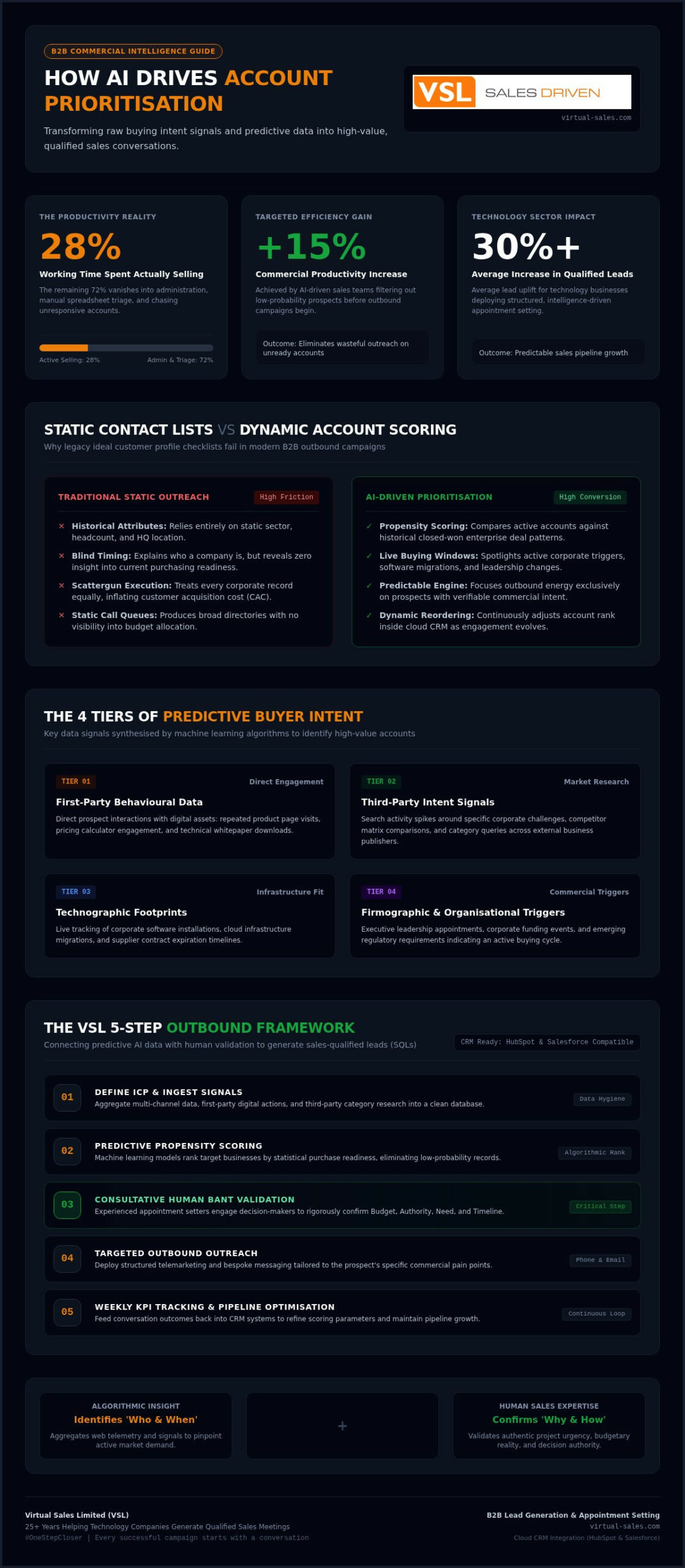
The VSL 5-Step Framework: Combining AI Intelligence With Consultative Outreach
Generating high-value meetings requires bridging computational signal detection with skilled commercial conversation. Knowing how AI can help sales teams prioritise high-value accounts provides the strategic direction, but execution determines the commercial return. The VSL 5-Step Framework connects automated intent discovery directly to dedicated, telephone-based business development. By creating a continuous feedback loop between software metrics and direct human qualification, commercial teams systematically target, engage, and convert in-market enterprise prospects.
The structured operational model follows five clear phases:
- 1. Define ICP Parameters: Establish rigorous firmographic, technographic, and regulatory qualification criteria based on proven revenue outcomes.
- 2. Aggregate Multi-Channel Signals: Ingest first-party web metrics and third-party research triggers to segment accounts into dynamic priority tiers.
- 3. Craft Contextual Value Messaging: Build sector-specific proposition angles that directly address the commercial pressures surfaced by the intent data.
- 4. Deploy Experienced Phone Specialists: Initiate conversational, consultative calls to uncover internal project scopes and confirm decision-maker involvement.
- 5. Optimise Through CRM Feedback: Transmit verified conversational data directly into client CRM environments, recalibrating target weightings weekly.
Calibrating Data Filters and Outreach Messaging
Precision begins by aligning inbound intent filters with historical commercial performance. Historical sales records highlight which corporate sizes, tech configurations, and regulatory challenges yield the highest lifetime value. Outreach copy is then engineered around the specific triggers flagged by the algorithms, avoiding generic pitches. Exploring how to deploy advanced lead scoring to build sales pipeline volume ensures messaging focuses strictly on solving acute operational bottlenecks rather than reciting broad corporate features.
Executing Consultative, Script-Free Sales Conversations
Senior decision-makers immediately reject rigid, robotic scripts. Effective outbound relies on mature, UK-based business development specialists who understand enterprise technology landscapes. Callers conduct exploratory peer-to-peer dialogues, asking probing questions that assess genuine pain points. Every engagement undergoes strict BANT qualification to ensure active project budgets, verified sign-off authority, tangible operational need, and definite implementation timescales are documented before diary slots are confirmed.
Managing Feedback Loops and CRM Integration
Conversational findings provide critical data that raw digital signals miss entirely. VSL captures full call intelligence within a cloud-based CRM, seamlessly exporting validated records into client platforms such as HubSpot or Salesforce. Dedicated Project Managers conduct weekly strategic reviews with client leadership, adjusting intent algorithms based on real-world objections and timeline updates heard directly on the phone. This closed-loop calibration ensures that how AI can help sales teams prioritise high-value accounts translates into an adaptive, self-improving commercial engine.
Partner with proven UK appointment setting specialists
Expected Outcomes: Converting Prioritised Accounts Into Predictable Revenue
Pairing algorithmic prioritisation with experienced telephone outreach delivers measurable pipeline acceleration. Gartner projections indicate that by the end of 2026, 75% of B2B sales organisations will use AI-guided selling to direct outbound activity. However, technology adoption alone does not close commercial deals. When commercial directors understand how AI can help sales teams prioritise high-value accounts alongside professional phone representation, conversion metrics shift from unpredictable spikes to repeatable monthly pipeline.
Targeted calling compresses the enterprise sales cycle significantly. Rather than spending months sending unread digital follow-ups, callers initiate direct dialogues with budget holders at the exact moment purchase triggers occur. Engaging buyers during active project definition shortens decision timelines, eliminates prolonged discovery phases, and lowers overall customer acquisition cost (CAC). VSL client campaigns across the UK technology and software sectors routinely deliver lead volume increases exceeding 30% compared to traditional, unprioritised outbound campaigns.
Measurable Conversion Metrics and Pipeline Impact
Verified client reviews on Clutch document that dedicated campaigns typically generate between 10 to 20 qualified decision-maker meetings each month, depending on programme scope and target market complexity. One verified campaign evaluation completed in 2026 recorded an average of three qualified meetings booked every week, whilst another generated 12 immediate enterprise appointments and 24 pipeline opportunities from targeted calling lists. Engaging our specialised B2B appointment setting services ensures that high-intent accounts are engaged via telephone to confirm real commercial viability before sales directors spend time on demonstrations.
Operational Scenarios: When to Deploy Outsourced Sales Teams
Deciding whether to build an internal outbound team or outsource sales services depends on commercial urgency and budget control. Building an internal business development function involves high recruiting fees, long ramp-up cycles, management overhead, and software subscription costs. Outsourced commercial deployment provides immediate capability in three clear scenarios:
- Launching New Technology Products: Entering competitive software markets requires immediate market penetration without waiting six months to hire and train junior callers.
- Intent Data Overload: When inbound intent streams generate hundreds of weekly signals that internal reps lack the operational bandwidth to telephone promptly.
- Controlling Customer Acquisition Costs: Bypassing the operational risks, recruitment fees, and lost productivity associated with internal SDR staff turnover.
Applying how AI can help sales teams prioritise high-value accounts through a structured outsourcing model gives businesses an elite, integrated extension of their commercial team. It transforms raw intent signals into booked BANT meetings, driving predictable sales pipeline growth without operational drag.
Transform Intent Signals Into Scalable Commercial Growth
Machine-learning models provide exceptional commercial focus by spotlighting accounts actively researching solutions in your space. Real revenue acceleration, however, requires pairing algorithmic scoring with consultative human dialogue. Understanding how AI can help sales teams prioritise high-value accounts allows your business to eliminate wasted outreach, focus senior commercial talent, and build an authentic competitive advantage.
Virtual Sales Limited brings over 25 years of specialist experience helping technology businesses build predictable sales pipelines. As a verified Clutch Champion and Global Honoree with 5-star reviews, our mature UK team acts as an integrated extension of your business, consistently achieving an average increase of over 30% in qualified sales leads.
Equip your commercial team with the intelligence, discipline, and consultative expertise required to turn prioritised enterprise accounts into predictable revenue today.
Frequently Asked Questions
How does AI determine which B2B accounts to prioritise first?
AI models evaluate thousands of data points across first-party site visits, third-party content consumption, and technographic changes. The system benchmarks these active signals against your historical closed-won enterprise customer profiles. Understanding how AI can help sales teams prioritise high-value accounts means using these algorithms to continuously re-rank corporate prospects, placing organisations displaying verified commercial urgency at the top of daily call queues.
Can sales teams rely on AI account prioritisation without human intervention?
No, full automation risks misallocating commercial resources. Algorithms detect digital topic research, but they cannot verify whether a prospect possesses sign-off authority or an approved project budget. Human sales professionals must conduct conversational qualification to validate internal requirements before committing executive time. Combining machine learning with consultative phone outreach ensures that only viable commercial opportunities progress through your sales pipeline.
What is the difference between predictive lead scoring and account prioritisation?
Lead scoring evaluates an individual contact’s discrete interactions, such as downloading a PDF or attending an online webinar. Account prioritisation analyses the collective behaviour of an entire corporate entity across multiple departments and decision-makers. This account-level view prevents sales reps from pursuing isolated junior staff members who lack commercial influence, focusing business development efforts on accounts showing comprehensive organisational demand.
How does account prioritisation impact our overall customer acquisition cost?
Prioritisation lowers customer acquisition cost (CAC) by eliminating wasted rep hours spent chasing cold or non-viable organisations. Concentrating commercial outreach on high-propensity accounts increases appointment booking rates and compresses deal cycles. Reps spend their selling time holding strategic conversations with qualified buyers, which maximises marketing return on investment and prevents budget depletion across broad, untargeted database campaigns.
Which intent data signals provide the most reliable indicators of buying readiness?
First-party interactions with technical implementation documentation and pricing calculators provide the strongest immediate signals. Third-party research spikes on independent software review sites also indicate active commercial evaluations. When combined with technographic triggers, such as contract expirations or new executive appointments, these signals pinpoint corporate buyers entering active purchasing windows before competitors notice their intent.
How quickly can an outsourced appointment setting team act on AI sales intelligence?
Specialised outsourced teams action high-priority intent triggers within hours of signal detection. Virtual Sales Limited pairs experienced IT callers with cloud-based CRM systems to initiate conversational telephone outreach while buyer interest remains acute. Swift human engagement ensures that how AI can help sales teams prioritise high-value accounts translates into immediate commercial meetings, preventing perishable intent signals from going cold.
Can AI prioritisation workflows integrate directly with existing platforms like Salesforce?
Yes, modern prioritisation systems sync seamlessly with enterprise platforms including Salesforce and HubSpot. Cloud-based architectures capture real-time intent scores and qualification notes, automatically routing prioritised accounts into active sales development workflows. This continuous data flow ensures internal commercial teams, external callers, and project managers share complete visibility over pipeline progression, account history, and meeting outcomes.


Disclaimer
Disclaimer: Content is for general information only and does not constitute professional advice. Results may vary. Virtual Sales Limited accepts no liability for actions taken based on this content.