


Automating generic outbound email cadences has broken the B2B inbox, leaving software firms to contend with record-low conversion rates and damaged domain reputations. Understanding how AI is changing the way SaaS companies build pipeline requires an immediate shift away from automated message blasts towards actionable commercial insight. You already recognise the daily operational friction: customer acquisition costs continue to climb whilst sales cycles become longer, and in-house sales development representatives waste precious hours on manual research and low-intent prospects rather than holding commercial conversations with genuine buyers.
Scaling software revenue in 2026 demands a far smarter, balanced approach. Rather than relying on detached bot sequences that alienate prospects, forward-thinking sales leaders use early behavioural signals to build a predictable revenue engine that identifies accounts actively demonstrating intent before competitors reach them. In this guide, you will discover how SaaS leaders combine intelligent software efficiency with high-impact human phone conversations, bridging the gap between algorithmic intent and closed-won revenue.
Key Takeaways
- Understand how AI is changing the way SaaS companies build pipeline by synthesising technographic triggers and genuine buying signals to target active accounts.
- Discover how algorithmic account prioritisation eliminates administrative drag and frees sales development teams to focus on revenue-generating activity.
- Avoid the reputational pitfalls of fully automated outbound cadences that trigger buyer fatigue and damage enterprise domain deliverability.
- Examine the structured 5-step framework that connects cloud CRM intelligence directly with unscripted, human telephone outreach.
- Review verified benchmark conversion metrics to accurately forecast sales-qualified leads and closed revenue for your commercial operation.
What AI Pipeline Generation Means for B2B SaaS in 2026
Modern AI pipeline generation isn’t about spamming prospective buyers with generative email copies. Instead, it represents continuous algorithmic data synthesis that directs targeted commercial outreach. Machine learning models parse millions of company data points, technographic stacks, and digital intent indicators in real time. Rather than relying on traditional spray-and-pray tactics that burn market goodwill, commercial teams now identify active buying cycles before initiating contact. This evolution demonstrates exactly how AI is changing the way SaaS companies build pipeline by replacing speculative guesswork with concrete behavioural triggers.
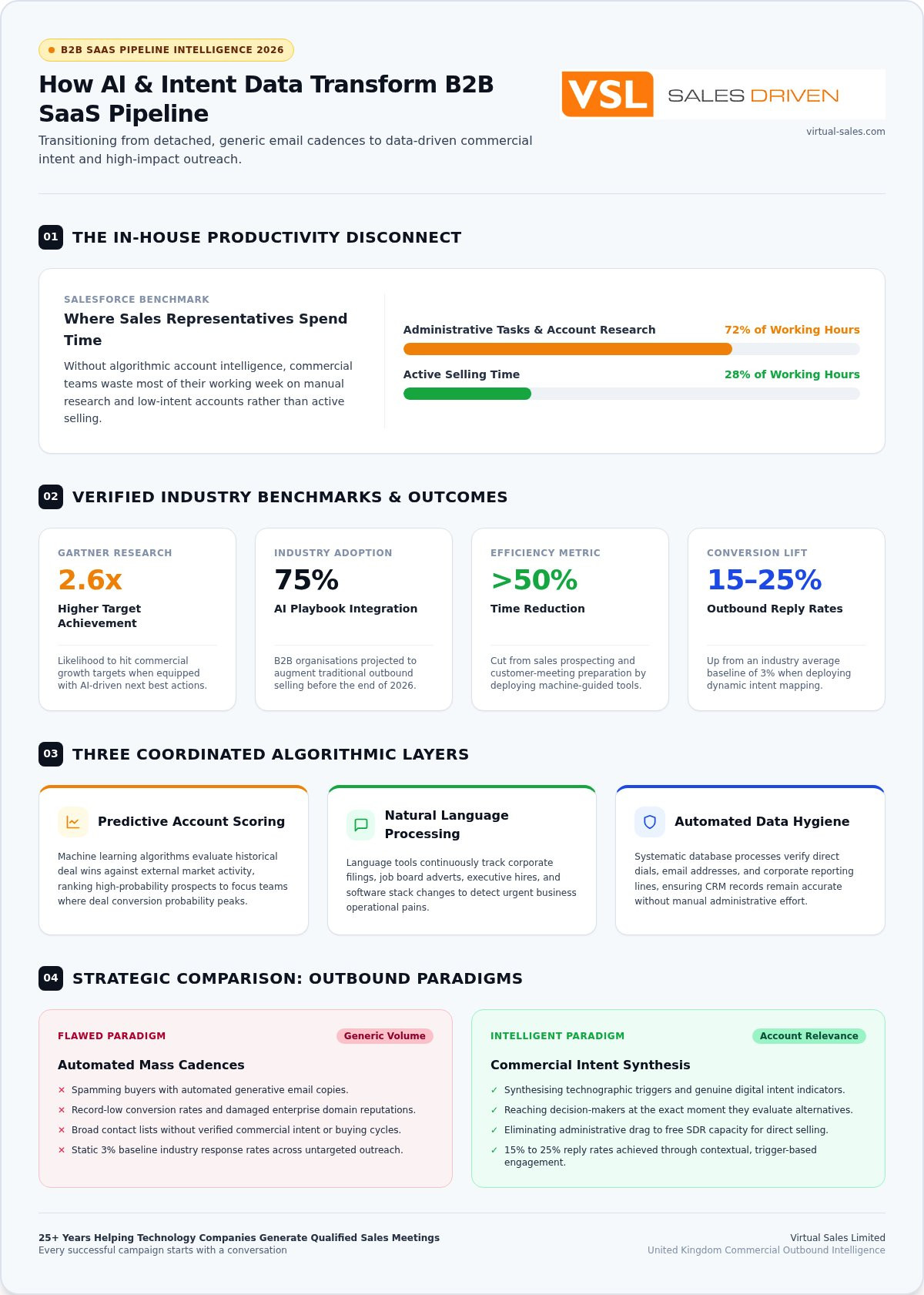
Research from Gartner reveals that sales organisations equipping representatives with AI-driven next best actions are 2.6 times more likely to hit commercial growth targets. Furthermore, 75% of B2B organisations are projected to augment traditional outbound playbooks with AI-guided selling before the end of 2026. Understanding how AI is changing the way SaaS companies build pipeline enables software leaders to eliminate wasted activity and focus resources strictly on receptive accounts.
The Shift from Outbound Volume to Account Relevance
Stricter email security protocols and aggressive spam filters have diminished mass cold email deliverability. Enterprise buyers immediately spot robotic, template-driven electronic messaging and discard it. Precision account selection yields significantly higher engagement than broad lists. Integrating intent triggers with automated lead scoring and qualification ensures outbound activity reaches decision-makers at the exact moment they begin evaluating software alternatives.
Core Components of the Modern AI Sales Stack
Modern commercial architectures rely on three coordinated algorithmic layers:
- Predictive Account Scoring: Machine learning algorithms evaluate historical deal wins against external market activity, ranking high-probability prospects. Deploying verified predictive lead scoring focuses commercial teams where deal conversion probability peaks.
- Natural Language Processing: Language tools continuously track corporate filings, job board adverts, executive hires, and software stack changes to detect urgent business operational pains.
- Automated Data Hygiene: Systematic database processes verify direct dials, email addresses, and corporate reporting lines, ensuring CRM records remain accurate without manual administrative effort.
Why Intelligent Prospecting Drives Measurable SaaS Growth
Revenue leaders face mounting pressure to deliver sales pipeline growth without inflating commercial headcount. Unchecked expenditure on unfocused sales outreach rapidly burns capital. According to Salesforce industry benchmark reports, sales representatives spend merely 28% of their working hours actively selling, with the remaining 72% consumed by administrative tasks and account research. Deploying intelligent algorithms directly reverses this dynamic by identifying high-intent organisations before outreach begins. This efficiency demonstrates how AI is changing the way SaaS companies build pipeline into a measurable, scalable science.
Lowering Customer Acquisition Cost Through Better Targeting
Targeting accounts showing active buying signals dramatically reduces customer acquisition cost (CAC). Chasing unresponsive organisations wastes SDR capacity and inflates top-of-funnel expenditure. Industry findings from a Gartner benchmark on AI sales prospecting indicate that sales organisations deploying machine-guided tools will cut prospecting and customer-meeting preparation time by over 50% by 2026. This targeted velocity shortens sales cycles, lowering the overall cost per appointment while delivering reliable commercial forecasting.
Increasing Conversion Rates from Lead to Opportunity
Contextual, timely outreach transforms conversion metrics across the entire sales cycle. Understanding how AI is changing the way SaaS companies build pipeline allows commercial teams to replace static contact lists with trigger-based engagement:
- Dynamic Intent Mapping: Monitoring intent indicators such as digital tool evaluations, executive hires, and funding rounds lifts initial outbound reply rates from an industry average of 3% up to 15% to 25%. Reviewing tactical AI sales signals ensures your team contacts accounts exactly when internal operational pains surface.
- Technographic Alignment: Pinpointing specific software deployments and gaps inside target accounts equips representatives to articulate immediate, tailored business outcomes on early discovery calls.
- Predictive Opportunity Scoring: McKinsey research confirms that predictive models improve lead-to-opportunity conversion rates by up to 30% compared to traditional static rules, ensuring your account executives only evaluate genuine commercial prospects.
When software providers pair intelligent intent data with mature, unscripted telephone qualification, commercial results follow quickly. Technology firms aiming to accelerate pipeline growth can review our proven client performance via verified Clutch appointment setting UK case studies to see real-world conversion benchmarks in action.
Common Pitfalls: Where Pure AI Automation Fails SaaS Pipeline
Relying entirely on autonomous bots to engage prospects introduces severe operational exposure. While machine models excel at pattern recognition, deploying autonomous generative bots to draft and send outbound messages degrades enterprise brand equity. The personalisation paradox is acute: synthetic messages that attempt superficial familiarity by referencing a prospect’s university or recent social post sound disingenuous to senior executives. Recent research from Gartner highlights this growing trust gap, with 51% of enterprise buyers reporting misleading or inaccurate vendor data generated by AI tools. Truly grasping how AI is changing the way SaaS companies build pipeline means recognising where software automation stops and human competence begins.
The Limits of Synthetic Outreach to Senior Decision-Makers
Enterprise IT directors, chief information security officers, and finance leaders receive dozens of synthetic outreach notes daily. When algorithms attempt to discuss board-level risks, they lack commercial empathy and fail to grasp nuanced commercial realities. According to Gartner, 69% of B2B buyers require sales representatives to validate machine-generated insights before committing to high-stakes decisions. Synthetic messaging sequences inevitably miss the mark because machine tools cannot navigate political friction or confirm BANT parameters within a boardroom.
Scenario: How Over-Automation Burned a High-Value TAM
Consider a mid-market enterprise SaaS provider targeting an addressable market of 500 tier-one accounts. Eager to accelerate lead flow, the commercial team connected an automated outbound bot directly to their primary domain. Over three weeks, the system blasted multi-touch cadences across the entire contact database. The outcome proved disastrous:
- Domain Reputation Destruction: Aggressive bounce rates and prospect spam complaints caused major email providers to blacklist the company’s core domain.
- Executive Account Attrition: Inaccurate algorithmic claims prompted dozens of C-suite executives to issue permanent opt-outs, removing prime target accounts from future outreach.
- Pipeline Evaporation: In-house account executives spent weeks answering prospect complaints rather than holding qualified commercial discovery meetings.
Our analysis on fixing pipeline bottlenecks highlights how unchecked automation burns addressable accounts, locking commercial teams out of viable revenue opportunities. Software platforms should direct consultative phone conversations, not replace them. This distinction lies at the core of how AI is changing the way SaaS companies build pipeline safely.

The VSL Hybrid Framework: Merging Machine Intelligence with Human Calls
Generating enterprise pipeline requires combining algorithmic speed with human discernment. At Virtual Sales Limited (VSL), our methodology bridges this divide by turning raw account triggers into qualified discovery meetings. This disciplined execution exemplifies how AI is changing the way SaaS companies build pipeline without sacrificing brand standards or conversion quality. By anchoring technology within a structured commercial process, sales organisations build a predictable revenue engine that scales predictably.
The VSL 5-step framework integrates software efficiency directly with mature human outreach:
- 1. Signal Ingestion: Ingesting firmographic, intent, and technographic data into our cloud-based CRM, which outputs seamlessly to client systems including HubSpot and Salesforce.
- 2. Data Verification: Cleansing contact records to ensure full GDPR compliance and phone number validity before initiation.
- 3. Direct Human Outreach: Deploying mature UK-based sales callers from professional technology backgrounds to initiate unscripted phone conversations.
- 4. Rigorous Qualification: Applying strict BANT criteria to confirm whether target accounts possess genuine commercial intent.
- 5. Iterative Feedback: Reviewing calling data and market responses weekly to refine messaging angles and prospect targeting criteria.
Rigorous Lead Qualification via the BANT Framework
Algorithmic models excel at identifying potential interest, but they cannot assess Budget, Authority, Need, and Timeline (BANT) parameters. Software intent cannot verify whether a prospect controls procurement budgets or possesses a signed-off implementation window for 2026. Seasoned callers engage senior decision-makers in commercial discussions, validating project timescales and pain points directly. Filtering out ambiguous interest ensures internal account executives spend their working hours exclusively on sales-qualified leads.
Unscripted Conversations That Uncover Latent Pain
Rigid telephone scripts fail when dealing with senior executives. Meaningful commercial dialogue requires adaptability, conversational agility, and strategic business awareness. Experienced callers navigate corporate gatekeepers naturally, establishing immediate peer-to-peer credibility. Instead of delivering a rehearsed product pitch, they explore the operational friction uncovered by intent triggers. For an in-depth breakdown of these conversational tactics, explore the definitive guide to B2B appointment setting to refine your outreach strategy.
Bridging data-driven signals with experienced human qualification represents the practical reality of how AI is changing the way SaaS companies build pipeline sustainably.
Expected Outcomes, Benchmark Data, and Deployment Options
Quantifying the return on outbound investment requires realistic benchmark data rather than speculative marketing promises. When commercial operations align algorithmic trigger data with experienced telemarketing caller engagement, conversion figures improve rapidly. Industry performance benchmarks indicate that signal-led calling models achieve qualified meeting rates substantially higher than traditional email blitzes, showing how AI is changing the way SaaS companies build pipeline into a predictable commercial operation.
SaaS Pipeline Benchmarks and Real Performance Metrics
Verified delivery across mature campaigns consistently yields concrete commercial gains. For mid-market and enterprise technology offerings, a disciplined hybrid engagement delivers between 10 and 20 sales-qualified meetings per month, depending on total target account volume and contract complexity. Across verified Clutch reviews, technology clients working alongside VSL routinely secure 3 qualified meetings per week, achieving sustained pipeline increases exceeding 30%.
Transparent CRM connectivity protects every stage of the process. Call notes, objection patterns, and BANT qualification details flow directly from our cloud-based infrastructure into client systems such as HubSpot or Salesforce, ensuring commercial teams maintain complete operational oversight over every active account.
When to Partner with an Outsourced Sales Team
Deciding between recruiting an in-house sales development team and partnering with an external specialist requires examining long-term operational risk. Recruiting internal SDRs involves significant overheads, long ramp periods, ongoing management distraction, and severe productivity losses if staff leave after six months. In contrast, deciding to outsource sales services delivers immediate access to experienced UK-based appointment setters backed by data infrastructure from day one.
- Early-Stage Scale-ups: Emerging software companies needing rapid market validation benefit from outsourced calling to test product-market fit without incurring permanent internal headcount liabilities.
- Established Enterprise SaaS: Mature vendors targeting high-value enterprise accounts use dedicated calling teams to unlock specific vertical markets or target frozen enterprise tiers.
- Resource-Constrained SDR Teams: Growth firms struggling with SDR churn use outsourced partners to maintain predictable top-of-funnel discovery volume while internal reps focus on pipeline execution.
Adopting structured monthly subscription arrangements removes capital exposure while scaling sales-qualified leads predictably. For organisations aiming to integrate algorithmic intent tracking with seasoned calling, deploying our AI-powered lead generation services provides an immediate path to sustainable revenue growth. This hybrid execution remains the benchmark for how AI is changing the way SaaS companies build pipeline effectively.
Scale Your SaaS Revenue with Hybrid Outbound Precision
Achieving sustainable revenue growth requires moving beyond disconnected bots and low-converting email sequences. Understanding how AI is changing the way SaaS companies build pipeline comes down to balance: deploying software signals to uncover target accounts, then trusting unscripted human conversations to qualify complex enterprise deals. This synergy shields your domain reputation, lowers acquisition costs, and fills your commercial calendar with verified buying interest.
Virtual Sales Limited acts as a seamless extension of your internal team. Backed by over 25 years generating qualified enterprise tech appointments, our mature UK-based callers navigate complex organisations without rigid scripts, supported by dedicated Project Managers and transparent cloud CRM reporting. Recognized as a Clutch Global Champion and the UK’s most-reviewed lead generation partner, we turn raw market signals into dependable revenue.
Equip your sales organisation with genuine discovery conversations and transform your commercial pipeline into a predictable growth engine today.
Frequently Asked Questions
How is AI changing sales pipeline generation for SaaS companies in 2026?
AI transforms pipeline generation by replacing static databases with real-time intent triggers and technographic tracking. Examining how AI is changing the way SaaS companies build pipeline reveals that machine models now detect early buying interest from executive hires, tech stack updates, and corporate expansion. This intelligence directs sales teams towards active buyers, cutting administrative research time and allowing commercial teams to focus on high-conversion accounts.
Can AI completely replace human sales development representatives in B2B software?
No, AI cannot replace experienced sales development professionals in complex B2B software environments. While algorithms effectively synthesise market data, senior enterprise decision-makers require consultative commercial conversations before committing expenditure. Gartner benchmark data reveals that 69% of enterprise buyers require human validation of machine-generated insights. Experienced callers provide the business empathy, conversational agility, and strategic qualification needed to turn raw algorithmic interest into confirmed sales meetings.
What is the difference between automated email sequences and signal-led outbound calling?
Automated email sequences rely on static prospect lists and templated cadences that often trigger spam filters and damage corporate domain deliverability. In contrast, signal-led outbound calling uses behavioural data triggers, such as leadership changes or tool evaluations, to guide direct telephone conversations. Experienced UK callers conduct unscripted discussions addressing specific operational challenges, achieving engagement rates up to five times higher than generic digital messaging sequences.
How does intent data help SaaS businesses target the right enterprise accounts?
Intent data tracks digital consumption patterns, software review evaluations, and technical recruitment trends to identify organisations actively seeking solutions. Instead of contacting cold organisations at random, sales teams use these behavioural indicators to engage buyers during active evaluation windows. Reaching accounts showing verified commercial signals significantly lowers customer acquisition costs, accelerates pipeline velocity, and prevents commercial representatives from chasing unresponsive prospects.
Why is BANT qualification necessary when using AI lead generation tools?
Algorithmic tools identify digital interest, but they cannot assess Budget, Authority, Need, and Timeline directly. A prospect researching technology online might lack budgetary approval or formal purchasing authority. Experienced telephone qualification verifies whether an organisation has genuine commercial intent, signed-off funding, and an active project schedule. This rigorous vetting prevents wasted discovery calls, ensuring internal account executives focus exclusively on sales-qualified leads.
How do high-growth SaaS firms integrate AI intelligence into their existing CRM systems?
High-growth software companies connect intent feeds and contact data directly into cloud-based CRMs such as HubSpot and Salesforce. This architecture ensures predictive scores, trigger signals, and caller outcome notes sync across commercial teams in real time. Adopting this integrated approach demonstrates how AI is changing the way SaaS companies build pipeline, giving revenue leaders complete operational visibility while maintaining meticulous data hygiene across the pipeline.
What are the primary risks of using fully automated AI prospecting tools?
Relying on fully automated prospecting tools risks severe domain blacklisting, reputational damage, and high unsubscribe rates across target enterprise accounts. Autonomous bots frequently produce awkward phrasing and inaccurate claims that alienate senior buyers. Without human oversight, automated cadences burn valuable addressable market accounts, closing doors on decision-makers who expect professional, consultative engagement rather than repetitive, machine-generated outreach.


Disclaimer
Disclaimer: Content is for general information only and does not constitute professional advice. Results may vary. Virtual Sales Limited accepts no liability for actions taken based on this content.