



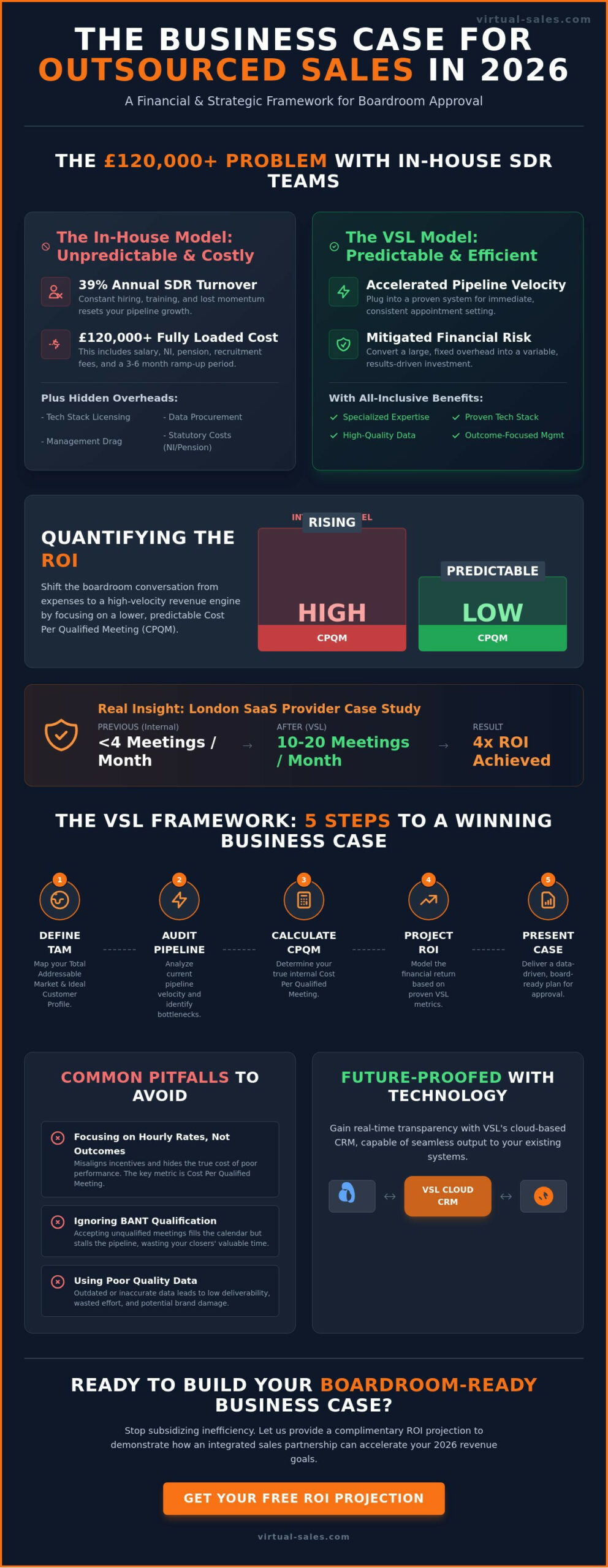
With average SDR turnover rates hitting 39% and the fully loaded cost of a single in-house hire often exceeding £120,000, mastering how to build a business case for outsourced sales is now a strategic necessity. You’ve likely seen the friction firsthand; internal teams struggle with inconsistent lead quality while rising UK recruitment costs drain your budget before a single meeting is even booked. It’s a cycle that stalls momentum and frustrates the board.
This guide changes that dynamic. You’ll learn the exact financial framework and ROI projections needed to justify an external partnership to your CFO. We’ll outline a risk mitigation strategy that shifts the conversation from simple cost-cutting to technology acceleration. You’re about to gain a boardroom-ready plan to integrate professional B2B appointment setting into your 2026 growth strategy, ensuring your pipeline remains full without the overhead of a bloated internal department.
Key Takeaways
- Quantify the financial impact by comparing the £120,000+ cost of internal hires against the efficiency of an integrated agency model.
- Discover how to build a business case for outsourced sales that prioritizes cost-per-meeting over hourly rates to ensure boardroom buy-in.
- Master the 5-step VSL Framework to define your TAM and audit pipeline velocity for maximum revenue acceleration in 2026.
- Learn to identify and avoid common strategic pitfalls, such as ignoring “Bant” qualification or relying on poor quality data.
- Explore how real-time CRM transparency and seamless integration with HubSpot or Salesforce can future-proof your sales infrastructure.
Identifying the High Cost of Internal Sales Inefficiency in 2026
A business case is not merely a budget request; it is a strategic roadmap that justifies shifting from internal generalist teams to specialized external expertise. When you evaluate how to build a business case for outsourced sales, you must start by auditing the objective reality of your current burn rate. In 2026, the gap between the cost of maintaining an in-house team and the actual revenue they generate has widened significantly. This document serves as the bridge, proving to your board that the “Cost of Inaction” is far higher than the investment in a professional partnership.
The 2026 Sales Recruitment Friction
Hiring experienced sales professionals in the UK has become a primary bottleneck for scaling businesses. The talent pool is shallow, and salary expectations for even junior SDRs have surged. You are likely facing a “revolving door” scenario; industry data shows that annual SDR turnover now sits between 25% and 39%. Every time a rep leaves, your momentum resets.
The financial risk of a bad hire is catastrophic in a high-stakes B2B environment. Beyond the recruitment fee, you must account for a 3 to 6 month ramp-up period. During this time, you are paying a full salary for partial productivity. If that rep leaves within a year, you have effectively subsidized their training for a competitor while your own revenue targets slip. Revenue doesn’t wait for your internal team to find its feet.
Hidden Overheads of Internal Sales Development
The true cost of an internal team extends far beyond the base salary. To build an accurate comparison, your business case must include these often-overlooked figures:
- Statutory Costs: Employer National Insurance contributions and pension auto-enrolment add a minimum of 13% to 15% to your payroll burden.
- Technology Stack: CRM seats, sequencing tools, and intent data platforms can cost thousands of pounds per user annually.
- Data Procurement: Sourcing compliant, high-quality B2B databases is an ongoing expense that requires constant cleaning and verification.
- Management Drag: Every hour a Sales Director spends coaching a junior SDR is an hour not spent on high-level closing or strategy.
Successful firms are increasingly treating b2b appointment setting as a specialized, technical function rather than a generalist entry-level role. By outsourcing, you eliminate the training lag and the management overhead. You shift the focus from managing people to managing outcomes. This transition allows your internal closers to do exactly what they were hired for: finalizing deals and driving 2026 revenue growth.
Quantifying the ROI: Metrics and Real Insights from B2B Campaigns
Stop viewing outreach as a line-item expense. When you analyze how to build a business case for outsourced sales, the most compelling data point is the predictable acceleration of qualified pipeline. Decision-makers don’t buy into “potential”; they buy into proven conversion ranges and the mitigation of financial waste. By shifting from a fixed-cost internal model to a variable, results-driven partnership, you transform a cost center into a high-velocity revenue engine.
Real Insight: A London-based SaaS provider recently faced the collapse of their internal prospecting team. They were burning cash on two junior SDRs who produced fewer than four meetings per month combined. After transitioning to an integrated model, they stabilized their output to a range of 10–20 qualified meetings per month. This shift didn’t just increase volume. It reduced the management burden on their Sales Director, allowing them to focus entirely on closing deals worth £50,000 or more. Within seven months, the program reached a positive ROI, eventually delivering a 4x return on the initial investment.
Clutch-Verified Metrics for Sales Success
To secure board approval, your business case must distinguish between “raw leads” and “qualified appointments.” Raw leads are often just contact data; qualified appointments represent a genuine opportunity with a decision-maker who has a confirmed need. Verified campaign data for sales team outsourcing shows that professional campaigns typically yield a 2 to 6 times ROI. You can calculate your internal efficiency by using the Cost Per Qualified Meeting (CPQM) formula: divide your total monthly campaign investment by the number of meetings that actually enter your pipeline. If your internal CPQM is rising while your conversion rate stays flat, your current model is failing. Review our verified B2B outcomes to see how these metrics scale across different industries.
The Value of Professional Maturity
The “Pay-for-Performance” model is a common industry myth that often results in low-quality, high-volume noise. In contrast, professional telemarketing relies on the maturity of veteran sales staff who understand the nuances of the B2B buying cycle. In 2026, “Intent-Based Calling” has become the standard for high-conversion outreach. This approach targets prospects who are already showing signals of a buying cycle, rather than cold-calling a static list. Professional maturity ensures that every interaction protects your brand reputation while moving the prospect closer to a decision. Experienced representatives produce up to three times the results of junior internal hires because they possess the emotional intelligence to navigate complex gatekeepers and technical objections.
The VSL Framework: 5 Steps to Building a Winning Business Case
Moving from the conceptual “why” to the operational “how” requires a structured methodology that withstands boardroom scrutiny. When you evaluate how to build a business case for outsourced sales, you must present a plan that balances immediate pipeline needs with long-term strategic alignment. The VSL Framework provides a repeatable 5-step process designed to quantify the value of an integrated partnership while removing the typical friction points of sales expansion.
- Step 1: Define Your ICP and TAM. Clearly articulate your Ideal Customer Profile and identify the Total Addressable Market. Precision here ensures that every outreach hour is spent on high-value accounts rather than generic prospecting.
- Step 2: Audit Current Pipeline Velocity. Identify exactly where leads are dropping off in your current funnel. If your top-of-funnel is stagnant, this audit proves that a specialized outreach function is the missing link.
- Step 3: Comparative Financial Analysis. Create a side-by-side ££ comparison. Contrast the fully loaded cost of in-house SDRs, including recruitment and tech, against a scalable subscription model.
- Step 4: Technology and Data Strategy. Outline how the outsourced partner will integrate with your existing infrastructure. This step addresses data security, compliance, and real-time transparency.
- Step 5: Scalability Roadmap. Define how the partnership will scale. Your business case should show how you can double your lead volume without doubling your internal headcount or management overhead.
Aligning ICP and Messaging
A common boardroom concern is whether an external partner can master complex, technical product messaging. You address this by highlighting the importance of initial Database Development. By building a bespoke, verified dataset of targets, you ensure the outreach is grounded in accuracy from day one. We recommend using a structured pilot programme to validate the business case. This allows you to test messaging and prove conversion rates before committing to a full-scale rollout, effectively de-risking the entire transition.
Financial Comparison: The Hard Numbers
Your business case must account for the “Opportunity Cost” of your senior leadership. When a Sales Director spends 20% of their week managing junior SDRs or troubleshooting data issues, they aren’t closing high-value deals. Outsourcing reclaims this time. You save significantly on recruitment fees, which often run at 15% to 20% of a base salary, and eliminate the ££ burden of expensive tech stack licensing for internal staff. Professional b2b appointment setting scales more efficiently than internal hiring because it replaces fixed payroll liabilities with a flexible, results-oriented investment.

Avoiding Strategic Pitfalls: Common Mistakes in Sales Outsourcing
Even a data-backed proposal can fail if it ignores the operational friction points that derail external partnerships. When you evaluate how to build a business case for outsourced sales, you must account for the strategic pitfalls that separate elite agencies from high-volume shops. Avoiding these mistakes ensures your board sees outsourcing as a surgical growth tool rather than a desperate cost-cutting measure. A flawed execution model will quickly erode the ROI projections you’ve worked hard to establish.
- Focusing on Retainers over Cost-Per-Meeting: Prioritising a low monthly retainer is a common error. If a low-cost provider delivers poor-quality leads, your cost-per-close actually increases as your Account Executives waste time on dead-end calls.
- Ignoring Data Quality: Volume is a vanity metric. If a prospect doesn’t meet strict “Bant” (Budget, Authority, Need, Timeline) criteria, they are a drain on your internal resources. High-quality outreach requires adherence to these qualifiers to maintain pipeline integrity.
- Fragmented Hand-off Processes: Failing to define a seamless transition between the agency and your internal team creates a “black hole” where leads die. Your business case should specify a unified workflow that treats the external team as an elite extension of your own department.
- The Pay-Per-Lead Mirage: These models often incentivise quantity over quality. This leads to high-volume noise that damages your brand reputation and frustrates your sales closers.
The Trap of Low-Cost Outsourcing
International call centres frequently struggle to book meetings with high-level UK decision-makers due to a lack of geographic relevance and professional maturity. In the B2B world, the person making the call represents your brand. A mature, UK-based professional understands the local commercial landscape and can navigate complex technical objections that a script-reading agent cannot. You can address the “Loss of Control” objection in your business case by insisting on a partner that offers real-time transparency and high-standard output. Maturity reduces brand risk and ensures that every interaction adds value to the prospect’s journey.
Data Silos and Communication Breakdowns
A disconnected sales pipeline is a liability. You need an integrated view of every touchpoint to avoid communication breakdowns. We ensure our team acts as a natural, integrated part of your workforce by maintaining a consistent brand voice across all communications. This integration prevents data silos and ensures your CRM remains the single source of truth. By aligning external outreach with internal strategy, you create a cohesive front that accelerates the buying cycle. If you want to see how an integrated model drives results, explore our professional B2B lead generation services.
Future-Proofing with Technology: Seamless CRM Integration
Technology is the final pillar in understanding how to build a business case for outsourced sales. In 2026, a static spreadsheet is no longer sufficient for boardroom reporting. You need a tech stack that offers real-time transparency and high-velocity data flow. VSL utilises a sophisticated cloud-based CRM designed to act as an elite, integrated component of your own infrastructure. This setup ensures that every interaction is logged, every meeting is tracked, and every pound spent is accounted for through granular reporting.
The technical process is designed for clinical efficiency. Our system outputs qualified leads directly to popular platforms like HubSpot and Salesforce, eliminating the administrative friction that typically slows down internal teams. By automating this transfer, your Account Executives can focus on closing deals rather than manual data entry. This integration also guarantees “Clean Data” within your internal systems. We filter out the noise, ensuring your CRM remains a high-value asset populated only by “Bant” qualified opportunities rather than a graveyard of junk leads.
Innovation in 2026 focuses on signal-led growth. We leverage AI orchestration and real-time intent data to identify high-propensity buyers who are already active in a buying cycle. This proactive approach ensures your outreach isn’t just loud; it’s relevant. By integrating these advanced tools into your business case, you demonstrate a commitment to technology acceleration that manual internal hiring simply cannot match.
Closing the Loop: From Lead to Revenue
Automated data transfers do more than just save time; they create a closed-loop system for continuous optimization. Real-time feedback loops between our team and your internal closers allow for rapid messaging adjustments based on actual market responses. You can use CRM analytics to track the journey from the initial appointment to the final ££ invoice. This level of transparency allows you to continuously refine your business case after launch, proving the ongoing ROI to stakeholders through hard, indisputable data.
Next Steps: Finalising the Board Proposal
To secure final approval, your presentation must be concise and results-oriented. Focus your board proposal on these five essential slides:
- The Efficiency Gap: Contrast current internal costs with the scalable VSL model.
- The ROI Projection: Detail the expected 2x to 6x return based on average deal sizes.
- Risk Mitigation: Highlight the use of professional, UK-based staff and secure CRM integration.
- Technology Acceleration: Show how AI and intent data will shorten your sales cycle.
- The Scalability Roadmap: Outline the 90-day ramp-up and long-term growth phases.
Phrase your internal Call to Action around momentum. Don’t ask for permission to “try” a service; ask for the mandate to accelerate 2026 revenue through a proven, integrated partnership. Ready to build your case? Contact Virtual Sales Limited for a bespoke ROI projection and start your transition to a high-performance sales model.
Accelerate Your 2026 Revenue Strategy
Mastering how to build a business case for outsourced sales is the first step toward reclaiming your leadership’s time and eliminating the “revolving door” of junior recruitment. You now have the tactical framework required to quantify the transition from a fixed-cost internal model to a high-velocity, integrated partnership. By focusing on qualified meeting volume rather than raw lead counts, you ensure your Account Executives spend their hours closing high-value deals instead of prospecting into the void.
VSL brings over 20 years of B2B expertise to your operation, acting as a natural, elite extension of your internal team. Our cloud-based CRM ensures total transparency, outputting data directly to HubSpot or Salesforce to maintain your single source of truth. With an average delivery of 10–20 qualified meetings per month, we provide the consistent pipeline required to meet ambitious growth targets. It’s time to stop managing overhead and start driving outcomes.
Download our latest Case Studies to see the ££ impact of outsourced sales. Your 2026 growth is within reach; take the first step toward a more efficient, data-driven sales future today.
Frequently Asked Questions
What is the difference between a business case and a business plan for outsourcing?
A business case is a justification document focused on the strategic ROI and financial “why,” while a business plan is an operational roadmap. When you are learning how to build a business case for outsourced sales, your priority is proving the value of the investment to the board. The business plan only comes into play once the budget is approved and you need to detail the tactical execution of the campaign.
How much does it typically cost to outsource B2B appointment setting in the UK?
UK outsourcing costs vary based on the complexity of your sector and the depth of the required research. Most professional agencies operate on a monthly retainer model that covers staff maturity, data procurement, and technology overheads. You should evaluate the total investment against the fully loaded cost of an internal SDR, which often exceeds £120,000 per year when including NI contributions, benefits, and recruitment fees.
How do I address the CFO’s concerns about the “loss of control” with an agency?
Address control concerns by emphasizing real-time transparency and CRM integration. Professional partners act as an integrated component of your workforce rather than an isolated vendor. By providing direct access to call recordings and pipeline analytics, you maintain full visibility over the brand voice and lead quality. This level of oversight often exceeds what is possible with a remote or siloed internal team.
What are the most important KPIs to include in a sales outsourcing business case?
Focus on metrics that prove revenue impact, such as Cost Per Qualified Meeting (CPQM) and Pipeline Velocity. Your business case should also track the conversion rate from appointment to closed deal to ensure the quality of the outreach. These KPIs allow the board to see a direct line between the outsourcing investment and the final ££ outcome on the company balance sheet.
Can an outsourced sales team integrate with our existing Salesforce or HubSpot setup?
Yes, seamless integration with platforms like HubSpot and Salesforce is a standard technical requirement for modern B2B lead generation. VSL uses a cloud-based CRM that outputs qualified data directly into your existing system. This automation removes administrative friction and ensures your internal Account Executives can act on new opportunities immediately without the need for manual data entry.
How long does it take to see a positive ROI from outsourced lead generation?
Most businesses begin to see a positive ROI within 3 to 7 months of launching a campaign. It’s important to account for a 90-day ramp-up period where messaging is refined and the database is built. Once this foundation is established, a professional program typically delivers a 2x to 6x return on investment as the pipeline matures and deals begin to close.
What should I do if my internal sales team feels threatened by outsourcing?
Reframe the partnership as a support function that empowers your internal team rather than replacing them. Outsourcing handles the high-volume, repetitive task of prospecting, which is often the primary cause of SDR burnout. This allows your senior closers to focus entirely on high-value strategy and deal finalisation, which usually leads to higher commission earnings and better overall job satisfaction.


Disclaimer
Disclaimer: Content is for general information only and does not constitute professional advice. Results may vary. Virtual Sales Limited accepts no liability for actions taken based on this content.