


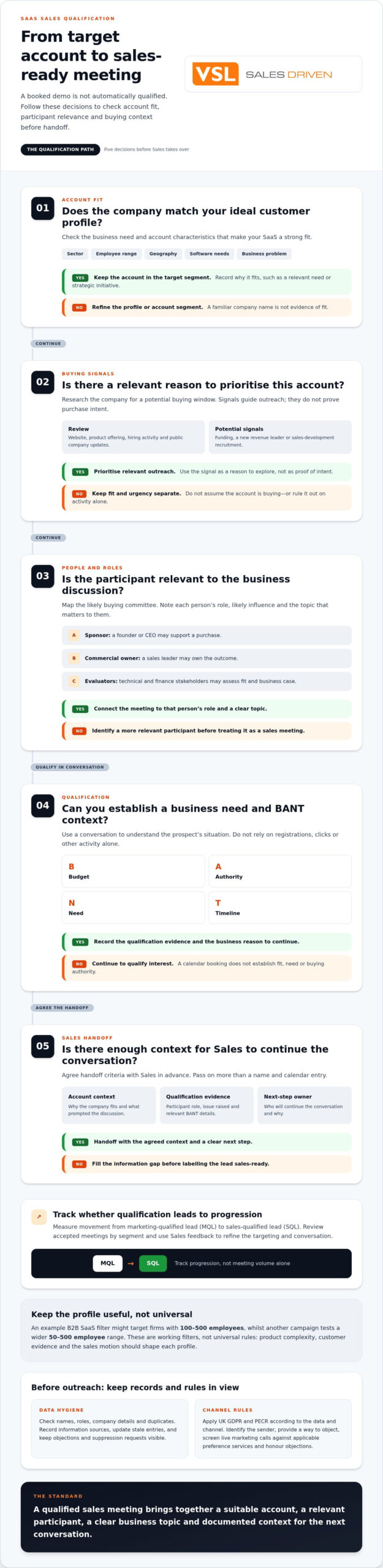
A booked demo is not automatically a qualified sales meeting. To generate qualified sales meetings for SaaS companies, target accounts that fit your ideal customer profile, engage a relevant participant and establish a clear business reason for the conversation. Qualification criteria should be agreed with Sales before outreach begins, so marketing, SDRs and account executives assess meetings consistently.
A busy calendar will not build a healthy pipeline if prospects lack the right fit, buying intent or influence. In SaaS, decisions often involve several stakeholders, so qualification should consider both the account and the people involved.
Key Takeaways
- Define your ideal customer profile around the account characteristics and business problems your SaaS product serves best.
- Research relevant roles and buying-group involvement rather than treating one contact as the whole opportunity.
- Use buying signals to prioritise outreach, but confirm relevance and need through conversation.
- Measure progression from lead to sales acceptance and opportunity, not activity alone.
- Agree meeting and handoff criteria in advance, then pass Sales the evidence and context needed for the next step.
Ideal customer profile and buying-signal list building
Build prospect lists around a clear ideal customer profile, then prioritise accounts showing relevant buying signals. Record company fit, contact roles and engagement separately.
-
Define ideal customer profiles
Set account criteria first: sector, company size, geography, software needs and the business problem your product solves. Treat size bands as working filters, not universal rules, and keep buyer personas distinct from the company profile. Refine the criteria using records of won, lost and retained customers.
-
Research target accounts and buying committees
Review each account’s website, product, hiring activity and public updates for signs of a current priority. Funding, a new revenue leader or sales recruitment can suggest a buying window, but none proves intent on its own. Map the likely committee: a sponsor, a commercial owner, a technical evaluator and a finance reviewer. Technology company lead generation depends on matching research to the target market.
-
Build accurate lists within outreach rules
Check names, roles and duplicates before outreach, record the source of each entry and keep suppression requests visible. Update stale data regularly.Apply UK GDPR and PECR according to the data and channel. UK GDPR requires a lawful basis, transparency and respect for individual rights. PECR treats corporate subscribers differently from individuals and sole traders. Identify the sender, provide a way to object, and screen live marketing calls against applicable preference services.
Account fit and participant relevance
Turn account research into meeting criteria before inviting prospects to speak with Sales. A useful meeting needs a suitable business, a relevant participant and an agreed commercial topic.
- Judge each account on evidence of fit, not name recognition. Check that it has the problem your software addresses, a plausible reason to change and a role that can contribute to evaluation. Record the evidence rather than relying on assumptions.
- Coordinate marketing engagement and sales outreach around shared accounts, messaging and next steps. If an account responds but has no relevant project, refine the segment or conversation instead of treating the response as a qualified opportunity.
- Give prospects a reason to engage before asking for a meeting. A webinar or other useful resource focused on a defined challenge, such as forecasting or manual reporting, can open a relevant conversation. Registration indicates interest in the subject; follow-up should explore what the participant did, needs and said.
- Assess the participant as well as the account. A suitable contact may be a user, commercial owner, technical evaluator or executive sponsor. Record their role in the decision and identify other relevant stakeholders where possible. Several participants from one company should remain connected to the same account record.
Lead qualification and MQL-to-SQL measurement
Measure whether each channel produces sales-ready leads, not just form fills. A marketing-qualified lead (MQL) meets marketing’s fit and engagement criteria; a sales-qualified lead (SQL) is suitable for direct sales engagement.
- Set qualification rules before Sales accepts an MQL. We use BANT qualification to assess Budget, Authority, Need and Timescale recording what remains unknown.
- Require useful CRM fields before changing a lead’s stage: name, role, company, original source, latest touch, fit evidence, stated need and qualification status. Mark unknowns clearly rather than guessing, and keep the account, contact and activity history connected.
- Assess SEO, social media and lead magnets by the quality of leads they produce, not clicks or downloads. Compare channels using consistent definitions for MQL, sales review, SQL, accepted opportunity and closed outcome. Targets should reflect your own sales cycle, account mix and historical progression.
- Track the time and volume moving through each stage, including rejected or returned leads. Weight meaningful actions, such as requesting a technical discussion or describing a current business problem, above passive page views. Connect accepted opportunities to pipeline and revenue so the team can see which sources create commercial value.

Capturing engagement and buying-intent signals
A single click rarely proves that a SaaS account is ready to buy. Combine account activity, stakeholder involvement and business triggers to decide when outreach should progress.
- Track meaningful actions such as webinar attendance, replies, repeat visits to product pages and requests for technical details. Separate observed behaviour from inferred intent. Our guide to using intent data to prioritise outreach covers this in more depth.
- Watch for trigger events such as funding, a new revenue leader, sales hiring or a competitor switch. Use them to shape a relevant conversation, not to assume a purchase is approved. For example, if a firm is hiring account executives, ask whether its current software supports the planned sales process.
- Combine signals at account level. One interested contact may not represent the whole decision, while activity from several relevant people can help reveal a shared business issue. Keep one account record and preserve each person’s engagement history.
- Use engagement strength to choose the next action. A high-intent question merits timely human follow-up, passive engagement can enter nurture and a clear objection may pause outreach. The purpose of signals is to improve relevance and timing, not to replace a qualification conversation.
Defining qualified leads and sales handoff criteria
A qualifying SaaS sales meeting is an agreed conversation with a relevant participant at an account that fits your target criteria. Before booking, establish the business problem, the participant’s role and what the prospect wants to discuss. Budget and timing can remain open at an initial meeting, but unknowns should be recorded for Sales to explore.
-
Set observable acceptance criteria
Agree criteria that Sales can apply consistently: a relevant business problem, an appropriate role, a company that meets the account rules and a clear purpose for the next conversation. Separate hard exclusions, such as an unsupported market or an explicit refusal, from lower-priority gaps such as an unclear timeline. Record the reason for each decision.
-
Make the handoff complete
Define the handoff before outreach begins. Pass on the account and contact record, campaign source, topic of interest, fit evidence, stated need, relevant stakeholders, objections and next-step owner. The account executive should be able to understand why the meeting was arranged without repeating basic discovery.
-
Measure meeting quality
Keep bookings, cancellations, meetings held, accepted handoffs and opportunities created as distinct stages. Calculate acceptance rate as accepted handoffs divided by reviewed handoffs, then use rejection reasons to improve targeting, messaging or qualification. Count an opportunity once, even if several buying-group contacts attend.
Book a 15 minute Discovery Call
Virtual Sales Limited: B2B Appointment Setting
Virtual Sales Limited is a UK-based B2B appointment-setting specialist. We help SaaS teams hold qualified conversations with relevant business decision-makers through B2B Appointment Setting and B2B Lead Generation.
When your account criteria and handoff standards are clear but you need extra capacity, our experienced UK-based callers hold consultative business conversations rather than following scripts. We apply the agreed qualification framework, including BANT where appropriate, and capture the evidence Sales needs. Each campaign has a dedicated caller and campaign manager, with weekly reporting.
Put your meeting standard into practice
Choose one segment, document what makes a meeting worth accepting and apply the same criteria in campaign planning, CRM records and review meetings. Start with a focused campaign, compare the quality of conversations by account segment and source, and change one variable at a time. Use Sales feedback to improve the profile, message and qualification questions rather than simply increasing activity.
Frequently Asked Questions
How do you generate qualified meetings for a SaaS company?
Start with a specific audience and business problem, then invite suitable prospects to discuss it. For example, a firm selling workflow software could approach operations leaders facing manual approval bottlenecks. Review outcomes with Sales, then adjust the audience or message if prospects repeatedly lack the same requirement.
How might a SaaS sales team use leads, people, companies and opportunities?
Use leads for unreviewed prospects, people for individual contacts, companies for account-level context and opportunities for active sales pursuits. Several people from one company may evaluate your product, but they belong to one account. Create an opportunity only when Sales recognises a potential deal.
Which metrics should you track?
Track target-account engagement, positive responses, meetings booked, meetings held, sales acceptance and opportunities created. Compare results by campaign source and account segment. Review cancellations separately from no-shows, and pair activity measures with pipeline outcomes.
Must a qualified meeting have confirmed budget?
No, a prospect does not always need an approved budget before an initial meeting. The qualification conversation should establish what is known, who controls spending and whether funding needs further approval. Record an unconfirmed budget as unknown. If your criteria require budget clarity before booking, keep the prospect in development until it is available.
Which channels work best for SaaS outbound?
The right channel depends on the audience, offer and contact’s role. Email can introduce a business issue, LinkedIn can provide professional context and phone conversations can clarify priorities directly. For UK electronic marketing, account for PECR and UK GDPR, and respect requests to stop contact.
25+ Years Helping Technology Companies Generate Qualified Sales Meetings
Every successful campaign starts with a conversation.
#OneStepCloser 🚀


Disclaimer
Disclaimer: Content is for general information only and does not constitute professional advice. Results may vary. Virtual Sales Limited accepts no liability for actions taken based on this content.