


A buying signal is a reason to investigate, not proof that an account is ready to buy. For UK technology, SaaS and IT services teams, that distinction can decide whether intent data sharpens B2B telemarketing or directs callers towards weak-fit prospects. Knowing how to use intent data for telemarketing means weighing account fit, signal context and timing before a call, then using the conversation to check what the data cannot confirm.
Marketing teams may have more signals than sales can act on, while callers may receive a company name without enough context to make outreach relevant. Don’t call every account showing activity. Prioritise the strongest combinations, brief callers on the signal without treating it as fact, and use informed questions to explore the prospect’s actual needs.
This guide explains how to rank accounts, turn intent context into consultative opening points, avoid common data-led outreach mistakes and assess whether calls produce qualified BANT leads and useful market feedback. The aim is practical: better-prioritised calls and more relevant conversations, with qualification grounded in what decision-makers tell you.
Key Takeaways
- Start with your ideal customer profile and relevant decision-makers, then assess intent signals against account fit and context.
- Use how to use intent data for telemarketing as a practical process: check signals, prioritise accounts and prepare relevant conversation points.
- Treat research activity as a prompt for discovery, not proof of budget, authority, need or buying readiness.
- Use consultative conversations to test what a signal may mean and qualify genuine opportunities against BANT criteria.
- Review account fit, meaningful conversations, qualified leads, appointments and campaign outcomes to refine future call priorities.
What intent data means for B2B telemarketing
Intent data is information that suggests an organisation is researching a subject related to your offer. It can help a sales team decide which accounts to review, when a call may be timely and what context could make the conversation more relevant. It doesn’t confirm that a particular person has a need, buying authority or readiness to meet.
For example, research activity around cloud security could prompt a software provider to review an account that fits its ideal customer profile. The signal gives the caller a reason to explore the topic, not an assumption to present as fact. This is the core of how to use intent data for telemarketing: treat activity as a cue for considered outreach, then use a conversation to understand the prospect’s situation.
Intent marketing offers a starting point for understanding how digital activity can indicate interest. In B2B calling, the practical value comes from interpreting activity at account level and combining it with target fit and human judgement. Learn more about consultative B2B telemarketing.
First-party and third-party intent data
First-party signals come from a company’s own channels. Where lawfully available, these might include visits to product pages, engagement with relevant content or interactions at an event. Third-party signals relate to research activity observed outside those channels, such as interest in a topic across other websites or platforms.
Sources, coverage and interpretation vary. A signal may relate to an organisation without identifying the person who researched the topic, and account matching can be incomplete. Check what the signal describes before using it to shape call timing or preparation.
Intent data versus lead qualification
Intent is a prioritisation input, not a qualification result. BANT is a framework for assessing Budget, Authority, Need and Timeline. A signal score cannot establish any of these. A qualified BANT lead requires a conversation-based assessment of the prospect’s circumstances and potential fit.
Use the signal to prepare a relevant opening question, then listen. A caller might ask how the organisation currently manages a challenge related to the research topic, rather than claiming to know what it needs. The prospect’s answer gives the sales team a sounder basis for deciding what should happen next.
How to turn intent signals into a focused telemarketing call list
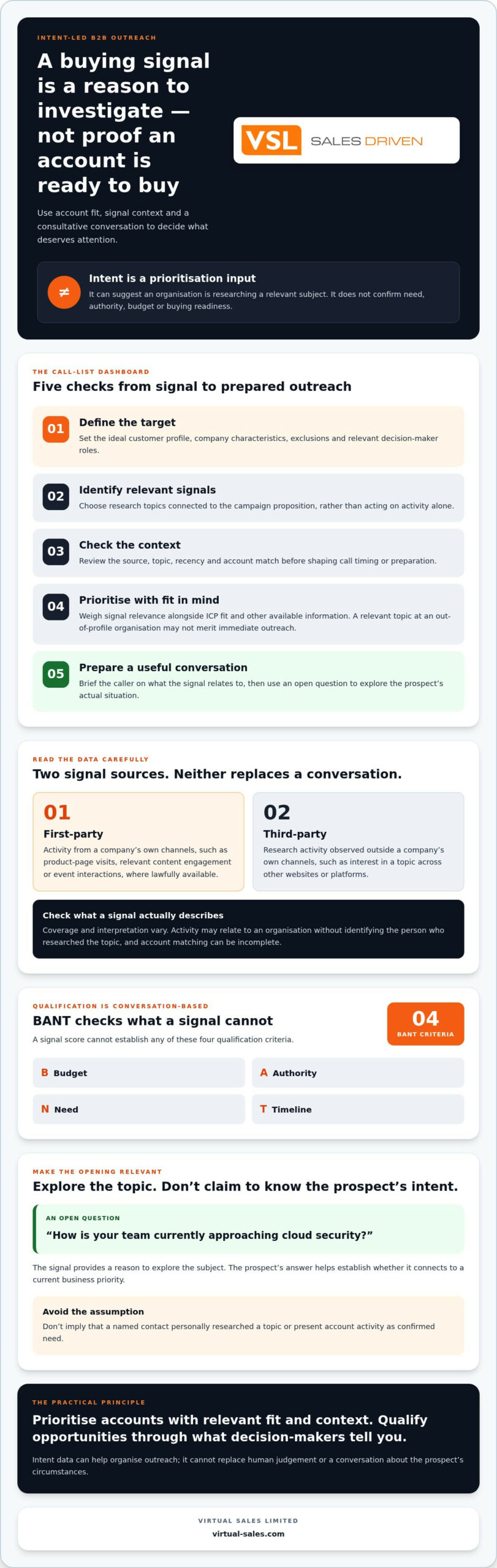
A useful call list starts with the market you can serve, not with whichever accounts show the most activity. Define your ideal customer profile (ICP) and relevant decision-maker roles first. For a SaaS provider, this could mean identifying the types of organisations that suit its offer and the technology or commercial leaders likely to be involved in the problem it addresses.
Then work through the signal data in sequence:
- Define the target: Set out company characteristics, exclusions and relevant roles.
- Identify signals: Select research topics connected to the campaign proposition.
- Check context: Review the source, topic, recency and account match.
- Prioritise accounts: Weigh signal relevance alongside ICP fit and other available information.
- Prepare outreach: Give the caller a clear account summary and a useful question to explore.
This sequence turns signal data into call priorities without treating activity as proof of demand. VSL’s guidance on prioritising B2B sales activity explains why account relevance matters alongside data.
Match signals to your ideal customer profile
Separate a strong account match from a signal that is only loosely related to your offer. A relevant topic at an organisation outside your target market may not merit immediate outreach. Activity that aligns with both the account profile and campaign proposition may warrant closer attention, while still needing to be explored through a conversation.
Check how closely the signal’s topic relates to the proposition, when the activity occurred and whether it is associated with the account you plan to contact. Use priority labels your sales and marketing teams can explain, rather than a scoring formula with unclear assumptions. Keep account records current and review data hygiene as part of campaign preparation.
Choose a useful priority and prepare the call
Labels such as “review first” or “standard follow-up” can help organise the call list when they reflect account fit, signal relevance and available context. Brief callers on what the signal relates to and why the account fits. Don’t imply that a named contact personally researched a topic or assume what prompted the activity.
Prepare an opening question that invites discussion. For example, “How is your team currently approaching cloud security?” gives the prospect room to describe their situation without suggesting you know what they have been researching. The caller can then explore whether the topic connects to a current business priority.
For more on consultative appointment setting, see client feedback on appointment-setting services.
Why intent data does not prove a prospect is ready to buy
A research signal can indicate that an account is exploring a relevant subject. It can’t tell you whether the organisation has a current requirement, who can approve a purchase, whether budget is available or when a decision might happen. In BANT terms, it doesn’t confirm Budget, Authority, Need or Timeline.
Intent data helps prioritise outreach, but it does not qualify a lead. Its value is in helping a team decide where to focus attention. A conversation establishes whether the topic connects to a real business priority and whether there is a suitable next step. This distinction also underpins B2B sales prioritisation.
Interpret account-level signals with care. Shared devices can blur who showed interest; broad research may relate to general learning rather than a live project; and incomplete account matching may associate activity with the wrong organisation. Even a relevant topic may have a different explanation from the one a sales team assumes.
Common mistakes when using intent data for calls
Don’t treat every increase in topic activity as an immediate sales opportunity. First check whether the account fits your ideal customer profile, whether the likely contact has a relevant role and whether the signal relates to your proposition. Without these checks, a timely-looking signal can still point to a poor-fit account.
Signal volume alone is a weak measure of campaign value. Track whether outreach leads to meaningful conversations, qualified BANT leads, appropriate appointments and useful feedback. These outcomes show whether signals are helping the team engage relevant businesses, rather than simply adding names to a call list.
Use consultative questions to test relevance
Open with a business question, not a claim about what someone has researched. For example, a caller discussing a related technology challenge could ask, “How is your team currently approaching this area?” The prospect can then describe their priorities in their own terms.
Listen for current requirements and timing, and explore who is involved in the decision. Keep the conversation natural and consultative. Record what the prospect confirms separately from the initial signal, so sales colleagues can distinguish expressed need from inferred interest.
VSL’s consultative appointment-setting approach uses conversation to assess business relevance and qualifies leads to BANT criteria as a minimum. See client feedback on appointment setting for further context.

A practical VSL framework for intent-led telemarketing
Knowing how to use intent data for telemarketing takes more than passing a list of active accounts to callers. The signal needs to connect to a clear target, a relevant campaign proposition and a conversation that tests what the account may actually need. VSL’s five-step approach is define, interpret, prioritise, discuss and review.
- Define: Set the ideal customer profile, relevant decision-maker roles and campaign proposition before reviewing signals.
- Interpret: Check what the signal relates to, its source and how it fits the account.
- Prioritise: Decide which accounts merit attention using fit and available context, not signal activity alone.
- Discuss: Give the caller relevant context, then explore the prospect’s situation through a consultative conversation.
- Review: Use reported activity, outcomes and prospect feedback to inform campaign recommendations.
This sequence gives intent data a defined role: it helps focus outreach, while the conversation establishes commercial relevance. It connects account selection with VSL’s B2B telemarketing services and practical thinking on relevance in B2B outreach.
From signal review to a qualified conversation
Each VSL campaign has a dedicated caller and campaign manager. They coordinate campaign preparation and share useful account context, so callers understand the proposition and why an account has been prioritised. Experienced UK-based callers then engage business decision-makers through consultative, script-free conversations.
The signal informs preparation; it doesn’t dictate what the caller should assume. Through discussion, callers assess BANT: Budget, Authority, Need and Timeline. Leads are qualified to BANT criteria as a minimum, based on what the prospect confirms rather than a score assigned to research activity.
Use campaign feedback to refine priorities
Weekly reporting gives the team a basis for reviewing campaign activity and outcomes. Look for patterns in account fit, conversations and prospect feedback. If a topic attracts interest but doesn’t connect to the campaign proposition, the team can reconsider its priority or adjust how the offer is explained. These are informed campaign recommendations, not automatic optimisation or a promise of results.
VSL uses a cloud-based CRM to manage campaign activity and can output campaign data for use with popular CRM platforms such as HubSpot and Salesforce. This makes campaign outcomes available for review alongside sales activity.
Discuss your appointment-setting requirements →
How to assess results and decide when intent-led calling fits
Assess intent-led calling by whether it helps your team engage suitable accounts and create qualified sales opportunities. Track account fit, meaningful conversations, qualified BANT leads, appointments and campaign outcomes. This gives you a clearer view of whether the signals are helping callers focus their effort, without treating activity as evidence of revenue impact.
Evidence and reporting without unsupported claims
Virtual Sales Limited’s weekly campaign reporting covers activity and outcomes, giving the team a regular basis for review and recommendations. Consider a practical scenario: a software company targets organisations that fit its ideal customer profile and flags accounts showing research activity related to a campaign topic. The caller receives the topic and relevant account context, then explores the organisation’s priorities through a consultative conversation. The campaign team can review confirmed needs, questions and outcomes in its reporting without assuming that the signal predicted readiness or claiming an unmeasured result.
Keep verified Virtual Sales Limited results distinct from third-party research and illustrative scenarios. Don’t state conversion rates, appointment volumes or client outcomes unless supported by approved evidence. Attribute any published case study clearly when using it as a relevant, verifiable example.
When to bring intent data into a campaign
Intent data may help when your target accounts, decision-maker roles and proposition are already clear, and your team needs a considered way to prioritise outreach. It can support market entry, testing a defined segment or building qualified pipeline. It can’t compensate for an unclear ideal customer profile, and it shouldn’t be treated as a guarantee that an account is ready to buy.
Virtual Sales Limited can work as an extension of your sales and marketing team, with experienced UK-based callers, dedicated campaign management and consultative, script-free conversations. To explore how this approach could fit your B2B telemarketing activity, visit Virtual Sales Limited’s telemarketing services.
25+ Years Helping Technology Companies Generate Qualified Sales Meetings
Every successful campaign starts with a conversation. Learn more about our specialised approach to UK technology appointment setting.
Turn buying signals into better sales conversations
Intent data can help your team decide which accounts to prioritise, but research activity doesn’t confirm buying readiness. The practical answer to how to use intent data for telemarketing is to combine signal context with ideal customer profile fit, then let a real conversation establish whether there’s a relevant need.
Use signals to prepare, not to make assumptions. Assess whether calls lead to meaningful conversations, qualified BANT leads and appropriate appointments, then use campaign outcomes to refine your priorities.
Founded in March 2001, VSL supports technology companies in the UK and USA. Experienced UK-based callers and dedicated campaign management bring context to consultative, script-free conversations. Leads are qualified to BANT criteria as a minimum, and weekly reporting helps your team review activity and outcomes. VSL works as an extension of your sales and marketing team.
With clear priorities and thoughtful conversations, intent signals can become a more useful starting point for building qualified opportunities.
Frequently Asked Questions
What is intent data in telemarketing?
Intent data in telemarketing is information that may indicate an organisation is researching a business topic or solution. It can help teams prioritise accounts and prepare relevant conversations, but it doesn’t confirm an individual’s need, budget, authority or timing. A signal is a starting point for outreach, not a qualified opportunity. Callers need to explore the prospect’s situation directly before the sales team can assess whether there’s a suitable next step.
How do you use intent data to prioritise B2B calls?
Start with a defined ideal customer profile and relevant decision-maker roles. Review each signal’s topic, source and recency, then assess how well it fits the account and campaign proposition. Understanding how to use intent data for telemarketing means giving callers factual context and a relevant opening question, not instructions to assume buying intent. The conversation should establish whether the topic relates to a current business priority.
Does intent data prove a prospect is ready to buy?
No. Intent data may indicate that an organisation is researching a subject, but it can’t confirm buying readiness or show whether the activity represents a decision-maker or a live project. Use a consultative conversation to explore Budget, Authority, Need and Timeline. This helps distinguish initial interest from a qualified BANT lead, based on what the prospect confirms rather than what a signal appears to suggest.
What is the difference between first-party and third-party intent data?
First-party intent data comes from activity observed through a company’s own channels, such as relevant website visits, content engagement or event interactions, where lawfully available. Third-party intent data relates to research activity observed outside those channels. Sources and coverage vary, so review what a signal represents and how it was gathered before using it to inform calls. Neither type confirms an individual’s identity, need or readiness to buy.
How can callers use intent data without sounding intrusive?
Use the signal to guide preparation, not to tell a prospect what they have researched. Open with a relevant business question, such as asking how their team approaches a related challenge, and let them explain their priorities. Keep the conversation consultative and focused on their requirements. This avoids presenting an unverified signal as personal knowledge and gives the prospect room to clarify whether the topic matters to their organisation.
How should a business measure intent-led telemarketing?
Track whether outreach reaches relevant accounts and decision-makers, creates meaningful conversations and produces qualified BANT leads or appointments. Review prospect feedback alongside campaign activity and outcomes to identify what may need adjustment. Don’t rely on signal volume alone or treat activity as proof of revenue impact. Base performance claims on verified campaign data, and distinguish measured results from illustrative examples or third-party research.
Can intent data work for SaaS and IT services companies?
Yes. SaaS, software and IT services teams can use relevant signals to prioritise accounts that fit their ideal customer profile. The signal should inform call preparation, not replace qualification. A conversation can explore the organisation’s requirements, decision process and timing before the team decides whether the opportunity belongs in its sales pipeline. This keeps outreach relevant while grounding next steps in what the prospect confirms.


Disclaimer
Disclaimer: Content is for general information only and does not constitute professional advice. Results may vary. Virtual Sales Limited accepts no liability for actions taken based on this content.