


Closing a £500,000 deal in the UK rarely fails because of a technical glitch or a missing feature. It fails because of a silent, structural resistance within the British C-suite that prioritizes risk mitigation over digital transformation. You’ve likely seen your sales pipeline stall as you face the unique challenges of selling enterprise software in the UK, where opaque procurement processes and extreme risk aversion can turn a promising lead into a multi-year stalemate. It’s an environment where middle management often acts as a shield for the true economic buyer rather than a bridge to them.
We recognize that navigating this landscape requires more than a standard pitch. You need a strategy that accounts for the £49.5 billion UK software market’s specific hurdles, from the 2026 Corporation Tax shifts to the strict £17.5 million UK GDPR penalty ceiling. This article promises to help you master the complex procurement landscape and learn how to overcome the structural barriers to enterprise software adoption. We will provide a tactical framework for reaching decision-makers and present a proven methodology to accelerate your sales velocity in a high-interest rate economy.
Key Takeaways
- Shift your sales strategy from feature-pushing to demonstrating definitive business outcomes to satisfy the rise of the UK “Consensus Committee” in procurement.
- Understand why local data residency and the 2026 UK GDPR standards are now critical prerequisites for securing any enterprise-level contract.
- Overcome the primary challenges of selling enterprise software in the UK by adopting an educative sales approach that bridges the gap between technical capability and executive risk aversion.
- Implement a structured 5-step outreach framework that utilizes intent mapping and human-led nurturing to penetrate high-level accounts effectively.
- Evaluate the strategic benefits of partnering with a specialized UK sales agency to scale your pipeline without the overhead and ramp-up time of internal hiring.
The Shifting Landscape of UK Enterprise Software Sales in 2026
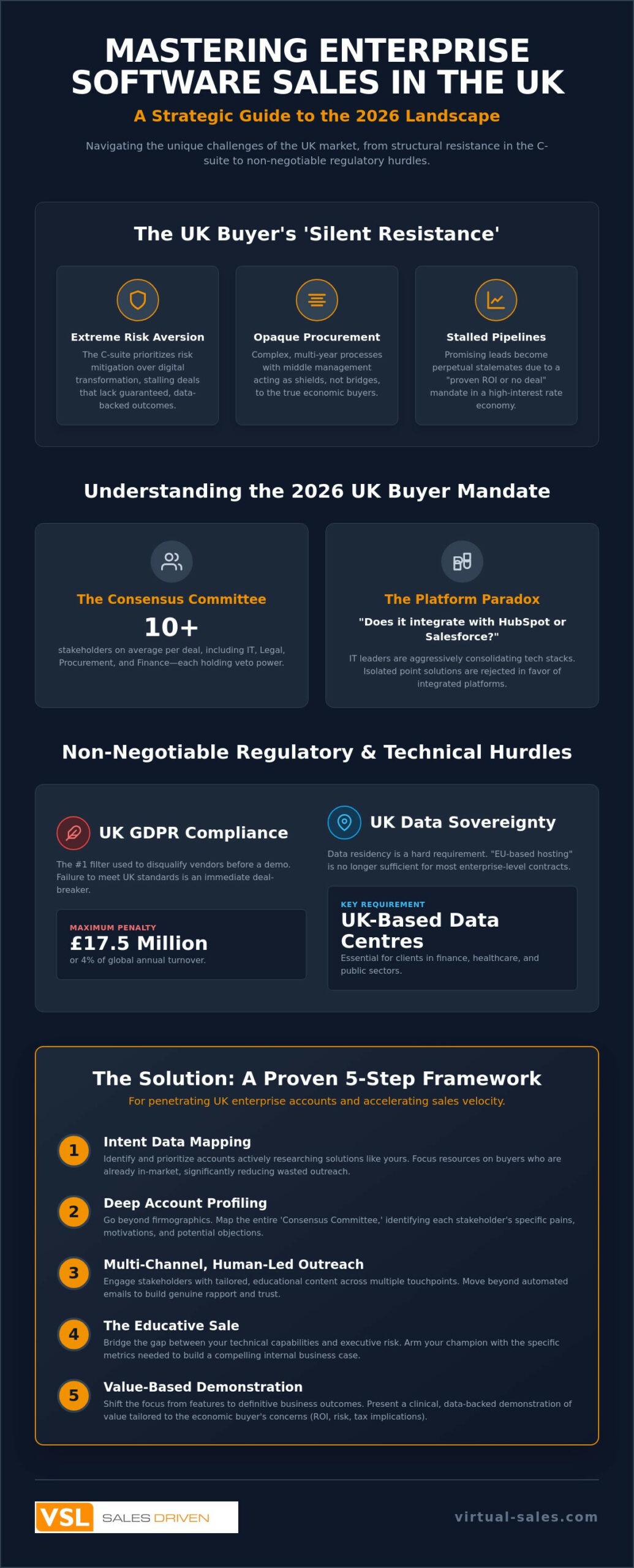
The era of speculative tech spending has officially ended. In 2026, UK enterprise buyers have replaced the “move fast and break things” mantra with a rigid “proven ROI or no deal” mandate. This shift represents one of the core challenges of selling enterprise software in the UK today. With the Bank of England base rate holding at 3.75%, capital remains expensive. CFOs are no longer approving experimental budgets or “nice-to-have” tools. They demand a clinical, data-backed demonstration of value before a single pound is committed. This “Safe Buying” mentality is particularly prevalent across the FTSE 250, where the professional risk of a failed implementation often outweighs the perceived gain of a niche innovation.
British corporate culture has always leaned toward caution, but the current regulatory environment has intensified this trend. Businesses are navigating a 25% corporation tax rate and an increasingly aggressive enforcement of UK GDPR. In this context, software is no longer viewed just as a productivity booster; it’s scrutinized as a potential liability. Sellers must pivot from selling “possibility” to selling “certainty.” If your pitch doesn’t lead with fiscal impact and risk mitigation, you won’t get past the first gatekeeper.
The Consensus-Driven Buying Culture
Decision-making in the UK has become a team sport. The average enterprise deal now involves at least 10 stakeholders, forming what we call the “Consensus Committee.” This group typically includes representatives from IT, legal, procurement, and finance, each holding a potential veto. Successfully selling enterprise application software (EAS) requires you to distinguish between your internal Champion and the true Economic Buyer. Your Champion might value the user interface, but the Economic Buyer only cares about the 25% corporation tax implications and bottom-line efficiency. If you can’t arm your Champion with the specific metrics needed to convince the rest of the committee, the deal will stall in a cycle of perpetual review.
Platform Consolidation vs. Point Solutions
UK IT leaders are aggressively consolidating their technology stacks to reduce complexity and cost. They’re moving away from fragmented “point solutions” in favour of integrated platforms. This “Platform Paradox” means that being the best in a tiny niche can actually be a hurdle. If your software doesn’t integrate seamlessly with existing hubs like HubSpot or Salesforce, it’s often a non-starter. Buyers want a single source of truth, not another siloed dashboard that requires separate maintenance. This is why modern b2b lead generation must focus on ecosystem fit. We see many businesses failing because they sell isolated features in a market that is only buying infrastructure. You aren’t just selling a tool; you’re selling a component that must fit perfectly into an existing, complex corporate machine.
Technical and Regulatory Hurdles: UK GDPR and Data Sovereignty
The regulatory environment in 2026 is a minefield for the unprepared. UK GDPR enforcement has accelerated, with maximum fines reaching £17.5 million or 4% of global turnover. For enterprise buyers, this isn’t just a legal concern; it’s an existential risk. When you analyze UK software market trends, it’s clear that compliance is the primary filter used to disqualify vendors before they even reach a demo. If your solution cannot guarantee adherence to the latest UK data protection standards, you’re effectively locked out of the FTSE 250. This regulatory scrutiny represents one of the most persistent challenges of selling enterprise software in the UK today.
Data residency has transitioned from a preference to a hard requirement. While 94% of UK businesses utilize cloud services, they increasingly demand that data remains within UK borders to avoid the complexities of post-Brexit international transfers. Providing “EU-based” hosting is no longer a sufficient answer for a London-based bank or a Manchester-based healthcare provider. They need to know their data stays under the jurisdiction of the ICO. If you can’t provide a UK-specific data centre, your sales cycle will likely end before it truly begins.
Navigating the UK Security Audit
Expect to face a 200-question security audit as a standard part of the procurement cycle. UK IT leaders prioritize vendors who hold ISO 27001 certification and Cyber Essentials Plus. These aren’t just technical credentials; they’re trust signals that bypass months of back-and-forth questioning. Security has evolved into a core sales function where your ability to articulate encryption protocols is as vital as your ability to demo features. Don’t wait for the audit to arrive; lead with your security posture to build immediate credibility.
Real Insight: The “Data Sovereignty” Deal-Breaker
Consider a scenario involving a high-growth US SaaS provider targeting the UK legal sector. They offered a superior product at a competitive price. However, their primary data centres were in Northern Virginia. Despite promising “compliance,” they couldn’t offer localized UK hosting. The prospect, a top-tier London law firm, terminated the deal during the final procurement stage. The risk of future regulatory shifts was deemed too high. This single oversight cost the vendor an estimated £250,000 in annual recurring revenue and six months of wasted sales effort.
This caution is characteristic of the UK legal sector. Firms like Triangle Legal Services Limited operate with this same high standard of due diligence, whether they are conducting environmental searches for a property purchase or evaluating a new software vendor’s data residency policy.
At VSL, we integrate these regulatory realities into our IT appointment setting workflows. We qualify prospects based on their specific residency requirements, ensuring your sales team only spends time on deals where your infrastructure aligns with their compliance needs. You can see how we’ve helped other tech firms navigate these hurdles in our verified client reviews on Clutch.
The Educative Sale: Bridging the Knowledge Gap
Feature-bashing is a terminal mistake in the British enterprise sector. In 2026, UK buyers are inherently cynical of technical hype; they don’t want to hear about your latest API update or proprietary algorithm. They want to hear about business outcomes. One of the persistent challenges of selling enterprise software in the UK is the disconnect between what a vendor sells and what a Finance Director (FD) actually buys. While your sales team might be focused on “Tools,” the UK C-suite is exclusively focused on “Results.” Success requires a transition to the educative sale, where you act as a strategic partner who teaches the prospect how to solve a specific commercial friction point.
You must also address the widening skills gap. With IT and data positions remaining the most difficult roles to recruit for in the UK over the last five years, many enterprises are hesitant to adopt complex new software they lack the internal talent to manage. In these instances, suggesting top-tier remote staffing solutions like IMO Talent can help buyers secure the technical expertise needed to support a rollout. Your pitch shouldn’t just focus on the software’s capability; it must demonstrate how the platform lowers the barrier to entry for existing staff. If your solution requires a team of PhDs to operate, it’s a non-starter in a market where technical recruitment is a primary operational bottleneck.
Building the Business Case for ROI
Quantifying “Soft ROI” is essential when presenting to UK Finance Directors. Efficiency gains and improved morale are rarely enough to trigger a high-value purchase. Instead, you must pivot to the Cost of Inaction (COI). Demonstrate the specific fiscal penalty of maintaining the status quo, whether through legacy system maintenance costs or missed market opportunities. Data from Gartner indicates that 60% of UK enterprise deals stall mid-cycle due to a lack of ROI clarity. By providing a clinical, data-driven business case early in the cycle, you remove the primary excuse for executive indecision.
Results and Data: Meeting the 2026 Standard
Achieving a predictable sales pipeline in this environment requires a high-standard output. In the current UK software sector, the average conversion rate from a qualified lead to a pilot program sits between 15% and 22%, depending on the complexity of the integration. At VSL, our experience shows that generating 10–20 high-quality meetings per month requires a specialized UK software appointment setting approach that prioritizes professional maturity over sheer volume. Shortening your sales cycle from the traditional 12 months down to 9 months can result in a 25% increase in annual revenue capacity, but this only happens when the initial engagement is rooted in education rather than persuasion.

The VSL Framework: A 5-Step Method for UK Enterprise Outreach
Overcoming the structural challenges of selling enterprise software in the UK requires a tactical shift from volume-based cold calling to a precision-led framework. You cannot brute-force your way into a FTSE 250 boardroom. Instead, you must deploy a methodology that respects the prospect’s time while addressing the consensus-driven nature of British procurement. Our 5-step framework is designed to penetrate high-value accounts by combining granular data intelligence with high-standard human outreach.
- Step 1: Deep Database Cleansing and Intent Mapping.
- Step 2: Multi-Channel Nurturing (Human-led, Tech-enabled).
- Step 3: The “Educative First” Outreach Script.
- Step 4: Stakeholder Mapping and Champion Identification.
- Step 5: Seamless CRM Integration and Handoff.
Step 1 & 2: Building the Foundation
Data is the fuel for any successful campaign. If your database is cluttered with outdated contact records or international leads with no UK presence, your ROI will suffer. We begin with rigorous b2b data cleansing to ensure every dial and email reaches a valid, high-intent decision-maker. We then layer in intent data to identify UK firms currently in a buying window, focusing your resources where they are most likely to convert. While automation handles the initial touchpoints, we maintain a “Human-in-the-loop” philosophy. Professional, UK-based staff lead the high-value conversations, ensuring the nuance of the British business lexicon isn’t lost to a generic AI bot.
Step 4 & 5: Closing the Loop
Identify the veto-holders before you ever book the demo. Because the average UK deal involves 10+ stakeholders, our framework prioritizes mapping the “Consensus Committee” early in the cycle. We find your internal Champion and arm them with the specific ROI metrics needed to satisfy the Finance Director. To prevent lead decay, we integrate directly with your existing technology stack. Our systems sync with platforms like HubSpot and Salesforce in real-time, providing your sales reps with a comprehensive history of every interaction. This “VSL Handshake” ensures your team enters every meeting with full context, including the prospect’s specific pain points and regulatory concerns. This professional maturity is why we maintain a high standard of output, which you can verify through our verified client reviews on Clutch.
Scaling Your UK Pipeline with Expert Sales Partnership
The 2026 enterprise outlook demands disciplined growth and intense scrutiny. While the UK software market is projected to reach a value of £49.5 billion, the friction involved in closing high-value deals hasn’t been higher. To overcome the structural challenges of selling enterprise software in the UK, you need a go-to-market strategy that prioritizes precision over volume. Stop relying on the same tactics that worked five years ago. Today’s market demands a sophisticated, human-led approach that respects the professional maturity of the British C-suite. Partnering with an elite sales component allows you to bypass the traditional hurdles of market entry and scale your pipeline with clinical efficiency.
Don’t settle for the “spray and pray” methodology of offshore call centres. Enterprise tech requires a deep understanding of local nuances, from the specific impact of the 3.75% Bank of England base rate on capital expenditure to the nuances of UK GDPR compliance. We position ourselves as an integrated extension of your internal team, not an external vendor. This integration ensures that the high-standard output of your sales outreach matches the quality of the software you’ve built. We’ve refined our processes to ensure that every interaction adds value to the prospect, building the trust necessary to move a deal through a complex “Consensus Committee.”
Outsourcing vs. In-house: The Cost Analysis
Recruiting an internal sales team in the UK is a high-risk, high-cost endeavour. A senior SDR in London now commands a base salary exceeding £70,000, but that’s only the starting point. When you factor in National Insurance, pension contributions, private healthcare, and the cost of physical office space, your total cost of ownership (TCO) sky-rockets. The typical ramp-up time for a new hire to become fully productive is six months. Eliminate that lag. Choosing sales team outsourcing acts as a primary risk-mitigation strategy. It grants you immediate market presence without the long-term liabilities of a bloated internal headcount. You gain access to a team that already understands the UK procurement landscape and can start delivering qualified meetings from month one.
Next Steps: Secure Your UK Market Share
Securing your position in the FTSE 250 requires a proactive, tech-savvy partner who isn’t afraid to engage deeply in the pursuit of growth. We invite you to start with a pilot project to witness the impact of our 5-step framework on your conversion rates. Our team handles the heavy lifting of database cleansing, intent mapping, and stakeholder identification, allowing your closing reps to focus on what they do best. If you’re ready to accelerate your sales velocity and master the complexities of the British market, visit the Virtual Sales Limited contact page to schedule a strategic consultation. Let’s build a sales pipeline that delivers measurable outcomes in 2026 and beyond.
Mastering the 2026 UK Enterprise Sales Cycle
Success in the UK software market now requires a clinical balance of regulatory precision and educative sales strategy. You’ve seen how the rise of the Consensus Committee and strict data sovereignty requirements have reshaped the procurement landscape. While the challenges of selling enterprise software in the UK are formidable, they also provide a clear opportunity for vendors who lead with proven ROI and professional maturity. Deploying a structured framework that prioritizes human-led nurturing and deep data cleansing allows you to cut through the noise and reach the true economic buyer.
VSL brings over 20 years of specialized UK software sales expertise to your pipeline. We act as an elite, integrated component of your team, providing seamless HubSpot and Salesforce integration to ensure no lead decay. Our approach is validated by Clutch-verified case studies from ambitious tech businesses that have successfully navigated these structural barriers. It’s time to stop fighting the UK procurement culture and start mastering it.
Book a consultation with Virtual Sales Limited to scale your UK enterprise pipeline today and secure your market share in an evolving landscape.
Frequently Asked Questions
What is the average sales cycle for enterprise software in the UK in 2026?
The average sales cycle for enterprise software in the UK typically ranges from 9 to 12 months. Factors such as consensus-driven procurement and the 3.75% interest rate environment have made buyers more disciplined and cautious. You can often shorten this window to 6 or 9 months by using an educative sales approach that addresses ROI and fiscal impact early in the conversation.
How does UK GDPR affect outbound B2B lead generation?
UK GDPR mandates that outbound B2B lead generation must rely on a “Legitimate Interest” assessment. It requires rigorous database maintenance and clear opt-out mechanisms to remain compliant. With maximum fines reaching £17.5 million, ensuring your outreach is compliant is now a fundamental part of the sales process rather than just a legal checkbox.
Why do most international software firms fail when entering the UK market?
International firms often fail because they underestimate the UK’s risk-averse corporate culture and the necessity of local data residency. Many attempt to use generic global scripts that don’t resonate with the British C-suite. Success requires a localized strategy that accounts for the unique challenges of selling enterprise software in the UK, including the 25% corporation tax rate and specific procurement nuances.
What is the “Platform Paradox” in UK enterprise procurement?
The “Platform Paradox” refers to the trend where UK IT leaders prioritize platform consolidation over individual “best-of-breed” features. While they want innovation, they won’t buy niche tools that create data silos. Your software must demonstrate seamless integration with existing stacks like HubSpot or Salesforce to be considered a viable long-term investment in 2026.
Can cold calling still work for complex enterprise software in 2026?
Cold calling remains a powerful tool for enterprise software when it’s human-led and intent-based. In 2026, the key is professional maturity. High-level decision-makers still value direct, educative conversations that solve specific business pain points, provided the caller understands the technical and regulatory nuances of the UK market and avoids a generic script.
What is the difference between a Champion and an Economic Buyer in UK business?
A Champion is the person who will use your software and advocates for its adoption within the company. The Economic Buyer is the stakeholder with the final budget authority, usually a CFO or Finance Director. You must satisfy the Champion’s technical needs while proving the bottom-line fiscal impact and risk mitigation to the Economic Buyer to close the deal.
How much does it cost to outsource appointment setting in the UK?
Outsourcing costs are typically structured through subscription models that provide a predictable ROI. This is a strategic alternative to hiring an internal UK SDR, whose total cost of ownership includes a £70,000+ salary, National Insurance, and office overheads. Outsourcing provides an immediate market presence and professional expertise without these high long-term fiscal liabilities.
Should I use a UK-based agency or an offshore team for enterprise outreach?
A UK-based agency is almost always superior for enterprise tech outreach. Offshore teams often struggle with the cultural nuances and professional maturity required to engage UK executives effectively. A local partner acts as an integrated component of your team, ensuring that your brand is represented with the high standard of output that FTSE 250 prospects expect.


Disclaimer
Disclaimer: Content is for general information only and does not constitute professional advice. Results may vary. Virtual Sales Limited accepts no liability for actions taken based on this content.