


What if your biggest sales bottleneck isn’t your team’s talent, but the invisible rot inside your CRM? Research indicates that poor data quality costs organisations an average of £10 million annually, yet many technology firms still treat database hygiene as a secondary concern. In 2026, the consequences of poor data quality in sales have evolved from a minor admin headache into a full-scale brand equity tax that burns high-value prospects before you even speak to them.
You’ve likely dealt with high SDR turnover and marketing budgets that vanish into dead-end leads. It’s frustrating to watch your sales forecasting fail because your pipeline is built on inaccurate records. This guide serves as a practical manual for technology companies to stop the bleed. You’ll discover how inaccurate data silently erodes your sales velocity and gain the VSL framework to reclaim your pipeline ROI. We’ll explore the true financial impact of database decay and provide a tactical roadmap to fix your database issues and restore team productivity.
Key Takeaways
- Quantify the hidden costs of data decay using the “1-10-100 Rule” to understand why ignoring errors costs 100x more than proactive prevention.
- Identify the strategic consequences of poor data quality in sales, including high SDR turnover and the reputational risks of contacting prospects with outdated information.
- Optimise your CRM performance by removing the friction caused by duplicates and missing fields in platforms like HubSpot and Salesforce.
- Deploy the VSL 5-Step Method to audit and cleanse your database, turning a toxic asset into a high-velocity revenue engine.
- Unlock measurable growth with data-driven results, targeting a 25% increase in connect rates and up to 20 qualified meetings per month.
The Financial and Strategic Cost of Poor Sales Data in 2026
Poor data isn’t just a messy spreadsheet; it’s a structural failure in your revenue engine. Inaccurate records, duplicate entries, and outdated firmographics form the core data quality issues that plague modern B2B organisations. Research suggests that companies lose an estimated 15% to 25% of their total revenue due to these inefficiencies. When you examine the consequences of poor data quality in sales, the impact is both immediate and compounding.
Industry experts apply the “1-10-100 Rule” to quantify this damage. It costs approximately £1 to verify a record at the point of entry. If you miss that step, it costs £10 to clean it later. Ignore the error entirely, and the cost balloons to £100 through wasted outreach, missed opportunities, and damaged reputation. For a technology firm with 10,000 records, allowing just 20% of your data to remain “dirty” creates a hidden liability that scales into the hundreds of thousands of pounds.
Direct financial losses manifest most clearly in your SDR team’s payroll. If your staff spends 60% of their time cleaning data or calling non-existent numbers, you’re paying a premium for administrative work rather than high-value pipeline building. This inefficiency leads to skewed sales forecasts. When your CRM is bloated with ghost accounts, your resource allocation and hiring decisions are based on fiction, not reality. You end up over-hiring for territories that don’t exist or under-investing in markets that are actually ripe for growth.
Data Decay: Why Your 2025 Database is Obsolete
The IT sector moves faster than almost any other industry. Job churn, company mergers, and rapid acquisitions mean that contact data expires at an alarming rate. Static databases are essentially depreciating assets. By the time you start your 2026 campaigns, a significant portion of your 2025 data is already irrelevant. Data decay is projected to hit a 30% annual rate in 2026, meaning nearly a third of your database becomes functionally useless every twelve months.
The Hidden “Tax” on Your Marketing Budget
Bad data acts as a silent tax on every marketing pound spent. High email bounce rates don’t just waste individual sends; they trigger domain blacklisting that can take months to rectify. If you’re running LinkedIn ads or direct mail campaigns targeting the wrong personas, you’re subsidising the platforms without any hope of ROI. Implementing a rigorous b2b data cleansing process is the only way to ensure your marketing spend reaches the actual decision-makers. Without this foundation, your automation tools in HubSpot or Salesforce simply accelerate the delivery of errors.
Operational Paralysis: How Bad Data Erodes Sales Productivity
Bad data acts as a silent brake on your sales engine. While the financial costs are significant, the operational consequences of poor data quality in sales are often more damaging because they are harder to measure in real-time. When your CRM is cluttered with duplicates and missing fields, your team enters a state of operational paralysis. Instead of selling, they spend their hours acting as amateur data detectives, manually verifying LinkedIn profiles and cross-referencing company websites just to make a single call.
This friction directly impacts sales velocity. Every minute spent fixing a record is a minute not spent advancing a deal. If your SDRs are forced to spend 60% of their time on data hygiene, your sales cycle naturally extends. You lose the competitive advantage of speed. In a market where the first company to provide a relevant solution often wins, the “Lead Response Time” trap becomes fatal. If a genuine prospect requests a demo but your team is bogged down verifying a batch of “dirty” leads, that prospect will have moved on to a competitor before you even pick up the phone.
The Psychology of the Sales Floor
The human cost of poor data is reflected in your staff turnover rates. High-performing callers rely on a “flow state” to maintain energy and authority. This state is shattered when they hit three dead-end numbers in a row. Morale plummets when an SDR spends an entire morning reaching out to contacts who left their roles years ago. There is a direct correlation between data integrity and the confidence of a sales pitch. A caller who expects the data to be wrong will sound tentative and unprepared. Maintaining a clean database is the foundation of effective b2b appointment setting, ensuring your team speaks with conviction to the right people.
CRM Automation Failure
Marketing automation promised personalisation at scale, but this is only possible with pristine data sets. Incomplete fields lead to embarrassing failures, such as automated emails sent with “Hi {First_Name}” or sequences that target the wrong persona entirely. These mistakes don’t just lose a lead; they damage your brand’s reputation with high-level decision-makers. VSL mitigates this risk by integrating directly with cloud-based platforms like HubSpot and Salesforce, ensuring that only verified, high-quality data enters your automation workflows. If you are looking to scale your outreach without the risk of operational friction, reviewing our clutch-verified results provides a roadmap for success.
Real Insight: Reputational Risks and Opportunity Costs
The true consequences of poor data quality in sales extend far beyond internal spreadsheets and wasted SDR hours. When your outreach hits a high-value prospect with outdated information, you aren’t just losing a lead; you’re actively burning a bridge. Imagine an Account Executive calling a CTO to discuss a legacy system the company replaced two years ago. That interaction signals a lack of professional maturity and suggests your organisation doesn’t do its homework. This “Burned Lead” scenario is an expensive mistake in the enterprise space, where the pool of potential clients is finite and hard to enter.
Then there’s the opportunity cost. Every hour your best closers spend following up on unqualified or non-existent leads is an hour they aren’t closing deals. If a closer’s time is worth £500 per hour in potential revenue, and they waste five hours a week on bad data, you’re losing £130,000 annually per head. This isn’t just an administrative oversight; it’s a direct hit to your bottom line that compounds over time.
Real Insight: The £15,000 Monthly Save
A UK-based IT SaaS firm recently audited their outbound operations after seeing a 45% bounce rate on their primary campaigns. They discovered that nearly half of their “active” leads were obsolete due to rapid job churn in the London tech scene. By outsourcing their database cleansing and development to a professional partner, they eliminated the noise. This move saved them £15,000 in monthly overhead previously wasted on ineffective marketing automation and SDR salary hours spent on “ghost” accounts. Their connect rates tripled within sixty days because they were finally calling the right people.
The IT Sector Nuance
Technical decision-makers are particularly unforgiving of sloppy outreach. They expect a level of precision that matches the software they build and buy. A “wrong-person” call or an email addressed to a predecessor doesn’t just feel like a mistake; it feels like spam. Our experience in lead generation for technology companies shows that data accuracy is the primary differentiator between a cold call and a strategic conversation. If you can’t get the name and role right, why should they trust you with their infrastructure?
Compliance as a Competitive Advantage
Compliance isn’t just a legal hurdle; it’s a competitive advantage. Failing to maintain accurate “Opt-out” lists under GDPR can lead to catastrophic fines and permanent domain blacklisting. Maintaining a sustainable, legal sales engine requires rigorous database development. We use our telemarketing services as a proactive verification tool, ensuring every contact in your pipeline has been human-verified for accuracy and consent, protecting your brand from the legal fallout of “dirty” data.

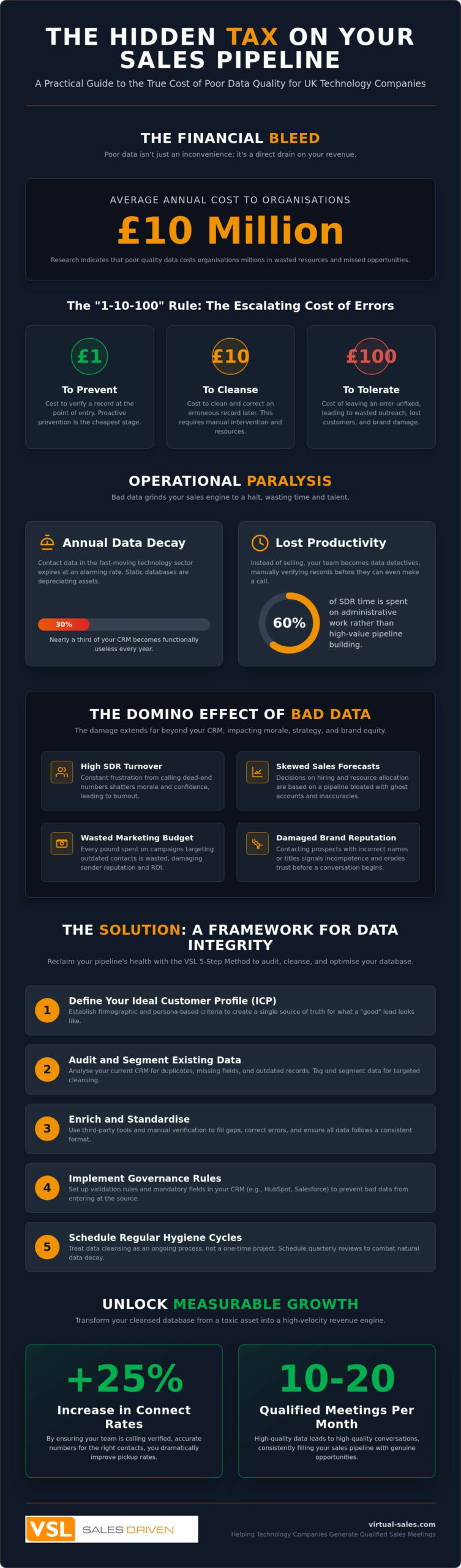
The VSL Framework for Data Integrity and Pipeline Health
Transforming a toxic database into a revenue engine requires more than a one-off spreadsheet scrub. It demands a systematic approach that bridges the gap between raw data and actionable intelligence. To mitigate the consequences of poor data quality in sales, VSL has developed a proprietary 5-Step Method designed specifically for high-growth technology firms looking to reclaim their pipeline ROI.
- Step 1: The Integrity Audit. We begin by identifying your “Dirty Data” percentage. This baseline audit reveals how many records are duplicates, missing key fields, or functionally obsolete.
- Step 2: Firmographic Alignment. We cross-reference your existing data against your Ideal Customer Profile (ICP). This ensures every record in your CRM matches the specific sectors and company sizes you actually want to target.
- Step 3: Human-Led Verification. This is the VSL differentiator. Our professional, UK-based callers manually verify contact names, direct dials, and job responsibilities. We don’t just scrape the web; we confirm the humans behind the data.
- Step 4: CRM Synchronisation. Once verified, we push the clean data directly into your cloud-based CRM. Whether you use HubSpot or Salesforce, we ensure the records are structured for immediate use.
- Step 5: Nurture and Maintain. Data decays at a rate of 30% annually. We implement a rigorous 90-day cleansing cycle to keep your database fresh and your sales velocity high.
By following this structured approach, you stop guessing and start selling. If you’re comparing b2b lead generation companies, look for those who prioritise this level of granular data integrity over simple volume.
Human-Led vs. Machine-Only Cleansing
Machine-learning tools and AI scrapers are excellent for scale, but they frequently miss the nuances of corporate title changes and departmental shifts. An AI might see a LinkedIn update, but it won’t know that a “Head of IT” has actually moved into a non-buying role during a merger. Our mature staff use discovery calls to update database intelligence in real-time. This human element ensures a high-standard output that automated tools simply cannot replicate, providing the professional maturity required for complex IT outreach. This same standard of meticulous human oversight is essential in other highly specialised fields, such as the support provided by Global Vets Consulting for complex documentation and consulting.
Defining Your ICP (Ideal Customer Profile)
Clean data allows you to narrow your focus to high-intent accounts. When you know your data is accurate, you can implement intent-based calling with confidence. You aren’t just dialling numbers; you’re engaging with prospects who fit your specific buying criteria. This alignment reduces the friction in your sales cycle and ensures your team’s energy is spent on the accounts most likely to convert. To see how this framework delivers measurable growth, review our clutch-verified results and discover the impact of a human-verified pipeline.
Results and Data: The ROI of Clean Databases
Investing in database integrity isn’t just about avoiding the negative consequences of poor data quality in sales; it’s about accelerating your commercial momentum. When you transition from a “dirty” database to a human-verified one, the shift in performance is immediate and quantifiable. By removing the noise of obsolete records and incorrect firmographics, your sales team can finally focus on the high-intent accounts that drive revenue. This strategic shift transforms your CRM from a digital graveyard into a high-velocity revenue engine.
The financial gains of a database cleanse manifest across several key performance indicators. Technology firms that implement a rigorous data hygiene programme typically see the following results:
- Increased Connect Rates: SDRs report an average 25% increase in “connect rates” because they are no longer dialling dead numbers or bypassed switchboards.
- Higher Meeting Volume: High-quality data typically yields 10–20 qualified meetings per month for IT firms, depending on the complexity of the solution and target market.
- Improved Opportunity Ratios: The “Lead-to-Opportunity” ratio strengthens significantly. When the initial data is accurate, the relevance of the outreach increases, leading to more meaningful discovery calls.
- CPA Reduction: By eliminating wasted marketing spend and SDR salary hours, firms can reduce their total cost-per-acquisition (CPA) by up to 40%.
These metrics prove that data quality is the foundation of sales velocity. Without it, your automation tools and talent are essentially running on a treadmill. With it, every outreach attempt has a higher probability of conversion.
Benchmarking Your Success
What does “good” look like in 2026? Industry standards have tightened. For technology companies, an email bounce rate above 2% is now a red flag for domain health. Similarly, a dial-to-connect ratio should ideally be 10:1 or better when using human-verified direct dials. VSL provides real-time reporting to track these health metrics, allowing you to see the state of your pipeline at a glance. Our commitment to these standards is reflected in our Clutch-verified results, which showcase how data-led strategies outperform generic volume-based approaches.
Strategic Next Steps
Treating your database as a “living asset” rather than a one-off project is the key to long-term growth. To begin, we recommend a pilot database development project to audit your current “Dirty Data” percentage and demonstrate the immediate uplift in connect rates. This proof-of-concept phase allows you to see the ROI before scaling. If you’re ready to reclaim your pipeline and stop the silent erosion of your sales velocity, contact our team to discuss a tailored database strategy. Let’s move your business away from the friction of bad data and into a cycle of predictable, scalable growth.
Future-Proofing Your Sales Engine for 2026
Success in the B2B technology sector requires a relentless focus on database integrity. We’ve seen how the consequences of poor data quality in sales manifest as operational paralysis, burned leads, and wasted marketing spend. By implementing a human-led verification framework, you transition from reactive firefighting to proactive pipeline growth. Clean data isn’t a luxury; it’s the high-octane fuel your sales team needs to maintain velocity in a competitive market.
VSL brings over 20 years of expertise to the table, specifically within the IT and SaaS sectors. Our UK-based professional team acts as an integrated component of your workforce, ensuring your CRM is a living asset rather than a liability. Whether you’re using HubSpot or Salesforce, we provide the technical maturity and human insight needed to drive 10 to 20 qualified meetings per month. Don’t let database decay erode your hard-earned revenue.
Ready to revitalise your sales pipeline? Explore our B2B Database Development services and start building a high-velocity revenue engine today. We’re here to help you turn your data into a competitive advantage.
25+ Years Helping Technology Companies Generate Qualified Sales Meetings. Every successful campaign starts with a conversation. #OneStepCloser 🚀
Frequently Asked Questions
What are the main consequences of poor data quality in sales?
The primary consequences of poor data quality in sales include eroded sales velocity, high SDR turnover, and wasted marketing budgets. Inaccurate records force your team to spend 60% of their time on administration rather than closing deals. This inefficiency creates a brand equity tax where your outreach to high-value prospects fails before a conversation even begins.
How much does bad data actually cost a UK business?
Poor data quality costs organisations an average of £10 million per year according to industry research. Using the 1-10-100 Rule, ignoring a single error can eventually cost your business £100 in lost opportunities and reputational damage. For technology firms, these losses often represent 15% to 25% of their total annual revenue.
How can I identify if my sales database is “dirty”?
Look for warning signs like email bounce rates exceeding 2% or SDR connect rates falling below industry benchmarks. If your team frequently reports “wrong person” calls or outdated job titles, your database is likely suffering from significant data decay. A professional integrity audit can quantify the exact percentage of dirty data within your CRM.
Is human-led data cleansing better than automated software?
Human-led cleansing is superior for complex B2B sectors because it captures nuances that automated AI tools miss. While software flags formatting errors, only a professional caller can verify a CTO’s job responsibilities or identify internal departmental shifts. VSL uses mature, UK-based staff to ensure your contact data is accurate and actionable.
How often should a B2B sales database be cleansed?
You should implement a rigorous cleansing cycle every 90 days to combat the 30% annual data decay rate seen in the IT sector. Job churn and corporate mergers mean that a database left untouched for six months becomes functionally obsolete. Regular maintenance ensures your sales velocity remains high and your pipeline stays healthy.
Can poor data quality affect my GDPR compliance?
Inaccurate data is a primary cause of non-compliance with UK data protection laws. Failing to maintain accurate Opt-out lists or contacting individuals who’ve changed roles can lead to significant legal fines and domain blacklisting. Maintaining a clean, human-verified database is a critical component of your overall compliance and risk management strategy.
What is the ROI of investing in professional database development?
Investing in professional database development typically yields a 25% increase in SDR connect rates and can reduce your cost-per-acquisition by up to 40%. By providing your team with accurate leads, you ensure they spend their time on high-intent accounts. This alignment directly improves your Lead-to-Opportunity ratio and overall sales productivity.
How does VSL integrate with my existing CRM like Salesforce?
VSL operates as an elite, integrated component of your team by synchronising verified data directly into your cloud-based CRM. We support popular platforms like HubSpot and Salesforce, ensuring a seamless flow of intelligence. This technical integration allows your internal staff to act on high-quality leads without the friction of manual data entry.


Disclaimer
Disclaimer: Content is for general information only and does not constitute professional advice. Results may vary. Virtual Sales Limited accepts no liability for actions taken based on this content.