


A high AI score isn’t an instruction to contact a prospect. It’s a prompt to check whether the timing, account context and reason for reaching out make sense. That’s why AI makes sales timing more important than ever: signals can arrive faster, but a relevant conversation still depends on sound judgement.
If you lead sales, marketing or business development at a technology company, you may already have more alerts than your team can act on. Prioritising every score can lead to rushed outreach; waiting too long can mean missing a useful opening. Treat AI as support for decision-making, not a substitute for it.
This article explains how to assess AI-generated sales signals, combine them with prospect research and decide when human outreach is appropriate. It also sets out a repeatable process for assigning ownership, qualifying responses and learning from campaign outcomes, so your team can focus on conversations that may contribute to qualified pipeline.
Key Takeaways
- Why AI Makes Sales Timing More Important Than Ever: faster signals still need account context and human judgement before outreach.
- Check prospect fit, signal relevance, contact role, proposition and follow-up capacity before acting on an alert.
- Use a clear detect, validate, prioritise, engage and review process so signals have an owner and outcomes inform future decisions.
- Match outreach to the prospect’s situation rather than assuming a high AI score means they’re ready to speak.
- Consultative conversations and BANT qualification can help technology firms turn relevant signals into qualified sales opportunities.
Why AI Makes Sales Timing More Important Than Ever in B2B
AI can flag a prospect’s activity quickly. It can’t decide on its own whether your team should make contact, what to say or whether the account belongs in the campaign. That is why AI makes sales timing more important than ever: faster detection increases the value of sound judgement rather than removing the need for it.
Sales timing is the decision about when a prospect merits contact, based on a signal, the account context and human judgement. A signal is an observed indicator that may justify further research or outreach. It could be a change in company circumstances, engagement with your content or another recorded activity. The signal can help direct attention, but it isn’t proof that a buyer is ready to speak or purchase.
What does sales timing mean when AI flags a prospect?
Separate when a signal appears from when your team can act responsibly. A notification may arrive immediately, but a useful response could depend on checking whether the company fits your ideal customer profile, confirming the contact’s role and understanding whether the signal relates to your proposition.
Predictive analytics uses data to estimate likely outcomes, as described in this overview of predictive analytics. In sales, this kind of analysis can help sort or interpret information. The resulting score is a prompt for assessment, not a promise of buyer intent. For more on the human role in that assessment, see VSL’s guidance on human judgement in AI-supported sales.
Why can faster insight make timing decisions harder?
More alerts can compete for the same limited sales attention. Without a clear priority process, a team may treat every notification as urgent while more relevant accounts receive less attention. Speed alone doesn’t solve that problem. It can make prioritisation less consistent.
Account context matters. A signal may look promising in isolation but be irrelevant if the organisation doesn’t match your target profile, the activity relates to a different need or the person identified has no part in the decision. Outreach without those checks can feel generic or mistimed.
Waiting too long can also waste a useful opportunity to start a relevant conversation. The answer isn’t to contact every flagged prospect immediately. Assess the signal promptly, assign an owner and decide whether further research or contact is justified. The following sections set out a practical process for turning changing signals into better-qualified conversations without mistaking a score for readiness to buy.
How AI Changes B2B Sales Timing Without Replacing Human Judgement
AI can help sales teams sort and summarise information, bringing a changed prospect or account signal forward for review. Its usefulness depends on the data and features available in a particular tool. Before building a process around its output, check which sources it uses, how current the records are and what the platform actually does.
A signal’s value depends on more than its freshness. Consider whether the account fits your ideal customer profile, whether the activity relates to your proposition and whether the right decision-maker is involved. Campaign priorities and the team’s capacity to follow up also affect whether outreach now makes sense.
Which timing decisions can AI support?
Depending on the tool and its data, AI-assisted analysis may sort prospect records, summarise account information or flag a change for review. For example, a recorded activity might bring an account to a representative’s attention. Treat this as a prompt for research, not an instruction to contact the prospect. Verify the signal’s source and context first.
| Stage | AI can flag or organise | A person checks or decides |
|---|---|---|
| Review | Available account information, recorded changes and records for assessment. | Whether the account fits, the signal is relevant and the contact has an appropriate role. |
| Outreach | Information that may help prepare for a conversation. | Whether to make contact and which business need gives the conversation relevance. |
| Follow-up | Recorded activity and responses, where the tool supports it. | What the response means and whether to qualify, follow up, defer or stop. |
Where should a person make the final call?
Start with fit. Does the company match your target profile, and is the contact connected to the issue your product or service addresses? Then ask whether you can explain why a conversation may be relevant to that account. A score alone is not a good reason to reach out.
A consultative conversation can surface details a signal cannot establish, such as current priorities, existing arrangements or whether the timing suits the prospect. Let the response shape the next step. For another perspective, see VSL’s article on AI and human conversation in B2B sales.
If your team wants experienced support to turn relevant account signals into qualified business conversations, explore VSL’s B2B appointment setting.
How to Tell Whether an AI Sales Signal Deserves Action Now
A high score can help an account stand out, but it doesn’t mean the prospect is ready to speak. Before acting, check what the signal represents, whether the account fits your campaign and whether you have a relevant reason to make contact. Why AI Makes Sales Timing More Important Than Ever comes down to using each signal as a prompt for informed judgement, not as proof of buying intent.
What should a sales team check before acting?
Use a short review before assigning outreach. If an answer is unclear, research further or defer the decision rather than treating the score as a command.
- Company fit: Does the organisation match your ideal customer profile and campaign criteria?
- Role fit: Is the contact connected to the issue or decision your proposition addresses?
- Signal context: What activity was detected, when was it recorded and is its source clear?
- Proposition: Can you explain why a conversation could be relevant to this account?
- Campaign capacity: Is someone available to research, make contact and follow up appropriately?
A strong score with weak account fit is not a priority. A relevant signal with unclear context may call for more research first. These checks help distinguish an account worth investigating from one that merits outreach now.
Real Insight: A practical campaign scenario
Consider a SaaS team reviewing an alert that a target company has engaged with material about a business problem the software addresses. The alert alone doesn’t establish who engaged, why they did so or whether the company is considering a purchase. A team member checks the source and account fit, then confirms whether the contact’s role relates to the issue. This is a practical example, not a claim about a specific VSL campaign or client result.
If the checks support outreach, a caller can open a consultative conversation about the business challenge without assuming the prospect is ready to buy. If the contact says the issue isn’t a current priority, record the response and agree whether a later review is appropriate. If the signal proves unrelated, correct the record and avoid repeating the same assumption.
Log the signal and its source, the fit checks, the decision and its owner, plus the prospect’s response and next action. Review these notes alongside campaign outcomes to assess which signals deserve attention. For more on prospect fit, see VSL’s guidance on AI signals and ideal customer profiles.

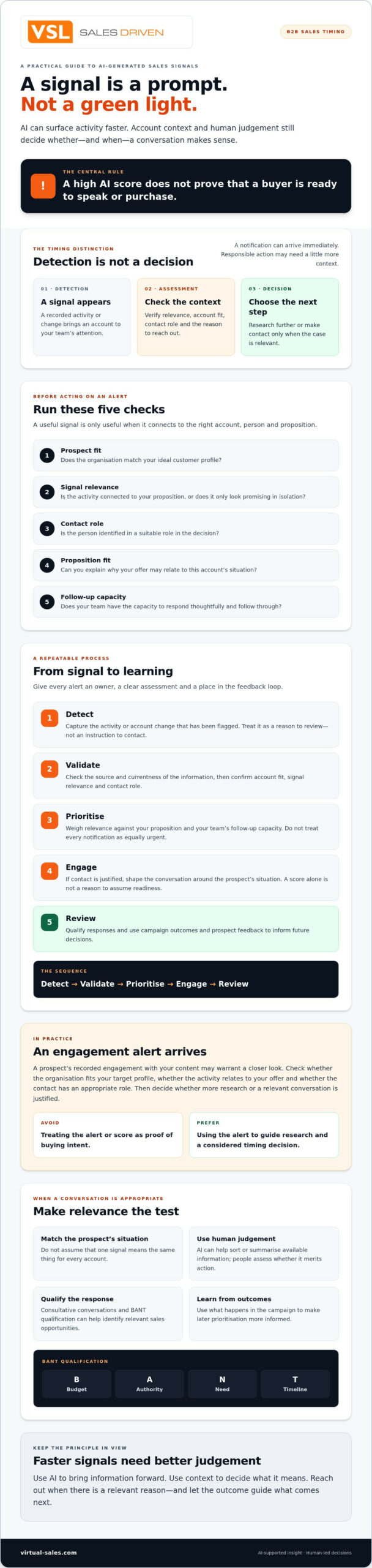
A Practical Framework for Acting on AI Sales Signals
A signal only becomes useful when someone owns the next decision. This five-step process gives sales and marketing teams a clear route from detection to review, while keeping human judgement at the centre of outreach.
The five steps from signal to conversation
- Detect: An assigned team member identifies a signal in available prospect or campaign information and notes its source.
- Validate: The owner checks the account against the ideal customer profile, confirms what the signal means and verifies that the contact is relevant to the campaign.
- Prioritise: A sales lead or campaign manager decides whether the account merits action now, further research or a later review. Weigh relevance against campaign priorities and available follow-up capacity.
- Engage: An experienced caller or sales representative opens a consultative conversation connected to a credible business need. If the prospect engages, qualify the opportunity to BANT criteria as a minimum.
- Review: The campaign manager records the action and outcome, then reviews the information with the team to inform future decisions.
Set ownership at each hand-off. For example, the person who spots a signal can assign validation to a named colleague. That colleague records whether the account is ready for outreach or needs more research. If the signal has no owner, it can sit in an alert queue without informing a real sales decision.
VSL assigns a dedicated caller and campaign manager to each campaign. Experienced UK-based callers can provide the human step between a signal and a qualified business conversation, while the campaign manager oversees activity and reporting. VSL works as an extension of a client’s sales and marketing team, using consultative conversations without scripts. For more on the role of this activity in the sales process, see the B2B appointment setting guide.
How should teams learn from timing decisions?
Review campaign activity and prospect outcomes each week. Look for patterns worth investigating: which types of signals led to relevant conversations, where account fit was weak and what prospects said about their priorities or timing. Treat patterns as questions to test, not proof that a particular signal will always predict interest.
VSL uses a proprietary telemarketing-focused CRM to track campaign activity and outcomes. Campaign data can be imported or exported in CSV or Excel format, and the CRM integrates with Salesforce. Review the activity and outcomes with your team to understand what happened and adjust priorities thoughtfully.
Explore VSL’s B2B appointment setting support
Turning Better Sales Timing into Qualified B2B Meetings
Better timing is useful when it helps your team turn a relevant prospect signal into a conversation that can be properly qualified. This approach may suit technology firms entering a market, testing an ideal customer profile or building qualified pipeline while keeping people responsible for contact decisions.
Virtual Sales Limited (VSL) supports technology companies in the UK and USA with B2B appointment setting and lead generation. Its experienced UK-based callers use consultative conversations, with a dedicated caller and campaign manager for each campaign. Leads are qualified to BANT criteria as a minimum. VSL works as an extension of your sales and marketing team.
Results, Evidence & Data
Assess timing using qualified meetings, BANT outcomes, campaign activity and prospect feedback. Together, these measures help you review whether outreach reached relevant decision-makers and whether conversations produced qualified opportunities. This gives a more useful view than judging performance by signal or activity volume alone.
VSL provides weekly campaign reporting on activity and outcomes. Use those reports to review prospect responses, qualification and follow-up decisions, then discuss what the results suggest with your campaign team. These operational measures help inform decisions; they do not guarantee a particular commercial outcome.
When can an experienced appointment-setting partner help?
Consider working with an experienced partner when you are entering a market, testing a new ICP or need more consistent prospect conversations to support pipeline development. VSL’s callers and campaign manager can work alongside your team, with weekly reporting to help review activity and prospect responses. BANT qualification provides a minimum standard for qualifying leads, while your team can decide which opportunities merit further sales attention.
For support with UK B2B appointment setting, speak with Virtual Sales Limited about your campaign objectives and qualification requirements.
Pair AI-informed research with experienced UK-based appointment setters who use consultative conversations and qualify leads to BANT criteria as a minimum. Learn more about Virtual Sales Limited’s B2B lead generation and appointment-setting services to support your technology sales pipeline.
Make Every Sales Signal Count
AI can help your team spot and organise prospect signals, but it can’t confirm that an account is ready to talk. Why AI Makes Sales Timing More Important Than Ever comes down to using each signal as a prompt: check account fit, understand the context and give a person ownership of the next decision.
A repeatable process helps your team act with purpose. Validate the signal, prioritise against campaign needs, engage through a relevant conversation and review the response. That feedback can inform future decisions, while BANT qualification helps establish whether an opportunity merits sales follow-up.
VSL has supported technology companies in the UK and USA since 2001. Its experienced UK-based callers use consultative, script-free conversations, and leads are qualified to BANT criteria as a minimum. Weekly campaign reporting gives your team visibility into activity and outcomes.
With clear ownership and thoughtful follow-up, your team can turn relevant signals into better business conversations. Keep the judgement human and the process consistent.
Frequently Asked Questions
Does AI tell sales teams exactly when to contact a prospect?
No. AI may rank, flag or summarise available prospect information, but its output can’t establish that a buyer is ready to talk. Check the signal’s source, age and context, then confirm account fit, contact relevance and a credible reason for outreach. Treat a score as a prompt to assess, not an instruction to contact immediately. Sales teams should retain ownership of the decision and its follow-up.
How can AI help improve timing in B2B sales outreach?
AI can help sort available account information, surface changed signals and bring records forward for review. That can guide a representative’s research towards accounts that may merit attention. The principle behind Why AI Makes Sales Timing More Important Than Ever is to pair faster sorting with human checks of data quality, account fit and campaign priorities. Confirm each tool’s features and data sources before relying on its output.
Can AI identify when a business is ready to buy?
AI can identify patterns or signals that may relate to a buying process, but it can’t confirm readiness on its own. A company’s activity might have another explanation, and a score doesn’t reveal every stakeholder’s priorities or plans. Treat any prediction as an indication to investigate. A relevant conversation can test whether there’s a need, who is involved and whether the timing is suitable.
What should a sales team check before acting on an AI sales signal?
Check whether the company matches your ideal customer profile and whether the contact has a relevant role. Confirm what the signal represents, when it was recorded and whether its source is understood. Then ask whether your proposition addresses a credible business need and whether someone can follow up properly. If context is unclear, assign further research rather than treating a high score as proof of intent.
How can human salespeople add context to AI-generated signals?
Salespeople can verify account information, connect activity to the company’s likely business priorities and decide whether the proposition gives the prospect a sound reason to talk. In a consultative conversation, they can ask open questions and listen for needs, constraints and timing that a score cannot establish. Record the response accurately, including when the prospect isn’t interested or the signal proves irrelevant.
Is AI-led prospect prioritisation suitable for technology companies?
It can help technology companies organise prospect information, provided the team checks the underlying data and keeps human ownership of contact decisions. It may be useful when testing an ideal customer profile, entering a market or managing several prospect segments. Start with a clear definition of account and role fit, then assess whether the signals support useful research and relevant outreach rather than simply adding alerts.
How can appointment setting turn timely outreach into qualified B2B meetings?
B2B appointment setting involves engaging business decision-makers to generate qualified sales appointments. A timely signal can help direct research, while a consultative conversation tests whether there’s a relevant need. VSL’s experienced UK-based callers speak with prospects without scripts, and leads are qualified to BANT criteria as a minimum. A dedicated campaign manager oversees campaign activity, supporting coordination with your sales and marketing team.
What should businesses measure when reviewing AI-informed sales timing?
Review qualified meetings, BANT outcomes, campaign activity and prospect feedback together. Record the signal and its source, the account fit checks, the contact decision and the next step. Compare results across relevant campaign segments to identify patterns worth investigating, but don’t treat correlation as proof that a signal predicts buying intent. Separate activity measures from qualified pipeline outcomes, and use findings to guide future review.


Disclaimer
Disclaimer: Content is for general information only and does not constitute professional advice. Results may vary. Virtual Sales Limited accepts no liability for actions taken based on this content.