


More outreach doesn’t automatically mean more qualified conversations. AI can help your team research accounts, prioritise prospects and draft tailored messages, but it can also miss buying context or make a message feel generic. Why AI-Powered Outreach Still Needs Human Judgement comes down to one commercial truth: scale only matters when relevance survives.
If you lead sales or marketing at a technology company, SaaS business or MSP, you’re likely weighing how to use AI without weakening buyer trust. AI can speed up research and surface useful signals. People still need to decide whether those signals matter, how to approach a prospect and when a conversation is worth pursuing.
This article explains where AI can accelerate B2B outreach and where human judgement should lead. You’ll learn how to use AI insights without sending poorly qualified messages, assess campaign quality through relevant outcomes and feedback, and find the right balance for more credible conversations with potential buyers.
Key Takeaways
- Why AI-Powered Outreach Still Needs Human Judgement: use AI to support research and prioritisation, but let people assess context and choose the next step.
- Separate AI-supported tasks from decisions that need human review, especially when messaging prospects or assessing buying readiness.
- Agree sales-qualified lead (SQL) criteria with your sales team, then measure relevant conversations and qualified BANT leads alongside activity.
- Apply a practical five-step framework: define your ideal customer profile, agree messages, test outreach, track KPIs and optimise weekly.
- Consider experienced B2B appointment setters when your proposition is specialist, buying groups are complex or qualification is uncertain.
Why AI-powered outreach still needs human judgement in B2B sales
AI can help a sales team research accounts, sort prospects and prepare outreach at greater scale. But more activity doesn’t prove that a prospect is relevant, ready to talk or a good fit. A message can use accurate data and still miss why a business might consider a solution now. For technology, SaaS and other B2B sales leaders, the practical question isn’t whether to use AI. It’s where people should remain responsible for decisions that shape the prospect’s experience.
Human judgement in AI-supported outreach means interpreting prospect context and choosing an appropriate next action. AI can organise information and flag possible signals. A person must decide what those signals mean for the account, whether contact makes sense and how to approach it in a relevant, respectful way. That oversight complements useful automation; it doesn’t require teams to reject it.
What human judgement means in AI-powered outreach
Structured records rarely capture every detail that can affect a conversation. A contact’s role may have changed, an account’s priorities may be unclear, or a prospect’s response may show that the timing is wrong. A salesperson can ask a follow-up question, listen to the answer and adjust the next step. AI may support research and prioritisation, but people should guide decisions that directly affect how a prospect is contacted.
For example, a technology company might appear to match its ideal customer profile, yet a conversation could reveal that the contact has no involvement in the relevant decision. Treating a score as proof of readiness risks pushing an unsuitable meeting. Human review gives the team a chance to confirm relevance, clarify interest and decide whether to continue, pause or redirect the conversation.
Why outreach volume is not the same as sales pipeline growth
Messages sent, calls made and replies received describe activity. On their own, they don’t show that a campaign has created a qualified opportunity. Lead generation is the process of attracting and identifying potential customers. Effective B2B outreach must also establish whether an opportunity is relevant enough for a sales conversation.
Poor-fit outreach can take up a prospect’s attention and leave the sales team following up contacts who don’t meet agreed criteria. A stronger measure is whether conversations produce qualified opportunities. The sales pipeline is a visual representation of the stages a prospect moves through. Sales pipeline growth is the increase in the number and value of opportunities within it over time. Neither is established by sending more messages alone.
That is why AI-powered outreach still needs human judgement. Keep automation focused on supporting research and prioritisation, then use informed conversations to test context, interest and fit. This gives sales leaders a clearer basis for assessing campaign quality than activity totals alone.
Where AI can support outreach, and where human judgement must lead
AI is most useful in outreach when it helps people work with information, rather than making prospect-facing decisions without review. The right boundary depends on your process, the quality of available records and the effect a decision could have on the prospect. A clear division of responsibility helps your team prepare efficiently while keeping relevance and messaging in accountable hands.
AI output is an input to a decision, not proof of a prospect’s intent. Treat a summary, classification or suggested priority as something to check, not confirmation that someone is ready to buy.
| Area | AI-supported task | Human decision | Joint review |
|---|---|---|---|
| Research and records | Organise available information or summarise existing records, if your process supports it. | Check whether information is relevant and current enough to inform contact. | Review unclear or incomplete records before they shape outreach. |
| Prioritisation | Sort records using criteria already set by the team. | Decide whether a prioritised account fits the ideal customer profile and merits attention. | Refine the criteria when reviewed accounts repeatedly prove unsuitable. |
| Messaging and follow-up | Prepare a draft or summarise previous interactions, where these tasks are part of your workflow. | Approve the message and choose the next step based on the prospect’s circumstances. | Review responses and feedback to improve future outreach. |
Tasks AI can assist with before outreach
Start with preparation: organise information already available to your team, summarise account notes or bring records forward for review. Don’t assume a tool has access to extra contact details or intent signals unless your setup confirms it. For practical guidance on assessing prospects, read this article on lead scoring and sales pipeline development. Check that the records and criteria behind a suggestion are suitable for your campaign.
Decisions that need human context
A contact’s role may not show their influence in a buying group. Account priorities can change, and a prospect’s response may make the original approach irrelevant. A caller can ask a follow-up question to clarify an ambiguous answer, then adapt the conversation. For further reading on working collaboratively in lead generation, see B2B lead generation partnership. Here, the focus is on the specific review points in an outreach workflow.
For an example of human-led appointment setting, explore VSL’s appointment-setting profile.
How to judge AI-powered outreach quality beyond activity metrics
AI can help a team increase outreach activity, but more calls or messages don’t show whether the campaign is reaching suitable prospects. Assess performance across activity, prospect response and qualified opportunities. This gives you a clearer view of campaign quality than activity totals alone.
Choose measures that reflect prospect and sales-team value
Track calls made, messages sent and responses received alongside relevant conversations, booked meetings and qualified BANT leads. Agree the criteria for a sales-qualified lead (SQL) with your sales team before reporting SQLs. Define what a lead needs to demonstrate to progress, and record whether each outcome meets those criteria.
Conversion rates need a clear numerator, denominator, timeframe and campaign context. For example, state whether you’re measuring booked meetings as a proportion of conversations or replies as a proportion of delivered messages. Cost per appointment means total campaign spend divided by the number of booked meetings. Report it only when the period and campaign scope are defined. No verified campaign conversion rate or meeting total is available in the information for this article, so no performance figure is claimed here.
Use weekly reporting and feedback to identify where a campaign may need attention. High activity with few relevant conversations may point to a targeting issue. Prospect engagement without a clear understanding of the proposition may indicate a messaging problem. Meetings that don’t meet agreed qualification criteria call for a review of the qualification process. Record the finding and any change made, then assess the next reporting period using the same definitions.
Use real evidence without overstating results
Before publishing campaign figures, confirm their source, timeframe, definition and calculation method. Check that meetings or outcomes can be attributed to the campaign and that the description reflects what was measured. Use external research only when its original publication and relevance to the claim have been confirmed. The stated 30%+ increase in technology-sector leads remains unverified in the available material, so it shouldn’t be presented as an established result.
Why AI-Powered Outreach Still Needs Human Judgement is also a measurement principle: data can show patterns, but people must decide whether the campaign created conversations the sales team considers useful. Learn more about VSL’s B2B lead generation service.

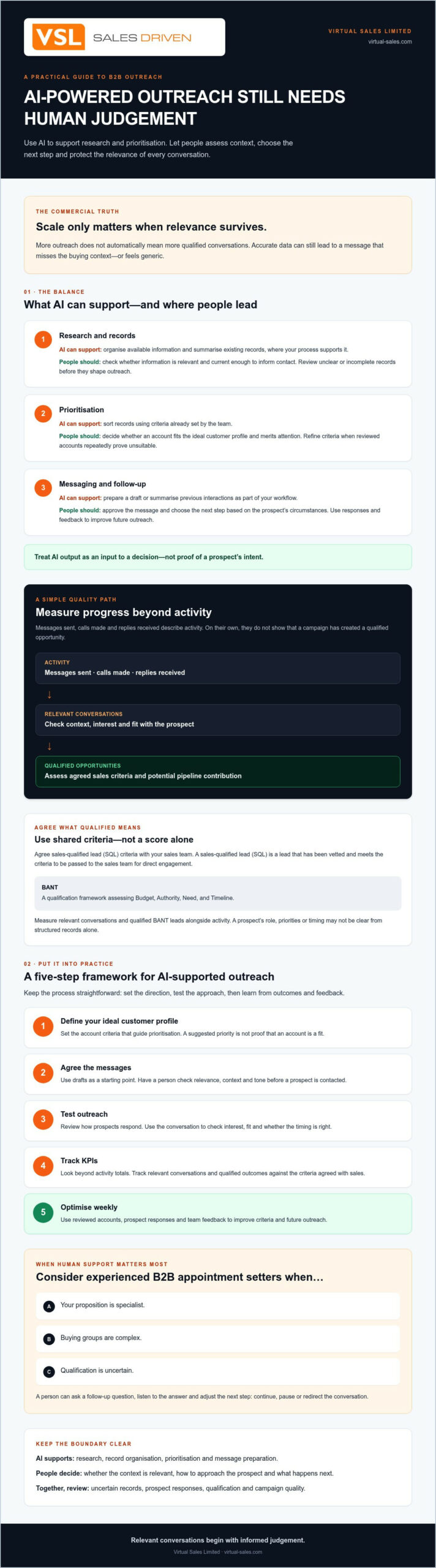
A five-step framework for applying human judgement to AI-supported outreach
Use this as a practical framework for your team, not as a proprietary VSL methodology. It sets clear review points so AI-supported research can inform outreach without deciding, unchecked, who should be contacted or what they should hear.
- Define the ideal customer profile. Agree which organisations fit the campaign and identify the roles or decision-makers it should reach. Treat any AI-generated match as a suggestion to check against those agreed criteria.
- Agree the messages. Set out the proposition, relevant business problem and purpose of contact with your sales team. A responsible sales professional should approve prospect-facing wording and check that it reflects the offer accurately.
- Test the outreach. Start with a controlled run and review how prospects respond. Callers can note where the opening earns a relevant conversation, causes confusion or needs a follow-up question. Use that feedback to refine the message before extending the approach.
- Track KPIs. Measure activity alongside outcomes, such as relevant conversations, meetings and qualified BANT leads. Agree qualification criteria with the sales team, and record why a prospect qualifies or is disqualified so the results have useful context.
- Optimise weekly. Review caller feedback and campaign outcomes with the client’s team. Adjust targeting or messaging when evidence points to a mismatch, and document what changed and why. This makes each revision a considered decision, not a reaction to activity totals alone.
Illustrative scenario: reviewing an uncertain prospect
Consider an illustrative scenario, not a VSL client case study or measured result. AI-supported research surfaces a technology company that appears to fit the agreed profile. Before treating that suggestion as a qualified opportunity, a caller checks the contact’s role and asks whether the relevant business need is a current priority. The prospect confirms a potential need but explains that the timing is uncertain.
The caller records the role, stated need and timing, then applies the team’s agreed qualification criteria. If the contact doesn’t meet them, the record is disqualified or held for review, with the reason noted. If the criteria are met, the caller passes the context to the client’s sales team. Shared weekly feedback can then help the team decide whether the targeting, proposition or qualification questions need adjustment.
Why AI-Powered Outreach Still Needs Human Judgement is apparent at this decision point: a possible match becomes useful only after a person tests the context and records what the conversation established.
When to combine AI insight with experienced B2B appointment setters
AI-supported research can help prepare outreach, but a human-led approach is especially useful when your proposition needs explanation, several stakeholders may influence a decision, or qualification is uncertain. In these situations, a record or score rarely tells the full story. A conversation can establish whether your offer is relevant, who should be involved and what a sensible next step looks like.
What to assess before introducing AI-supported outreach
Check that your campaign has a clear ideal customer profile, approved messages, agreed qualification criteria and defined success measures. If these foundations are vague, AI may help apply the ambiguity faster rather than resolve it.
Set clear ownership. Decide who reviews AI-supported research or draft messages, who approves prospect-facing communication and who is accountable for contact decisions. Agree how callers and sales colleagues will share feedback, and how that feedback will inform campaign adjustments. For broader planning, read this guide to outsourcing B2B appointment setting.
How Virtual Sales Limited can extend your sales and marketing team
Virtual Sales Limited assigns a dedicated caller or callers and a Project Manager to support each client. They work alongside your existing team, not in place of its product knowledge or sales decisions. After AI-supported research, consultative calls can test whether the proposition fits a prospect’s circumstances, clarify who is involved and explore qualification in conversation.
Virtual Sales Limited’s callers have IT backgrounds and sales and marketing experience. The company uses BANT, a qualification framework assessing Budget, Authority, Need and Timeline. Weekly reporting and feedback between callers and client sales teams make campaign learning visible. If conversations show that a target role lacks decision-making authority, for example, the team can review its targeting criteria. If prospects understand the problem but not the offer, the messaging may need attention. Changes should follow evidence from conversations and the qualification standards agreed with your team.
Virtual Sales Limited can also work with a client’s existing CRM or use its own cloud-based CRM, with CSV and Excel import and export. This supports shared data and reporting alongside consultative outreach, without making an AI-generated suggestion a substitute for human qualification.
Why AI-Powered Outreach Still Needs Human Judgement comes down to accountability: AI can inform preparation, while experienced people interpret responses, qualify interest and help shape the next step.
To explore how experienced appointment setters could support your B2B outreach, you can learn more about AI-powered B2B lead generation and appointment setting or discover more about Virtual Sales Limited’s B2B lead generation service.
Build outreach around better decisions
AI can support account research and help your team organise outreach, but it can’t confirm on its own that a prospect is ready for a conversation. Why AI-Powered Outreach Still Needs Human Judgement is the need to check context, approve messaging and choose an appropriate next step.
For technology and SaaS sales teams, judge campaign quality by relevant conversations and qualified opportunities, not activity alone. Agree sales-qualified lead criteria with your sales team, then use weekly reporting and caller feedback to refine targeting, messages and qualification.
VSL’s dedicated caller and Project Manager model is designed to support your existing team through consultative outreach and BANT qualification. Explore the appointment-setting profile and assess whether this approach fits your campaign. Check the source and context of any testimonial or campaign result before relying on it.
Explore VSL appointment setting and Clutch feedback
Keep people accountable for the decisions that shape a prospect’s experience. With clear criteria and consistent review, you can make AI-supported outreach more relevant and build stronger conversations over time.
Frequently Asked Questions
Can AI-powered outreach replace human sales judgement?
No. AI can assist with organising information, preparing research and prioritising records, but it can’t reliably interpret every detail that shapes a B2B conversation. A prospect’s role, priorities or response may change the right next step. Keep people accountable for reviewing context, approving messages and deciding whether to contact or qualify a prospect. Use automation to support your team’s process, not replace its decision-making.
How can human judgement improve AI-powered B2B outreach?
Human judgement helps your team check whether an AI-supported suggestion fits the prospect’s circumstances. A caller can clarify a contact’s role, ask about a business need and respond appropriately if the timing isn’t right. Why AI-Powered Outreach Still Needs Human Judgement is especially clear when a record appears to match your ideal customer profile but the conversation reveals a different priority. Record that context and use it to inform follow-up.
What should people review before AI-generated outreach reaches a prospect?
Check that the account and contact information is relevant to your campaign, the proposed message reflects your actual offer and the contact has a plausible reason to hear from you. Review personalisation for accuracy and remove assumptions presented as fact. Confirm who approves prospect-facing messages and who owns contact decisions. If the available information is unclear or incomplete, investigate it or adapt the approach before outreach.
How do you measure the quality of AI-supported sales outreach?
Measure activity, such as calls made or messages sent, alongside outcomes such as relevant conversations, booked meetings and qualified BANT leads. Agree sales-qualified lead criteria with your sales team before reporting results. Define conversion rates by stating the numerator, denominator, measurement period and campaign context. Weekly feedback can help identify whether targeting, messaging or qualification needs attention. Activity totals alone don’t show whether outreach created a suitable sales opportunity.
Can AI identify qualified BANT leads on its own?
AI may help organise information against agreed BANT criteria, but that doesn’t confirm a lead is qualified. BANT assesses Budget, Authority, Need and Timeline, and some of this context may need to be established through a conversation. A caller can ask relevant follow-up questions, record what the prospect confirms and apply the qualification rules agreed with your sales team. Treat an AI assessment as a prompt for review, not a verified outcome.
When should a B2B company combine AI tools with human appointment setters?
Consider a combined approach if your proposition is specialist, buying decisions involve several stakeholders or prospect qualification is uncertain. AI-supported research may help your team prepare, while an experienced appointment setter can explore context in conversation and assess whether a meeting is appropriate. VSL assigns a dedicated caller and Project Manager to support each client’s sales and marketing team through consultative outreach, weekly reporting and BANT qualification.
How can a sales team test AI-supported outreach without overstating results?
Start with an agreed ideal customer profile, approved messaging, qualification criteria and success measures. Review the outreach with your sales team, then track activity and outcomes over a defined period. Report the source, timeframe and calculation method for each result, and avoid treating early observations as proven performance. Use caller feedback to document why leads qualified or didn’t, then make and record measured changes to targeting or messaging.


Disclaimer
Disclaimer: Content is for general information only and does not constitute professional advice. Results may vary. Virtual Sales Limited accepts no liability for actions taken based on this content.