


A full diary can still hide an empty pipeline. For UK technology and SaaS sales teams, b2b appointment setting metrics only mean something when they show whether meetings fit the ideal customer profile, earn sales acceptance and progress towards opportunity creation.
High activity and booking totals can look encouraging, but they don’t answer the commercial questions. Did the right decision-makers attend? Did sales agree the appointment was qualified? Did it move into the sales pipeline? When marketing and sales use different definitions, campaign reports can obscure rather than clarify performance.
This guide explains how to build a manageable scorecard with clear metric definitions and denominators. You’ll learn how to assess appointment quality alongside volume, track show rate, sales acceptance and appointment-to-opportunity conversion, and connect campaign activity with pipeline contribution. It also covers how to use prospect and sales-team feedback to identify specific changes, from refining your ideal customer profile to adjusting qualification criteria. Agreeing what counts in each metric, and which appointments form its denominator, gives everyone a shared basis for reviewing results and deciding what to improve.
Key Takeaways
- Use b2b appointment setting metrics to follow meetings from booking through attendance, sales acceptance and opportunity progression.
- Agree what counts as a qualified appointment with sales and marketing before comparing campaign results.
- Choose clear calculations and denominators so each metric answers a specific management question.
- Use an illustrative campaign scorecard to distinguish meeting volume from quality and pipeline movement.
- Refine targeting, qualification, proposition or follow-up in response to observed results, not assumed benchmarks.
What are B2B Appointment Metrics and Why Do They Matter?
B2B appointment metrics are measurable indicators used to assess appointment-setting activity, meeting quality and progression towards a sales opportunity. They help UK technology sales teams see whether outreach is reaching relevant decision-makers and whether booked meetings are accepted by sales and moving into the pipeline.
A booking total alone gives only part of the picture. It doesn’t show whether prospects attended, matched the ideal customer profile, met the agreed qualification criteria or progressed after the meeting. Treat each stage separately, and the team can spot where results stall instead of assuming that more bookings automatically mean more pipeline.
A useful definition is: a metric is a defined measure of performance with a clear stage, numerator and denominator. For example, meeting attendance rate could be calculated as meetings attended divided by meetings scheduled, with the reporting period and treatment of rescheduled meetings agreed in advance. This reflects the broader purpose of Key Performance Indicators: making performance measurable against an objective.
- Activity measures count work completed, such as calls or conversations with decision-makers.
- Conversion measures show how often one stage leads to another, such as conversations resulting in booked appointments.
- Quality measures assess whether appointments meet agreed qualification criteria and are accepted by sales.
- Downstream outcome measures track later progress, including opportunity creation and pipeline contribution.
How do appointment-setting metrics differ from sales pipeline metrics?
Contact and booking measures sit within the appointment-setting stage. Attendance and sales acceptance assess what happens to those bookings. Opportunity creation and pipeline contribution come later, once sales has progressed a prospect through its own process. These measures connect, but they aren’t interchangeable. Agree what counts as an attended meeting, a sales-accepted appointment and an opportunity before comparing reports across teams or campaigns.
What makes a metric useful for a technology sales team?
A useful metric informs a decision. If the right companies aren’t engaging, review targeting. If meetings happen but aren’t accepted, check qualification and the sales-acceptance definition. If accepted meetings don’t progress, examine follow-up and opportunity criteria. Segment results by campaign, audience or proposition only when there’s enough consistent data for a meaningful comparison. Technology sales cycles and buying criteria vary, so a universal benchmark may mislead rather than guide your team.
Clear measurement also creates a better working link between appointment setting and sales. VSL’s B2B appointment-setting service uses weekly reporting to share campaign activity and classified outcomes, giving teams a practical basis for reviewing progress together.
Which B2B appointment setting metrics should you track first?
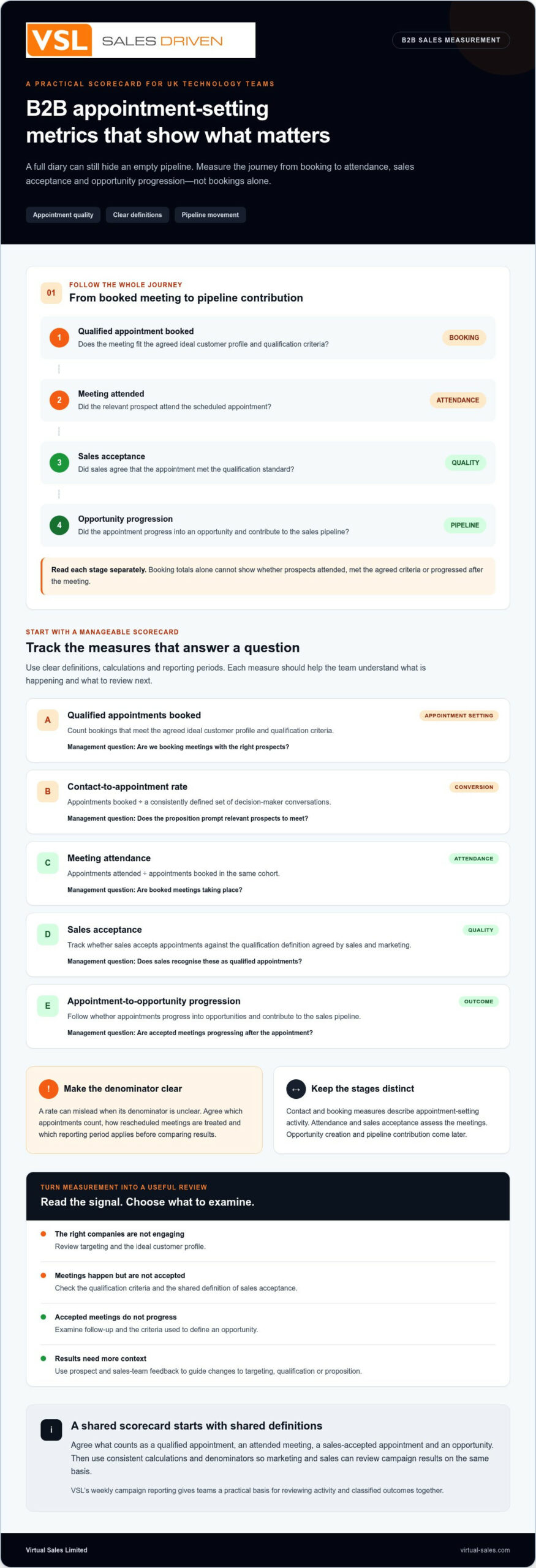
Start with a small scorecard that follows appointments from booking to sales progression. These b2b appointment setting metrics are useful when each has an agreed definition, calculation and reporting period. A rate without a clear denominator can mislead, even when the arithmetic is correct.
| Metric | Definition and calculation | Stage | Management question |
|---|---|---|---|
| Qualified appointments booked | Count of bookings that meet agreed ICP and qualification criteria. | Appointment setting | Are we booking meetings with the right prospects? |
| Contact-to-appointment rate | Appointments booked divided by a consistently defined set of decision-maker conversations. | Conversion | Does the proposition prompt relevant prospects to meet? |
| Meeting attendance | Appointments attended divided by appointments booked in the same cohort. | Meeting quality | Are confirmation and meeting expectations clear? |
| Sales acceptance | Appointments accepted by sales divided by the agreed eligible meeting group, such as attended appointments. | Sales handover | Do booked meetings meet sales’ fit and follow-up criteria? |
| Appointment-to-opportunity conversion | Accepted meetings that progress to an opportunity divided by accepted meetings eligible for assessment. | Pipeline progression | Are meetings contributing to qualified pipeline? |
| Qualification completeness | Records with all required qualification fields completed divided by records reviewed. | Appointment quality | Does sales have enough context to prepare and follow up? |
| Time to schedule | Elapsed time between the agreed starting point and appointment booking, reported using a consistent measure such as median time. | Scheduling | Is scheduling delay affecting the campaign? |
How should you calculate attendance and sales acceptance?
For attendance, divide meetings attended by meetings booked from the same cohort. Decide in advance how to treat cancellations and rescheduled meetings: for example, whether a rescheduled appointment remains in its original cohort or moves to the new booking period. Keep incomplete records visible rather than silently excluding them. Define sales acceptance with the sales team, including fit and required follow-up, then apply that definition consistently.
How can you connect meetings to qualified opportunities?
Track accepted meetings that progress to a sales-qualified lead or opportunity, and agree an attribution window with sales rather than choosing an arbitrary default. Report pipeline contribution separately from bookings and activity. Harvard Business Review recommends that sales teams deconstruct their sales conversion funnels to identify useful measures at each stage. For examples of how VSL appointment-setting work is reviewed, see its appointment-setting client reviews.
What does a useful appointment-setting scorecard reveal in practice?
Illustrative UK technology campaign scenario, not VSL campaign data: A software company is targeting IT decision-makers with a new cloud service. Its booking count looks strong against its internal plan, but sales accepts relatively few meetings. The booking total shows scheduled conversations; sales acceptance shows whether those meetings meet the sales team’s agreed criteria for fit and follow-up. The figures answer different questions, so the scorecard should keep each stage distinct.
Track the progression using consistent definitions:
- Qualified appointments booked: Do the companies and decision-makers fit the agreed ideal customer profile?
- Meetings attended: Are prospects attending the conversations they booked?
- Sales acceptance: Do attended meetings meet the team’s criteria for fit and follow-up?
- Opportunity progression: Do accepted meetings progress to a sales-qualified lead or opportunity?
A high booking count paired with weak acceptance is a reason to investigate, not proof of a particular cause. Target decision-makers may be too broadly defined, qualification details may be missing, or sales and marketing may be applying different standards. The scorecard identifies where to ask questions; feedback from campaign and sales teams helps explain the gap.
How should teams interpret a gap between booked and accepted meetings?
Check the ideal customer profile and decision-maker criteria, then review whether qualification information is captured consistently. Ask sales colleagues to record structured feedback on fit, need and next steps. Compare like with like: a booking count and an acceptance rate based only on attended meetings do not share the same denominator.
What should you do when meetings fail to progress?
Review prospect feedback and sales follow-up first. Check that meeting outcomes and next steps are recorded consistently in the CRM, and that opportunity creation follows agreed criteria. If the evidence points to an issue with the proposition, qualification or follow-up, test one change at a time so the team can assess its effect.
Results, Evidence & Data
The scenario above is illustrative, not a verified client result. No specific VSL campaign outcomes or conversion figures are available to report here, so none are presented as evidence or benchmarks. VSL’s weekly campaign reports include call metrics and classified outcomes, supporting a shared review of campaign activity and prospect feedback without implying a guaranteed level of appointments or pipeline contribution.

How can you build a B2B appointment setting framework around the metrics?
Turn measurement into a working process, not a report that ends at the booking total. A practical framework for b2b appointment setting metrics has five steps:
- Define the stages: Agree when a prospect becomes a booked, attended, accepted or progressed appointment.
- Set qualification criteria: Use BANT to assess Budget, Authority, Need and Timeline. It helps establish a prospect’s situation; it doesn’t guarantee a purchase.
- Select measures: Choose a small set that covers activity, appointment quality and later sales outcomes.
- Review outcomes: Compare results with the agreed definitions and discuss exceptions with campaign and sales owners.
- Adjust: Use evidence and prospect feedback to decide whether to refine targeting, qualification, proposition or follow-up.
VSL’s weekly campaign reporting brings together call metrics and classified outcomes, such as Call Back, Warmer Contact, Warm Lead, Future Opp, Not Interested and Happy to Keep in Touch. The review should connect those observations to agreed next steps, without treating every outcome as an appointment or pipeline opportunity.
How should teams agree definitions and reporting ownership?
Write down what qualifies as booked, attended, sales-accepted and progressed, including how cancellations, reschedules and incomplete records are handled. Assign campaign owners to maintain appointment and campaign outcomes, and sales owners to update acceptance and opportunity progression. Revisit definitions when the process changes; where possible, preserve the old rules in reports so comparisons remain clear.
How can CRM reporting support the framework?
VSL uses a cloud-based CRM to manage campaign activity and outcomes. Campaign data can be output for use with popular CRM platforms such as HubSpot and Salesforce; this does not imply a direct integration. A CRM can provide a shared record, but the value depends on agreed definitions and timely, consistent updates from the people responsible.
Simple scorecard layout
- Metric and definition: What is measured, and how is it calculated?
- Owner and reporting period: Who updates it, and which dates or cohort does it cover?
- Result and next action: What does the recorded result suggest, and what will the team review or change?
For a broader view of how sales measures support management decisions, see VSL’s guide to sales development metrics that matter to CEOs.
Using Appointment Results to Decide Your Next Steps
Use campaign results to identify where progress is slowing, then test a focused change. If suitable companies aren’t responding, review targeting or the proposition. If meetings are booked but sales doesn’t accept them, check qualification criteria and how consistently they’re applied. If accepted meetings don’t progress, look at sales follow-up, prospect need and how outcomes are recorded.
Don’t change several parts of the campaign at once. Compare like-for-like reporting periods and cohorts, then adjust one factor so the team can assess whether it made a difference. Set benchmarks using comparable campaigns or verified external research, not assumptions or a figure borrowed from a different market, audience or sales process. B2B appointment setting metrics are most useful when they inform a decision, not when they’re treated as targets without context.
When should a technology company review its appointment-setting approach?
Review the approach when entering a market, targeting a new ideal customer profile or testing a proposition. Compare campaign outcomes with structured sales feedback to distinguish a targeting issue from a qualification gap. For example, repeated feedback that a prospect’s role is outside the buying process may point to audience criteria; feedback that the need or timing is unclear may call for sharper qualification.
Consider whether your internal team can maintain consistent business-development activity alongside its other responsibilities. External support may be relevant, but it isn’t the right answer for every business. Check that the activity, qualification approach and reporting fit your sales process before deciding.
What evidence should you assess before choosing external support?
Ask how a provider defines a qualified BANT lead and how it distinguishes appointments from later pipeline outcomes. Clarify who manages the campaign, what the reporting includes and how prospect feedback informs recommendations. VSL provides weekly campaign reporting, with a dedicated caller and campaign manager supporting the work as an extension of the client’s sales and marketing team.
Review the provider’s appointment setting services alongside the reporting approach. To assess how campaign measures relate to commercial contribution, see this guide to calculating appointment-setting ROI.
If you’re weighing up appointment-setting support for a technology business, you can explore VSL’s UK technology appointment-setting service and consider whether its approach fits your team’s goals.
25+ Years Helping Technology Companies Generate Qualified Sales Meetings
Every successful campaign starts with a conversation.
#OneStepCloser 🚀
Explore UK technology appointment setting with VSL
Build a clearer path from meetings to pipeline
Useful b2b appointment setting metrics track more than bookings. They show whether the right prospects attend, whether sales accepts the meetings and whether opportunities progress. Agree definitions, owners and reporting periods so each measure leads to a clear action. Set benchmarks using comparable campaigns or verified research, then use sales feedback to decide whether to refine targeting, qualification, the proposition or follow-up.
VSL has supported technology companies in the UK and USA since March 2001. Experienced UK-based callers use consultative conversations and qualify leads to BANT criteria as a minimum. Each campaign has a dedicated campaign manager, and clients receive weekly reporting to support shared review and improvement.
With clear measures and the right feedback, your team can make more confident campaign decisions and focus on opportunities that fit your business. Keep testing, learning and building a stronger view of pipeline progress.
Frequently Asked Questions
Which B2B appointment setting metrics should a sales team track?
Track a focused set of b2b appointment setting metrics across booking, attendance, sales acceptance and pipeline progression. Useful measures include qualified appointments booked, meeting attendance rate, sales acceptance rate and appointment-to-opportunity conversion. Add contact-to-appointment rate if the team defines which conversations count in its denominator. Give each metric an agreed calculation, reporting period and owner, so the scorecard supports decisions rather than simply adding numbers to a report.
How do you calculate the appointment show rate?
Divide the number of appointments attended by the number booked in the same cohort, then multiply by 100 to express the result as a percentage. Agree how to treat cancellations and rescheduled meetings before calculating it. For example, decide whether a rescheduled meeting stays with its original booking cohort or moves to the period when it takes place. Apply the same rule consistently, and flag incomplete records rather than silently excluding them.
What is a good B2B appointment-setting conversion rate?
There isn’t one conversion rate that suits every B2B technology campaign. Results depend on factors such as the target audience, proposition, qualification rules and how each stage is defined. Choose a specific measure, such as decision-maker conversations resulting in booked appointments, and use a consistent numerator and denominator. Compare it with results from similar campaigns or verified external research, not a generic benchmark that may not fit your market or sales process.
How do you measure the quality of a booked sales appointment?
Assess whether the prospect and organisation fit your ideal customer profile, whether the right decision-maker is involved, and whether agreed qualification information has been captured. BANT checks Budget, Authority, Need and Timeline, but the sales team should also define its own acceptance criteria. Record whether the meeting took place, whether sales accepted it and what follow-up was agreed. A booking alone doesn’t confirm that the appointment is useful to the sales team.
How can appointment-setting metrics show pipeline contribution?
Track appointments through sales acceptance to sales-qualified leads and opportunities, using your organisation’s agreed stage definitions. Measure how many accepted meetings progress, and report resulting pipeline separately from bookings and outreach activity. Agree an attribution window with sales before reporting, so teams assess outcomes over a consistent period. This helps show where appointments contribute to pipeline without treating every booking as an opportunity or claiming revenue before it is recorded.
How often should a business review appointment-setting metrics?
Set a review cadence that matches the campaign and sales cycle. Regular reviews during active campaigns can help teams respond to call outcomes, meeting feedback and data-quality issues. Assess later-stage progression over an agreed period that gives sales time to update outcomes. Keep definitions and reporting periods consistent, and use each review to agree a specific next action rather than reacting to an isolated result.
What is the difference between a qualified BANT lead and a sales-qualified lead?
A qualified BANT lead has been assessed against Budget, Authority, Need and Timeline as a minimum qualification framework. A sales-qualified lead (SQL) is a qualified lead that the sales team considers suitable for direct engagement, using its own acceptance criteria. The terms aren’t interchangeable: a lead can meet BANT criteria yet still need review against the company’s fit, priority or handover rules before sales accepts it.


Disclaimer
Disclaimer: Content is for general information only and does not constitute professional advice. Results may vary. Virtual Sales Limited accepts no liability for actions taken based on this content.