


Why does your Finance team readily approve £50,000 for digital ads with a 2% conversion rate but stall when you propose a human-led outbound strategy? You likely feel the pressure to rely on “low-cost” digital leads that fail to move the needle on revenue. It’s a common roadblock; budget rejection often stems from the perception that outbound calling is an old-fashioned expense rather than a strategic asset. To win this battle, you must master how to convince your CFO to invest in telemarketing by reframing the conversation around de-risked capital and predictable growth.
We agree that relying on passive lead sources is a gamble your 2026 pipeline cannot afford. This article promises to arm you with the exact framework and financial language needed to win CFO approval for B2B telemarketing. We’ll examine how to link human-led conversations directly to your CRM data; providing a transparent view of ROI that Finance can trust. This is your roadmap to transforming outbound activity into a predictable, elite component of your internal growth team.
Key Takeaways
- Learn how to convince your CFO to invest in telemarketing by reframing outbound activity as a de-risked capital investment in your 2026 revenue engine.
- Use the VSL Strategic Pitch Framework to align your campaign with essential unit economics such as CAC and LTV.
- Identify the hard metrics Finance teams require, including meeting-to-SQL ratios and predictable benchmarks of 10–20 high-quality meetings per month.
- Leverage cloud-based CRM integrations with HubSpot or Salesforce to provide the transparent reporting that builds long-term budget trust.
- Quantify the Cost of Inaction to demonstrate how a stagnant pipeline directly threatens market penetration and overall company valuation.
Why CFOs Block Telemarketing Spend: Bridging the 2026 Trust Gap
CFOs don’t reject budgets because they hate growth; they reject them because they fear opacity. In the eyes of Finance, telemarketing often sits in the same bucket as high-volume, low-value telesales. This is a primary friction point where outbound activity is viewed as an opaque expense rather than a strategic asset. When you are determining how to convince your CFO to invest in telemarketing, you must bridge this trust gap by proving that human-led outreach is a revenue engine, not a cost centre.
The Perception Problem: Expense vs. Investment
The biggest hurdle is the “pay-and-spray” ghost of the past. CFOs often associate outbound calling with a lack of targeting and poor brand representation. However, a modern understanding modern telemarketing reveals a shift toward intent-based calling. This isn’t about dialling for the sake of dialling; it’s about using market intelligence to find the right person at the right time. High-quality strategic B2B telemarketing acts as a market intelligence tool that provides real-time feedback from your target accounts.
Relying solely on “cheap” digital leads is a false economy. These leads often lack depth and waste expensive Account Executive (AE) time on low-intent prospects. A strategic partner acts as an elite, integrated component of your team, filtering out the noise. This ensures your high-paid closers only speak to qualified decision-makers. It’s a tactical execution that protects your most valuable internal resources and improves your overall CAC (Customer Acquisition Cost).
The 2026 Revenue Reality
Digital-only strategies are hitting a ceiling. Gartner research indicates that the B2B buying journey now requires multiple human touchpoints to navigate complex decision-making units. Algorithms can’t navigate a boardroom, but a professional caller can. This human intervention is often the only way to reach C-suite decision-makers who are shielded by digital filters. Strategic outreach shortens the sales cycle by qualifying intent early and building a B2B appointment setting pipeline that is predictable.
In 2026, the “Cost of Inaction” is a heavy burden. A stagnant pipeline doesn’t just slow growth; it actively devalues the company. If you aren’t proactively engaging your market, you lose ground to competitors who are. Securing this investment isn’t just about making calls. It is about protecting your company valuation by ensuring a steady flow of high-value opportunities into your sales funnel.
The VSL Strategic Pitch Framework: 5 Steps to CFO Approval
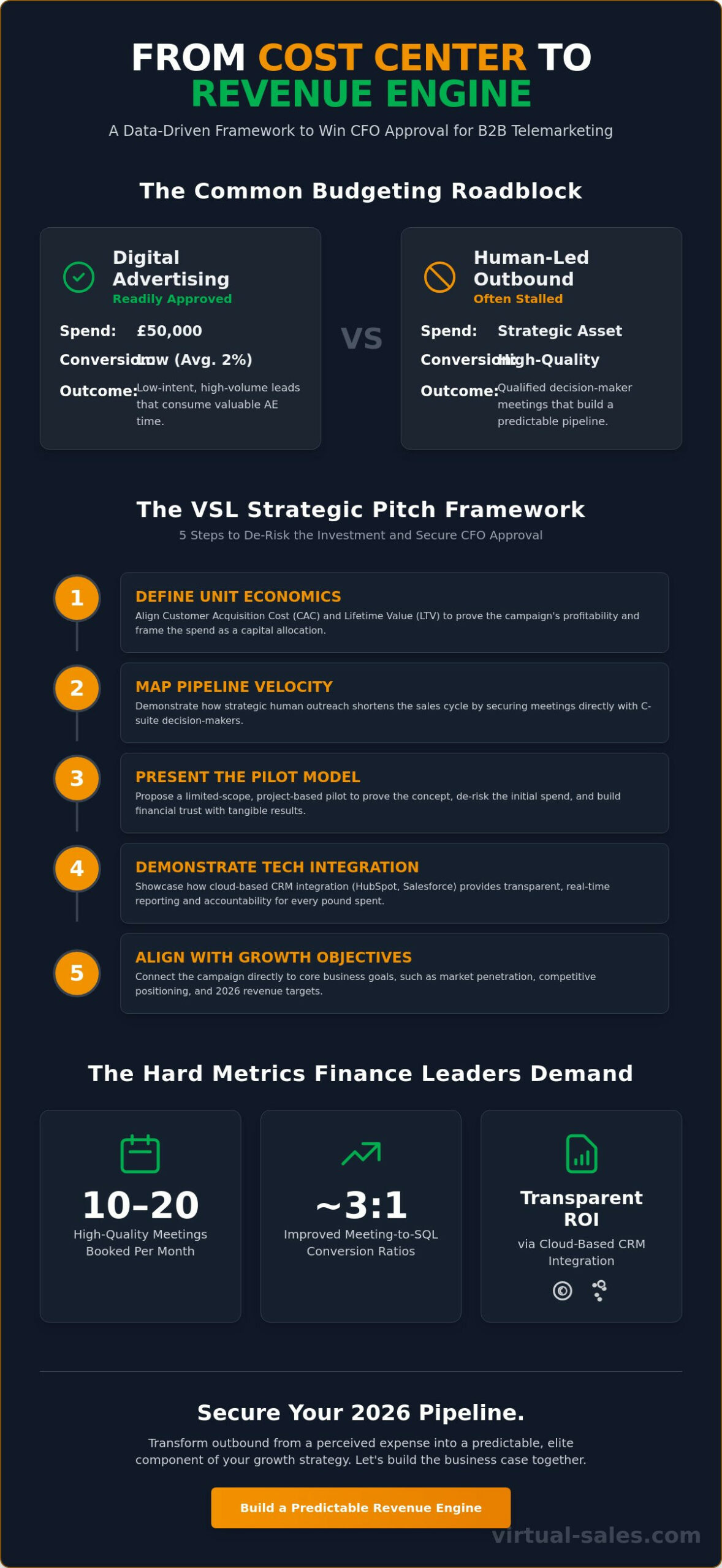
CFOs demand clinical precision. To secure budget, you need a repeatable method that treats marketing spend as a capital allocation. The VSL Strategic Pitch Framework provides this structure; moving the conversation away from “activity” and toward “capital efficiency.” This five-step method is your blueprint for how to convince your CFO to invest in telemarketing by speaking the language of the boardroom.
- Step 1: Define Unit Economics: Align CAC and LTV to prove profitability.
- Step 2: Map Pipeline Velocity: Demonstrate how outbound activity accelerates the sales cycle.
- Step 3: Present the Pilot Model: Propose a project-based approach to de-risk the initial spend.
- Step 4: Demonstrate Tech Integration: Show how CRM transparency ensures accountability.
- Step 5: Align with Growth Objectives: Connect the campaign directly to 2026 revenue targets.
Step 1 & 2: Speaking the Language of Unit Economics
Finance leaders prioritise unit economics over vanity metrics. You must define your Marketing Contribution to Pipeline (MCP) with absolute clarity. Using professional b2b appointment setting allows you to stabilise lead flow and calculate a predictable CAC. Contrast the cost of the campaign against the potential £ return of a single closed deal. If one enterprise contract is worth £50,000 and the campaign costs £5,000, the ROI is self-evident. This shift from “leads” to “revenue potential” is critical for budget approval.
Step 3 & 4: De-risking the Ask
High-risk asks get rejected. De-risk the investment by proposing a project-based pilot model. This proves the concept without the long-term commitment of a heavy retainer. Leveraging sales team outsourcing removes the internal hiring overheads, NI contributions, and training costs that often bloat budgets. Focus on “Time to Value.” A dedicated outbound team can fill a dry pipeline in weeks, whereas an internal hire might take months to reach full productivity. This speed to market is a powerful lever in your pitch.
Finally, align the activity with your 2026 corporate growth objectives. CFOs fund what they can measure. Demonstrate how cloud-based CRM integration with HubSpot or Salesforce provides total visibility into the sales funnel. This transparency ensures that every £ spent is tracked from the initial dial to the final invoice. Reviewing verified case studies can help you benchmark these metrics against industry standards before presenting your final case.
Real Insight: Turning a “No” into a £1M Pipeline
Understanding how to convince your CFO to invest in telemarketing often requires a fundamental shift in perspective. Take the case of a mid-sized SaaS firm in early 2026. They were struggling with a 40% drop in inbound lead quality. Their initial request for an outbound budget was flatly rejected. The CFO viewed it as a desperate move to buy volume. To win, the team had to pivot. They stopped asking for “outbound calling” and started pitching a “targeted market penetration strategy.”
The breakthrough came from a clinical adjustment to the pitch. Instead of requesting a broad budget, they proposed using intent data to target only high-fit accounts that were already showing active buying signals. This de-risked the investment by ensuring every dial was high-value. The CFO approved a three-month pilot. The result was a 10x ROI in qualified opportunities, generating a £1M pipeline from a fraction of the cost of their underperforming digital ads.
Scenario: The Software Sector Pivot
In 2026, lead generation for software is a battle for attention in a saturated market. This firm presented a clear comparison: a high Cost Per Lead (CPL) from digital sources that never converted versus a predictable Cost Per Meeting (CPM) from human-led outreach. They highlighted the professional maturity of the callers as a key differentiator. These were not script-readers; they were proactive insiders capable of engaging CTOs in complex technical discussions. This human touch ensured that meetings weren’t just booked; they were qualified and ready to close.
Lessons from the Boardroom
Boardroom resistance usually centres on attribution and lead decay. During the pitch, the CFO asked a critical question: “How do we know these meetings wouldn’t have happened anyway?” The team countered by showing the total absence of these high-value accounts in their inbound funnel. They used clutch appointment setting uk reviews to provide third-party validation of the methodology. This moved the narrative from “we need more leads” to “we need to protect our market share.” By framing the campaign as a defensive and offensive necessity, they secured the budget needed to scale their 2026 revenue engine.

Results and Data: The Hard Metrics Finance Leaders Demand in 2026
CFOs don’t fund activities; they fund outcomes. To master how to convince your CFO to invest in telemarketing, you must present a data set that survives a clinical audit. Gartner research confirms that 70% of B2B buyers prefer human interaction when navigating complex solutions. This preference translates into hard pipeline value. Finance leaders in 2026 prioritize three specific pillars: conversion rates, Meeting-to-SQL ratios, and payback periods. Providing these benchmarks upfront removes the perceived risk of the “opaque expense” discussed earlier.
For a dedicated professional campaign, you should benchmark a return of 10 to 20 high-quality meetings per month. This isn’t a guess; it’s a standard for elite outbound teams. These meetings serve as a primary lever for reducing your overall Customer Acquisition Cost (CAC). By qualifying intent through a human conversation, you ensure your sales team avoids the lead decay typically seen in digital-only funnels. This precision allows you to reallocate budget from underperforming ads into a high-converting human channel.
The ROI Calculation for Telemarketing
Finance teams require a clear path to profitability. Use this clinical formula: (Total Deal Value from Meetings minus Campaign Cost) divided by Campaign Cost. Consider a typical UK software campaign. If the campaign costs £10,000 and generates £100,000 in closed-won deal value, your ROI is 900%. Beyond the immediate win, you must account for “Lead Nurture Value.” This is the quantified £ value of the database development over time. Every conversation is a data point that matures, creating a secondary pipeline of future opportunities that Finance can forecast with confidence.
Attribution and Transparency
Budget rejection often happens because of “attribution fog.” CFOs want to know if the lead was truly generated by the outbound effort. While the “First Touch” vs. “Last Touch” debate continues, B2B telemarketing services provide a measurable, scalable lever that cuts through the noise. VSL provides real-time reporting through cloud-based CRM integrations; ensuring every £ is accounted for in HubSpot or Salesforce. This level of transparency proves that outbound activity is a direct revenue driver, not a secondary support function. To see how these metrics perform in real-world scenarios, review our verified UK appointment setting results.
Securing the Investment: Integrating Telemarketing into Your Growth Strategy
Securing budget is only the beginning. To maintain the trust you’ve built, you must integrate outbound activity into your wider 2026 growth strategy. A successful pitch concludes by showing how telemarketing doesn’t just sit alongside your sales team; it powers it. This requires a shift from viewing calling as a siloed task to seeing it as a data-rich component of your revenue operations. When you are finalising how to convince your CFO to invest in telemarketing, focus on the long-term stability it brings to your pipeline.
CFOs are notoriously protective of data integrity. They won’t fund a campaign that dials into a broken database. Implementing a rigorous b2b data cleansing process ensures that every dial is directed at a verified, high-intent prospect. This maximizes outreach efficiency and proves to Finance that you are a responsible steward of company capital. By removing redundant records and outdated contacts, you ensure the investment is spent on active opportunities rather than dead ends.
The Tech Stack Advantage
Transparency is the ultimate de-risking tool. We integrate directly with cloud-based CRMs like HubSpot and Salesforce to provide a single source of truth. Automated reporting removes the manual burden of tracking and ensures the CFO has real-time visibility into the pipeline. This integration allows you to track a lead from the first dial to the final invoice; providing the clinical accountability that Finance leaders demand. It transforms telemarketing from a “black box” expense into a transparent, measurable component of your tech stack.
Next Steps: Launching Your Pilot
Don’t aim for a year-long contract immediately. Propose a 90-day pilot focused on a specific set of target accounts. This proof of concept allows you to define success metrics that both Sales and Finance agree on; such as meeting-to-SQL conversion rates or specific market penetration targets. Once the pilot delivers the ROI discussed in our earlier sections, the path to a permanent budget becomes clear. This phased approach respects the company’s capital while providing the momentum needed to scale.
Virtual Sales Limited (VSL) functions as an elite, integrated extension of your internal team. We don’t just book meetings; we build and nurture your B2B appointment setting pipeline using professional, UK-based staff. Our proactive approach ensures that your 2026 growth targets are not just ambitious goals, but predictable outcomes. Contact us today for a custom ROI projection and see how we can help you win the boardroom battle.
Mastering the 2026 Revenue Pitch
CFOs in 2026 don’t want more activity. They want de-risked revenue. You’ve learned that the secret to how to convince your CFO to invest in telemarketing lies in translating outbound dials into the language of unit economics and pipeline velocity. By moving away from opaque expenses and toward a transparent, CRM-integrated extension of your team, you eliminate the friction that causes budget rejection. This transition ensures that every pound spent is an investment in a predictable revenue engine.
The path to a £1M pipeline starts with a clinical pilot and a focus on high-intent data. At Virtual Sales Limited (VSL), we bring over 20 years of B2B expertise specifically within the IT and Software sectors. As a Clutch-verified 5-star appointment setting agency, we understand the nuances of the complex buying cycle and the technical accuracy required to engage C-suite decision-makers. Don’t let a stagnant pipeline threaten your 2026 market share. It’s time to build a business case that Finance can’t ignore. Book a Strategic Consultation to Build Your Telemarketing Business Case and secure the investment your growth deserves.
Frequently Asked Questions
How do I prove telemarketing ROI when sales cycles are 6-12 months long?
You prove ROI by tracking leading indicators such as Sales Qualified Leads (SQLs) and the total £ value of the pipeline generated. While final revenue may take 12 months, the Marketing Contribution to Pipeline (MCP) provides an immediate metric for success. Tracking these milestones in your cloud-based CRM ensures that Finance sees the momentum and potential revenue long before the final deal closes. This transparency builds the trust necessary for sustained investment.
What is a reasonable Cost Per Meeting (CPM) for UK B2B telemarketing in 2026?
A reasonable CPM depends on the seniority of the decision-maker and the complexity of your solution. Rather than focusing on a single industry average, you should evaluate the CPM against your average deal value. If a single closed-won contract is worth £50,000, a campaign that delivers high-quality meetings remains highly efficient even at a premium cost level. Precision targeting ensures your budget isn’t wasted on low-value prospects who won’t convert.
How can I reassure my CFO about brand reputation during outbound calling?
Reassure your CFO by highlighting the professional maturity and geographic location of the calling team. VSL uses mature, UK-based staff who act as an elite, integrated extension of your own internal workforce. This isn’t high-volume telesales; it’s sophisticated outreach that maintains brand integrity through peer-to-peer conversations with C-suite executives. This professional approach mitigates the risk of brand damage often associated with lower-cost, international call centres that rely on rigid scripts.
Should I pitch for an in-house team or an outsourced agency to my CFO?
Pitching an outsourced model is often more attractive to a CFO because it removes internal overheads like National Insurance, training costs, and recruitment fees. Outsourcing provides immediate speed to market and allows you to de-risk the investment through project-based pilots. It’s a tactical execution that offers greater flexibility than hiring a permanent internal team; especially when you need to fill a dry pipeline quickly and efficiently without long-term employment liabilities.
What are the top 3 metrics a CFO actually cares about in a sales pitch?
CFOs primarily care about Customer Acquisition Cost (CAC), Lifetime Value (LTV) alignment, and the total Payback Period. When learning how to convince your CFO to invest in telemarketing, you must demonstrate how outbound activity lowers CAC by delivering higher-intent leads than passive digital channels. These metrics prove the long-term sustainability of the investment and show how a human-led strategy contributes directly to your 2026 corporate growth objectives.
How does telemarketing integrate with our existing HubSpot or Salesforce CRM?
Modern telemarketing integrates directly with HubSpot and Salesforce to create a single source of truth for your sales data. VSL provides real-time reporting that feeds activity and lead data directly into your existing tech stack. This ensures total transparency and accountability; allowing your Finance team to audit the campaign’s performance at any moment. This connectivity eliminates the attribution fog that often leads to the rejection of marketing and sales budgets.
Can we start with a small project-based budget to prove the concept?
Starting with a 90-day pilot is a proven strategy to prove the concept with minimal risk to the business. This project-based approach allows you to establish success benchmarks and demonstrate ROI before committing to a larger annual budget. It’s a clinical way to show the CFO that the methodology works in your specific market. Once the pilot proves successful, you’ll have the data-driven framework needed for full, long-term budget approval.
What does Gartner say about the role of human-led outreach in 2026?
Gartner research indicates that human-led interaction is essential for navigating the consensus-based buying cycles of 2026. Because modern B2B deals involve multiple stakeholders, digital-only strategies often fail to gain the necessary internal traction. Professional telemarketing bridges this gap by facilitating the cross-departmental conversations required to move complex deals forward. This human element is what shortens the sales cycle and drives predictable growth in a crowded and competitive market.


Disclaimer
Disclaimer: Content is for general information only and does not constitute professional advice. Results may vary. Virtual Sales Limited accepts no liability for actions taken based on this content.