


The median B2B sales forecasting accuracy has reached 71% in 2026, yet many software firms still find themselves trapped in a cycle of lumpy revenue and unpredictable churn. If your board reporting is currently a source of anxiety rather than a demonstration of control, you aren’t alone. Most leaders agree that long software sales cycles and inconsistent pipeline data make it difficult to commit to aggressive growth targets, which is why many now utilise outsourced sales for software companies to stabilise their lead flow. You need a model that provides clinical clarity instead of guesswork.
In this guide, we’ll demonstrate how to master the methodologies required to predict software revenue and align your pipeline with 2026 market dynamics. You’ll gain the insights needed to make smarter hiring decisions and scale your operations with confidence. We provide a repeatable framework for monthly and quarterly accuracy, ensuring your marketing spend finally aligns with your sales results. It’s time to move beyond reactive planning and start driving sustainable, predictable growth for your business.
Key Takeaways
- Learn why software sales forecasting in 2026 relies on the intersection of historical velocity and real-time market intent.
- Discover how to implement a repeatable 5-step framework to audit your sales baseline and eliminate guesswork from your quarterly projections.
- Understand the strategic role of outsourced sales for software companies in providing the high-volume pipeline required to hit aggressive ARR targets.
- Access industry-standard conversion benchmarks to align your marketing spend with actual closed-won results.
- Explore a real-world scenario of a UK fintech scaling to £5M ARR by solving the challenge of inconsistent lead generation.
The Critical Role of Sales Forecasting and Outsourced Sales for Software Companies
Software sales forecasting is the technical intersection of historical performance, pipeline velocity, and real-time market intent. In 2026, relying on gut feeling is a liability. Software firms operate in a high-volatility environment where long enterprise sales cycles, often spanning 6 to 18 months, create lumpy revenue that makes board reporting difficult. Churn risks further complicate these projections, as losing a single high-value account can derail quarterly targets. Accurate forecasting provides the clinical clarity needed to manage these variables and ensure growth remains predictable.
We’ve moved beyond static spreadsheets. Modern leaders use cloud-based CRM integrations like Salesforce and HubSpot to gain real-time visibility into every deal stage. However, even the most sophisticated software can’t fix the “Input Gap.” Most forecasts fail because they don’t account for lead quality at the top of the funnel. If your pipeline is filled with low-intent noise, your revenue projections will never manifest. This is why high-growth firms utilise outsourced sales for software companies to ensure a consistent stream of qualified, high-intent opportunities that bridge the gap between marketing spend and closed deals.
Why Software Revenue Models Demand Specialised Forecasting
Software revenue is unique. Projections must distinguish between one-time implementation fees and Annual Recurring Revenue (ARR). While implementation fees provide immediate cash flow, ARR drives your company valuation and long-term sustainability. Your 2026 model must also account for the “Land and Expand” strategy. This involves forecasting expansion revenue from existing accounts alongside net-new business. Finally, churn rate is the silent killer. Even a 5% increase in churn can negate a successful quarter of new sales. Your forecast must be a living document that reacts to these retention metrics in real-time.
Common Software Forecasting Pitfalls to Avoid
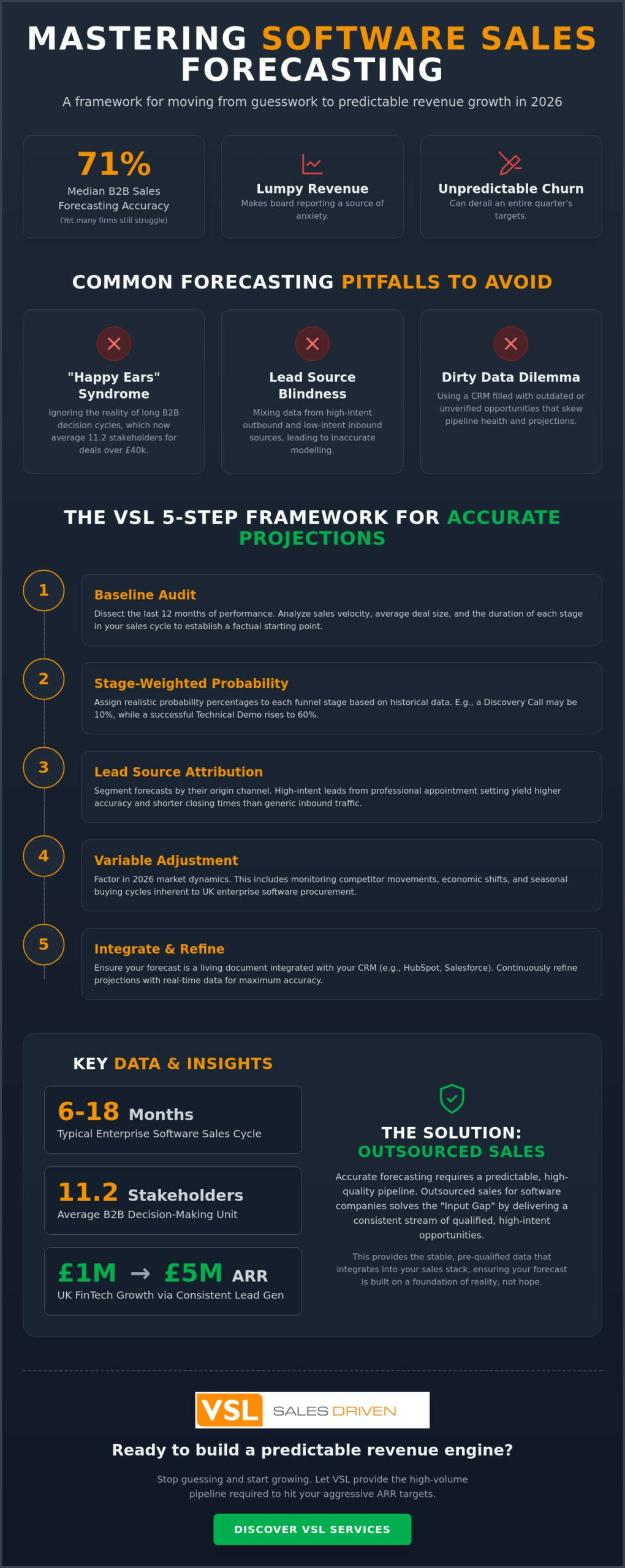
Avoid “happy ears.” Sales representatives often discount the reality of elongated B2B decision-making units, which now average 11.2 stakeholders for deals over £40,000. Another pitfall is ignoring lead source variance. Outbound leads typically have different conversion rates and sales velocities than inbound sign-ups. Mixing these data sets leads to inaccurate modelling and missed targets. Success requires rigorous B2B data cleansing. Without clean, verified data, your CRM becomes a graveyard of dead opportunities that skew your pipeline health. Reliable outsourced sales for software companies solve this by providing pre-qualified data that integrates directly into your sales stack, ensuring your forecast is built on a foundation of reality rather than hope.
The VSL 5-Step Framework for Software Sales Projections
The VSL Method shifts the focus from “hope-based” models to a proactive strategy that prioritises pipeline health. Many tech firms fail because they look back at historical data without assessing the quality of current inputs. It’s a mistake to assume last year’s performance dictates next month’s results in a shifting market. Our framework ensures your revenue targets are grounded in real-world activity. When you utilise outsourced sales for software companies, you gain a predictable volume of top-of-funnel opportunities that makes this framework significantly more accurate.
- Step 1: Baseline Audit. We begin by dissecting the last 12 months of performance. This involves analysing sales velocity, average deal size, and the specific duration of each stage in your sales cycle to establish a factual starting point.
- Step 2: Stage-Weighted Probability. We assign realistic probability percentages to each step of your funnel. A discovery call might carry a 10% weight, whereas a successful technical demo might rise to 60% based on verified historical closing data.
- Step 3: Lead Source Attribution. We segment forecasts by channel. High-intent professional appointment setting often yields a higher forecast accuracy and shorter closing time than generic organic inbound traffic.
- Step 4: Variable Adjustment. We factor in 2026 market dynamics. This includes monitoring competitor movements and the specific seasonal buying cycles inherent to UK enterprise software procurement, ensuring your model remains resilient.
Step 5: The Iterative Feedback Loop
Accuracy is a moving target. We conduct Forecast vs. Actual reviews every 30 days to refine your model. If SDR performance or meeting quality shifts, we adjust conversion ratios immediately. Using cloud-based reporting platforms like HubSpot or Salesforce, we provide stakeholders with real-time updates. This transparency allows for rapid scaling decisions and ensures that your internal team remains aligned with the latest data. Regular reviews prevent small discrepancies from becoming major revenue gaps that surprise the board.
Choosing Your Primary Forecasting Technique
Your choice of method depends on your operational maturity. The Length of Sales Cycle Method is essential for enterprise software with 6 to 18 month horizons. For high-volume SaaS with defined buyer journeys, Opportunity Stage Forecasting provides the most granular view of the pipeline. Established firms use Historical Forecasting as a baseline, but this often fails to account for rapid scaling or new product launches. To truly de-risk these projections, many leaders integrate outsourced sales for software companies to maintain a steady, high-quality lead volume that feeds the model consistently.
Real Insight: Scaling a SaaS Firm from £1M to £5M ARR
A prominent fintech provider recently faced the classic scale-up ceiling. At £1M ARR, their growth was stagnant because their pipeline was entirely reactive. Relying on inconsistent inbound leads led to a 40% variance in quarterly forecasts, making it impossible to plan resource allocation or justify further investment. They needed a clinical approach to revenue generation. Predictability was no longer a luxury; it was a requirement for their survival in a competitive market.
The firm moved away from passive lead capture and implemented a stage-weighted forecasting model. This was coupled with a dedicated outsourced lead generation SaaS strategy. By utilising outsourced sales for software companies, they gained control over the volume and quality of top-of-funnel inputs. Within two quarters, their forecast accuracy jumped to 92%. They weren’t just guessing anymore; they were engineering their growth through consistent, high-intent outreach.
This transition allowed the leadership team to hire with confidence. They knew exactly how many demos would result in a closed deal and, more importantly, when those deals would land. Predictability became their greatest competitive advantage in the 2026 market. By outsourcing the initial stages of the sales cycle, their internal account executives focused solely on closing, which doubled their conversion rate from SQL to Closed-Won.
Lessons from the Enterprise Software Frontline
- Decision Maker access is the single most important lead indicator for software deals. If your sales team is stuck talking to “champions” without budget authority, your forecast is a work of fiction. High-performing teams prioritise direct access to the C-suite or department heads to ensure timelines remain firm.
- Professional b2b appointment setting shortens the discovery stage significantly. Instead of your internal AEs spending weeks chasing prospects, they step into pre-qualified conversations. This efficiency allows you to move deals into the weighted stages of your forecast much faster.
- Technical proof-of-concept (POC) stages often act as a bottleneck. Our data shows that POCs can extend the closing timeline by an average of 45 days if not tightly managed. Your 2026 forecast must account for this technical drag to avoid over-promising to the board. Mastering these nuances is what separates a £5M ARR firm from those stuck at the £1M mark.

Results and Data: Benchmarking Your Software Sales Pipeline
Gartner research highlights that high-performing sales teams are 3x more likely to maintain a structured forecasting process. This isn’t a coincidence. It’s the result of treating the pipeline as a measurable engine rather than a collection of guesses. Teams that utilise outsourced sales for software companies often achieve a 15% to 25% increase in forecast predictability. This improvement stems from the consistent lead flow and pre-qualification that external specialists provide. By removing the burden of prospect identification from your internal team, you gain cleaner data and more reliable timelines.
Industry standards for software typically see MQL to SQL conversion rates between 10% and 15%. Moving from SQL to Closed-Won usually ranges from 20% to 30%, depending on the complexity of the solution. If your current metrics fall below these benchmarks, the issue often lies in the initial qualification stage. A weak top-of-funnel leads to “hope-based” forecasting, where sales reps cling to unlikely deals to meet their quotas.
The variance between a £10,000 and a £100,000+ Average Contract Value (ACV) significantly impacts forecast reliability. Smaller deals are generally more predictable and move through the funnel faster. Conversely, enterprise-level contracts introduce higher volatility. One delayed signature on a six-figure deal can swing your quarterly performance by double digits, making a high-volume top-of-funnel even more critical for risk mitigation.
Key Software Metrics for Your 2026 Dashboard
Your dashboard needs more than just a total revenue figure. The Pipeline Coverage Ratio is critical; you typically require 3x to 4x your target in active opportunities to account for inevitable slippage. Use the Sales Velocity Formula: (Number of Ops x Deal Value x Win Rate) / Sales Cycle Length. This calculation provides a clinical view of your growth trajectory, especially when scaling through outsourced sales for software companies. Stability in your ACV acts as a baseline, while tracking volatility metrics helps identify risks before they hit the bottom line.
Expected Results from Predictable Lead Flow
Consistency drives accuracy. Targeting 10 to 20 high-quality meetings per month creates the steady enterprise pipeline required for revenue stability. There is a direct correlation between this meeting volume and your ability to hit quarterly targets. VSL’s retainer-based telemarketing provides the continuous data stream needed for accurate modelling. By integrating these results into your CRM, you eliminate the peaks and troughs of traditional sales cycles and provide your board with the reliability they demand.
Review our verified performance benchmarks on Clutch to see how we deliver consistent pipeline results for software firms.
Integrating Your Forecast with Scalable Outsourced Sales for Software Companies
A revenue forecast is only as strong as the pipeline that feeds it. In the high-stakes environment of 2026, treat your forecast as a diagnostic tool rather than a passive report. If your projections reveal a shortfall in hitting Annual Recurring Revenue (ARR) targets, the solution isn’t to lower your expectations. Instead, use that data to justify a strategic investment in outsourced sales for software companies. By identifying the specific “Input Gap” in your funnel, you can procure the exact volume of high-intent leads required to bridge the distance between your current trajectory and your growth goals.
Data integrity relies on the synergy between CRM automation and human-led outreach. While platforms like Salesforce and HubSpot are excellent at tracking movement, they can’t verify the nuance of human intent or budget authority. We position our team as an elite, integrated component of your internal workforce. We provide the predictable input that makes predictable revenue possible. This human-led approach ensures that every opportunity entering your forecast is pre-qualified against the rigorous standards of the UK software market, preventing “junk” data from inflating your quarterly expectations.
Leveraging VSL for Forecast Certainty
Our experienced sales professionals specialise in removing the unqualified lead noise that typically clogs an enterprise forecast. We don’t just book meetings; we construct a pipeline based on clinical efficiency. By integrating VSL outreach data directly into your existing dashboards, you gain a transparent view of the buyer journey. This visibility allows you to move from reactive guessing to proactive pipeline construction. You’ll know exactly how many discovery calls are in play and their weighted probability of closing, allowing for smarter scaling decisions and more accurate board reporting.
Summary: Building Your 2026 Growth Engine
Mastering software sales in 2026 requires a shift from historical guesswork to a structured, proactive framework. We’ve explored the VSL 5-Step Method, starting with a baseline audit and moving through stage-weighted probabilities and iterative feedback loops. Success depends on tracking software-specific metrics like Sales Velocity and Pipeline Coverage rather than generic sales data. Human-led appointment setting remains the most reliable variable in this equation, providing the qualitative insights that algorithms often miss. It’s the most effective way to stabilise your lead flow and ensure your growth engine remains on track. Contact Virtual Sales Limited to stabilise your software sales pipeline today.
Secure Your 2026 Revenue Strategy
Accurate forecasting isn’t about looking at last year’s spreadsheets. It’s about engineering a pipeline that responds to real-time market intent. By adopting a stage-weighted framework and prioritising high-quality inputs, you eliminate the lumpy revenue that stalls growth. Integrating outsourced sales for software companies provides the consistent volume needed to make these projections a reality. It’s the difference between guessing your quarterly performance and controlling it with clinical precision.
Virtual Sales Limited (VSL) acts as a high-performing extension of your internal team. With 20+ years of expertise in IT and Software lead generation, we’re the Clutch-verified B2B appointment setting leader you can rely on. Our specialists ensure seamless integration with HubSpot, Salesforce, and other cloud CRMs to maintain total data transparency. Stop reacting to pipeline gaps and start building a resilient growth engine. Scale your software pipeline with VSL’s expert appointment setting and take command of your 2026 targets today. You have the tools to scale; now it’s time to execute.
Frequently Asked Questions
How often should a software company update its sales forecast?
Software companies should update their sales forecasts monthly at a minimum to account for shifts in pipeline velocity and buyer intent. High-growth firms often conduct weekly reviews to identify deal slippage early. This frequency ensures that your resource allocation and hiring decisions remain aligned with the latest data from your sales development team rather than outdated projections.
What is the most accurate sales forecasting method for SaaS startups?
Opportunity Stage Forecasting is typically the most accurate method for SaaS startups with clearly defined buyer journeys. By assigning probability percentages to milestones like technical demos or procurement reviews, you create a weighted model that reflects reality. This approach is superior to gut-feeling estimates and provides the transparency required for early-stage board reporting and investor relations.
How do I account for churn in my software sales projections?
Account for churn by deducting your historical attrition rate from your gross ARR projections to reach a net-new growth figure. You must distinguish between voluntary churn and contract expirations to gain a clear picture. Incorporating a churn buffer into your 2026 model prevents over-optimistic revenue reporting and ensures your cash flow projections remain grounded in actual retention data.
Can CRM tools like Salesforce automate my entire sales forecast?
CRM tools like Salesforce and HubSpot provide the infrastructure for automation but cannot verify the qualitative nuances of human intent. While they efficiently track deal movement, they require manual oversight to ensure data integrity. Successful firms use CRM automation for tracking and human-led analysis to validate the likelihood of a deal closing on time, especially for complex enterprise sales.
What is a good pipeline coverage ratio for B2B software?
A healthy pipeline coverage ratio for B2B software is typically 3x to 4x your quarterly revenue target. This multiple accounts for the inevitable deal slippage and procurement delays common in enterprise sales cycles. Maintaining this ratio provides a safety net that ensures you hit your numbers even if high-value opportunities move into the next fiscal period due to internal stakeholder delays.
How does outsourced sales for software companies improve forecast accuracy?
Utilising outsourced sales for software companies improves accuracy by providing a consistent, pre-qualified volume of leads at the top of the funnel. This steady input removes the “feast or famine” cycle often seen with internal teams. When your lead generation is predictable, your downstream revenue projections become significantly more reliable and easier to defend to stakeholders during quarterly reviews.
What external factors should I include in my 2026 software forecast?
Include 2026 market dynamics such as competitor product launches, UK economic shifts, and the increasing size of B2B buying committees. With the average buying group now exceeding 11 stakeholders for enterprise deals, your forecast must account for longer consensus-building periods. Ignoring these external variables leads to aggressive timelines that rarely manifest in closed-won revenue, creating friction with the board.
Is historical data still relevant for forecasting in a volatile tech market?
Historical data remains relevant as a baseline for understanding your sales velocity and average deal size, but it shouldn’t be your sole indicator. In a volatile tech market, you must balance past performance with real-time market intent data. Use historical trends to set baseline expectations and current pipeline health to validate your short-term revenue commitments to ensure accuracy.


Disclaimer
Disclaimer: Content is for general information only and does not constitute professional advice. Results may vary. Virtual Sales Limited accepts no liability for actions taken based on this content.