


A full calendar can still hide a weak sales pipeline. B2B appointment setting best practices start with fit, not volume. When teams contact businesses outside their target market, or judge campaigns by appointment numbers alone, salespeople can spend time on conversations that are unlikely to progress.
If you lead sales, marketing or business development at a technology, SaaS, software or IT services company, you’ll know that consistent outreach matters. But a meeting is useful only when it involves a relevant contact and gives your sales team enough context to decide what to do next. This guide covers how to build a more disciplined process, from defining your ideal customer profile to agreeing qualification criteria before outreach begins.
You’ll also learn how to review campaign outcomes and prospect feedback with your sales team, then use what you hear to refine targeting and messaging. The aim is to connect appointment setting to the wider purpose of B2B sales: creating relevant commercial conversations that can progress into qualified opportunities, rather than chasing activity for its own sake.
Key Takeaways
- Use B2B appointment setting to turn relevant business conversations into qualified sales meetings, and connect it clearly to your wider lead generation activity.
- Apply B2B appointment setting best practices by defining your ideal customer profile, identifying relevant decision-makers and preparing a clear proposition before outreach begins.
- Qualify each opportunity against Budget, Authority, Need and Timeline, focusing on useful context rather than the number of meetings booked.
- Track meeting quality, attendance, sales follow-up and pipeline contribution alongside activity measures to understand what your campaign is delivering.
- Use a regular review cycle to share prospect feedback with sales and marketing, then refine targeting and messaging based on what you learn.
What B2B appointment setting best practices are designed to achieve
B2B appointment setting means engaging business decision-makers and arranging qualified sales conversations. Its purpose isn’t simply to fill calendars. A booking alone doesn’t confirm that a prospect fits your target market, has a relevant need or is ready to speak with sales.
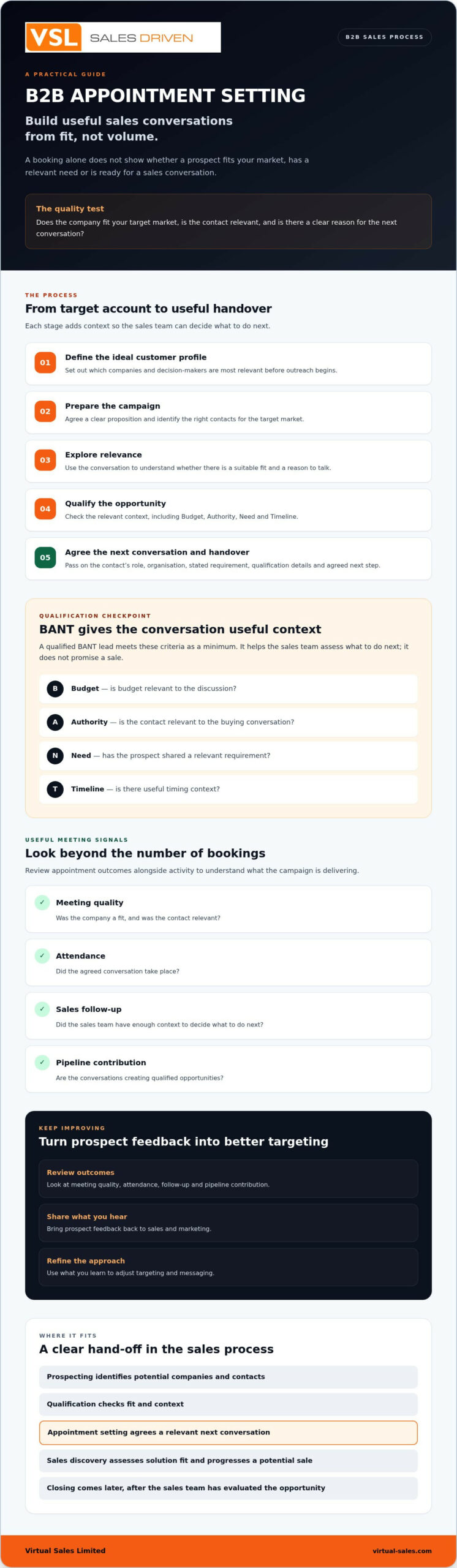
Appointment setting is one activity within the wider process of lead generation, which identifies and engages prospective customers to create sales opportunities. Appointment setting focuses on arranging a relevant next conversation. The activities connect in sequence: prospecting finds potential companies and contacts, qualification checks their fit and context, and appointment setting creates an opportunity for a salesperson to continue the discussion. For a broader overview, see this B2B appointment setting guide.
Effective B2B appointment setting best practices prioritise relevance, qualification, a useful handover and ongoing feedback. They help teams assess whether a conversation is worth a salesperson’s time, rather than treating appointment volume as proof of campaign quality.
How appointment setting fits into the B2B sales process
Prospecting identifies potential companies and decision-makers. Qualification explores whether there’s a suitable fit and a reason to talk. Appointment setting agrees a useful next conversation, while the salesperson takes responsibility for discovery, assessing solution fit and progressing a potential sale. Closing comes later, after the sales team has evaluated the opportunity. Clear role boundaries help prevent prospects being passed across without enough context.
For example, a SaaS company may identify a business that fits its ideal customer profile, then speak with a relevant technology leader about a stated operational challenge. If there’s a credible reason to explore the issue, an appointment can give the sales team a focused starting point. Virtual Sales Limited’s B2B appointment-setting service is designed to create qualified sales conversations with relevant business decision-makers.
What makes an appointment useful to a technology sales team?
A useful appointment gives the salesperson a clear basis for the next discussion. Consider three questions: does the company fit the target market, is the contact relevant to the buying conversation, and has the prospect shared a need or agreed a next step? The answers matter whether you sell SaaS, business software or IT services.
Qualification can also use BANT: Budget, Authority, Need and Timeline. A qualified BANT lead meets these criteria as a minimum. This doesn’t promise a sale; it gives the sales team relevant context to decide how to proceed. A concise handover should capture the prospect’s role, organisation, stated requirement, relevant qualification details and agreed next step. That makes the meeting more useful and gives the team a clear basis for follow-up.
Build better B2B appointments by sharpening targeting and campaign preparation
Appointment quality is shaped before outreach begins. A clear preparation sequence helps your team focus on the right organisations, speak with relevant people and check whether campaign assumptions hold up in real conversations.
- Define the ideal customer profile: Specify the company types, needs and characteristics that make an organisation a strong fit.
- Select decision-makers: Identify roles involved in the problem, decision or buying process.
- Clarify the proposition: Connect what your technology does to a business need the prospect may recognise.
- Check the data: Review contact details, company information and the reason for including each prospect.
- Brief the campaign: Align on the audience, proposition, qualification criteria and suitable next step.
Define the ideal customer profile and the people involved
Your ideal customer profile (ICP) describes the target companies and decision-makers most relevant to a campaign. Firmographic fit, such as company type or size, is only part of the picture. Consider the organisation’s technology needs and which people have a relevant role in assessing them.
For a software product, the right contact might be an IT leader who owns the system under discussion. Depending on the solution and its business impact, Finance, HR or Procurement may also contribute to evaluation or approval. A broad company list, or a job title on its own, doesn’t establish that a contact is relevant. Check how the person’s role relates to the need you aim to address. For further targeting ideas, see these IT lead generation tips.
Prepare relevant, consultative outreach
A useful proposition makes the connection between a technology offer and a business context clear. For example, instead of listing software features, explain which operational issue the product is designed to address, then explore whether that issue applies to the prospect. Keep the claim specific and grounded in what the product can do. Don’t assume every target company has the same priorities.
Brief callers on the proposition, audience, qualification criteria and desired next step. Give them enough context to hold consultative, script-free conversations and adapt their questions to the prospect’s answers. A strong brief sets direction without forcing a fixed exchange.
Before interpreting responses or meeting outcomes, check the underlying data and campaign assumptions. Are contacts still in relevant roles? Does each organisation fit the ICP? Is the message clear about the need addressed? If the audience or data is off-target, low engagement may say more about preparation than market interest. These checks make B2B appointment setting best practices a practical process for learning and refining, not just a way to count meetings.
Qualify B2B appointments through relevant conversations, not booking volume
A meeting is useful only when the conversation has established a credible reason for the sales team to follow up. BANT gives appointment setters and salespeople a shared way to assess that context. It should guide a thoughtful discussion, not become a rigid checklist or a reason to push for a meeting when there’s no clear fit.
Use BANT to make qualification consistent
BANT assesses four areas: Budget, whether funding is available or being considered; Authority, the prospect’s role in the decision; Need, the problem or requirement the organisation wants to address; and Timeline, when it may act. The detail will vary by conversation. A prospect may not know the budget yet, for example, but may be able to explain how a decision would be funded or approved.
Use professional judgement to understand what each answer means in context. A contact may influence a purchase without holding final approval, while a stated need may still require internal discussion. Virtual Sales Limited qualifies leads to BANT criteria as a minimum. The handover should make clear what was established, what remains uncertain and what next step the prospect agreed to.
Learn from a realistic campaign conversation
Hypothetical scenario: A technology company is introducing software to improve how businesses manage a particular operational process. Rather than asking a prospect a string of qualification questions, the caller opens a relevant discussion about how the organisation handles that process now.
The prospect describes a problem, indicating Need. The caller asks how the organisation would assess a change and learns the contact is involved in evaluation, clarifying Authority. They explore whether the organisation is actively considering options or has a future review in mind, adding Timeline context. If funding hasn’t been set, that’s recorded accurately rather than treated as a confirmed budget.
The salesperson should receive the prospect’s role, stated need, relevant BANT context and agreed next action. That’s more useful than a calendar entry with only a name and company.
Activity-led meeting: A meeting is booked, but the handover gives little evidence of fit, need or timing.
Qualified, relevant opportunity: The prospect’s role and requirement are understood, qualification details are recorded honestly, and both parties have agreed a relevant next step.
Review outcomes with the campaign team. If suitable contacts repeatedly describe a different priority, revisit the proposition. If conversations reach people without influence over the issue, refine role targeting. This feedback loop makes B2B appointment setting best practices more effective: qualification informs the handover, and the handover helps improve future targeting and conversations.

Measure appointment-setting performance with useful outcomes and evidence
Appointment numbers show activity, but they don’t tell you whether the campaign is reaching suitable prospects or creating useful sales conversations. To assess performance fairly, separate what the team did from what happened next. Agree measures and definitions with sales before the campaign begins, then review them alongside prospect feedback.
Choose measures that connect activity with sales progress
Call activity helps you understand the work completed. Classified outcomes show how prospects responded. Attendance and handover quality indicate whether the agreed meeting took place and whether sales received relevant context. Sales follow-up and pipeline contribution can show what happened later, provided your team records these outcomes consistently and can link them back to campaign activity.
Each measure has limits. Activity alone doesn’t prove prospect fit. A booked meeting doesn’t confirm attendance, and a sales opportunity may take time to progress. Conversion rates are useful only when the numerator, denominator, reporting period and source data are clear. Avoid comparing campaigns that define a qualified meeting differently.
- Activity: Review call activity and classified outcomes to understand the work and initial responses.
- Meeting quality: Check attendance and whether the sales handover contains the agreed qualification context.
- Downstream progress: Review sales follow-up and pipeline contribution where your CRM or reporting records support attribution.
Don’t substitute unsupported benchmarks for your own evidence. Label illustrative examples as such, rather than presenting them as VSL results. Attribute third-party research to its source, and check client performance claims or testimonials against approved published evidence before using them.
Use reporting to close the feedback loop
Weekly reporting gives sales and marketing a regular point to review progress, raise questions and agree refinements. It’s a review mechanism, not a promise of particular results. Look for patterns: which roles engage, what needs prospects describe, where qualification remains unclear, and whether the proposition reflects their language.
VSL uses outcome labels including Call Back, Warmer Contact, Warm Lead, Future Opp, Not Interested and Happy to Keep in Touch. These categories help distinguish different responses; review the underlying notes before drawing conclusions. For example, repeated future-timing responses may prompt a follow-up discussion, while consistent objections may signal a need to revisit targeting or messaging.
These B2B appointment setting best practices connect reporting to action: agree what success means, check the evidence, then share campaign feedback with the people responsible for sales follow-up and targeting. For related guidance, see effective B2B appointment setting for UK market success.
Apply a practical B2B appointment-setting framework and decide when to get support
A repeatable process helps your team turn campaign learning into better-targeted conversations. Use these six stages to keep appointment setting focused on sales usefulness, not activity alone.
The six stages of a quality-led appointment-setting framework
- Target: Agree the ideal customer profile, relevant decision-makers and qualification standards before outreach begins.
- Prepare: Brief the campaign team on the technology proposition, audience, likely business needs and suitable next step.
- Converse: Engage prospects through relevant, consultative and script-free conversations. Adapt questions to what each person says.
- Qualify: Explore Budget, Authority, Need and Timeline, recording what the prospect has confirmed and what remains unclear.
- Review: Compare campaign outcomes with the agreed measures and share prospect feedback with sales and marketing.
- Refine: Adjust targeting, proposition or qualification where the evidence points to a practical improvement.
Keep the stages connected. If a conversation reaches the right type of company but the contact has no role in the relevant decision, review your role targeting. If suitable decision-makers don’t recognise the problem described in the proposition, discuss whether the message reflects their priorities. This turns B2B appointment setting best practices into a working feedback cycle.
When a technology business may benefit from specialist support
Specialist support may suit your team when you’re entering a market, launching a technology proposition or testing a new vertical and need structured prospect conversations. It can also help when you want to build pipeline without hiring additional internal sales staff. Before outreach starts, make sure your team can explain the offer, identify the target audience and follow up qualified opportunities.
VSL’s campaign process starts with a briefing and project set-up discussion, followed by proposition training, campaign management and weekly review. Each campaign has a dedicated caller and campaign manager. They work with your sales and marketing team, share reporting and use prospect feedback to inform campaign discussions. VSL offers flexible monthly subscriptions without a long-term commitment, and clients may cancel at any time.
This approach gives your team a clear operating rhythm: align on the target, prepare the proposition, engage prospects, qualify consistently and use evidence to guide the next review. The review link below offers another reference point as you assess external support. If you’re considering a partner, explore VSL’s B2B appointment setting service to see how it may fit your sales and marketing activity.
Build a more useful appointment-setting process
Better results start with focus. Define the companies and decision-makers you want to reach, then prepare a proposition that speaks to their business needs. Qualify conversations consistently and review attendance, sales follow-up and prospect feedback, not just meetings booked. These B2B appointment setting best practices help your team connect outreach with genuine sales opportunities.
Virtual Sales Limited has supported technology companies in the UK and USA since March 2001. Experienced UK-based callers use consultative, script-free conversations, with leads qualified to BANT criteria as a minimum. Each campaign has dedicated management and weekly reporting, helping your sales and marketing team review outcomes and refine activity together.
With clear targeting and an active feedback loop, your team can make each sales conversation more relevant. Explore Virtual Sales Limited’s B2B appointment setting service to discuss an approach that fits your market and goals.
Frequently Asked Questions
What are the best practices for B2B appointment setting?
Effective B2B appointment setting starts with a defined ideal customer profile and relevant decision-makers. Prepare a clear proposition, check prospect data and agree qualification standards before outreach. Use consultative conversations to understand the prospect’s situation, then hand over useful context and an agreed next step to sales. Review meeting attendance, follow-up and prospect feedback as well as activity. These B2B appointment setting best practices keep the focus on relevant sales opportunities, not calendar volume alone.
How do you qualify a B2B appointment?
Qualify a B2B appointment by checking whether the company and contact fit your target, and whether there’s a relevant business need to discuss. Explore the prospect’s role in the decision, the issue they want to address and their likely timing. Record what they’ve confirmed, what remains unknown and the agreed next step. This gives the salesperson useful context without treating a booked meeting as proof that the prospect is ready to buy.
What does BANT mean in appointment setting?
BANT stands for Budget, Authority, Need and Timeline. It’s a framework for understanding whether funding is available or being considered, how the contact relates to the decision, what business requirement exists and when the organisation may act. Use it to guide a natural conversation, not as a rigid checklist. Prospects may not know every detail at an early stage, so record their answers accurately and distinguish confirmed information from assumptions.
How can technology companies improve appointment-setting results?
Technology companies can improve appointment-setting results by connecting a clear ideal customer profile with a proposition that addresses a specific business need. Identify relevant roles, which may include IT, Finance, HR or Procurement depending on the solution. Check company and contact data, then brief the campaign team on the offer and qualification criteria. Review prospect responses with sales and refine targeting or messaging where feedback shows a mismatch between the proposition and buyers’ priorities.
Which appointment-setting metrics should a B2B team track?
Track activity alongside measures of quality and sales progress. Review call activity and prospect outcomes, then check meeting attendance, handover quality and sales follow-up. Where your records allow, assess whether opportunities contribute to the pipeline. Define each measure and its data source before comparing results. Activity counts show work completed, but they don’t prove prospect fit or commercial value. Use conversion rates only when the underlying definitions and source data are consistent and available.
Should a B2B company manage appointment setting in-house or outsource it?
Choose the approach that fits your team’s capacity, market knowledge and need for consistent prospect engagement. In-house activity may suit a team with the people and time to manage targeting, outreach, qualification and review. Specialist support may help when entering a market, testing a vertical or building pipeline without hiring internally. Virtual Sales Limited provides technology-sector appointment setting with a dedicated caller and campaign manager, experienced UK-based callers and weekly reporting.
How does an appointment-setting campaign use sales feedback?
A campaign uses sales feedback to check whether meetings are relevant and handovers give sales enough context. After follow-up, sales can report whether the contact and need matched expectations, what questions arose and whether the agreed next step progressed. Share this feedback with the campaign team during regular reviews. Use it to identify patterns, then consider refining the target roles, qualification approach or proposition. Keep changes tied to observed feedback rather than assumptions.


Disclaimer
Disclaimer: Content is for general information only and does not constitute professional advice. Results may vary. Virtual Sales Limited accepts no liability for actions taken based on this content.