


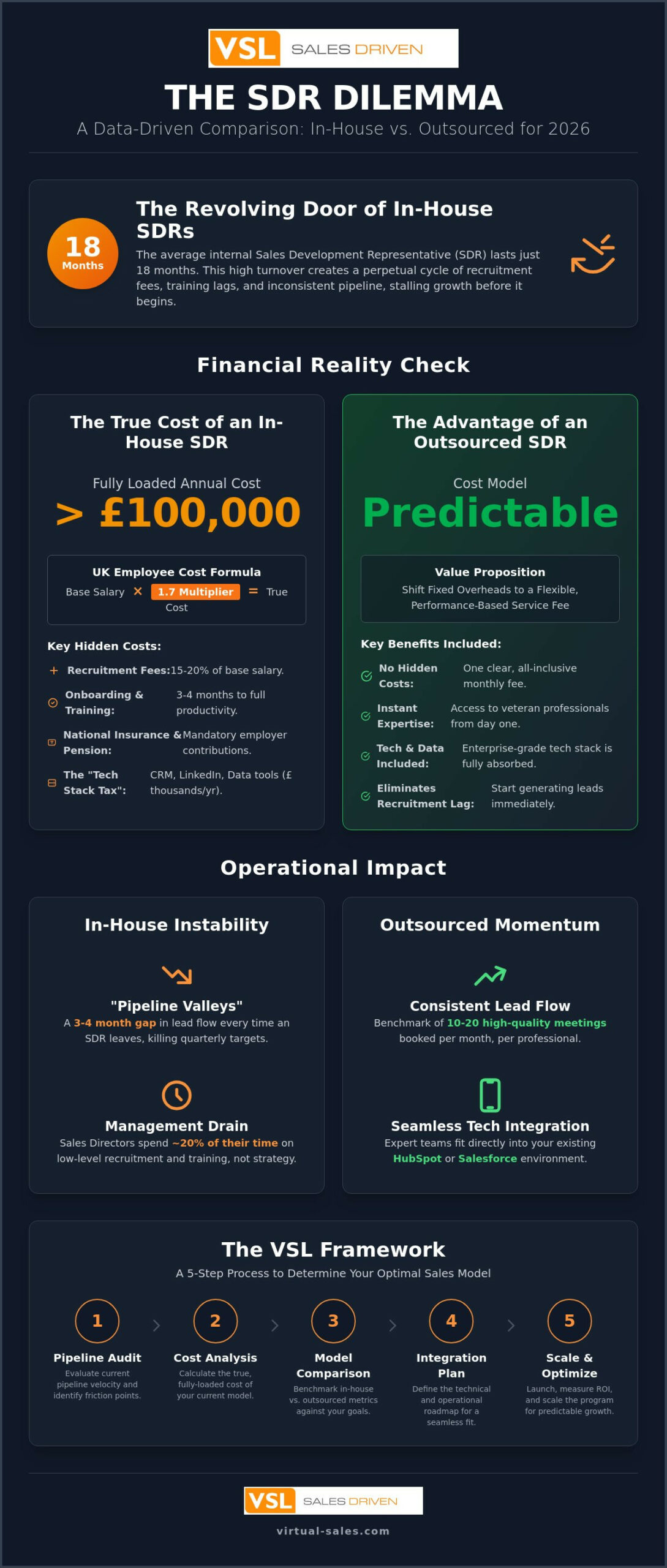
The average internal Sales Development Representative (SDR) now lasts just 18 months before moving on. This revolving door creates a perpetual cycle of recruitment fees and training lags that stall your growth. Most B2B leaders agree that maintaining a consistent sales pipeline feels like a constant uphill battle against high turnover and rising tech costs. When you calculate the fully loaded cost of a single hire, which often exceeds £100,000 once you factor in National Insurance, benefits, and CRM seats, it’s clear the in-house vs outsourced sdr decision is a critical strategic pivot for your 2026 roadmap.
We’ve built this definitive, data-driven analysis to help you move past the guesswork. You’ll gain a clear understanding of the performance metrics, strategic trade-offs, and hidden costs associated with both models in the current market. We’ll explore how elite teams leverage technical agility and “Speed to Lead” to secure a positive ROI on sales spend. This guide previews the shift toward integrated, human-led expertise that fits seamlessly into your Salesforce or HubSpot environment to drive predictable monthly lead flow.
Key Takeaways
- Calculate the true financial impact of the 1.7x multiplier for UK employees to move beyond base salary when evaluating your 2026 sales budget.
- Discover why the in-house vs outsourced sdr decision now hinges on technical agility and the ability to integrate seamlessly with HubSpot or Salesforce.
- Apply a proven 5-step framework to audit your current pipeline velocity and identify where “hire-and-hope” recruitment is stalling your growth.
- Understand the strategic importance of data maturity and how professional data cleansing improves Lead-to-Opportunity conversion rates.
- Benchmark your lead generation goals against 2026 industry standards of 10–20 high-quality meetings per month per dedicated professional.
The SDR Dilemma in 2026: Why Sales Leaders are Rethinking Internal Teams
B2B buying cycles have stretched into marathons. In 2026, a typical enterprise deal involves an average of 11 stakeholders, making the initial outreach phase more complex than ever. Many firms still cling to the “hire-and-hope” model, bringing in junior talent only to see them exit before they’ve even fully ramped up. This constant friction forces a critical evaluation of the in-house vs outsourced sdr approach. Relying on a traditional internal team often leaves businesses vulnerable to the “18-month churn,” where the moment an SDR becomes proficient, they leave for an Account Executive role elsewhere. This instability isn’t just an HR headache; it’s a structural threat to your revenue pipeline.
The traditional internal model is failing ambitious firms because it lacks the technical agility required to navigate modern procurement. Leaders are finding that the time spent managing a revolving door of junior staff could be better spent on high-level market strategy. Many firms are shifting their perspective, viewing sales development through the lens of business process outsourcing to ensure continuity and professional maturity. Choosing between an in-house vs outsourced sdr model is now a question of whether you want to manage people or manage results.
The True Cost of Inconsistency
Turnover creates “pipeline valleys” that kill quarterly targets. When an SDR leaves, it takes an average of three to four months to recruit, onboard, and ramp up a replacement. During this gap, your lead flow drops to zero while your overheads remain fixed. The management burden is equally damaging; when your Sales Director spends 20% of their week reviewing CVs and conducting basic training for entry-level roles, your high-level commercial growth suffers. Gartner reports that 2026 sales leaders are prioritising revenue agility over head count to maintain resilience in volatile markets. This shift reflects a move away from fixed internal costs toward flexible, expert-led solutions that can scale on demand.
Defining the SDR Role in 2026
Modern sales development is a data-led function that goes far beyond simple cold calling. The sdr meaning in 2026 has evolved to encompass deep data literacy and the ability to manage complex tech stacks. A high-performing SDR today must be proficient across multiple channels, including personalised email sequences, LinkedIn engagement, and intent-based calling. This technical requirement makes internal hiring difficult. You aren’t just looking for a “hungry” graduate; you need a professional who understands CRM architecture and multi-touch attribution. Without this technical edge, internal teams struggle to deliver the lead quality required to feed a hungry sales floor.
Financial Reality Check: The True Cost of In-House vs Outsourced SDRs
Most B2B leaders look at a base salary and stop there. That’s a mistake. In the UK, the effective cost of an employee is typically 1.7 times their base salary. When weighing an in-house vs outsourced sdr strategy, you must account for Employer National Insurance contributions, mandatory pension contributions, and the cost of a hybrid-ready equipment setup. These figures quickly swell a modest base salary into a significant departmental burden. You aren’t just paying for a person; you’re paying for the infrastructure that keeps them operational.
Then there is the “Tech Stack Tax.” A modern SDR requires a seat in Salesforce or HubSpot, a LinkedIn Sales Navigator license, and access to premium intent data providers. These subscriptions alone add thousands to your annual spend per head. If you are researching how to scale efficiently, consulting a guide to outsourced sales teams reveals that these costs are often absorbed by the provider. This provides immediate financial relief by shifting fixed overheads into a more manageable service fee.
The Internal Investment Breakdown (£)
Recruitment is a major upfront drain that many firms fail to track. Whether you use an external agency or internal HR time, finding the right talent is an expensive, high-risk activity. Consider these primary cost drivers for an internal UK team:
- Recruitment fees: Often 15-20% of the base salary to secure a quality candidate.
- Onboarding and training: Significant time investment from senior management that pulls them away from closing deals.
- Management overhead: The “hidden” cost of the Sales Manager who must spend hours each week coaching a junior hire.
- Ramp-up time: A typical 4-month period where the SDR is net-negative while learning the product and market nuances.
By the time a junior hire reaches full productivity, you’ve already invested heavily in their potential. If they exit at the 18-month mark, as is industry standard, your ROI is severely compromised.
The Outsourced Subscription Model
An outsourced model shifts the financial burden from fixed overheads to a results-driven service. By choosing a VSL subscription, you eliminate the recruitment cycle and the training lag. You aren’t paying for someone to learn on your time; you are paying for an established process that integrates with your existing CRM from day one. This model provides the predictability that CFOs crave, allowing for precise budget allocation based on lead volume rather than headcount.
Scalability is the final piece of the puzzle. Adding or reducing capacity doesn’t require HR complexity or redundancy risks. It allows your business to remain lean and agile in a fluctuating market. If you want to see how high-growth firms manage this transition, you can review the results from verified B2B appointment setting experts who handle the operational heavy lifting for you.
Operational Impact: Technical Integration and The Real Insight
Success in 2026 depends on how quickly your sales development function integrates with your existing tech stack. A common pitfall in the in-house vs outsourced sdr debate is the assumption that external teams operate in isolation. VSL functions as an elite, integrated component of your own team. We work directly within your HubSpot or Salesforce environment, ensuring that every interaction is logged, every task is tracked, and no data silos emerge. This level of technical cohesion eliminates the friction typically associated with external vendors.
High-performance outreach requires high-quality fuel. We prioritise b2b data cleansing to ensure your SDRs aren’t wasting time on dead ends or outdated contacts. This technical foundation allows for a superior “Speed to Lead” response time. While internal hires are often pulled into non-sales admin or internal meetings, our dedicated professionals focus exclusively on pipeline construction. We hire for professional maturity, using experienced, UK-based staff who understand the nuances of corporate commerce. This expertise ensures your brand is represented with the clinical efficiency it deserves.
Real Insight: The IT Software Scenario
A UK-based software firm recently faced stagnant growth with two internal SDRs. They struggled with inconsistent CRM logging and slow follow-ups that let warm leads go cold. We transitioned their outreach to a dedicated VSL team, starting with a deep dive into their existing Salesforce workflows. We mapped our intent-based calling sequences directly to their opportunity stages to ensure a seamless handoff to their Account Executives. The result was a 30% increase in qualified demo attendance within just 60 days. This success stemmed from technical alignment and professional execution rather than just increased call volume.
Technical Capabilities & Accountability
We move beyond vanity metrics like “number of calls.” Our reporting focuses on pipeline value and Lead-to-Opportunity conversion rates. By using advanced cloud-based tools for intent-based calling, we target buyers who are actively researching solutions in your sector. This proactive approach ensures your brand voice remains consistent across every touchpoint. We develop collaborative messaging briefs that ensure our team speaks your language, maintaining the high standards expected in B2B appointment setting. Accountability is baked into our process through real-time dashboards that provide a transparent view of your ROI.

The VSL Framework: 5 Steps to Determining Your Optimal Sales Model
Choosing between an in-house vs outsourced sdr model requires more than a cursory glance at your budget. It demands a clinical audit of your current commercial operations and future growth objectives. We use this five-step framework to help B2B leaders move past “it depends” and toward a definitive, data-backed decision. By evaluating your internal leaks and management capacity, you can determine which model provides the most resilient path to revenue.
Step 1 & 2: The Financial & Performance Audit
Start by auditing your current pipeline velocity. You must identify exactly where leads are stalling. Is it the initial outreach, or the transition from SDR to Account Executive? Once you’ve located the leaks, calculate your fully burdened cost per appointment. This calculation must include the hidden salary of the person managing the SDR and the recruitment fees discussed earlier. Many firms ignore the “Ramp-Up Gap,” which is the period where an internal hire costs money without producing results. For a baseline of success, Gartner research indicates that a high-performing SDR should deliver between 10 and 15 high-quality meetings monthly to justify their seat.
Step 3, 4 & 5: The Strategic Fit
Next, assess your internal management bandwidth. If your Sales Director is bogged down in tactical coaching rather than strategic closing, your growth is already capped. Technical readiness is equally vital; your CRM and data infrastructure must be mature enough to support a high-volume outreach function. Finally, define your scale timeline. If you need to ramp up within 90 days, sales team outsourcing is often the only logical choice to avoid the long recruitment cycles of internal hiring.
Product complexity also plays a role. While some believe complex solutions require in-house depth, modern outsourced agility allows for professional teams to master technical messaging briefs in weeks, not months. Avoid the “Hybrid Trap” by ensuring clear lines of accountability if you choose to mix models. Without defined ownership of the data and the outcome, your pipeline will suffer from fragmentation. To ensure your decision leads to a measurable ROI, consult with verified B2B appointment setting professionals who can help you audit your specific sales environment.
Results and Data: Scaling with VSL’s Integrated SDR Solutions
Data provides the only objective answer to the in-house vs outsourced sdr debate. While internal teams often struggle with the “ramp-up gap” and administrative distractions, our dedicated professionals consistently deliver between 10 and 20 qualified meetings per month. These aren’t just surface-level contacts; they’re high-intent engagements benchmarked against 2026 industry standards for Lead-to-Opportunity conversion rates. By shifting the focus from headcount to pipeline value, you ensure that every pound spent contributes directly to your commercial growth.
The ROI analysis is stark. An internal hire with a £65,000 base salary actually costs your business significantly more once you factor in the 1.7x UK employment multiplier and the tech stack expenses we’ve already detailed. In contrast, a VSL retainer provides a fixed-cost model that eliminates recruitment risk and management overhead. You aren’t just hiring a service; you’re integrating a high-performing sales engine that is already optimized for b2b appointment setting.
Measurable Outcomes for IT & Tech
Software and SaaS firms require a specialized approach that generalist agencies can’t match. We’ve refined our methodologies to address the longer buying cycles and complex stakeholder maps of the current B2B landscape. Our success in IT lead generation is driven by professional B2B database building, which ensures our outreach is targeted at active buyers rather than stagnant lists. This precision is why VSL remains a top-rated UK appointment setting firm on Clutch. We don’t just make calls; we build the technical and interpersonal bridges necessary to secure high-value demos for your Account Executives.
Your Next Steps for 2026
Transitioning from an underperforming internal model to a VSL partnership is designed to be frictionless. We don’t believe in months of “discovery” that delay your results. Our onboarding process takes just two weeks from initial kick-off to your first qualified meeting. During this window, we integrate with your CRM, master your messaging briefs, and deploy our experienced UK-based staff to start building your pipeline. This speed to market is a critical differentiator for ambitious firms looking to scale without the weight of HR complexity.
Prioritizing pipeline growth over administrative burden is the hallmark of a modern sales leader. By choosing an integrated model, you reclaim your management bandwidth and secure a predictable flow of opportunities. If you’re ready to move beyond the inconsistencies of traditional hiring, explore our range of B2B subscription services to find the right fit for your 2026 targets.
Secure Your 2026 Competitive Advantage
Navigating the in-house vs outsourced sdr landscape requires a focus on long-term pipeline resilience over short-term headcount. You’ve seen how the hidden costs of recruitment and technical CRM integration can stall growth. By prioritising professional maturity, you eliminate the 18-month turnover cycle that plagues internal teams. Success in the current B2B environment hinges on your ability to maintain a consistent flow of qualified opportunities without the management burden of a junior sales floor.
Virtual Sales Limited brings 25 years of specialized expertise to your outreach strategy. Founded in 2001, we’ve established ourselves as specialists in the IT, SaaS, and Technology sectors. As a top-rated UK appointment setting firm on Clutch, we act as an elite, integrated component of your workforce. We don’t just provide leads; we build the sustainable sales pipeline your business needs to scale with confidence. Your growth starts with a single high-quality conversation.
Ready to scale your pipeline? Explore VSL’s B2B Appointment Setting Services
Frequently Asked Questions
What is the average salary for an SDR in the UK in 2026?
The average base salary for a professional SDR in the UK typically ranges between £35,000 and £45,000 in 2026. This figure does not include commission, National Insurance contributions, or pension costs. When you calculate the fully burdened cost, the total investment for a single internal hire often exceeds £65,000 annually.
Is it better to have an in-house or outsourced SDR for a technical SaaS product?
Outsourcing is often the superior choice for technical SaaS products because it provides immediate access to experienced professionals who understand complex buying cycles. VSL staff specialize in technology sectors, allowing them to master technical messaging briefs rapidly. This avoids the long training lags associated with hiring junior internal staff who may lack corporate maturity.
How many meetings should an outsourced SDR team deliver per month?
A dedicated professional should deliver between 10 and 20 high-quality meetings every month. This benchmark varies based on your specific sector and the complexity of your solution. We prioritize pipeline value over call volume to ensure that every meeting booked has a high probability of converting into a closed deal.
What are the biggest risks of outsourcing my SDR function?
The primary risks involve a lack of brand alignment or fragmented data silos. You can mitigate these issues by partnering with a firm that integrates directly with your existing workflows. We use collaborative messaging briefs and real-time reporting to ensure our outreach remains a seamless extension of your internal sales culture.
Can an outsourced SDR team integrate with my HubSpot or Salesforce CRM?
Yes, a professional team operates as an integrated component of your workforce by working directly within your CRM. We log all activity, notes, and lead data in real-time within your HubSpot or Salesforce environment. This technical cohesion ensures your internal team has total visibility and maintains a clean, actionable database.
How long does it take to ramp up an outsourced SDR compared to an in-house hire?
An outsourced team can typically launch a campaign within two weeks of the initial kick-off. In contrast, an internal hire often requires four months to reach full productivity after recruitment and onboarding. When evaluating the in-house vs outsourced sdr timeline, the outsourced model provides a much faster route to market.
What is the hybrid SDR model and does it work?
The hybrid model combines an outsourced team for high-volume top-of-funnel outreach with internal staff for late-stage qualification. This strategy works effectively for scaling businesses that need to maintain a lean internal team. It ensures a consistent lead flow while your internal experts focus on closing high-value opportunities.
Why is SDR turnover so high and how does outsourcing solve it?
SDR turnover is high because the role is often viewed as a temporary entry point with an average tenure of just 18 months. Outsourcing solves this by providing access to career-level professionals who focus exclusively on sales development. This stability ensures your in-house vs outsourced sdr strategy delivers long-term pipeline consistency without the disruption of constant hiring cycles.


Disclaimer
Disclaimer: Content is for general information only and does not constitute professional advice. Results may vary. Virtual Sales Limited accepts no liability for actions taken based on this content.