


If your sales team is drowning in low-intent inquiries while your competitors are securing calendar space with CTOs, your current strategy isn’t just inefficient; it’s expensive. In 2026, effective lead generation for software companies requires a surgical approach to penetrate complex buying committees that have become immune to AI-driven automation. You’ve likely felt the frustration of long, stalled sales cycles and the prohibitive cost of hiring and training internal SDR teams within the UK.
We agree that high-growth firms need more than just volume; you need a predictable stream of qualified appointments with CIOs and technical leads. This guide provides a proven, human-led framework to transform your outreach into a high-value sales pipeline. We’ll explore how to build a scalable, ROI-driven operation that integrates seamlessly with your Salesforce or HubSpot CRM, ensuring your commercial team focuses only on deals that actually close.
Key Takeaways
- Understand the critical shift from volume-based outreach to intent-based engagement required for success in the 2026 B2B landscape.
- Discover how to implement a methodical 5-step framework to build high-intent databases and secure a predictable sales pipeline.
- Learn strategic techniques for lead generation for software companies to penetrate complex buying committees and handle high-stakes objections.
- Identify why your lead generation must be CRM-native to ensure seamless data flow and integration with Salesforce or HubSpot.
- Review benchmark KPIs and real-world metrics to measure the ROI and scalability of your high-performing sales operation.
What is Lead Generation for Software Companies in 2026?
The definition of success in the technology sector has fundamentally shifted. Effective What is Lead Generation is no longer a volume-based exercise in data scraping. It’s a strategic process of identifying and qualifying high-intent decision-makers within the IT and SaaS sectors. For growth-focused firms, lead generation for software companies represents a surgical effort to engage specific personas before they’ve even requested a demo. This transition toward intent-based engagement is essential because the market is saturated with automated noise that decision-makers now actively ignore.
Software companies face unique barriers that generic agencies fail to address. Complex Proof of Concept (POC) requirements, narrow buying committees, and deep-seated technical skepticism mean your outreach must be flawless from the first touchpoint. Success requires a level of professional maturity that allows your team to navigate peer-to-peer conversations with CTOs and CIOs. You aren’t just selling a tool; you’re proposing a high-stakes technical partnership that impacts their entire infrastructure.
The Evolution of Software Sales: Beyond the AI Noise
Automated email sequences have reached a breaking point. In 2026, response rates for generic bot-driven campaigns have hit record lows as security filters and “AI-fatigue” become standard. This has led to a powerful resurgence of human-led IT lead generation as a premium differentiator. Ambitious businesses are moving away from chasing “leads” which are often just contact details; they’re focusing on “qualified sales appointments.” This shift prioritizes human connection and technical nuance, ensuring that every meeting on your calendar has a genuine path to revenue.
Common Pitfalls in Software Lead Gen
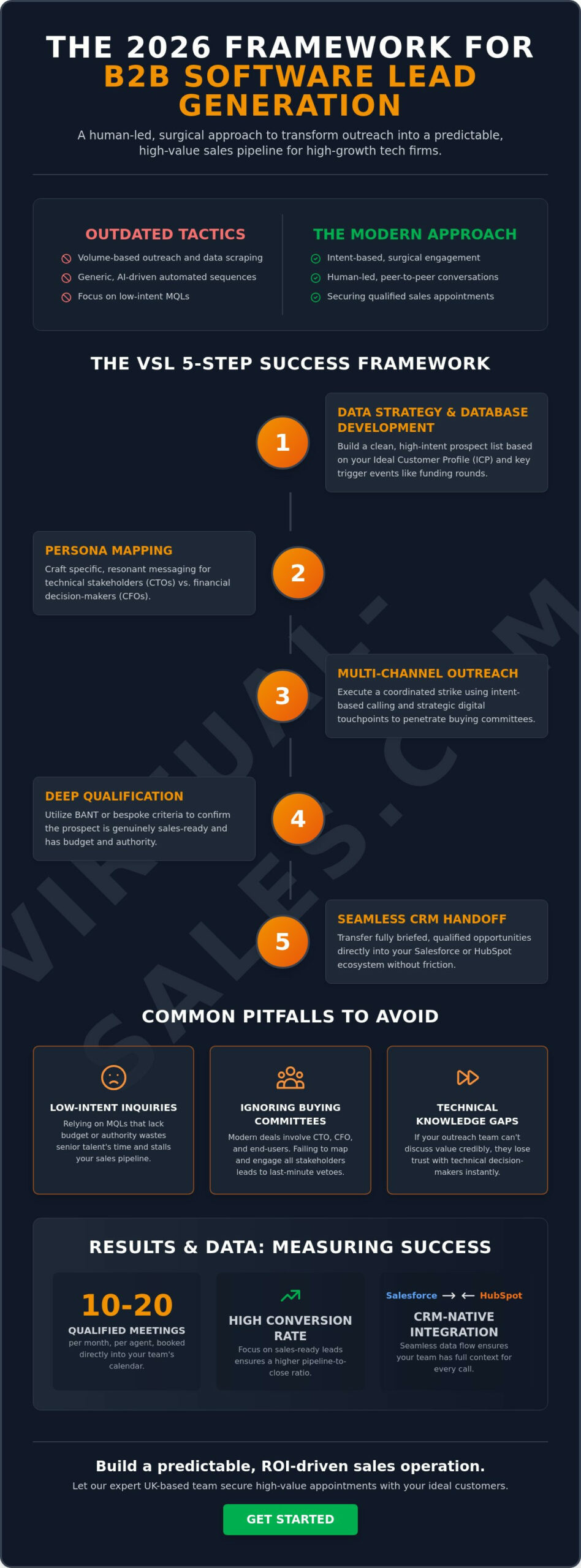
Many firms struggle because they repeat outdated tactics that fail to account for the modern buying cycle. To build a resilient UK software appointment setting operation, you must avoid these frequent errors:
- Relying on low-intent inquiries: Marketing-qualified leads that lack actual budget or authority stall in the sales pipeline and waste your senior talent’s time.
- Failing to map the buying committee: Modern software deals involve the CTO, CFO, and end-users. Ignoring any of these stakeholders leads to last-minute vetoes.
- Technical knowledge gaps: If your outreach team can’t explain the value proposition without a script, they’ll lose credibility with technical decision-makers instantly.
Overcoming these hurdles requires a team that functions as an elite, integrated component of your own workforce. By combining professional maturity with deep sector expertise, you can penetrate even the most guarded enterprise accounts. This ensures your sales operation is built on clinical efficiency rather than optimistic guesswork.
The VSL 5-Step Framework for Software Lead Generation Success
Scaling a software business requires a clinical approach to your pipeline. We’ve developed a methodical 5-step framework designed specifically to navigate the complexities of enterprise technology sales. This isn’t about optimistic guesswork; it’s about a repeatable, human-led process that converts cold prospects into high-value opportunities. By following this structure, we ensure your sales operation functions with the precision of a high-performing internal team.
- Step 1: Data Strategy & Database Development – Building a clean, high-intent prospect list based on your Ideal Customer Profile (ICP).
- Step 2: Persona Mapping – Crafting specific messaging for technical stakeholders (CTOs) versus financial decision-makers (CFOs).
- Step 3: Multi-Channel Outreach – Executing a coordinated strike using intent-based calling and strategic digital touchpoints.
- Step 4: Deep Qualification – Utilizing BANT or bespoke criteria to confirm the prospect is genuinely sales-ready.
- Step 5: Seamless Handoff – Transferring fully briefed opportunities directly into your CRM ecosystem without friction.
Step 1 & 2: Building the Foundation
Everything starts with the integrity of your list. Rigorous B2B data cleansing ensures your team doesn’t waste time on defunct contacts or outdated tech stacks. We focus on identifying “trigger events” within the software industry, such as recent funding rounds or the expiration of legacy contracts, to time our outreach for maximum impact. Successful lead generation for software companies depends on understanding that a CTO cares about integration and scalability, while a CFO prioritizes ROI. Our staff approach these conversations with a “Business Development Manager” mindset, ensuring they speak the language of leadership from the first interaction.
Step 3 to 5: Execution and Conversion
Execution requires professional maturity. The art of setting appointments with busy technical leaders involves more than just a script; it requires the ability to handle complex objections in real-time. For many of our clients, “Project-based Lead Gen” serves as the ideal entry point for new software launches, providing a focused surge of activity. Every lead must meet a strict “Sales-Ready” threshold before the handoff. This means your senior sales talent only spends time on meetings with a legitimate path to revenue. Aligning these modern lead generation strategies with your internal CRM ensures total transparency and clinical efficiency. You can see how this methodology translates into measurable growth by reviewing our verified performance on Clutch.
Real Insight: Navigating the Complex Software Buying Committee
Enterprise software sales rarely involve a single decision-maker. In 2026, the average buying committee for an ERP implementation or a major SaaS migration consists of at least six distinct stakeholders. This group typically includes the CTO, CFO, Procurement Lead, Security Officer, and representatives from the end-user departments. Successful lead generation for software companies requires mapping these individuals and understanding that a “one-size-fits-all” pitch will fail. You must deliver a narrative that addresses the specific technical and commercial anxieties of each member.
Consider a recent scenario where a SaaS provider struggled to gain traction in the enterprise space. By pivoting their strategy to target the “Shadow IT” pain point, they unlocked over 15 high-value meetings per month. Instead of lead-gen scripts focused on broad features, our team engaged CTOs on the security risks of unmanaged departmental software. This specific, high-intent angle bypassed the generic filters that usually block external vendors. It demonstrated a level of industry insight that automated tools simply cannot replicate.
Technical leaders ignore LinkedIn DMs because they’ve become a digital graveyard for automated spam. They pick up the phone for VSL because our staff possess the professional maturity to hold a peer-level conversation. When a prospect says, “We already have a solution,” we don’t retreat. We pivot to technical nuances, asking how their current stack handles specific emerging 2026 compliance requirements. This proactive approach transforms a standard objection into a consultative opening.
The CTO vs. The CFO: A Tale of Two Value Propositions
The CTO prioritizes scalability, security, and seamless integration with existing cloud infrastructure. Conversely, the CFO focuses on the commercial bottom line, seeking clear ROI and operational efficiency. Our sales professionals adapt their tone and vocabulary based on these priorities, ensuring the technical value matches the commercial reality. The Software Buying Committee is a multi-layered entity requiring bespoke messaging for each role to achieve consensus.
Stalled Deals: How Lead Nurturing Saves the Pipeline
Software sales cycles frequently exceed six months, leading to a high volume of stalled deals. Consistent, human-led follow-up is the only way to prevent these opportunities from decaying in your CRM. We often deploy project-based campaigns to revive cold or dormant leads, using fresh “trigger events” to re-engage the committee. This persistent nurturing ensures your sales pipeline remains active even during long procurement windows. You can see more real-world examples of this in action by reviewing our case studies.

Technical Integration: Aligning Lead Gen with Your CRM Ecosystem
Lead generation for software companies fails when data lives in isolated spreadsheets. In 2026, your outbound operation must be CRM-native to maintain a clinical level of efficiency. VSL functions as an elite extension of your workforce, integrating directly with platforms like HubSpot, Salesforce, and Pipedrive. This connectivity ensures real-time reporting and a transparent data flow that allows you to monitor the health of your sales pipeline at any moment. Without this technical alignment, you risk losing the nuanced insights that move a prospect from “interested” to “sales-ready.”
Providing your internal team with the full context of a booked meeting is vital. When we hand off an opportunity, your Account Executives receive more than just a calendar invite. They get a comprehensive record of the prospect’s pain points, technical environment, and specific buying signals. This level of detail ensures your senior talent enters every call prepared to close, rather than wasting time on discovery basics. It turns a cold handoff into a seamless transition that respects the prospect’s time and your team’s expertise.
Salesforce and HubSpot: The Backbone of 2026 Lead Gen
We utilise cloud-based CRMs to track every stage of lead progression and attribution. This automation streamlines the handoff from our SDRs to your internal team, removing the friction that often stalls enterprise deals. Maintaining strict data hygiene is a priority; we implement protocols to prevent duplicate records and outreach fatigue. This disciplined approach protects your brand’s reputation while maximising the utility of your database. By treating your CRM as the single source of truth, we ensure every interaction is documented and every follow-up is prioritised.
Intent Data and Buying Signals
Modern outreach relies on more than just contact info. We integrate third-party intent signals into our outbound strategy to identify accounts actively researching solutions. VSL sales professionals use these CRM insights to personalise the opening 30 seconds of a call, referencing specific industry challenges or recent “trigger events.” This precision increases conversion rates and establishes immediate credibility with technical decision-makers who are tired of generic pitches. You can explore how we apply these technical nuances through our specialised lead generation for software services.
If you’re ready to align your sales pipeline with a high-performing, tech-savvy partner, view our verified UK appointment setting performance to see the results we deliver for our clients.
Results and Data: Measuring Success in Software Lead Generation
Measuring success in lead generation for software companies requires moving beyond vanity metrics. We focus on KPIs that directly impact your bottom line. In the UK market, distinguishing between Cost Per Lead (CPL) and Cost Per Qualified Meeting (CPQM) is critical. A low CPL often masks a high volume of low-intent inquiries that stall your sales cycle and waste senior talent. By prioritising CPQM, you ensure that your investment targets decision-makers with the budget and authority to proceed. This professional qualification process eliminates the hidden costs of chasing dead-end deals.
The financial impact of reducing stalled deals is substantial. When your pipeline consists of thoroughly vetted opportunities, your sales velocity increases. You aren’t just filling a CRM; you’re building a scalable engine for revenue. This clinical approach to data ensures that every interaction is documented and every meeting has a legitimate path to a contract. It’s about quality over quantity, ensuring your commercial team remains focused on high-value activity.
Software Lead Gen Benchmarks (2026)
High-performing appointment setting service operations in 2026 deliver specific, measurable results. For niche software solutions, we typically see a conversion rate of 5–12% from cold call to qualified appointment. Enterprise-level retainers should aim for 10–20 high-quality meetings per month to maintain a healthy and predictable pipeline. The financial logic of outsourcing is clear. Hiring an internal SDR in the UK often costs upwards of £60,000 per year once you factor in recruitment, salary, National Insurance, and management overhead. VSL provides a scalable alternative that removes these fixed costs while delivering a higher standard of output.
Sustainable Revenue and ROI
Sustainable growth depends on understanding the Lifetime Value (LTV) of every lead generated. A dedicated lead generation agency offers a stable, predictable ROI that internal teams often struggle to match due to high staff turnover and training cycles. We don’t just book meetings; we build a foundation for long-term revenue by engaging the entire buying committee. Our commitment to clinical efficiency ensures that your sales operation remains agile and outcome-focused. This strategic partnership allows your senior team to focus entirely on closing high-value contracts rather than managing the friction of entry-level outreach.
Secure Your Strategic Growth for 2026
The landscape of software sales has evolved beyond the reach of simple automation. Success now depends on a human-led, surgical approach to penetrate complex buying committees and maintain a CRM-native pipeline. By implementing a methodical framework and focusing on qualified meetings rather than raw lead volume, you can eliminate the friction that stalls enterprise deals. Modern lead generation for software companies requires the professional maturity to engage CTOs and CFOs as technical peers.
VSL brings over 20 years of experience in IT and software sales, operating as an elite, UK-based extension of your internal team. As a Clutch-verified 5-star appointment setting agency, we provide the clinical efficiency needed to deliver a predictable ROI. It’s time to move past the high cost of internal recruitment and embrace a scalable, results-driven sales operation that integrates seamlessly with your commercial goals.
Scale your software sales pipeline with VSL’s expert lead generation services and start securing high-value appointments today.
Frequently Asked Questions
Is lead generation for software companies different from other B2B sectors?
Yes, lead generation for software companies is distinct because it involves navigating technical skepticism and multi-layered buying committees. Unlike simpler B2B sales, software deals often require Proof of Concept (POC) stages and buy-in from both technical and financial stakeholders. This complexity demands a higher level of professional maturity from the outreach team to ensure they can hold peer-level conversations with CTOs and CIOs without relying on basic scripts.
How much does professional lead generation for software cost in the UK?
Professional service costs vary based on the complexity of your target market and the seniority of the decision-makers you need to reach. While we don’t provide a flat fee, we focus on delivering a measurable Return on Investment (ROI) that outperforms internal hiring. Most UK firms find that outsourcing is significantly more cost-effective than the £60,000 annual overhead required to recruit, train, and manage a single internal SDR.
Can VSL integrate with our existing HubSpot or Salesforce CRM?
We integrate directly with HubSpot, Salesforce, and Pipedrive to ensure a seamless data flow. This CRM-native approach allows your internal team to view the full history of our interactions with a prospect in real-time. By functioning as an elite, integrated component of your own workforce, we eliminate the friction of manual data entry and ensure every booked meeting contains the full technical context your Account Executives need.
What is the typical lead-to-meeting conversion rate for software companies?
High-performing campaigns in the software sector typically achieve a conversion rate of 5% to 12% from cold call to qualified appointment. This rate depends heavily on the niche and the strength of the value proposition. We focus on Cost Per Qualified Meeting rather than raw lead volume to ensure your senior sales talent only spends time on opportunities that have a legitimate path to revenue and clear commercial intent.
How long does it take to see results from a software lead generation campaign?
You should expect to see a healthy pipeline of activity within the first four to eight weeks of a campaign launch. The initial phase involves rigorous data strategy and persona mapping to ensure outreach is targeted correctly. While some appointments may be secured immediately, the strategic build-up of lead generation for software companies ensures a predictable stream of 10 to 20 high-quality meetings per month as the campaign matures.
Do you provide technical sales professionals who understand my software product?
Our staff are professional sales experts with deep experience in the IT and technology landscape. We don’t use entry-level staff; we deploy mature professionals who understand the nuances of SaaS and infrastructure. This expertise allows us to handle complex technical objections and articulate your software’s value proposition in a way that resonates with senior IT leaders who are often immune to generic, automated marketing noise.
Why should I choose an agency over hiring an internal SDR team?
Choosing an agency provides immediate access to a high-standard output without the risks of internal recruitment. Building an internal SDR team requires significant time and a financial commitment of over £60,000 per head in the UK. By outsourcing, you bypass these fixed costs and gain a scalable, proactive partner that is already equipped with the technical tools and methodology needed to penetrate guarded enterprise accounts from day one.
What happens if a lead doesn’t show up for a scheduled appointment?
If a prospect fails to attend a scheduled meeting, we immediately initiate a re-engagement and nurturing process to reschedule. We treat every appointment as a high-value asset in your sales pipeline. Our team works to understand the reason for the no-show and maintains a professional persistence to get the conversation back on track, ensuring that no potential revenue opportunity is lost due to simple scheduling conflicts.


Disclaimer
Disclaimer: Content is for general information only and does not constitute professional advice. Results may vary. Virtual Sales Limited accepts no liability for actions taken based on this content.