



Is your UK business development manager actually a hunter, or just a highly-paid administrator? Most ambitious leaders agree that finding a true closer who can navigate the 2026 regulatory landscape is becoming an expensive gamble. With the average UK business development manager now commanding a base salary of £81,208 plus bonuses, the cost of a hiring mistake has never been higher. You’re likely struggling with inconsistent lead flow and the mounting overheads of a traditional in-house team. Between the new “Day 1” rights for paternity leave and the removal of the lower earnings limit for SSP, the complexity of managing internal sales staff is shifting the commercial math.
We understand the frustration of recruiting ‘farmers’ when you desperately need ‘hunters’ to drive market entry. This guide promises to show you how to deploy a high-performance sales strategy that secures a predictable pipeline while lowering your cost per acquisition. We’ll explore the evolving role of the BDM in 2026, analyze the impact of the latest employment laws on your sales overheads, and introduce the VSL framework for sustainable revenue growth. By the end, you’ll know exactly how to integrate expert-led market entry into your existing HubSpot or Salesforce ecosystem to ensure clinical efficiency and measurable outcomes.
Key Takeaways
- Understand how a modern UK business development manager bridges the gap between cold outreach and high-value partnerships to ensure a steady flow of qualified opportunities.
- Learn to stabilize your revenue stream by eliminating the “feast or famine” lead generation cycle through strategic, data-driven market expansion.
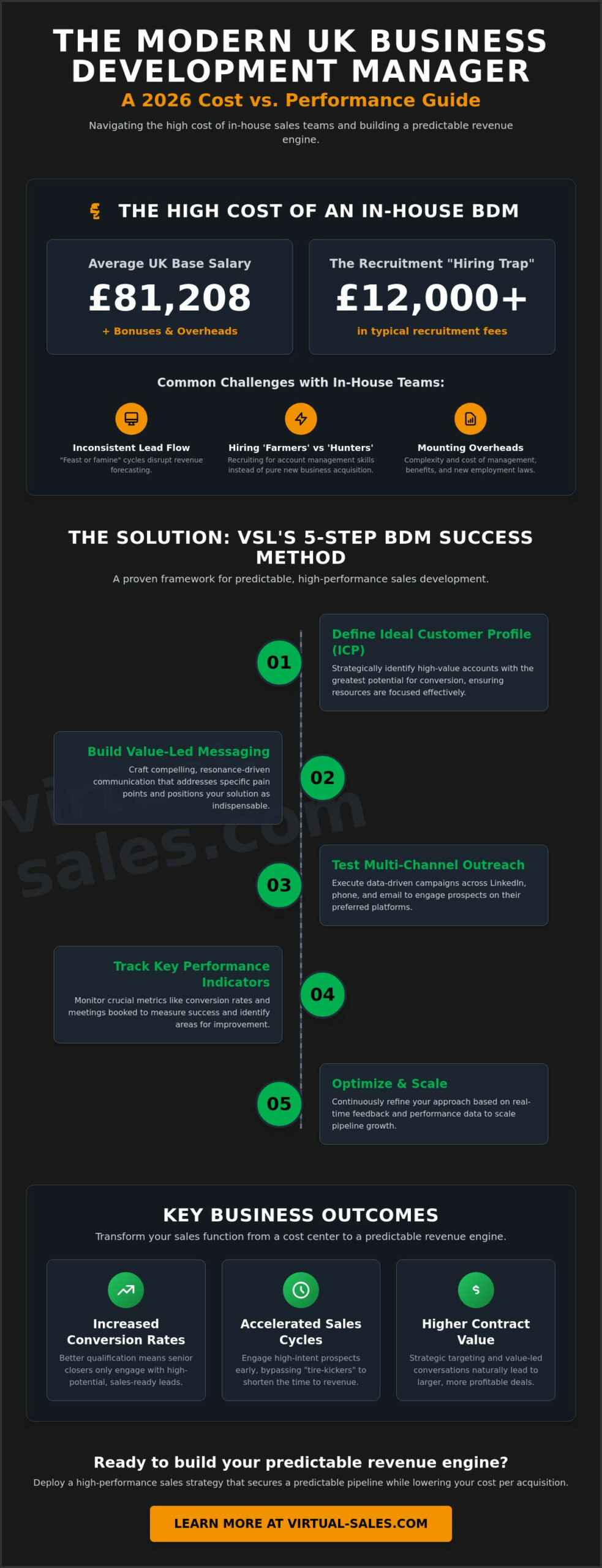
- Discover why traditional recruitment often leads to high overheads and how to avoid the £12,000 hiring trap common in the UK tech sector.
- Identify the critical mistakes that derail sales strategies, including the use of poor-quality data and the lack of integration with senior closing teams.
- Explore the VSL 5-Step Method to define your Ideal Customer Profile (ICP) and craft value-led messaging that resonates with key decision-makers.
Defining the UK Business Development Manager Role in 2026
The 2026 UK business development manager is a specialist architect of growth. Unlike account managers who nurture existing portfolios, this role focuses exclusively on the acquisition of “new logos.” They operate at the sharp end of the sales funnel, identifying high-value opportunities where none previously existed. To understand What is business development? in a modern context, one must look past generic networking. It’s now a data-driven discipline that requires the execution of strategic outreach across LinkedIn, phone, and email to secure new partnerships.
The primary objective is the seamless transition from a cold prospect to a qualified sales lead. This requires a “hunter” mindset. They don’t wait for inbound inquiries; they create them. By leveraging sophisticated B2B lead generation techniques, a BDM ensures your sales pipeline remains insulated from market volatility. They bridge the gap between initial curiosity and a formal commercial discussion.
Core Responsibilities and Daily Output
A high-performing BDM focuses on output that translates directly into revenue potential. Their daily routine isn’t about administrative fluff. It centers on conducting high-volume outbound calling to qualify decision-makers within specific target industries. They spend significant time mapping complex organizational structures. In large UK enterprises, identifying the actual budget holder is often more difficult than the pitch itself. The ultimate metric of success is securing high-quality B2B appointment setting outcomes for your senior sales executives to close.
The Skill Set Required for Modern UK Sales
Success in the current market demands more than a friendly phone manner. Modern BDMs must possess advanced proficiency in intent-based calling and social selling. They need to navigate professional “gatekeepers” in the services and IT sectors with clinical precision. This isn’t about trickery; it’s about demonstrating immediate value. A UK business development manager must have the commercial acumen to discuss ROI and complex business value propositions fluently. They don’t just “check in” with prospects. They provide insights that challenge the status quo and move the needle for the buyer.
- Intent-Based Outreach: Using signals to call prospects when they’re actually in a buying cycle.
- Strategic Mapping: Understanding the hierarchy of UK SMEs and enterprises to find the right entry point.
- Multi-Channel Execution: Seamlessly moving a conversation from a LinkedIn connection to a discovery call.
Why High-Performance Business Development Matters
Deploying a high-performance UK business development manager is about more than just filling a seat. It’s about building a predictable revenue engine. Most businesses suffer from a “feast or famine” cycle where lead generation stops the moment the sales team gets busy closing. A dedicated BDM function ensures the top of your funnel remains active regardless of internal capacity. This consistency allows you to forecast revenue with confidence rather than relying on the unpredictability of referrals or inbound luck.
Strategic outreach also serves as a low-risk vehicle for market expansion. Before committing to a full-scale office launch or a massive marketing spend, a BDM can test new sectors. They gather real-time feedback from decision-makers, allowing you to pivot your messaging before you’ve spent significant capital. This agility is a hallmark of the Business development manager role in 2026. It’s about market intelligence as much as it is about sales volume.
3 Key Business Outcomes of a BDM Function
- Increased Conversion Rates: Better qualification at the discovery stage means your senior closers spend time on deals that actually have the potential to sign.
- Accelerated Sales Cycles: By identifying high-intent prospects early, a UK business development manager bypasses the “tire-kickers” and focuses on buyers with an active need.
- Higher Average Contract Values: A structured outbound approach allows you to target specific, high-value accounts rather than waiting for smaller leads to find you.
Professional outreach also builds your brand equity. In the competitive national UK market, every touchpoint matters. When your business is represented by a professional who understands the nuances of the local landscape, you establish authority. This is why many firms look to verified UK-based sales partners to ensure their market presence remains elite and credible.
Measuring BDM Success in 2026
Success metrics have evolved. It’s no longer enough to track raw activity like “dials made.” Ambitious businesses now focus on Sales Qualified Leads (SQLs). You should monitor the cost per meeting booked to ensure your ROI remains healthy. Gartner research suggests that benchmarking your sales performance against industry standards is critical for staying competitive. By focusing on the quality and “maturity” of leads, you ensure your BDM function is a profit center rather than an overhead expense.
The Hiring vs. Outsourcing Dilemma: A Real Insight
Hiring a high-level UK business development manager is a significant capital commitment. Recruitment fees in the current market often exceed 15-20% of the base salary. For a senior hire, this represents a substantial upfront sunk cost before a single outbound call is even made. While the National Careers Service outlines the extensive skills and career path for this role, finding a candidate who actually executes is a different challenge altogether.
Consider the experience of a UK-based tech firm that recently spent £12,000 on recruitment fees for a specialist “hunter.” The candidate appeared perfect during the interview process but left the business in month three due to a “cultural mismatch.” The firm didn’t just lose the recruitment fee; they lost a full quarter of sales momentum and the internal management time spent on training. This is the “Real Insight” many leaders ignore: the true cost of a bad hire is often triple their monthly salary.
Beyond the base pay, hidden costs typically add 30% to the total overhead. You must account for CRM licenses, premium data subscriptions, and the heavy burden of management time. Outsourcing provides immediate access to professional maturity and established tech-stacks without these variables. An outsourced sales team delivers results in days, whereas internal recruitment and onboarding cycles typically take three to six months to reach full productivity. For B2B leaders evaluating this decision, understanding how lead generation and appointment setting services can function as a seamless extension of your internal workforce is essential to making the right commercial choice.
Financial Comparison: Internal vs. Outsourced
An internal UK business development manager costs between £45,000 and £80,000 in base salary. When you add National Insurance, pension contributions, and tiered commission structures, the total cost of employment (TCE) becomes a heavy weight on the balance sheet. Conversely, an outsourced model operates on a fixed monthly retainer. This eliminates long-term employment liability and provides a transparent, predictable expenditure model that scales directly with your commercial ambitions.
Mitigating Risk with Flexible Sales Solutions
Retainer-based models allow for rapid scaling. You can ramp up activity for a product launch or scale down during seasonal lulls without the legal complexities of redundancy or the latest 2026 employment law restrictions. You gain access to a pool of experts rather than relying on a single hire’s limited skill set. For businesses seeking clarity on these operational costs, VSL Subscriptions offer transparent pricing tiers designed to support everything from startups to high-growth SMEs.

Common Mistakes When Deploying a BDM Strategy
Execution often fails not because of the individual, but because of a flawed operational foundation. Even a high-performing UK business development manager cannot overcome a strategy built on poor data or misaligned goals. The most prevalent mistake we see is providing a BDM with poor quality or “cold” data lists. If your sales professional spends 60% of their day correcting outdated phone numbers or bounced emails, they aren’t hunting. They’re performing administrative data cleansing at a premium salary rate.
Another critical failure point is the lack of integration between the BDM and the senior closing team. A BDM should operate as an elite, integrated component of your internal workforce. When the transition from a qualified lead to a discovery call is clunky, the prospect feels the disconnect. This friction often results in high “no-show” rates and lost momentum. Finally, many leaders set unrealistic KPIs without understanding the nuances of the UK market. Chasing raw volume over lead maturity leads to a calendar full of “tire-kickers” rather than genuine buyers.
The Technology Gap in Business Development
Manual spreadsheets are the graveyard of sales opportunities. Relying on static documents leads to poor follow-up cadences and lost revenue. Modern outreach requires a cloud-based CRM that ensures transparent reporting and accountability. VSL utilizes a sophisticated tech-stack designed to output directly into popular platforms like HubSpot and Salesforce. This ensures that every interaction is logged and every follow-up is scheduled with clinical efficiency. Before any outreach begins, VSL ensures all data is cleansed and verified. This proactive approach eliminates the “noise” of bad data. You can view our verified metrics and client reviews to see how this technical precision drives results.
Misaligning Messaging and ICP
Generic scripts fail to resonate with sophisticated UK decision-makers. They’re time-poor and highly sensitive to “salesy” approaches that offer no immediate value. Your BDM strategy must start with a clearly defined Ideal Customer Profile (ICP). If the messaging doesn’t solve a specific business pain point, it won’t secure the meeting. We recommend reviewing our definitive guide to B2B appointment setting for tactical tips on crafting value-led propositions. Failing to align your outreach with the actual needs of your target market is a mistake that even the most talented UK business development manager cannot fix. Success requires a marriage of human-led expertise and a data-backed methodology.
The VSL Framework: Our 5-Step BDM Success Method
Deploying a high-performing UK business development manager requires more than a desk and a phone. It demands a repeatable, data-backed methodology. VSL utilizes a proprietary 5-step framework to ensure every outreach campaign is engineered for maximum conversion. This isn’t a “set and forget” strategy. It’s a living process that integrates with your internal systems to drive sustainable growth.
- Step 1: Define ICP. We identify the exact industries and job titles that drive your revenue. Mapping the Ideal Customer Profile prevents wasted effort on low-value prospects.
- Step 2: Build Messaging. We craft value-led propositions that solve specific business pain points. This moves beyond generic scripts to high-impact dialogue.
- Step 3: Test Outreach. We conduct rigorous A/B testing on different channels and scripts. We find what resonates with your target UK audience before scaling.
- Step 4: Track KPIs. We monitor conversion rates and meetings booked in real-time. Our cloud-based CRM ensures you have full visibility into the pipeline. Selecting the right B2B lead generation tool is essential at this stage to ensure your data flows seamlessly into your reporting dashboards.
- Step 5: Optimize. We refine the approach based on performance data. This continuous loop maximizes your ROI and ensures the strategy evolves with the market.
Implementing the Framework for National Scale
Executing this framework at scale requires professional maturity. When we apply these steps to UK demand generation, we focus on the nuances of the B2B buying cycle. Our clients typically see a 15-25% increase in lead quality through strict adherence to this framework. By qualifying prospects against rigorous criteria, we ensure your closers only engage with high-intent decision-makers. This structured approach is what separates a professional operation from a standard telemarketing floor. We don’t just find leads; we find the right leads.
The Role of Human-Led Expertise
AI can’t replace the interpersonal intelligence of an experienced UK business development manager. While automation handles the data, the human element secures the deal. Geographic context and regional accents remain critical in national UK sales. A prospect in London or Manchester responds differently to a peer who understands their local business environment. This emotional intelligence is vital for navigating complex gatekeepers and building the trust necessary for high-value contracts.
Partnering with VSL turns this framework into a revenue engine. We provide the expertise and the technology to execute complex B2B appointment setting campaigns with clinical efficiency. Our proactive attitude and transparent reporting ensure you’re always in control of your growth. Stop gambling on inconsistent lead flow and start building a predictable sales pipeline that drives sustainable revenue. Contact us today to see how our integrated sales solutions can scale your business.
Accelerating Your 2026 Commercial Growth
The role of the UK business development manager has evolved into a highly specialized, tech-driven function. Success no longer depends on a solo hunter’s luck, but on a repeatable framework that integrates human intelligence with clinical data execution. By choosing a structured approach over the high-overhead gamble of traditional recruitment, you secure a predictable pipeline and lower your cost per acquisition. You’ve seen how the VSL framework eliminates the common pitfalls of poor data and misaligned messaging to drive genuine ROI.
VSL acts as an elite, integrated component of your own workforce, bringing over 20 years of UK B2B sales expertise and a Clutch-verified 5-star rating for appointment setting. Our methodology ensures seamless output to HubSpot and Salesforce, providing the transparency you need to scale with confidence. It’s time to move past inconsistent lead flow and build a sustainable revenue engine that prioritizes quality over raw volume. Scale your sales pipeline with VSL’s expert BDM solutions today. Your next phase of market expansion is within reach.
Frequently Asked Questions
What is the average salary for a UK business development manager in 2026?
The average annual gross salary for a UK business development manager is £81,208, supplemented by an average bonus of £6,326. Entry-level professionals with one to three years of experience typically earn around £56,095. Senior-level experts with over eight years in the field command salaries upwards of £92,147. These figures exclude additional employer costs like National Insurance, pension contributions, and recruitment fees.
What is the difference between a Sales Development Rep (SDR) and a BDM?
A Sales Development Representative (SDR) primarily focuses on high-volume lead qualification and initial outreach. In contrast, a BDM manages the strategic transition from a cold prospect to a qualified partnership opportunity. BDMs identify new growth sectors and map complex organizational structures. They act as “hunters” who secure high-value agreements rather than just processing volume.
How many meetings should a BDM book per month on average?
Target meeting volumes depend on industry complexity and your specific sales goals. High-growth SMEs often aim for four to eight high-quality discovery calls per month per consultant. In more transactional sectors, this number may increase. The focus remains on the “maturity” of the lead rather than raw numbers. Quality meetings with actual budget holders drive better ROI than a high volume of unqualified chats.
Is it better to hire an internal BDM or use a lead generation agency?
Hiring an internal UK business development manager involves significant recruitment fees and the risk of “Day 1” employment rights. Outsourced agencies provide immediate market entry and professional maturity without long-term liability. An agency model offers a predictable monthly cost and access to a full tech-stack. This avoids the hidden overheads of training, CRM licenses, and the potential £12,000 cost of a failed hire.
What are the essential tools for a UK business development manager?
Essential tools include a cloud-based CRM capable of outputting to HubSpot or Salesforce for transparent reporting. Professionals also require intent-based calling data to identify prospects already in a buying cycle. LinkedIn Sales Navigator and multi-channel outreach platforms are critical for social selling. Choosing the right B2B lead generation tool ensures every touchpoint is logged and every follow-up is scheduled with clinical efficiency.
How do I measure the ROI of my business development function?
Measure success by tracking Sales Qualified Leads (SQLs) and the cost per meeting booked. You should also monitor the conversion rate from the initial discovery call to a closed contract. Comparing your acquisition costs against the average contract value (ACV) provides a clear picture of ROI. Using Gartner research to benchmark your sales performance ensures your metrics align with national UK standards.
What industries benefit most from outsourced BDM services?
IT services, SaaS, Fintech, and professional services benefit most from specialized BDM outreach. These industries involve complex buying cycles and high contract values that require human-led expertise to navigate. Strategic outreach is particularly effective for businesses looking to enter the London market or test new UK sectors without full-scale capital investment.
How long does it take for a new BDM strategy to show results?
Outsourced sales strategies typically show activity within days and qualified meetings within the first month. Internal recruitment often takes three to six months to reach full productivity when you account for hiring and onboarding. A structured framework allows for rapid testing of messaging and ICP. This agility ensures you can pivot your approach based on real-time market feedback.


Disclaimer
Disclaimer: Content is for general information only and does not constitute professional advice. Results may vary. Virtual Sales Limited accepts no liability for actions taken based on this content.