


More meetings won’t strengthen an MSP sales pipeline if the prospects aren’t a good fit. MSP appointment setting works best when outreach starts with the organisations and decision-makers most likely to need your services, not a target list built around volume.
Referrals can bring valuable opportunities, but they’re difficult to plan around. And when your proposition spans managed IT, security or strategic support, it can be hard to explain its value in an initial conversation. Meanwhile, your internal sales team still needs time to prospect consistently and follow up well.
This guide sets out a practical approach to targeting, qualifying and booking relevant conversations with business decision-makers. You’ll learn how to define your ideal customer profile, make your proposition clearer, use consultative outreach and qualify opportunities against agreed criteria before a meeting reaches your sales team. It also covers common mistakes and a repeatable framework for building pipeline visibility, so your team can focus on conversations with organisations that fit your MSP’s offer.
Key Takeaways
- Make service fit the starting point for MSP appointment setting, rather than measuring success by meeting volume alone.
- Define your ideal customer profile around the services you deliver, the organisations you can support and the decision-makers involved.
- Agree qualification criteria before outreach, using BANT to assess Budget, Authority, Need and Timeline.
- Outsourced support is more useful when prospecting, qualification and sales handover standards are clear from the outset.
- Use campaign feedback to refine your targeting and proposition when entering a market or pursuing a new customer profile.
Why MSP appointment setting needs a service-fit approach
For an MSP relying mainly on referrals, prospecting can be hard to plan. Introductions may bring strong opportunities, but their timing and volume are outside your control. When referrals slow, the sales team can be left without a clear, repeatable way to reach suitable organisations. The answer isn’t simply to book more meetings. It’s to start conversations with businesses whose needs align with the services you can deliver.
MSP appointment setting means engaging business decision-makers to create qualified sales appointments. It differs from general lead generation, which identifies and engages potential customers across a wider process. Appointment setting focuses on establishing whether a relevant conversation is worth having and arranging it with the right person. It also stops before later-stage sales activity: your MSP’s sales team leads the meeting, develops the opportunity and discusses next steps. The wider practice of telemarketing provides context, but effective B2B appointment setting depends on understanding the business offer and the prospect’s requirements.
What makes appointment setting specific to an MSP?
An MSP may offer managed IT support, cybersecurity, cloud services or a combination of these. Each proposition can solve a different problem and involve different buyers. A finance leader may influence a cost or risk discussion, whilst an IT decision-maker may assess technical fit. Relevance depends on the prospect’s needs and the MSP’s service scope, including what it can support and for which organisations. The appointment setter opens a consultative conversation, checks fit against agreed criteria and passes useful context to the MSP’s sales team.
That distinction should shape the campaign from the start. A broad message about “IT services” may not give a prospect a clear reason to engage. A more focused conversation can relate the MSP’s actual offer to a relevant business need, without assuming that every organisation has the same priorities. VSL’s B2B appointment setting service supports conversations with relevant business decision-makers.
Which business outcomes should an MSP look for?
Useful outcomes start with fit and context. Qualified opportunities can help your internal sales team spend meeting time on organisations that match the offer, rather than sorting through contacts with no clear need. Consistent prospecting also gives leaders a clearer view of activity and progress through the sales pipeline, helping them assess which target profiles and conversations merit further attention.
Raw call counts or meetings booked tell only part of the story. Track whether prospects match the ideal customer profile, whether the right decision-maker is involved and whether there is a relevant business need. These signals give you a more useful view of sales progress and help refine targeting over time. Measure the quality of the conversation, not just how many conversations took place.
How MSPs should define their ICP and make the proposition relevant
A useful ideal customer profile (ICP) starts with what your MSP can deliver, not a broad list of companies that might need IT support. Define the service line, organisational needs and sectors you can support, then identify accounts where those factors align. This gives prospecting a practical focus: conversations can explore a relevant business issue instead of relying on a general pitch.
Which MSP prospects belong in the target market?
Separate must-have criteria from signals that may help prioritise an account. Must-haves could include a need that matches your service scope, a suitable operating environment and the capacity to support the organisation. Optional signals might include a recent change in IT leadership or plans to review current provision. Company size alone doesn’t confirm need or intent.
- Must-have: a service need you can address and the ability to support the account.
- Useful signals: a stated review, business change or relevant technology requirement.
- Decision-maker: the person involved in assessing or approving the service, which may be in IT, Finance, Procurement or senior leadership.
How should an MSP explain its value in an initial conversation?
Lead with the business issue, then connect it to the relevant service. For example, frame a security conversation around the organisation’s approach to managing cyber risk, rather than opening with a list of technical tools. Prepare conversation points for each service line and buyer role, but leave room to ask questions and understand the prospect’s situation. For wider technology-sector context, see this guide to IT appointment setting.
What prospect information should the team capture?
Record the organisation, contact’s role, stated need and agreed next step, alongside how well the account matches your ICP. Keep notes factual, relevant and useful to the sales handover. VSL tracks call outcomes and transcribes calls in its telemarketing-focused CRM. Campaign data can be imported or exported in CSV or Excel format, and the CRM integrates with Salesforce.
Before outreach begins, check that your target criteria reflect both the service you want to discuss and the organisations your team can support. This makes it easier to review prospect responses and decide whether the campaign is reaching the right accounts.
If you’d like to assess how VSL works with clients, its appointment-setting reviews offer further context.
How to qualify MSP appointments before handing them to sales
A meeting is useful only if the sales team understands why it’s happening and can judge whether the opportunity fits. Agree qualification criteria before outreach begins, then apply them consistently. In MSP appointment setting, this means qualifying against both BANT and the MSP’s service scope, rather than treating an expressed interest as proof of a sales opportunity.
BANT is a framework for assessing Budget, Authority, Need and Timeline. A qualified BANT lead meets the agreed criteria as a minimum. It isn’t a guarantee that the prospect will buy, or that the sales conversation will progress. Its value is in giving your team a shared standard for deciding which appointments to accept and what context they need beforehand.
What should an MSP establish during qualification?
Use a natural sequence of questions shaped around the prospect’s answers. Don’t turn qualification into an interrogation. First, establish whether there’s a relevant need and how it relates to the MSP’s services. Then understand the contact’s role and whether they can make or influence a decision. If they aren’t the decision-maker, clarify the route to the right person. Discuss budget and timing through appropriate business questions, using criteria agreed with the MSP.
- Need: What issue or requirement has the prospect described, and does it fit the service offer?
- Authority: Who is involved in assessing or approving a potential change?
- Budget: Is there a relevant budget or process to establish, according to the agreed criteria?
- Timeline: Is there a timeframe or trigger for reviewing the requirement?
What makes a sales handover useful?
Give the sales team more than a name and meeting time. Summarise the prospect’s stated requirements, relevant role, qualification details and agreed next action. Include campaign context that helps the salesperson pick up the conversation without asking the prospect to repeat information. Before launch, agree what makes an appointment acceptable and how sales feedback will be shared. This keeps the handover standard clear for both the appointment-setting activity and the MSP team.
Which measures help assess appointment quality?
Review qualification outcomes, appointments booked and the sales team’s feedback on fit and readiness. Use consistent definitions so the team can distinguish a suitable appointment from an early-stage conversation or an account that falls outside the ICP. Campaign reports can show contact metrics and classified outcomes, but the numbers only help if the team reviews them and acts on what it learns.
Avoid four common traps: a vague ICP that admits poor-fit accounts; activity-led targets that reward volume over relevance; handovers with no useful context; and prospect feedback that’s collected but never reviewed. Together, these gaps make it harder to understand why meetings progress or stall. Agree the criteria, record outcomes consistently and use sales feedback to refine qualification. That gives your team a clearer basis for judging pipeline quality without relying on an unsupported conversion rate or appointment target.

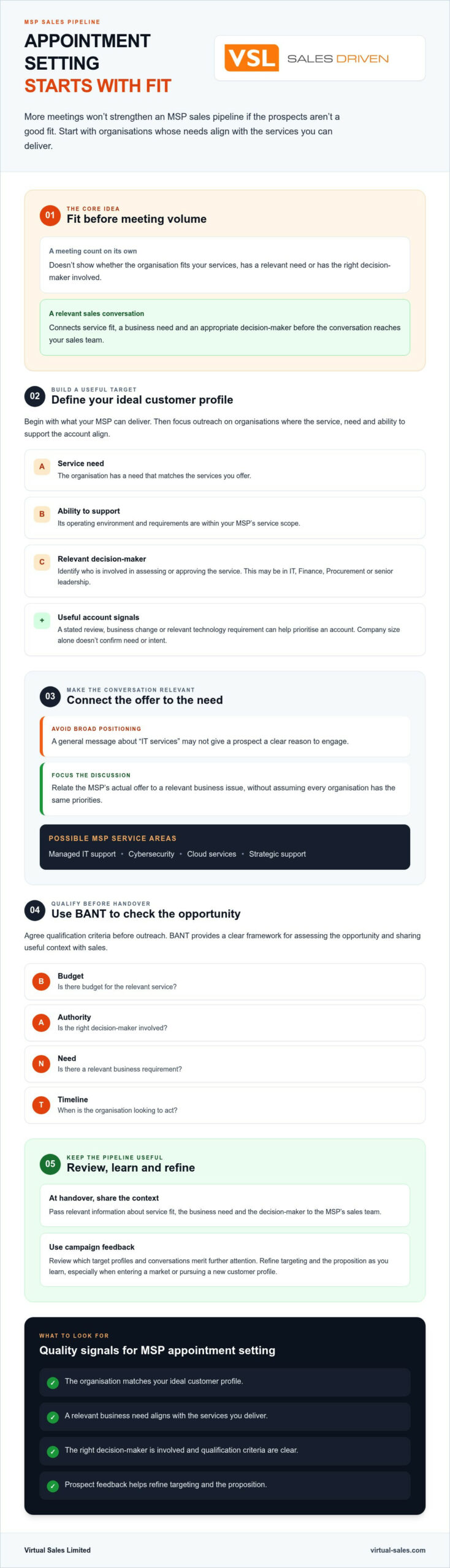
Can outsourced MSP appointment setting deliver quality? Real insight and a practical framework
Outsourcing can support an MSP’s sales team, but it won’t fix unclear targeting or inconsistent qualification by itself. Before outreach starts, agree the ideal customer profile (ICP), what counts as a suitable opportunity and the information sales needs at handover. Without those shared standards, activity may produce conversations that are difficult to assess or progress.
Real Insight: what an MSP campaign should learn from conversations
Illustrative scenario, not a VSL client result: An MSP offers managed IT support, cybersecurity and cloud services. During prospect conversations, some organisations describe a need to review their support arrangements, whilst others focus on security concerns or cloud changes. The useful lesson isn’t that one service line will always attract more interest. It’s that those conversations can reveal which needs are arising within the agreed target market.
The campaign team can share recurring prospect feedback with the MSP, then review whether the account priorities, qualifying questions or service-specific conversation points need refining. The MSP’s sales team can add its feedback after appointments, including whether the need was relevant and whether the handover gave enough context. Treat this as a learning loop, not proof of a particular outcome.
A practical VSL framework for MSP appointment setting
Use a campaign sequence that connects each decision to the MSP’s offer:
- Define fit: Agree the ICP, service scope, target sectors and relevant decision-maker roles.
- Shape the conversation: Develop the proposition with the MSP, linking the service to business needs through consultative, script-free conversations.
- Engage and qualify: Experienced UK-based callers speak with prospects and qualify leads to agreed BANT criteria as a minimum.
- Hand over with context: Share the prospect’s stated need, qualification information and agreed next step with the sales team.
- Review and refine: Use weekly reporting, contact outcomes and sales feedback to inform campaign recommendations.
With dedicated caller support and a campaign manager, VSL works as an extension of the MSP’s sales and marketing team. The campaign is shaped with the client rather than treated as a standard process.
What evidence should an MSP expect to review?
Ask for reporting that shows campaign activity and classified contact outcomes, alongside a clear explanation of how appointments are qualified. VSL provides weekly campaign reporting, with outcomes classified as Call Back, Warmer Contact, Warm Lead, Future Opp, Not Interested or Happy to Keep in Touch. For external proof, assess published VSL Clutch reviews or approved client references, keeping testimonials distinct from campaign data. Any third-party research should be attributed to its named source; if a statistic can’t be checked, leave it out.
When MSPs should consider appointment setting and how to choose support
MSP appointment setting may be worth considering when your team has limited time for consistent prospecting, qualified sales conversations are irregular, or referrals alone don’t provide enough pipeline visibility. It can also support a defined business development test, such as introducing a new service, exploring a target segment or re-engaging suitable contacts in an existing database. It won’t guarantee appointments, revenue or a particular result. Its value depends on the fit between your offer, target accounts and qualification standards.
When is the approach a good fit?
Start by checking that you can describe the organisations you want to reach, the service need you want to explore and the decision-makers likely to be involved. If those are clear, appointment setting can give prospecting a more consistent structure whilst your sales team focuses on progressing suitable conversations. If the target market or proposition is still uncertain, use prospect feedback to test and refine your assumptions rather than treating early activity as proof of demand.
How should MSPs assess an appointment-setting partner?
Ask practical questions before agreeing the work. How will the provider define fit with your ideal customer profile? What qualification criteria will they use, and how will your sales team accept or review appointments? Who owns campaign management, how often will you receive reporting, and how will prospect feedback inform recommendations?
Check that the delivery approach relies on experienced people who can hold consultative, script-free business conversations. Look for clear campaign ownership, regular reporting and a handover your sales team can act on. VSL provides appointment setting for technology companies, including MSPs, and works as an extension of the client’s sales and marketing team. You can review its B2B appointment-setting service to understand the service scope.
What happens when an MSP starts working with VSL?
VSL’s process starts with a monthly subscription and a briefing document. A project set-up call covers the campaign content, processes, actions and timescales, followed by a kick-off call and training on the proposition. A dedicated campaign manager handles campaign set-up, data sourcing, weekly reporting, caller management, result analysis and recommendations. This gives both teams a clear way to review activity and discuss refinements.
For broader context on how appointment setting supports B2B pipeline development, explore the B2B appointment-setting guide. If you’re weighing up whether the approach fits your MSP’s target market and sales capacity, you can review VSL’s appointment-setting experience and use that as a starting point for a conversation about campaign fit.
Build your MSP pipeline around the right conversations
Effective MSP appointment setting starts with fit, not meeting volume. Define the organisations your services can support, connect your proposition to their business needs and agree qualification standards with your sales team. Clear BANT criteria and useful handovers help your team assess each opportunity, whilst prospect feedback can guide campaign refinements.
VSL has supported technology companies since March 2001. Its experienced UK-based callers work through consultative, script-free conversations, with dedicated campaign management and weekly reporting. VSL campaign managers have over 20 years of telemarketing experience. These credentials describe VSL’s experience and delivery approach, not a guarantee of appointments or sales outcomes. You can review published Clutch feedback and discuss whether the approach fits your MSP’s target market, service proposition and sales capacity.
To assess whether the approach fits your MSP, review VSL’s appointment-setting feedback and discuss your campaign requirements with the team.
Frequently Asked Questions
What is MSP appointment setting?
MSP appointment setting is the process of engaging business decision-makers to arrange qualified sales conversations about managed IT or related services. The focus is on finding organisations whose needs fit the MSP’s offer, then giving its sales team relevant context before the meeting. It sits between prospecting and later-stage sales activity: the appointment setter opens and qualifies the conversation, while the MSP’s sales team progresses the opportunity.
How does appointment setting help a managed service provider build its sales pipeline?
Appointment setting gives an MSP a structured way to create sales conversations beyond referrals and inbound enquiries. Targeted outreach can help the team engage organisations that fit its ideal customer profile, while qualification and consistent reporting make campaign progress easier to review. The approach doesn’t guarantee revenue or a particular number of meetings. Its value depends on a relevant proposition, suitable prospects and a clear process for progressing opportunities.
How are MSP sales appointments qualified before they reach the sales team?
Set qualification criteria with the MSP before outreach begins. The appointment setter can explore the prospect’s need, its fit with the services offered, the contact’s role and route to a decision, plus relevant budget and timing. The handover should include the prospect’s stated requirements and agreed next step. This gives the sales team a useful starting point and a consistent basis for assessing appointment fit.
What does BANT mean in MSP appointment setting?
BANT stands for Budget, Authority, Need and Timeline. It’s a framework for assessing whether a prospect meets agreed qualification criteria: whether there is a relevant budget, who can make or influence the decision, what need exists and when action may be considered. A qualified BANT lead meets those criteria as a minimum. It isn’t a promise that the prospect will buy or that the sales opportunity will progress.
Should an MSP outsource appointment setting or manage it in-house?
The right choice depends on your team’s prospecting capacity, available expertise and need for consistent activity. In-house work can keep outreach close to your existing team; outsourced support can add dedicated prospecting capacity when internal staff have limited time. Agree targeting, qualification and handover standards either way. VSL positions its work as an extension of the client’s sales and marketing team, not a replacement for the MSP’s sales role.
How can an MSP assess the quality of booked sales appointments?
Assess whether each appointment matches your ideal customer profile, involves a relevant decision-maker and has a stated need that fits your services. Check the qualification notes and agreed next step, then ask the sales team for feedback after the meeting. Review patterns in accepted appointments and contact outcomes over time. Don’t rely on raw activity or a single headline measure to judge quality.
Can appointment setting support an MSP entering a new market or targeting a new service sector?
Yes. Appointment setting can help an MSP test conversations with a defined audience when entering a market, introducing a service or exploring a new sector. First, clarify which organisations you can support, the need your offer addresses and the decision-makers to approach. Use prospect responses and sales-team feedback to refine the message and target profile. Treat findings as campaign learning, not proof of guaranteed demand.
What should an MSP look for in an appointment-setting provider?
Look for technology-sector experience, consultative conversations, agreed qualification standards and clear campaign ownership. Ask who manages the campaign, how often you’ll receive reports and how prospect feedback informs recommendations. VSL uses experienced UK-based callers, a dedicated campaign manager and weekly reporting. Its proprietary telemarketing-focused CRM tracks outcomes and supports CSV and Excel import and export, as well as Salesforce integration.


Disclaimer
Disclaimer: Content is for general information only and does not constitute professional advice. Results may vary. Virtual Sales Limited accepts no liability for actions taken based on this content.