


Why is your growth still tethered to the CEO’s personal network when your competitors are building autonomous, data-led engines? If you’re exhausted by the “feast or famine” pipeline cycle and the high cost of internal SDR recruitment, you aren’t alone. Most UK founders struggle to move beyond erratic sales performance. Implementing a modern predictable revenue model for UK tech companies is no longer about just sending more emails; it’s about shifting from founder-led heroics to a clinical, data-driven system that operates with surgical precision.
You’re about to discover how to transform your sales operation into a scalable engine that lowers your Customer Acquisition Cost (CAC) while delivering a consistent monthly pipeline. This guide provides a tactical roadmap for the 2026 outbound landscape, focusing on signal-based triggers and seamless CRM integration with platforms like HubSpot and Salesforce. We will preview a specific framework designed to build a high-performing team that functions independently of leadership, ensuring your business scales with the reliability and professional maturity your board expects.
Key Takeaways
- Break the cycle of inconsistent pipelines by decoupling lead generation from closing with a specialized SDR and AE architecture.
- Implement a data-driven predictable revenue model for UK tech companies to reduce founder dependency and lower your customer acquisition costs.
- Protect your brand’s deliverability and reputation by avoiding the 2026 crisis caused by generic, AI-only automated outreach.
- Apply a strategic 5-step framework to map high-yield market segments and integrate verified prospect data into your HubSpot or Salesforce CRM.
- Quantify your growth potential with realistic benchmarks, aiming for 10–20 high-quality meetings per month through professional, human-led development.
Overcoming the “Lumpy” Pipeline: Why UK Tech Firms Struggle with Revenue Consistency
The “feast or famine” cycle is a common reality for many UK startups and SMEs. One month, the calendar is packed with demonstrations; the next, the sales team is staring at a dormant inbox. This volatility stems from a reactive approach to growth. Relying on sporadic referrals or the occasional inbound lead creates a lumpy sales pipeline that makes long-term planning impossible. Without a steady stream of qualified opportunities, your business cannot scale with confidence.
Most ambitious firms eventually hit the “Founder-Led Sales Trap.” In the early stages, the CEO’s expertise and network drive every deal. However, growth plateaus the moment the founder’s time is consumed by operations or product development. Transitioning to a sustainable predictable revenue model for UK tech companies requires moving away from these individual heroics. It demands a system where lead generation is a distinct, measurable function, separate from closing deals. When you depend on one person to find, nurture, and close every lead, you aren’t building a company; you’re managing a job.
Unpredictable revenue doesn’t just stress your cash flow; it actively devalues your business. Investors and venture capital firms in 2026 prioritize forecastable growth over one-off spikes. A lack of clarity in your future earnings makes your firm a higher risk, often resulting in lower valuations during funding rounds. To secure the best terms, you must prove that your revenue is the result of a repeatable engine, not just luck or timing.
The Cost of Reactive Sales in 2026
Relying on inbound leads and word-of-mouth limits your market share to those who are already looking for a solution. It ignores the vast majority of your Total Addressable Market (TAM) that requires proactive engagement. Furthermore, building an internal SDR team often leads to high churn rates and recruitment costs, as junior staff frequently leave for better offers just as they become productive. Without accurate forecasting, you cannot make strategic decisions regarding hiring or R&D, leaving you perpetually behind the market curve.
Defining the UK Tech Buyer Persona
Success in the British market requires a nuanced touch. UK B2B decision-makers value professional maturity and a consultative approach. Aggressive, high-volume “US-style” tactics often backfire here, creating friction rather than trust. Our experience in lead generation for technology companies shows that geographic proximity and staff seniority are critical differentiators. Buyers want to speak with peers who understand the UK’s unique regulatory and economic environment, not an automated bot or a low-cost, offshore script-reader. Building this trust is the foundation of a predictable revenue model for UK tech companies that actually converts.
The Core Pillars of a Predictable Revenue Engine in 2026
A predictable revenue model for UK tech companies isn’t just a sales strategy; it’s a structural overhaul. At its core, this model replaces the “all-rounder” salesperson with a specialized architecture that separates lead generation from closing. By creating a dedicated outbound engine, you ensure that the top of your funnel is never empty. This systematic approach allows for granular tracking of every stage, turning growth from a guessing game into a mathematical certainty.
The architecture relies on the Sales Development Representative (SDR) and Account Executive (AE) split. SDRs focus exclusively on prospecting and qualifying leads, while AEs focus on closing those opportunities. This division of labor aligns with the broader objectives found in the techUK Growth Plan, which emphasizes operational efficiency as a driver for sector-wide scaling. When your best closers spend 30% of their time researching LinkedIn profiles, you’re wasting expensive talent on low-value tasks.
Specialisation: The Secret to Scaling Tech Sales
Your closers should never be prospecting for their own leads. It’s a recipe for burnout and inconsistent performance. Implementing dedicated b2b appointment setting ensures that your AEs wake up to a calendar full of high-intent meetings. This focus provides several psychological and operational advantages:
- Reduced Context Switching: AEs stay in “closing mode” rather than jumping between research and negotiation.
- Skill Mastery: Roles become specialized, allowing staff to develop elite-level expertise in their specific domain.
- Clear Accountability: Performance metrics are easier to track when one team is responsible for pipeline volume and another for conversion.
Data-Driven Lead Generation and Cleansing
A predictable engine is only as powerful as the fuel you feed it. In 2026, generic lists are a liability. You need a comprehensive “Market Map” of your Total Addressable Market (TAM) that identifies specific triggers and decision-makers within your UK territory. This process requires rigorous b2b data cleansing to remove defunct contacts and outdated information, which is a non-negotiable step for any predictable revenue model for UK tech companies. Clean data ensures your outreach reaches the right inbox, protecting your domain reputation and maximizing SDR efficiency.
Integrating these pillars into your HubSpot or Salesforce CRM creates a transparent, high-velocity environment. If you want to see how this looks in practice, you can review our verified track record on Clutch for appointment setting in the UK.
Real Insight: Why AI-Only Outreach is Sabotaging UK Tech Growth
The “spray and pray” method has officially reached its expiration date in 2026. High-volume, AI-generated email automation has triggered a widespread deliverability crisis. Mail servers now use advanced filters to identify and shadow-ban repetitive AI patterns, rendering mass outreach invisible. This shift has fundamentally broken any predictable revenue model for UK tech companies that prioritizes volume over relevance. If your messages never reach the inbox, your model isn’t predictable; it’s non-existent.
Real-world data confirms the risks of over-automation. A mid-market UK SaaS firm recently attempted to replace its entire SDR function with AI-only agents. While their outbound volume tripled, their results plummeted. Within one quarter, they recorded a 40% drop in response rates and a significant decline in meeting quality. This failure proves that professional, human-led telemarketing remains the most effective way to cut through the digital noise. Human intuition is the only tool capable of navigating the complex nuances of a modern B2B sale.
Effective outbound now relies on “Intent-Based Calling.” We use specific market signals, such as leadership changes or recent funding rounds, to identify companies actively seeking solutions. This approach replaces cold, scripted monologues with meaningful, timely interactions. It ensures your predictable revenue model for UK tech companies is built on genuine engagement rather than automated spam.
The “Human Premium” in Tech Sales
Selling complex IT services requires a level of nuance that algorithms simply lack. UK-based professionals understand the subtle social cues and professional etiquette required to navigate British gatekeepers effectively. They build rapport through active listening and empathy, identifying pain points that automated systems miss. This “human premium” ensures your pipeline contains high-value leads with a genuine intent to buy, rather than hollow clicks or bot-generated interest.
Tech Stack Integration: HubSpot and Salesforce Synergies
VSL integrates as a seamless, proactive part of your internal team. We connect directly with cloud-based CRMs, including HubSpot and Salesforce, to provide real-time visibility into the B2B sales pipeline. This closed-loop reporting ensures your Account Executives have full context before every meeting. We use technology to enhance the human element, ensuring every interaction is tracked, measured, and optimized for conversion without losing the personal touch that defines your brand.

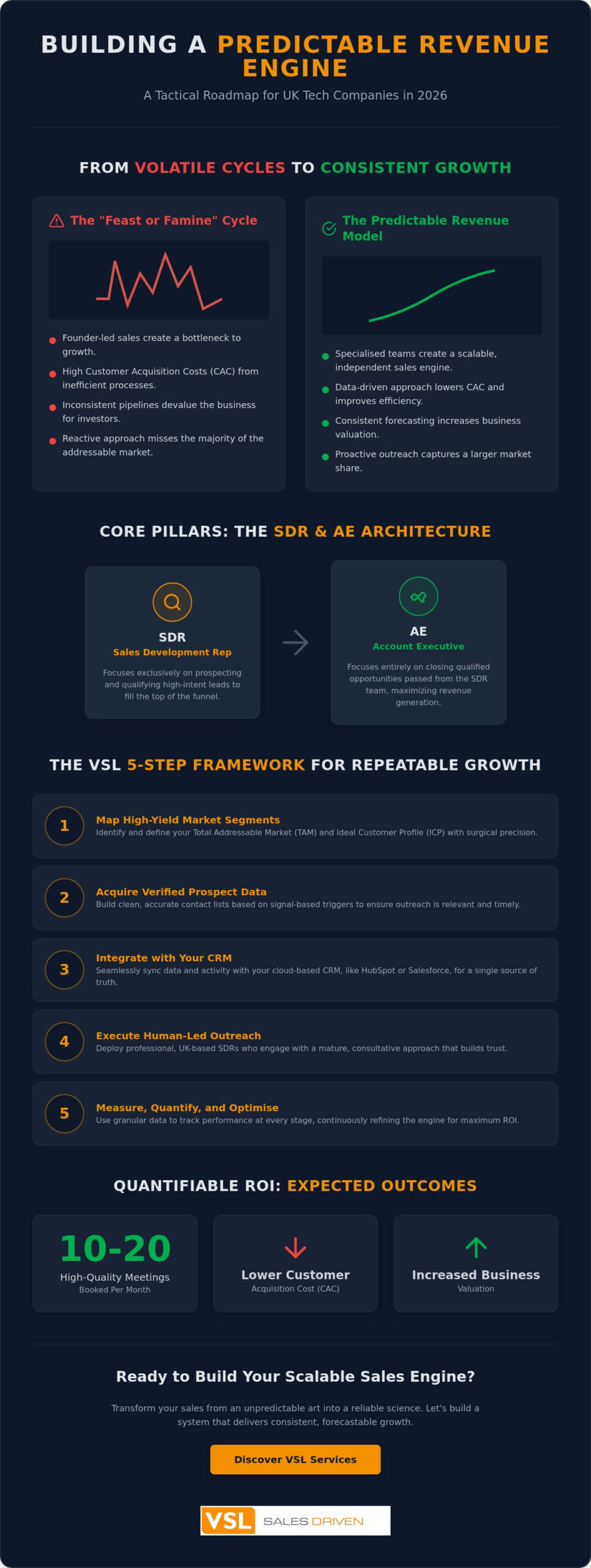
The VSL Framework: 5 Steps to Building a Repeatable Revenue System
Building a predictable revenue model for UK tech companies requires more than theory; it demands a repeatable execution framework. We’ve developed a 5-step method that moves your business from reactive selling to a proactive growth engine. This framework ensures every stage of the funnel is measurable and optimized for the British B2B landscape. It eliminates the guesswork that plagues founder-led sales and replaces it with clinical, data-driven progress.
- Step 1: Strategic Market Mapping. We identify high-yield segments within your UK territory. This involves granular analysis of your Total Addressable Market (TAM) to find the niches where your value proposition is most relevant.
- Step 2: Data Architecture. We build and cleanse a bespoke database of decision-makers. High-accuracy contact data is the lifeblood of lead generation for technology companies. We verify every entry to ensure your outreach never hits a dead end.
- Step 3: Multi-Channel Outreach. We combine professional telemarketing with intent-based email. This layered approach creates multiple touchpoints, ensuring your brand stays top-of-mind for busy decision-makers.
- Step 4: Rigorous Qualification. We use frameworks like BANT or CHAMP to protect your Account Executives’ time. We only pass through leads that meet strict criteria for budget, authority, and need.
- Step 5: Continuous Optimization. Weekly reporting cycles allow us to refine messaging and targeting based on real-world feedback. This ensures the engine stays efficient as market conditions shift.
Strategy and Data: The Foundation
Defining your Ideal Customer Profile (ICP) is the first priority. In the UK market, this involves understanding the specific professional maturity and geographic nuances of your buyers. We set realistic KPIs for the first 90 days of the framework, focusing on pipeline volume and meeting quality. This phase is about establishing a baseline for your predictable revenue model for UK tech companies, ensuring every pound spent on outbound is tracked against a measurable return.
Execution and Closing the Loop
The hand-off process must be seamless. When our SDRs qualify a lead, the transition to your AE feels like a natural progression of the same conversation. In 2026, handling objections requires a consultative pivot. Buyers are more informed and skeptical of generic pitches. Using VSL subscriptions allows you to maintain this consistent sales presence without the heavy overhead and churn of an internal team. You can see how this structured approach delivers results by reviewing our verified performance benchmarks on Clutch.
Results and Data: Quantifying the ROI of Outsourced Sales Development
A predictable revenue model for UK tech companies is more than a tactical sales choice; it’s a strategic financial asset. When growth is forecastable, the risk profile of the business drops, which directly impacts your bottom line and attractiveness to investors. By 2026, data from the UK technology sector suggests that companies with a defined revenue framework are significantly more likely to hit their growth targets than those relying on reactive sales. In fact, research indicates that a robust, repeatable engine can increase company valuation by 2x to 3x by proving that revenue isn’t dependent on a single individual or market fluke.
Success in the UK market is measured by the quality of the pipeline, not just the volume of activities. For a dedicated SDR operating within this model, the benchmark for “good” performance is 10 to 20 high-quality meetings per month. These aren’t just “discovery calls” with low-level managers; they’re qualified appointments with decision-makers who have a verified intent to buy. Achieving this internally is increasingly expensive. An experienced UK-based SDR now commands a salary of £45,000 or more. When you add National Insurance contributions, pension, management overhead, and the cost of a modern tech stack, the true cost of a single internal hire often exceeds £70,000 per year.
The Metrics that Matter
We focus on three primary indicators to measure the health of your sales engine. First is the conversion rate from cold contact to qualified discovery call. Clean data and human-led outreach typically yield higher conversion than automated alternatives. Second is Pipeline Velocity. A predictable model shortens the sales cycle by ensuring your Account Executives only speak with prospects who are ready to move. Finally, we track the reduction in your Customer Acquisition Cost (CAC). Outsourced efficiency allows you to scale up or down without the friction of recruitment or redundancy costs, keeping your growth lean and profitable.
Real-World Success in UK Tech
The financial logic is clear. We’ve seen software firms achieve a 5:1 ROI within the first six months of implementing this framework. By integrating a professional outbound team, these businesses stop wasting their AEs’ time on prospecting and start focusing on closing. This transition is backed by clutch-verified appointment setting, which provides the transparency and social proof required to win in a competitive landscape.
Transitioning to this model is the logical conclusion for any ambitious firm looking to dominate its sector. If you’re ready to move beyond the feast-or-famine cycle, you can explore our B2B subscription services to start building your engine today. For a deeper look at how we’ve helped other firms scale, visit our B2B sales case studies.
Future-Proof Your Revenue Engine for 2026
Sustainable growth in the current landscape requires a departure from erratic, founder-led sales heroics. By decoupling lead generation from closing and prioritizing human-led engagement over automated noise, you build a resilient pipeline that survives market shifts. A predictable revenue model for UK tech companies relies on this specialization and a relentless commitment to data integrity. It’s about moving from “hope as a strategy” to a clinical, repeatable system that delivers results every month.
We bring over 20 years of UK tech sales expertise to your operation, acting as an elite, integrated component of your own workforce. As specialists in the IT, SaaS, and software sectors, we understand the professional maturity required to win in the British B2B market. Our proactive approach ensures your Account Executives stay focused on high-value negotiations while we maintain the momentum of your sales pipeline. Don’t let your growth plateau due to inconsistent outreach or high internal churn.
Ready to transform your sales cycle? Explore our Clutch-verified B2B Appointment Setting results and start building your engine today. Your scalable future is within reach, and it starts with a data-driven foundation.
Frequently Asked Questions
What is the predictable revenue model?
The predictable revenue model is a systematic approach to sales that decouples lead generation from closing by creating specialized roles for SDRs and AEs. It moves away from reactive, founder-led selling toward a data-driven engine where outbound prospecting is a consistent, measurable function. By focusing on repeatable processes, companies can forecast growth with clinical accuracy rather than relying on inconsistent referrals or inbound luck.
How much does it cost to implement a predictable revenue model in the UK?
Implementing this model involves costs related to recruitment, technology, and data. Hiring an internal SDR in the UK typically requires a salary of £45,000 plus National Insurance and benefits, while CRM seats and data tools add several thousand pounds more. Outsourcing remains a cost-effective alternative to these high overheads, allowing firms to access professional maturity without the long-term liability and management burden of internal headcount.
Can I use the predictable revenue model for small tech startups?
Yes, small tech startups benefit significantly from this model because it builds a scalable foundation from day one. It prevents the “founder-led sales trap” where growth stalls once the CEO’s personal network is exhausted. Starting with a predictable revenue model for UK tech companies ensures that your first sales hires are specialized, preventing the inefficiencies of “all-rounder” roles that often fail in complex IT environments.
Is the predictable revenue model still effective in 2026 with AI?
The model is more effective than ever in 2026, provided you prioritize human-led outreach over automated spam. While AI helps with market mapping and research, the “human premium” is required to navigate gatekeepers and build rapport in the UK B2B sector. We use AI to identify intent signals, but our staff handles the nuanced conversations that actually convert high-value technology leads.
How long does it take to see results from an outbound sales engine?
You should expect to see early pipeline activity within the first 30 days, with qualified meetings typically scaling between 60 and 90 days. Building a predictable revenue model for UK tech companies requires an initial “ramp-up” period to cleanse data, refine messaging, and establish rapport with decision-makers. This structured approach ensures that the resulting pipeline is sustainable and forecastable rather than a one-off spike.
What is the difference between lead generation and appointment setting?
Lead generation is the broad process of identifying and attracting interest from potential buyers, whereas appointment setting is the specific act of qualifying that interest and booking a firm meeting. Appointment setting is a deeper stage of the funnel that requires rigorous qualification using frameworks like BANT. While lead generation fills the top of the funnel, appointment setting ensures your Account Executives only speak with high-intent prospects.
Why should I outsource my sales development instead of hiring internally?
Outsourcing provides immediate access to professional maturity and specialized expertise without the risk of high SDR churn. Building an internal UK team involves significant management overhead and the constant threat of staff being headhunted. By partnering with an integrated component like VSL, you mitigate recruitment risks and gain a high-performing team that functions independently of your core leadership while maintaining clinical efficiency.
Does VSL integrate with my existing CRM like Salesforce or HubSpot?
Yes, we integrate directly with major cloud-based CRMs, including Salesforce and HubSpot, to ensure real-time visibility and transparency. This connectivity allows for closed-loop reporting where every lead, interaction, and outcome is logged within your own system. It ensures that your internal Account Executives have full context for every meeting we book, creating a seamless transition from our outreach to your closing process.


Disclaimer
Disclaimer: Content is for general information only and does not constitute professional advice. Results may vary. Virtual Sales Limited accepts no liability for actions taken based on this content.