



If your CRM hasn’t undergone a professional audit in the last 12 months, 30% of your prospect data is already obsolete. You’ve likely seen the fallout: sales reps wasting 2.5 hours every day on incorrect phone numbers and your sender reputation taking a hit from email bounce rates exceeding 10%. It’s frustrating to watch your team struggle to reach the actual decision-maker because of a database that’s slowly decaying. At VSL, we know that a bloated, inaccurate list isn’t just a nuisance; it’s a direct drain on your UK sales ROI.
You already understand that high-quality outreach requires high-quality data, but maintaining that standard is a constant battle. This guide reveals how to transform your database into a high-performance sales asset through strategic b2b data cleansing and human-verified intelligence. I’ll show you the exact steps to build a streamlined sales pipeline that delivers higher conversion rates for appointment setting while maintaining full GDPR and TPS/CTPS compliance. We’ll move beyond automated tools to explore how human intelligence ensures your team only speaks with the right people at the right time.
Key Takeaways
- Identify the “silent pipeline killer” by understanding how annual data decay renders up to 40% of your B2B database obsolete.
- Implement a strategic b2b data cleansing workflow to ensure your sales team focuses exclusively on accurate, high-value target accounts.
- Learn why human-verified intelligence is essential for navigating complex job role changes that automated tools consistently miss.
- Adopt a “quality over quantity” methodology that prioritises high-precision data to generate more qualified appointments with less effort.
The Silent Pipeline Killer: Why B2B Data Cleansing is Non-Negotiable in 2026
Your CRM is likely losing value as you read this. At its core, b2b data cleansing is the systematic process of identifying and correcting inaccurate, outdated, or incomplete records within your database. It’s not a one-off housekeeping task; it’s a strategic necessity for any growth-focused organisation. In the high-velocity markets of 2026, data functions as a perishable asset. Without proactive management, its utility evaporates, leaving your sales team to chase ghosts and dead ends.
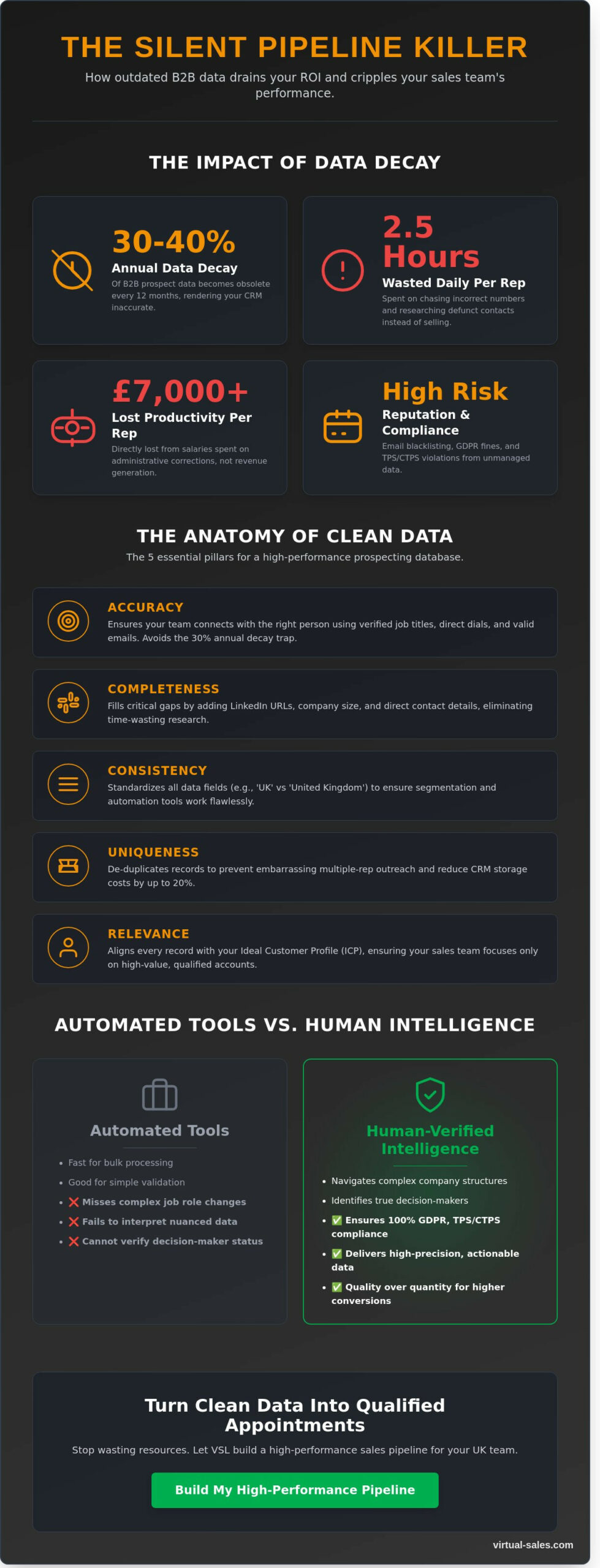
The “Data Decay” phenomenon is relentless and unforgiving. Industry benchmarks consistently show that 30-40% of B2B data becomes obsolete every 12 months. Professionals change roles, companies undergo restructures, and mergers dissolve entire departments. If you haven’t refreshed your prospect list since last year, nearly half of your outreach is likely hitting invalid inboxes. This isn’t just a database management issue; it’s a direct drain on your company’s bottom line.
Dirty data carries heavy, often invisible, costs that erode your ROI. Consider the wasted investment in SDR salaries. If a representative earning £35,000 per year spends 20% of their time correcting wrong numbers or researching defunct emails, you’re losing £7,000 in productivity per head. When you add escalating CRM storage fees and the opportunity cost of missed revenue targets, the price of inaction becomes staggering. Effective Data cleansing ensures your budget is spent on engagement, not administrative corrections.
The Impact on Your Sales Pipeline
Inaccurate data creates immediate sales friction. It forces high-performing teams to pause, verify, and restart; this destroys the momentum required for high-volume prospecting. There’s a direct, measurable link between poor data quality and subpar B2B appointment setting results. When your data is flawed, your conversion rates plummet. Beyond the internal frustration, the external risks are severe. Repeatedly emailing defunct addresses or hitting spam traps can lead to your domain being blacklisted, effectively killing your outreach campaigns before they even begin.
Compliance and the Legal Imperative
Maintaining a clean database is a legal requirement in the UK. Strict adherence to GDPR and PECR regulations is mandatory for any business operating in 2026. You must screen all outbound lists against the Telephone Preference Service (TPS) and the Corporate Telephone Preference Service (CTPS) to avoid heavy fines and regulatory scrutiny. Compliance is the proactive protection of your brand’s reputation and legal standing. VSL ensures that every contact point is verified, protecting you from the regulatory fallout that follows sloppy data management.
The Anatomy of Clean Data: 5 Essential Pillars for High-Performance Prospecting
Success in B2B sales isn’t about the volume of your CRM; it’s about the integrity of the records within it. Effective b2b data cleansing transforms a cluttered database into a precision instrument. To build a pipeline that actually converts, you must master five distinct pillars of data health.
- Accuracy: Business records decay at a rate of roughly 30% per year. You need current job titles and direct contact details to avoid the “bounce-back” trap. If your data is 12 months old, nearly a third of your outreach is already wasted.
- Completeness: Gaps kill momentum. A high-performing record includes direct dials, LinkedIn URLs, and company size metrics. Without these, your team spends more time researching than selling.
- Consistency: Uniformity is vital. Standardised fields ensure your automation tools don’t send “Dear [FIRSTNAME]” emails in all caps or fail to categorise leads correctly during a campaign.
- Uniqueness: De-duplication prevents the embarrassment of contacting the same prospect twice with conflicting messages. It also saves resources; redundant records can inflate CRM costs by up to 20% in unnecessary storage and licensing fees.
- Relevance: This ensures your outreach aligns with your Ideal Customer Profile (ICP). If the firmographic data doesn’t match your target, the lead is a liability that drains your sales team’s energy.
Standardising Your Database
Naming conventions and address formats are the gears of your marketing engine. If one salesperson enters “UK” and another enters “United Kingdom,” your segmentation breaks. High-quality data lays the foundation for reliable sales forecasting and reporting. At VSL, we advocate for a “Single Source of Truth.” This central hub ensures every department works from the same verified data set, eliminating friction between marketing and sales teams. Standardisation allows for clean, automated reporting that reflects the true state of your pipeline rather than a distorted version of it.
Enrichment and Firmographics
Basic contact info is no longer enough for 2026 sales leaders. Enrichment involves appending deep firmographic layers such as annual revenue, employee counts, and specific tech stacks. This granular detail enables highly personalised lead generation for technology companies. We’ve moved away from broad outreach; the modern standard is precision targeting. By knowing exactly which software a prospect uses or their recent funding rounds, your pitch becomes a solution rather than an intrusion. If your current pipeline lacks this depth, consider how VSL’s subscription services can provide the continuous data refinement your growth requires. For SaaS businesses looking to scale without the overhead of internal SDR teams, pairing enriched data with an outsourced lead generation SaaS strategy can dramatically accelerate pipeline velocity.
Automated Tools vs Human Verification: Choosing the Right Cleansing Strategy
Efficiency often masks inaccuracy. Sales leaders in 2026 face a critical choice: automate for volume or verify for value. Effective b2b data cleansing requires a calculated blend of both, yet many firms lean too heavily on software that lacks context. While algorithms process millions of records in seconds, they cannot navigate the political nuances of a British boardroom.
When to Use Automation
Software excels at binary tasks. Use automated tools for bulk email syntax checks, identifying 404 domains, and standardising UK postcodes. According to 2024 industry benchmarks, 60% of B2B organisations now use automated hygiene tools to maintain CRM health. These systems provide a vital first line of defence.
However, 2026 AI still hits a wall with complex organisational structures. Machines struggle to distinguish between a “Marketing Director” with budget authority and a title-inflated junior in a small startup. Integrate these tools into your CRM for real-time basic hygiene, but don’t rely on them for strategic prospecting. They’re built for speed, not for the granular accuracy required to close high-value deals.
The Power of Human Intelligence
Genuine insight lives in the gaps between data points. Professional telemarketers identify gatekeeper shifts and internal restructuring that no algorithm can scrape from LinkedIn. At VSL, we position our UK-based calling team as a seamless extension of your team. They uncover “hidden” insights through direct conversation, ensuring your sales staff don’t waste hours chasing ghosts.
Human verification allows you to map the Decision Making Unit (DMU) accurately. A caller might discover that while a contact’s title remains the same, their influence has shifted following a recent merger. This “Human-in-the-loop” philosophy ensures your b2b data cleansing process is both clinical and commercially relevant. When combined with a signal-based approach to cold calling B2B companies, human-verified data becomes the foundation for consistently reaching senior decision-makers who are ready to engage. Ensuring your callers can also clearly articulate what sets your offer apart is equally critical; a well-crafted unique selling point lead generation telemarketing strategy ensures that every verified contact receives a pitch that differentiates rather than blends in.
The ROI of this approach is undeniable. Consider these two scenarios:
- The Automation Trap: An unverified list of 5,000 records. Bounces and wrong numbers waste approximately £3,000 in SDR salary costs over a month.
- The VSL Standard: A clean list of 500 verified decision-makers. This targeted group typically generates 3x more qualified appointments because every dial connects to a legitimate prospect. Tech companies looking to eliminate this overhead entirely can explore how a dedicated outsourced lead generation SaaS partner delivers verified SQLs without the cost of internal hiring.

How to Cleanse Your B2B Database: A Step-by-Step Practical Workflow
Effective b2b data cleansing isn’t a one-off chore; it’s a rigorous operational process. You can’t scale a 2026 sales strategy on 2024 information. Start with a cold, hard audit of your current assets. Industry data from 2023 suggests that B2B contact data decays at a rate of 2.1% per month. If you haven’t touched your database in a year, 25% of it is likely useless. Identify red flags such as email bounce rates exceeding 8% or direct dials that return “number not recognised” tones. These aren’t just minor errors; they’re resource drains that kill sales momentum.
The Audit and Segmentation Phase
Prioritise your records based on potential ROI rather than volume. Focus your initial cleansing energy on high-value target accounts currently in the middle of your sales cycle. A 5% improvement in data accuracy for these accounts can lead to a 10% increase in conversion rates. Set clear KPIs for the project: aim for a 98% email deliverability rate and ensure 95% of your “Decision Maker” titles are verified within the last six months. This targeted approach ensures your team spends time where the money is. Identifying “red flag” data early allows you to isolate toxic records before they damage your sender reputation.
Executing the Cleansing Workflow
Execution requires a blend of automation and human intelligence. Use automated tools for syntax checks to strip out obvious formatting errors in phone numbers and email addresses. When de-duplicating, merge records based on unique company registration numbers or LinkedIn URLs to ensure you don’t lose historical sales notes. Losing that context is a cardinal sin in B2B sales. For “goneaways,” don’t just delete the record. Track the mover to their new role; 15% of new business opportunities come from following a previous champion to a new company. Deploying a specialised team to verify these details manually ensures 100% accuracy that software alone cannot match.
The final step of any cleansing workflow must be a CRM sync to prevent data silos.
Maintain this standard by establishing a “Cleansing Calendar.” Review your top 20% of accounts monthly and the remaining 80% quarterly. This prevents the database from ever reverting to a state of decay. Consistent b2b data cleansing ensures your sales team never wastes a dial on a dead lead. At VSL, we act as a seamless extension of your team to handle this heavy lifting, ensuring your pipeline remains primed for growth. For sales leaders who want to remove the burden of prospecting entirely, exploring outsourced sales services can free your internal team to focus exclusively on closing deals rather than database management.
Turning Clean Data into Qualified Appointments: The VSL Methodology
VSL doesn’t operate on guesswork. We fuel our B2B telemarketing services with clinical precision. High-quality data acts as the high-octane fuel for every outbound campaign we manage. Without it, even the most talented sales professional is simply spinning their wheels. We reject the “spray and pray” model that defines many lower-tier agencies. Instead, we champion a “Quality over Quantity” philosophy.
Calling 50 verified, high-intent prospects produces significantly better results than cold-calling 500 unverified names. This focus on b2b data cleansing ensures our team spends their time having meaningful conversations rather than wrestling with dead switchboards or incorrect job titles. It’s about being effective, not just busy. Sales leaders who want to maximise the impact of every verified contact should explore how B2B Sales Campaigns built on clean, verified data can turn a precision-targeted list into a consistent flow of high-quality appointments.
Efficiency translates directly to your bottom line. Clean data slashes the “Cost Per Lead” by maximising SDR output. When we remove the 25% to 30% of records that are typically outdated in a standard B2B list, we increase the actual calling time by several hours every week. We also close the loop by using real-time feedback from our sales calls to update your database. If a prospect has moved on or a company has restructured, that intelligence is captured and reflected in your CRM immediately. As decision-makers increasingly retreat behind AI filters and automated gatekeepers, pairing clean data with proven b2b telemarketing services is the most reliable way to cut through the digital noise and reach the right people.
From Database to Sales Pipeline
Accurate data transforms the appointment setting process from a grind into a scalable growth engine. Sales teams experience a massive psychological lift when every lead they dial is valid and relevant. It builds momentum and confidence. In a 2024 project for a UK-based software firm, our data-first approach accelerated their B2B sales pipeline velocity by 32% in just one quarter. We don’t just provide names; we provide a clear, validated path to revenue. For London sales leaders evaluating appointment setting firms that deliver qualified meetings at scale, clean and verified data is the non-negotiable foundation that separates high-performing partners from disconnected vendors.
Your Next Steps for 2026
Waiting until a campaign launch to fix your records is a tactical failure. You’ll waste the first two weeks of your budget on data correction rather than conversion. Proactive b2b data cleansing should be a permanent fixture in your B2B lead generation strategy. This ensures your 2026 targets remain achievable and your ROI stays high from the first dial. If you’re also evaluating which b2b lead generation companies can deliver human-verified intelligence at scale, understanding how they approach data quality is the single most important criterion for making the right choice. For software and technology firms specifically, pairing a clean, verified database with a structured IT appointment setting strategy ensures your SDR team engages CISOs and IT Directors as informed technical peers rather than cold callers.
Stop letting bad data drain your sales budget and demotivate your team. Contact Andy Dickens and the VSL team today for a bespoke data and sales audit. Let’s build a pipeline that actually converts.
Master Your Market with Precision Intelligence
Stop letting decayed records erode your ROI. By 2026, the gap between firms using automated-only tools and those leveraging human-verified intelligence will widen significantly. Research shows that B2B data decays at a rate of 30% every year, meaning a static list is a liability, not an asset. Effective b2b data cleansing isn’t just about deleting bounces; it’s about building a foundation for the VSL methodology to convert prospects into high-value appointments. It’s the difference between a cold call that goes nowhere and a strategic conversation with a decision-maker.
At VSL, we’ve spent over 20 years refining database development for the IT, Software, and Fintech sectors. Our specialised UK-based calling team ensures every contact is verified by a real person, providing a level of accuracy that software alone can’t replicate. We’ve proven this approach delivers measurable ROI for ambitious businesses looking to scale. Don’t leave your 2026 sales targets to chance. Book a consultation with Andy Dickens to audit your sales data and see the difference that high-performance prospecting makes. Your team’s next big win starts with a clean slate.
Frequently Asked Questions
What is the difference between data cleansing and data enrichment?
Data cleansing focuses on removing inaccuracies, duplicates, and outdated records to restore your database integrity. Data enrichment involves appending new, high-value information to existing records, such as company turnover or specific technology stacks. While cleansing ensures your CRM is accurate, enrichment ensures it’s actionable for targeted prospecting and personalized outreach.
How often should a B2B database be cleansed?
You should cleanse your B2B database at least once every quarter to combat the 2.1% monthly decay rate typical in UK professional sectors. High-growth firms often implement monthly automated sweeps to ensure sales teams don’t waste time on dead leads. Waiting a year to audit your CRM often results in a 30% drop in outreach efficiency as contacts change roles or companies.
Can I use AI to automate my B2B data cleansing entirely?
AI can automate approximately 80% of b2b data cleansing tasks, such as identifying duplicates and formatting UK postcodes. However, it cannot replace human intelligence for verifying complex job title changes or nuanced company mergers. VSL recommends a hybrid approach where AI handles bulk processing and experienced researchers verify high-value accounts to ensure total accuracy.
Is B2B data cleansing a legal requirement under GDPR?
Yes, b2b data cleansing is a legal requirement under Article 5(1)(d) of the UK GDPR, which mandates that personal data must be accurate and kept up to date. Failing to remove “stale” contacts who’ve left their roles can lead to non-compliance and potential regulatory scrutiny. Maintaining a clean database isn’t just about sales efficiency; it’s a critical component of your legal data protection obligations.
How much does B2B data cleansing typically cost for a mid-sized CRM?
Professional data cleansing for a mid-sized UK CRM typically costs between £0.15 and £0.45 per record, depending on the depth of verification required. For a database of 10,000 records, companies often budget between £1,500 and £4,500 for a comprehensive manual and automated overhaul. These figures represent industry averages for third-party services and exclude internal staff costs or software subscriptions.
What are the main signs that my B2B data is dirty and needs cleaning?
High email bounce rates exceeding 2% and a sudden drop in appointment setting success are primary indicators of dirty data. If your sales team spends more than 15 minutes per hour fixing CRM errors, your database is compromised. Frequent “not at this company” responses during cold calls signal that your records have reached a critical decay point and require immediate intervention.
How do I cleanse data without losing my existing sales history and notes?
Use “Merge” functions rather than “Delete” to consolidate duplicates without losing activity logs or historical sales notes. Always perform a full CSV export backup before starting any bulk b2b data cleansing operation. Most modern CRMs allow you to map historical notes to a master record, ensuring your sales pipeline history remains intact while the contact details are updated.
Does data cleansing help with email deliverability and sender reputation?
Data cleansing directly improves email deliverability by reducing hard bounces, which are a primary trigger for ISP filters. Maintaining a bounce rate below 1% protects your sender reputation and ensures your campaigns reach the primary inbox rather than the spam folder. Consistently hitting dead inboxes leads to your domain being blacklisted by major providers like Outlook and Google.


Disclaimer
Disclaimer: Content is for general information only and does not constitute professional advice. Results may vary. Virtual Sales Limited accepts no liability for actions taken based on this content.