


A meeting can reach your sales team on time and still leave them guessing about the prospect’s requirements, decision process or next steps. BANT Qualified Meetings should do more than record Budget, Authority, Need and Timeline. They should give salespeople useful context: what the prospect has said, who may be involved and which questions remain open. That helps representatives prepare and judge whether there’s a sensible next step, rather than using the meeting to repeat questions that could have been explored earlier.
For technology, SaaS and IT services businesses, qualification can be difficult to apply consistently. Prospects may not have a final budget, one clear decision-maker or a fixed purchase date when first approached. A rigid checklist can miss useful signals, while vague handovers leave sales representatives to fill in the gaps. The practical approach is to capture what the prospect has actually shared, distinguish confirmed details from estimates and make unknowns clear.
This guide explains what makes a BANT-qualified meeting useful, how to explore qualification evidence through a natural business conversation and what information to pass to sales. You’ll also learn how to set a consistent standard, review meeting quality and use campaign feedback to improve prospect targeting and pipeline visibility.
Key Takeaways
- Define qualification around useful evidence, so sales meetings bring context rather than just calendar activity.
- Explore Budget, Authority, Need and Timeline through natural business discussion, including how buying responsibilities are shared.
- Use BANT Qualified Meetings to give sales representatives relevant prospect context and a clearer basis for preparation.
- Build a consistent process to define the target, brief the team, engage prospects, qualify opportunities and review feedback.
- Assess meeting quality through qualification evidence, relevance, attendance and sales-team feedback, then use reporting to guide campaign improvements.
What Are BANT Qualified Meetings in B2B Sales?
Sales teams need relevant meetings, not calendar activity without context. An appointment can be confirmed while key details about the prospect’s requirement, role or decision process remain unclear. BANT Qualified Meetings aim to give the sales representative a useful starting point by capturing evidence about Budget, Authority, Need and Timeline before the conversation. This context supports preparation, but it doesn’t replace the representative’s own discovery.
A BANT-qualified meeting is a sales appointment supported by information gathered about these four areas. The handover is only as useful as the evidence it contains: it should reflect what the prospect actually said, not what the caller inferred. A meeting may still be worth holding when some details are unknown, provided those gaps are made visible instead of presented as settled facts.
It’s also useful to distinguish a qualified BANT lead from an appointment. A lead is a prospect assessed against agreed qualification criteria. An appointment is a meeting arranged with that prospect. Qualification doesn’t confirm buying intent, guarantee attendance or ensure a sale. It gives the sales team a clearer basis for deciding what to explore next.
What does BANT stand for in B2B qualification?
BANT is a qualification framework for assessing four parts of a prospect’s buying context:
- Budget: The financial capacity or funding context discussed with the prospect. This might be approved funding, planned investment or a budget that still needs to be explored.
- Authority: The contact’s involvement in decision-making and the other people who may influence or approve a purchase.
- Need: The business requirement or problem the prospect has described, rather than a need inferred from their job title alone.
- Timeline: The prospect’s intended timeframe for assessment, decision or action, including any dependencies they have mentioned.
Together, these areas help teams describe an opportunity using a shared language. They don’t require every answer to be final before a meeting can be arranged. In technology sales, the first contact may explain the business issue but not know who will approve funding or when a technical assessment will take place. The value lies in capturing that position accurately so the sales representative knows where to focus.
How does a qualified lead become a useful meeting?
A useful handover turns qualification into practical preparation. It should tell the representative why the prospect agreed to meet, what they have already shared and which questions remain open. The meeting can then build on the prospect’s context instead of starting with avoidable repetition. Clear notes also help the sales team decide whether to focus first on the business requirement, stakeholder roles or the prospect’s next decision.
A BANT-qualified meeting is an agreed sales appointment informed by evidence about Budget, Authority, Need and Timeline, not a promise of purchase.
B2B lead generation identifies and engages prospective business customers to create qualified opportunities. B2B appointment setting focuses on engaging relevant business decision-makers and arranging qualified sales appointments. For a closer look at that process, see this guide to B2B appointment setting and qualified meetings.
How to Assess Budget, Authority, Need and Timeline Without a Checklist
Qualification should feel like a business discussion, not a sequence of questions delivered regardless of what the prospect has just said. Listen for the issue they raise, then explore the buying context that follows. A prospect may not know the final budget or decision date at first contact. Capture what they have confirmed, what they estimate and what remains unknown. That distinction helps the sales team prepare without turning assumptions into facts.
Technology purchases often involve several functions. IT may assess technical fit, Finance may consider funding, Procurement may manage approval, HR may represent affected teams, and business leaders may sponsor or approve a change. The person you speak with may influence the decision without holding final authority. HubSpot’s framework for qualifying leads offers a useful reference for structuring questions, but adapt the discussion to the prospect’s role and organisation.
What questions help establish Budget and Authority?
Explore how the organisation expects to fund or approve the work without pressing for a figure before the prospect is ready. For example, ask, “Has funding been set aside, or would it depend on building a business case?” The answer can show whether funding is confirmed, being estimated or has not yet been discussed. Record that distinction. For Authority, clarify who assesses the proposal, who recommends a course of action and who gives approval. A senior job title alone doesn’t establish decision authority.
How do you qualify Need and Timeline in technology sales?
Start with what prompted the prospect to consider a change. Ask about the operational or commercial issue, its effect on the business and what a better outcome would look like. Then explore what needs to happen before action is possible, such as a technical review, internal agreement or approval. You could ask, “What would shape the timing of a decision?” Record the prospect’s stated timeframe and any dependencies. Don’t turn a tentative target into a confirmed deadline.
Use the prompts below selectively. The aim is to capture reliable evidence, not to ask every question in order. Let the prospect’s answers guide the next question, and note when a point still needs to be explored.
| BANT area | Evidence to capture | Possible follow-up |
|---|---|---|
| Budget | Funding status and whether it is confirmed, estimated or unknown | “How is a project like this usually funded?” |
| Authority | Contact’s role, other stakeholders and approval steps | “Who else would assess or approve a solution?” |
| Need | Business issue, its effect and the change sought | “What prompted you to look at this now?” |
| Timeline | Intended decision or action period and dependencies | “What could affect the timing of a decision?” |
Clear notes give sales a practical basis for follow-up and make qualification easier to review across a campaign. To explore VSL’s appointment-setting approach and client feedback, visit its UK appointment-setting profile.
What Makes BANT Qualified Meetings Useful? Real Insight and Common Mistakes
The value of a qualified meeting depends on what the sales representative knows before it starts. A useful handover connects the prospect’s stated requirement with the people involved and the next step they have agreed to consider. BANT Qualified Meetings can give sales a sound basis for preparation, provided the notes distinguish evidence from assumption.
Illustrative technology campaign scenario
This example is hypothetical and is not a VSL client result. A software company is speaking with an operations lead who wants to explore whether a reporting platform could reduce manual work. The prospect describes the process and its effect on the team. They expect IT to assess technical requirements and Finance to review funding, but neither has yet confirmed a role in the decision. The prospect is gathering information before planning a possible review next quarter.
That context helps the sales representative prepare relevant questions about the workflow, technical assessment and funding process. It also sets a sensible expectation: the prospect has expressed a need and a possible timeframe, but budget approval and stakeholder involvement remain unconfirmed. The representative can use the meeting to explore those gaps, rather than treating them as settled facts.
What does a strong meeting handover include?
A concise handover should capture the prospect’s requirement, their role, known stakeholders and the next step they stated. Separate confirmed details from points that need discovery. For example, write “IT assessment expected, approver not confirmed”, rather than labelling the contact the decision-maker. Add a clear prompt for the sales representative, such as asking how technical review and funding approval fit into the prospect’s process.
Which BANT qualification mistakes weaken meeting quality?
- Rigid questioning: Forcing every topic into a fixed order can interrupt the prospect’s explanation. Follow the conversation and ask for clarification where it adds context.
- Rejecting a prospect for an unknown budget: A missing figure is not proof that funding is unavailable. Record what is known and leave budget discovery as an open point.
- Assuming seniority equals authority: A senior contact may influence a decision without approving it. Clarify who else assesses, recommends or signs off.
- Defining the ideal customer profile too broadly: If the target companies and relevant roles are unclear, meetings may be poorly matched to the sales team’s remit.
- Measuring activity alone: Meeting counts do not show whether handovers were relevant or useful. Without follow-up from sales, qualification gaps can persist.
Ask representatives what information helped, what was missing and whether the agreed next step matched the discussion. Review that feedback alongside campaign outcomes to refine qualification and targeting. For more practical guidance, see these common B2B lead generation mistakes.

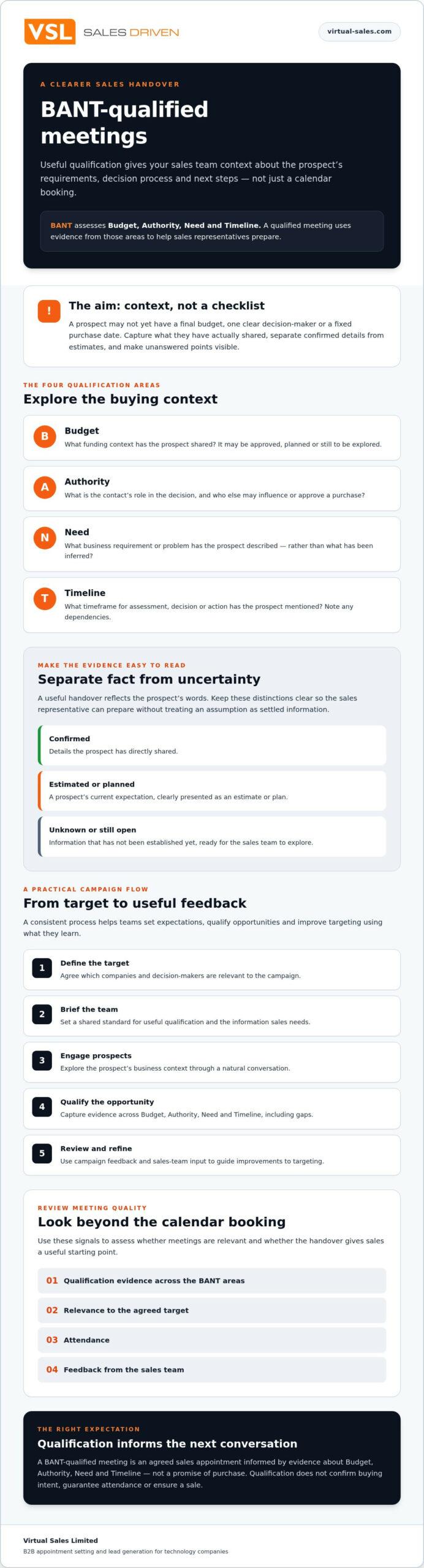
A Practical VSL Framework for BANT Qualified Meetings
A consistent process helps turn qualification into a useful handover, rather than a set of disconnected answers. For BANT Qualified Meetings, VSL’s approach follows five practical stages: define, brief, engage, qualify and review. Each stage connects campaign planning to the sales conversation that follows.
- Define: Agree the ideal customer profile, target organisations and relevant decision-makers. Clarify the business need the campaign will explore and the proposition prospects will hear.
- Brief: Set expectations for evidence across Budget, Authority, Need and Timeline. Agree how to describe unknowns, which details sales needs before a meeting and how the handover will reach the team.
- Engage: Experienced UK-based callers hold consultative, script-free business conversations with relevant prospects. Dedicated callers and a campaign manager support continuity and campaign management.
- Qualify: Explore the prospect’s requirements and buying context naturally. VSL qualifies leads to BANT criteria as a minimum, recording what the prospect has shared without presenting assumptions as confirmed information.
- Review: Use weekly reporting, tracked campaign outcomes and sales-team feedback to assess qualification quality and identify useful campaign recommendations.
How should a campaign define a BANT-qualified meeting?
Before outreach begins, the client and campaign team should agree which organisations and roles fit the target, what proposition is relevant to them and what information makes a meeting useful to sales. For example, the brief can specify that a prospect’s stated need and role must be captured, while budget status and other stakeholders should be labelled clearly if they are not yet known. Agree how the sales team will receive the context and what follow-up action it should take.
How should teams review campaign feedback?
Weekly reporting gives the team a regular point to review outcomes and qualification patterns. Sales representatives can share whether the meeting context matched the conversation, which details helped them prepare and what they still needed to establish. The campaign manager can use that feedback in analysis and recommendations, helping refine the brief and future conversations.
VSL’s telemarketing-focused CRM tracks campaign activity and outcomes. Campaign data can be exported in CSV or Excel format, and the CRM integrates with Salesforce. This helps client teams work with campaign information in their sales processes.
Measuring BANT Meeting Quality and When to Use It
Meeting quality is more than a count in a campaign report. To understand whether BANT Qualified Meetings are helping your sales team, review the evidence behind each handover, the fit between the prospect and your target market, whether the meeting took place and what happened next. Set a consistent review process, but don’t impose arbitrary benchmarks without a reliable basis.
Which measures reveal whether meetings are well qualified?
Assess each meeting against the agreed qualification standard and the needs of the sales team. Check whether the notes record what the prospect said about Budget, Authority, Need and Timeline, and whether any unknowns are clearly marked. Then consider:
- Prospect relevance: Does the organisation and contact fit the agreed ideal customer profile and target roles?
- Attendance: Did the prospect attend, and if not, was a follow-up action recorded?
- Sales feedback: Did the representative find the context accurate and useful? What information was missing?
- Progression: Did the conversation lead to a clear next step in the sales process, or is more discovery needed?
Activity measures, such as outreach completed or meetings arranged, help explain campaign delivery. They don’t show on their own whether a prospect was relevant or a sales conversation advanced. Compare campaign records with sales feedback to spot recurring gaps, such as unclear stakeholder roles or an assumed timeframe. For broader guidance on choosing meaningful measures, see sales development metrics that matter to CEOs.
Weekly reporting can bring call outcomes, follow-up actions and campaign recommendations into a regular review. Use it to identify patterns and agree what to adjust, whether that means refining the target profile, clarifying the evidence expected in a handover or exploring a qualification point differently. Keep the focus on learning, not on treating one meeting outcome as a verdict on the whole campaign.
When should a technology company use BANT-qualified meeting setting?
This approach can suit a technology business entering a market, testing a defined ideal customer profile or seeking more capacity to build its sales pipeline without placing all prospect engagement on internal sellers. It can also help when launching a technology offer and the team needs structured prospect feedback alongside relevant sales conversations.
BANT should remain flexible, particularly when demand is early-stage. A prospect may have a clear business need but no confirmed budget or decision date yet. Record that position accurately and give sales the context to decide whether further discovery is worthwhile, rather than treating every unknown as a reason to disqualify the prospect.
For a wider view of the process, explore this guide to B2B appointment setting and generating qualified meetings.
Put Better-Qualified Meetings into Practice
Good qualification gives your sales team a clearer starting point: evidence about the prospect’s need, role, stakeholders and timing, with unknowns recorded honestly. Use Budget, Authority, Need and Timeline as a guide for a relevant conversation, not a rigid test that rules out prospects before their buying context is understood.
BANT Qualified Meetings are most useful when the handover helps sales prepare and campaign feedback informs what happens next. Review meeting relevance, attendance, qualification notes and sales-team feedback together. That gives you a shared standard and a practical basis for improving targeting and pipeline visibility.
Founded in March 2001, VSL works with technology companies in the UK and USA. Experienced UK-based callers, dedicated campaign management and weekly reporting support consultative, script-free outreach. VSL qualifies leads to BANT criteria as a minimum and passes on prospect context to support the next sales conversation. Its flexible monthly subscriptions have no long-term commitment, and clients can cancel at any time.
Build your qualification process with VSL’s B2B appointment-setting service, and discuss the context your sales team needs from each meeting.
A clear process can help your team turn each relevant conversation into a better-informed next step. Build your qualification standard around the evidence your salespeople need, then refine it with their feedback.
Frequently Asked Questions
What does BANT stand for in sales?
BANT stands for Budget, Authority, Need and Timeline. It’s a qualification framework for understanding a prospect’s funding context, involvement in decision-making, business requirement and intended timeframe. In practice, explore these areas through a relevant conversation rather than asking questions mechanically. Record what the prospect has confirmed, distinguish estimates from facts, and note what remains unknown so the sales representative can follow up appropriately.
What is a BANT-qualified meeting?
A BANT-qualified meeting is a sales appointment supported by information about the prospect’s Budget, Authority, Need and Timeline. BANT Qualified Meetings give the receiving representative context to prepare and decide what to explore next. They don’t mean the prospect has committed to buy or guarantee a sale. A useful handover separates details the prospect confirmed from open questions, such as whether funding is approved or who else will assess the purchase.
How do you qualify a B2B meeting using BANT?
Qualify a B2B meeting using BANT by first agreeing what evidence your sales team needs across Budget, Authority, Need and Timeline. Explore those areas in a natural business conversation, adapting your questions to the prospect’s role and situation. Record confirmed information separately from assumptions, then share the context with the sales representative. After the meeting, ask what was useful or missing and use that feedback to refine future qualification.
Can a lead be qualified if the prospect has no confirmed budget?
Yes, a lead can be qualified when the prospect has no confirmed budget. A relevant business need and an active decision process may exist before funding is approved or allocated. Record what the prospect says about how the purchase could be funded, who needs to approve it and what timing they have in mind. Label estimates clearly, then let the sales team decide whether a meeting is worthwhile and what discovery should follow.
Is BANT still useful for technology sales?
Yes, BANT can help technology sales teams use a shared structure to understand funding context, decision-making, business need and timing. Apply it flexibly, rather than treating it as a pass-or-fail checklist. For a complex purchase, note relevant stakeholders and dependencies, such as technical assessment or internal approval. The sales representative can then use that context to guide discovery, while checking details that weren’t established before the meeting.
What should a BANT meeting handover include?
A BANT meeting handover should include the prospect’s role, organisation fit, stated requirement, known stakeholders and any information shared about Budget and Timeline. Add the agreed purpose of the meeting and the unresolved questions the sales representative should explore. Make clear which details came directly from the prospect and which remain uncertain. This gives sales a practical briefing without implying that qualification confirms buying intent or guarantees pipeline progression.


Disclaimer
Disclaimer: Content is for general information only and does not constitute professional advice. Results may vary. Virtual Sales Limited accepts no liability for actions taken based on this content.