Presenting Lead Generation Results to the Board: The 2026 Strategic Guide
Most board directors view your marketing dashboard as a collection of expensive vanity metrics rather than a strategic roadmap for growth. They aren’t interested in impressions or social engagement when the average B2B buying cycle now spans over 10 months. You’ve likely felt the professional friction of presenting lead generation results to the board only to be met with skepticism regarding the direct link to revenue. It’s a disconnect that frequently stalls budgets and prevents ambitious scaling.
You know that marketing must be viewed as a predictable revenue engine, not a cost center. This guide empowers you to master boardroom reporting by translating complex lead generation metrics into the high-level financial outcomes directors demand. We’ll show you how to demonstrate a reliable sales pipeline, align your 2026 strategy with corporate financial goals, and secure the budget required to dominate your sector. We’re moving beyond data volume to focus on the pipeline velocity that drives commercial success.
Key Takeaways
- Eliminate the “Boardroom Gap” by ditching vanity metrics like clicks and impressions in favour of commercially accountable outcomes.
- Master a structured 5-step method for presenting lead generation results to the board that shifts the focus from tactical activity to predictable revenue.
- Learn how to translate lead quality into concrete revenue forecasts using real-world scenarios from successful B2B campaigns.
- Identify the “Golden Trio” of board-level KPIs that prove the direct link between marketing spend and corporate financial goals.
- Utilise cloud-based CRM integrations to provide the real-time data transparency and pipeline visibility that directors demand for 2026.
The Boardroom Gap: Why Traditional Lead Gen Reporting Fails in 2026
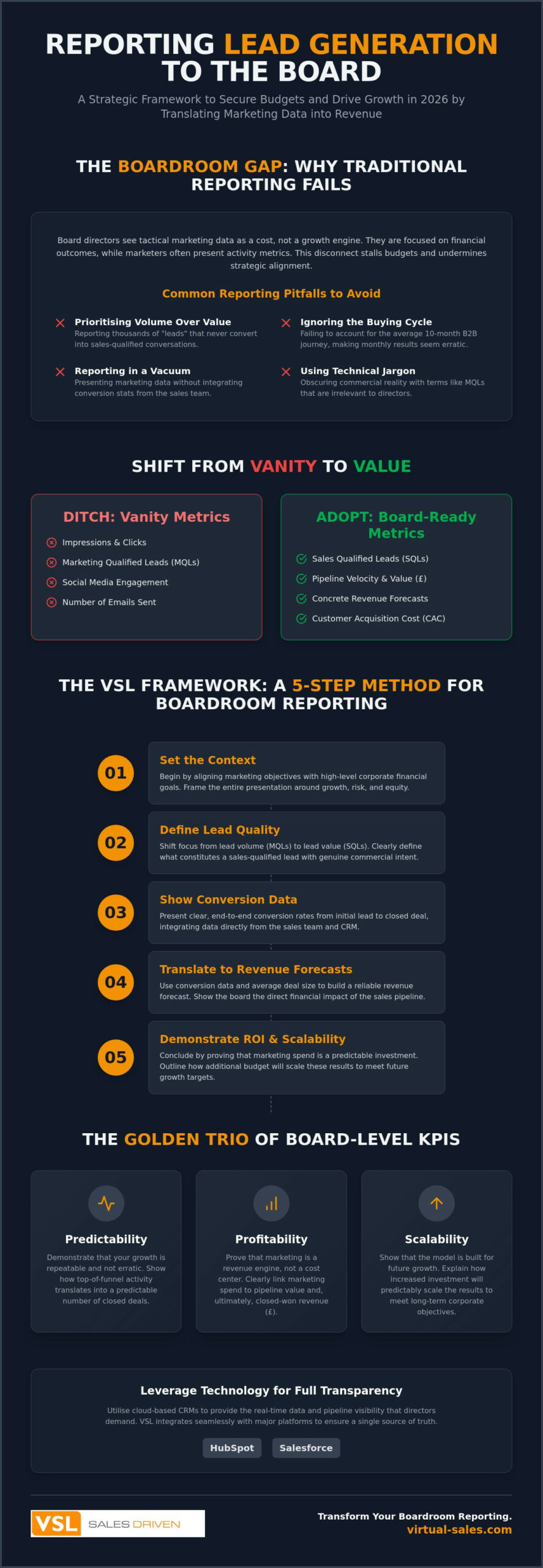
The Boardroom Gap describes the persistent disconnect between tactical marketing activity and high-level financial strategy. Many marketing leaders enter annual reviews armed with data about impressions and click-through rates, while the CFO remains focused on the balance sheet. In 2026, directors have lost patience with vanity metrics that obscure the company’s actual commercial health. When presenting lead generation results to the board, you must bridge this gap by speaking the language of growth, risk, and equity. Failure to do so often results in stalled budgets and a lack of strategic confidence from senior leadership.
Avoiding the common pitfalls of traditional reporting is the first step toward boardroom credibility. Directors view marketing through a lens of risk management and return. If your data feels disconnected from the sales floor, it damages your professional standing. Here are the most frequent mistakes made during these high-stakes sessions:
- Prioritising volume over value: Reporting on thousands of “leads” that never convert into sales conversations.
- Ignoring the buying cycle: Failing to account for the typical 10-month B2B journey, which makes monthly “fluctuations” look like failures.
- Reporting in a vacuum: Presenting marketing data without integrating feedback or conversion stats from the sales team.
- Using technical jargon: Obscuring commercial reality with marketing-specific terms that directors find irrelevant.
This shift in expectations has established Revenue Operations (RevOps) as the new boardroom standard. RevOps demands a level of professional maturity that many internal teams struggle to maintain. This is why UK firms increasingly rely on B2B lead generation partners like Virtual Sales Limited. Our UK-based staff provide the commercial intelligence required to ensure that every interaction is handled with the sophistication the board expects from an elite, integrated component of their own workforce.
Moving Beyond Vanity Metrics
High-level directors have little interest in Marketing Qualified Leads (MQLs) because these often lack genuine intent. They demand visibility into Sales Qualified Leads (SQLs) that represent real revenue potential. Reporting on “activity,” such as the number of emails sent, is viewed as a cost. In contrast, reporting on pipeline value is viewed as an asset. A foundational understanding of lead generation helps teams focus on data points that directly impact company valuation. Adopting Board-Ready Metrics provides several immediate advantages:
- Budget Security: Proves that marketing spend is a predictable investment in future revenue.
- Strategic Alignment: Ensures tactical outreach supports the company’s long-term 2026 growth objectives.
- Risk Mitigation: Identifies pipeline gaps early, allowing for proactive tactical adjustments.
What the Board Actually Wants to See
When you are presenting lead generation results to the board, your narrative must focus on three pillars: Predictability, Profitability, and Scalability. Directors don’t just want growth; they want to know that growth is repeatable. They view the sales cycle as a risk-management exercise. If your prospecting is erratic, it represents a financial risk. To satisfy the board, you must prove that your efforts are aligned with corporate goals. This means demonstrating how a specific volume of top-of-funnel activity translates into a predictable number of closed deals, effectively transforming marketing from an overhead into a strategic driver of success.
The VSL Framework: A 5-Step Method for Presenting Lead Generation Results
The VSL Framework is engineered to eliminate the ambiguity that often plagues marketing reviews. It facilitates a critical shift in the narrative from tactical execution to commercial contribution. While internal departments often get bogged down in the minutiae of campaign settings, the board requires a high-level view of the revenue engine. By leveraging an external partner, you introduce objective, third-party data that carries significant weight in a high-stakes environment. This framework is equally effective for high-velocity b2b appointment setting and complex, long-cycle lead generation strategies.
Steps 1-3: Context, Quality, and Conversion
The first half of the framework establishes the integrity of the data. Before discussing revenue, you must prove that the prospecting engine is operating within the reality of the 2026 market. This phase focuses on the following steps:
- Step 1: Set the Market Context. Reference Gartner research indicating that B2B buyers now spend only 17% of their total purchase journey meeting with potential suppliers. This explains why every meeting secured represents a hard-won strategic opportunity.
- Step 2: Lead Quality Audit. Demonstrate the rigour of the qualification process. This proves that every lead meets the strict BANT or custom criteria agreed upon, ensuring no sales time is wasted on low-intent prospects.
- Step 3: Conversion Analysis. Track the efficiency of the funnel from initial contact to the booked appointment. This provides a clear view of the top-of-funnel health and the effectiveness of the messaging strategy.
Providing this level of transparency is vital when presenting lead generation results to the board, as it validates the quality of the pipeline before moving into financial forecasts.
Steps 4-5: Pipeline Velocity and ROI
The final steps of the framework translate activity into the financial outcomes that directors demand. This is where you justify the continued investment in the sales pipeline:
- Step 4: Pipeline Velocity. Measure how fast leads move through the sales cycle. If lead generation is the fuel, velocity is the speedometer. We show the board exactly how quickly a VSL-generated opportunity turns into a signed contract.
- Step 5: Return on Investment. Deliver the final financial justification in £ sterling. This step must always reference the Customer Acquisition Cost (CAC). By comparing the total campaign spend against the projected contract value, you provide a clinical ROI analysis.
This structured approach ensures that presenting lead generation results to the board becomes a conversation about strategic growth rather than a defence of marketing spend. You can review our Clutch-verified performance results to see how this framework delivers measurable success for our partners.
Real Insight: Translating Lead Quality into Revenue Forecasts
Directors demand a narrative that connects marketing spend to the bottom line. When presenting lead generation results to the board, the most common mistake is focusing on volume over value. A presentation that highlights “500 calls made” is fundamentally flawed because it prioritises activity over outcomes. Directors view raw call volume as a cost center. In contrast, a successful report focuses on contract value. You must demonstrate how specific prospecting activities have populated the sales funnel with high-intent opportunities likely to close within your typical sales cycle. This requires a shift from reporting on what the team did to what the team earned.
Transparency is essential when data doesn’t meet expectations. If a quarter is slow, avoid burying the numbers in complex charts. Present the data clearly alongside a clinical pivot plan. Explain why the conversion rate dipped and what tactical adjustments you’ve implemented to correct the trajectory. This proactive approach builds more credibility than a polished presentation that ignores obvious gaps. It shows the board that you are managing the pipeline as a dynamic financial asset. This level of honesty is a hallmark of professional maturity in the boardroom.
Scenario: Presenting IT SaaS Lead Generation Results
Consider an IT SaaS firm that invested £50,000 in a six-month campaign. A weak presentation would focus on the 40 meetings booked. A board-ready presentation highlights that those 40 meetings generated a £500,000 pipeline. By applying a conservative 20% closing rate, you can forecast £100,000 in realised revenue. This 2:1 return on investment is exactly what directors need to see to justify continued budget allocation. You can master these nuances by following a strategic guide for b2b success that prioritises high-value outcomes.
The strategic use of Account-Based Marketing (ABM) adds another layer of authority to your report. Mentioning specific target accounts by name demonstrates that your lead generation efforts are aligned with the company’s high-value prospect list. This shows the board that you aren’t just “fishing” in a broad market but are systematically penetrating the accounts most likely to drive significant growth. Human-verified leads reduce the sales team’s friction by ensuring every conversation is grounded in genuine business need and verified budget authority.
Addressing the “Quality vs Quantity” Objection
Directors often worry that a high volume of leads might be diluting the sales team’s focus. You can counter this by using feedback loops from your sales department. Presenting testimonials or internal data that proves lead relevance validates the qualification process. Intent-based data serves as a powerful predictor of future boardroom success, showing that you are engaging prospects who are already searching for your specific solution. To maintain credibility, avoid these common reporting mistakes:
- Reporting raw lead counts: Without qualification, these numbers are commercially meaningless to the board.
- Ignoring attribution: Failing to show which specific campaigns drove the highest value deals.
- Vague revenue links: Providing “estimated” revenue without basing it on historical conversion data.
You can also leverage external case studies to show how this rigorous approach has worked for similar firms in your sector. This evidence-based strategy ensures that presenting lead generation results to the board remains a high-level discussion about market capture rather than a debate over lead definitions. It positions you as a strategic partner in the company’s growth rather than just a department head managing a budget.
Results and Data: The Board-Level KPIs for 2026
Directors demand a clinical analysis of commercial performance. When presenting lead generation results to the board, you must focus on the “Golden Trio” of KPIs: Return on Investment (ROI), Customer Acquisition Cost (CAC), and Lifetime Value (LTV). These metrics provide the financial context that senior leadership requires to make informed decisions about future budgets. Moving beyond raw lead counts ensures that the conversation remains focused on how marketing efforts are contributing to the company’s valuation and long-term stability.
Calculating the “Cost Per Appointment” is often more valuable than the standard “Cost Per Lead.” While a lead represents potential, a qualified appointment represents a tangible sales opportunity. To find the cost per appointment, divide the total campaign spend by the number of human-verified meetings booked. This figure allows the board to see exactly what they are paying for a seat at the table with a high-value prospect. It provides a level of cost transparency that internal marketing departments often struggle to articulate.
Financial KPIs: ROI, CAC, and LTV
Calculating ROI is a straightforward but essential exercise: (Revenue from Leads – Cost of Campaign) / Cost of Campaign. The board cares deeply about the “fully loaded” CAC. This means you must include the agency fee, any internal management time, and the cost of the supporting tech stack. Presenting a fully loaded figure builds trust because it shows you aren’t trying to hide the true cost of growth. Finally, you must connect lead generation to LTV. By showing how a £10,000 investment in a lead generation agency secures a client worth £150,000 over three years, you demonstrate the strategic importance of the sales pipeline.
Operational Benchmarks for 2026
Benchmarking is vital for setting realistic expectations. In the B2B tech and software sectors, a high-performing campaign typically delivers between 10 and 20 high-level meetings per month. Typical conversion rates from cold outreach to a qualified appointment often hover between 2% and 5% depending on the niche and target account list. Data cleansing plays a critical role here. By removing outdated or incorrect contact information before the campaign starts, you reduce wasted sales spend and improve the overall efficiency of the outreach team.
A mature outsourced partner should contribute a significant percentage of the total sales pipeline. In 2026, the board expects to see that lead generation is a predictable, scalable process rather than a series of one-off wins. You can compare your current internal benchmarks against our Clutch-verified performance data to see where your strategy sits in the current market. This level of comparative analysis is essential when presenting lead generation results to the board to prove your strategy is competitive.
Leveraging Technology for Transparent Boardroom Reporting
In 2026, boardroom reporting is no longer a quarterly retrospective event. It is a continuous stream of commercial intelligence. Directors now demand real-time data transparency to mitigate the risks associated with long B2B sales cycles. Relying on manual spreadsheets or static slide decks creates a reporting lag that can damage your professional credibility. When presenting lead generation results to the board, you must demonstrate that your data is live, accurate, and directly pulled from a single source of truth. This level of technical maturity proves that you have total control over the sales pipeline.
Closed-loop reporting is the only way to satisfy a modern CFO. This process tracks every prospect from the initial touchpoint through to the final signed contract. It eliminates the “marketing black box” by providing clear attribution for every pound spent. By showing exactly which outreach activities led to which high-value deals, you transform lead generation from a speculative activity into a predictable financial engine. VSL facilitates this by functioning as an elite, integrated component of your own internal team, ensuring that our output standards match your corporate requirements.
CRM Integration: HubSpot and Salesforce
Automated dashboards are essential for high-stakes meetings. VSL integrates seamlessly with cloud-based CRMs like HubSpot and Salesforce, ensuring that the data directors see in their own portals is always current. This integration eliminates the friction of manual data entry and ensures that every sales opportunity is tracked with clinical precision. It allows you to prove the immediate ROI of your b2b appointment setting efforts by linking booked meetings directly to pipeline growth. To maintain this accuracy, we also perform regular b2b data cleansing. This prevents your CRM from becoming cluttered with “ghost” leads and ensures your sales team only focuses on verified, high-intent prospects.
The Role of Professional Telemarketing in Predictable Growth
While software tracks the quantitative data, professional telemarketing provides the qualitative “market intelligence” that algorithms cannot capture. Our UK-based staff engage in sophisticated conversations that reveal buyer sentiment, competitor movements, and emerging market pain points. When presenting lead generation results to the board, these human-led insights serve as a significant secondary value-add. You aren’t just reporting on numbers; you’re providing a strategic briefing on the competitive landscape. This combination of real-time technical tracking and human-led expertise provides the board with the confidence they need to approve your 2026 growth budget. It ensures that your lead generation strategy is not just a tactical success, but a core driver of corporate financial goals.
Securing Your 2026 Growth Budget
Transitioning from tactical reporting to strategic partnership is the key to boardroom success. You’ve seen how the VSL Framework bridges the gap between raw activity and financial outcomes. By focusing on the Golden Trio of KPIs and maintaining real-time CRM transparency, you transform marketing into a defensible revenue engine. Success in 2026 requires this high level of commercial maturity when presenting lead generation results to the board. It’s about moving beyond the “marketing black box” to prove that every pound spent is an investment in future equity.
VSL brings over 20 years of B2B expertise to your operation, specifically serving as an elite, integrated extension for ambitious firms in the IT and software sectors. We don’t just provide numbers; we provide the human-led market intelligence that drives long-term company valuation. Our specialists understand the nuances of the B2B buying cycle and the pressure of boardroom accountability. Ready to present predictable results? Explore our Clutch-verified UK appointment setting services and secure the budget your growth strategy deserves. It’s time to turn your sales pipeline into your most reliable corporate asset.
Frequently Asked Questions
What are the most important KPIs to show the board for lead generation?
The most important KPIs focus on commercial impact rather than tactical activity. You should prioritise Return on Investment (ROI), Customer Acquisition Cost (CAC), and the total value of the sales pipeline. These metrics allow directors to see how marketing spend converts into potential revenue. Avoid vanity metrics like impressions, as they don’t provide the financial clarity required for high-level decision-making.
How often should I present lead generation results to the board?
Formal reviews typically happen quarterly to align with financial reporting cycles. However, providing a high-level monthly dashboard keeps directors informed about pipeline health and avoids surprises. This regular cadence builds trust and demonstrates that you are proactively managing the company’s growth engine. It ensures that the board views lead generation as a continuous strategic priority rather than a sporadic expense.
How do I justify the cost of an outsourced lead generation agency?
Justifying the cost requires a comparison between the “fully loaded” expense of an internal team and the results delivered by a specialist partner. Highlight the speed to market, access to senior UK-based staff, and the removal of recruitment or training overheads. When presenting lead generation results to the board, focus on the lower risk profile and the predictable volume of qualified appointments that an elite agency provides.
What is a good ROI for a B2B lead generation campaign in 2026?
A healthy ROI typically ranges between 3:1 and 5:1, though this depends heavily on your specific industry and Average Contract Value (ACV). In high-ticket IT and software sectors, even a lower ratio can be highly profitable if the Lifetime Value (LTV) is significant. The goal is to prove that the revenue generated from the pipeline comfortably exceeds the total cost of the campaign.
How do I handle a quarter where lead volume was lower than expected?
Address the shortfall directly with transparency and a clinical pivot plan. Explain the specific market factors or tactical hurdles that caused the dip, such as seasonal shifts or changes in buyer behaviour. Presenting a clear roadmap for correction shows the board that you are in control of the strategy. It rebrands a slow quarter as a data-driven learning opportunity rather than a failure of the model.
Should I present MQLs or SQLs to the board of directors?
You should always prioritise Sales Qualified Leads (SQLs) in boardroom presentations. Directors view Marketing Qualified Leads (MQLs) as speculative data that lacks verified intent. SQLs represent tangible sales opportunities that have passed through a rigorous qualification process. Focusing on SQLs ensures the conversation remains grounded in revenue potential and pipeline velocity, which are the metrics that directors value most.
How can I prove that lead generation is driving long-term revenue?
Proving long-term impact requires closed-loop reporting that tracks leads from the initial touchpoint through to the final contract. Use cohort analysis to show how leads generated in previous quarters are now converting into realised revenue. This historical data demonstrates the stability of the sales engine. It proves that your current prospecting efforts are building a foundation for future financial success.
What role does CRM integration play in boardroom reporting?
CRM integration provides the “single source of truth” required for real-time data transparency. Connecting your outreach efforts directly to HubSpot or Salesforce eliminates reporting lag and manual errors. This technical accuracy is vital when presenting lead generation results to the board, as it allows directors to drill down into specific accounts or pipeline stages. It demonstrates that your reporting is both defensible and technologically mature.

Disclaimer
Disclaimer: Content is for general information only and does not constitute professional advice. Results may vary. Virtual Sales Limited accepts no liability for actions taken based on this content.
Tags: B2B Marketing, Board Reporting, Lead generation, Marketing KPIs, Marketing ROI, Revenue Marketing, Sales Pipeline