Sales Development Metrics That Matter to CEOs: The 2026 Strategic Guide
Your SDR activity volume is a vanity metric that’s currently masking a failing revenue pipeline. CEOs in 2026 can no longer afford to focus on total dials or email sends while ignoring the lack of closed-won deals. To scale effectively, you must identify the specific sales development metrics that matter to CEOs to ensure your investment drives actual bottom-line growth. It’s frustrating to see a disconnect between high SDR activity and the revenue targets that keep your board satisfied.
You likely agree that an unpredictable pipeline is the greatest threat to your growth ambitions. This guide promises to help you bridge the gap between outbound effort and predictable revenue by focusing on efficiency ratios rather than raw volume. We’ll explore how to implement the VSL Framework to align your marketing and sales teams, ensuring every £1 spent on lead generation produces a measurable return. You’ll learn to leverage integrated tech stacks and cloud-based CRMs to gain total transparency and turn your SDR function into a high-performing asset.
Key Takeaways
- Shift focus from vanity metrics like call volume to efficiency ratios that directly correlate with future revenue health and board-level goals.
- Identify the specific sales development metrics that matter to CEOs, including pipeline contribution percentages and SQL-to-opportunity conversion rates.
- Utilise the VSL Framework to reverse-engineer your sales funnel from ARR targets back to required lead generation activity.
- Discover how to present high-level SDR data in board meetings to demonstrate clear ROI and secure future growth budget.
- Learn to leverage cloud-based CRM integrations to eliminate the disconnect between SDR activity and actual closed-won deals.
Transitioning from SDR Activity to Executive Outcomes
CEOs often view sales development as a black box of activity. To gain clarity, you must redefine sales development metrics as indicators of future revenue health rather than a log of past calls. When you shift the focus toward profit-based sales targets, the conversation changes from how many emails were sent to how much predictable revenue is in the queue. This transition is essential for any leader who wants to scale without wasting capital on inefficient outreach.
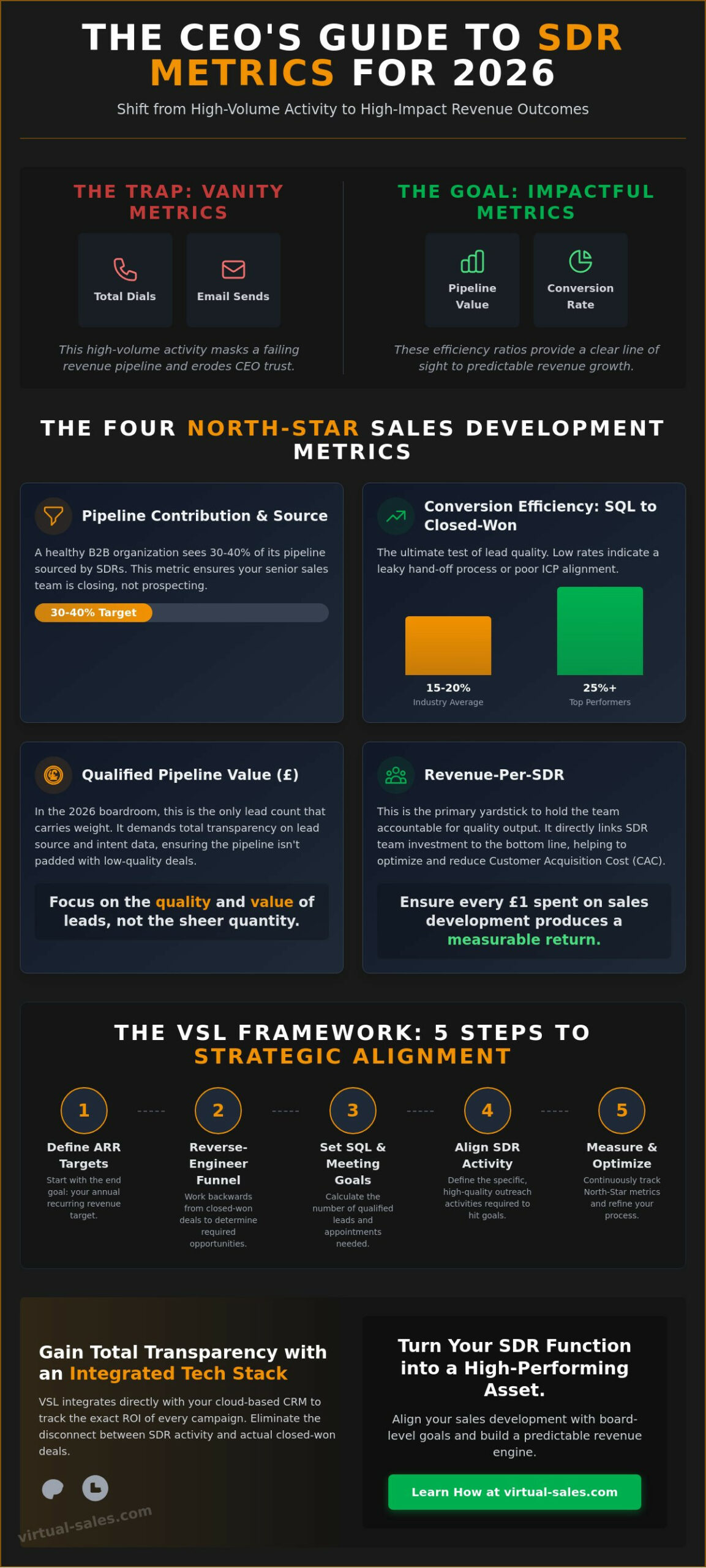
Vanity metrics like open rates and total dials often erode CEO trust. These numbers feel good in a weekly report, but they rarely correlate with the company’s bottom line. The sales development metrics that matter to CEOs are those that provide a clear line of sight to the bank account. By introducing Revenue-Per-SDR as your primary yardstick, you hold the team accountable for the quality of their output. This approach ensures the SDR function serves its true purpose: reducing the Customer Acquisition Cost (CAC) by delivering high-intent opportunities to your senior sales staff.
The Pitfall of Volume-Based Reporting
Reporting on high activity levels is a common trap that masks underlying rot in the sales cycle. For instance, 100 low-quality dials are significantly more expensive than 10 high-quality appointments. Each wasted dial consumes salary, CRM storage, and management bandwidth. More importantly, it creates a busy culture that prioritises motion over progress. Moving from volume to value requires a psychological shift. You must stop celebrating the size of the outreach list and start rewarding the depth of the engagement. Activity-heavy reporting leads to burnout and high turnover, whereas outcome-based metrics foster a culture of professional maturity and clinical efficiency.
Defining Value in the 2026 B2B Landscape
In the 2026 market, Qualified Pipeline Value is the only lead count that carries weight in the boardroom. CEOs should demand total transparency regarding lead source and intent data to ensure the pipeline isn’t padded with fluff deals. VSL prioritises B2B appointment setting that integrates directly with your cloud-based CRM, whether you use HubSpot or Salesforce. This integration allows you to track the exact ROI of every campaign. By focusing on intent-based calling and technical accuracy, you ensure that your sales development function acts as an elite, integrated component of your internal team rather than a disconnected external vendor.
The Four North-Star Sales Development Metrics for 2026
High-level leadership requires a distilled view of performance. You can’t manage what you don’t measure, but measuring too many variables leads to analysis paralysis. In 2026, four specific sales development metrics that matter to CEOs stand above the rest as true indicators of commercial health. These North-Star metrics provide the transparency needed to justify sales spend and forecast growth with clinical precision. By focusing on these indicators, you move away from micromanaging daily tasks and toward steering a predictable revenue engine.
Pipeline Contribution and Source Attribution
A healthy B2B organisation typically sees a 30% to 40% SDR-sourced pipeline. If your sales development team contributes less, your Account Executives are likely spending too much time on prospecting rather than closing deals. Distinguishing between outbound-sourced leads and inbound-qualified leads is vital for accurate attribution. This clarity allows you to see exactly where your revenue originates and which channels deserve more investment. Many ambitious businesses use these insights to justify moving toward professional B2B subscription services, ensuring a consistent flow of top-of-funnel opportunities without the overhead of internal management.
Conversion Efficiency: SQL to Closed-Won
The ultimate test of lead quality is the conversion rate from a Sales Qualified Lead (SQL) to a closed deal. According to 2026 industry benchmarks, the average close rate for deals sourced by SDRs is between 15% and 20%, with top performers reaching 25% or higher. If your rates are lower, you likely have a leaky bucket in your hand-off process or an ill-defined Ideal Customer Profile (ICP). Tracking this metric forces alignment between your SDRs and AEs, ensuring that only high-intent prospects enter the formal sales cycle. You can evaluate your current performance against high-standard benchmarks by reviewing our UK-based appointment setting results.
SDR-to-CAC Ratio and Sales Velocity
Your SDR-to-CAC ratio measures the cost efficiency of your lead generation engine. With the benchmark for a well-optimised sales tech stack now sitting between £2,300 and £3,500 per representative annually, you must ensure your SDRs are generating enough pipeline value to offset these costs. Finally, consider Sales Velocity. This metric tracks how quickly a lead moves through your entire funnel. SDR involvement should act as a catalyst, shortening the total time-to-close by pre-qualifying prospects and identifying technical requirements early in the journey. When your SDR function is properly integrated, it doesn’t just find leads; it accelerates the entire commercial operation.
The VSL Framework: 5 Steps to Strategic Metric Alignment
Execution without a roadmap leads to wasted capital. To bridge the gap between high-level ambition and tactical output, you need a structured approach to reporting. The VSL Framework provides a repeatable method for identifying and tracking the sales development metrics that matter to CEOs. This five-step process ensures that every SDR activity is directly tethered to your primary growth objectives.
- Step 1: Define Board-Level Goals. Start with your desired ARR growth or market share expansion.
- Step 2: Reverse Engineer the Funnel. Calculate the exact number of SQLs and appointments required to hit those revenue targets.
- Step 3: Integrate Tech Stack. Sync your outreach tools with cloud-based CRMs like HubSpot or Salesforce for real-time visibility.
- Step 4: Establish a Weekly Pulse Report. Create a concise, one-page summary for the executive team focusing on pipeline value.
- Step 5: Pivot Based on ROI. Aggressively reallocate budget away from stagnant channels toward those with the highest conversion efficiency.
Step 1 & 2: Goal Alignment and Funnel Math
Start with the end in mind. If your board demands 20% growth in ARR, your SDR targets shouldn’t be arbitrary. Work backwards from your average deal size and close rate to determine how many qualified meetings your team needs to book each month. For example, if your average deal is worth £50,000 and your close rate is 20%, you need 100 SQLs to generate £1 million in new revenue. Calculating your cost per appointment is vital here. It allows you to determine if your current lead generation engine is sustainable or if you’re overpaying for growth. Using 2026 market data ensures your benchmarks reflect the current competitive environment rather than outdated industry standards.
Step 3: Technical Integration for Clean Data
Manual reporting is the enemy of CEO-level clarity. It introduces human error and creates a lag between activity and insight. You must leverage cloud-based CRMs to build real-time executive dashboards that reflect the true state of your pipeline. Accuracy at this level depends heavily on the quality of your underlying information. Implementing a rigorous process for B2B data cleansing is essential for maintaining metric integrity. Without clean data, your CRM becomes a graveyard of missed opportunities rather than a strategic asset. By integrating your tech stack correctly, you ensure that every interaction is logged, attributed, and ready for executive review.
Real Insight: Moving Beyond Vanity Metrics in the IT Sector
In the competitive UK IT sector, high activity often masks fundamental performance failures. A common scenario involves a London-based SaaS firm employing three internal SDRs. On paper, the team appeared successful, logging over 600 calls daily and filling the HubSpot CRM with hundreds of “leads” every month. However, the Account Executives reported that these prospects were consistently low-intent. The business was spending thousands on salary and tech overhead while the revenue needle remained static. This disconnect occurs when leadership fails to monitor the sales development metrics that matter to CEOs, focusing instead on dial volume over deal potential.
By shifting the primary KPI from “calls made” to “Sales Qualified Opportunities” (SQOs), the firm transformed its commercial output. This transition required a clinical look at the cost efficiency of their internal team versus professional outsourced lead generation. While internal teams often struggle with high turnover and training lag, an integrated outbound partner provides immediate access to mature, professional staff who understand the nuances of the IT buying cycle. This strategic pivot ensures that every interaction is designed to move the prospect closer to a closed-won deal.
Case Study: Scaling an IT Managed Service Provider
A mid-sized IT Managed Service Provider (MSP) faced a similar challenge: a high volume of leads but zero conversion to revenue. Their SDRs were rewarded for booking meetings, regardless of the prospect’s budget or authority. We implemented a “Quality-First” metric system that prioritised technical fit and intent signals over raw numbers. Within six months, the MSP saw a 25% increase in pipeline velocity. Their AEs spent less time on “discovery” calls that went nowhere and more time on high-value negotiations. You can see how this approach translates into tangible growth by reviewing our UK-based appointment setting results.
Results and Data: 2026 Benchmarks
To evaluate your own sales development function, you must compare your performance against current 2026 benchmarks for the UK technology sector. These figures represent the standard for a high-performing, well-integrated lead generation engine.
- Average cost per qualified meeting: £250 to £600, depending on the complexity of the IT solution.
- Standard conversion rate (SQL to Opportunity): 60% to 75% for teams focusing on high-intent data.
- Expected meetings booked: 10 to 20 qualified meetings per month for a dedicated, professional SDR.
- SDR-sourced win rate: 15% to 20% on average, with elite teams reaching 25%.
Relying on internal staff to hit these numbers often requires a tech stack costing between £2,300 and £3,500 per representative annually. If your current internal cost per meeting exceeds £600, your sales development engine is a cost centre rather than a revenue asset. CEOs must demand transparency in these figures to ensure the sales pipeline remains healthy and predictable.
Integrating Sales Development into the 2026 Growth Strategy
Aligning sales development with your 2026 growth strategy requires a cultural shift led directly from the top. CEOs must foster deep alignment between marketing, SDRs, and AEs to eliminate the functional silos that typically stifle conversion rates. When you treat your SDR function as a strategic revenue engine rather than a support role, you create a foundation for predictable scaling. This integration ensures that the sales development metrics that matter to CEOs remain at the forefront of every commercial discussion, from weekly stand-ups to quarterly board reviews.
VSL acts as an elite, integrated component of your internal team, providing the professional maturity needed to execute complex outbound campaigns. By leveraging our UK-based expertise, you mitigate the risks associated with high SDR turnover and the training lag of internal hires. Our focus on intent-based calling and technical accuracy ensures your pipeline remains robust, allowing you to focus on high-level strategy while we handle the granular execution of your lead generation engine.
Boardroom Reporting Best Practices
Securing a larger budget for sales development requires data presented with executive-level clarity. Move away from granular spreadsheets and utilise visual dashboards within your HubSpot or Salesforce CRM to show pipeline health at a glance. Board members value the trend line over single-day fluctuations. You should demonstrate how your SDR-sourced pipeline value is growing month-on-month and how that growth correlates with your ARR targets. For a deeper dive into optimising these processes, consult our Definitive Guide to B2B Appointment Setting, which outlines how to accelerate your funnel with precision.
The Future of Predictable Revenue
The 2026 landscape is defined by the shift toward signal-based outreach. Intent data now allows teams to identify exactly when a prospect is in a buying window, significantly improving your efficiency ratio. While AI-driven insights generate 77% more revenue per representative, human-led expertise remains the core differentiator for high-value B2B sales. Automated systems can’t navigate the nuances of a complex corporate hierarchy or build the interpersonal trust required for enterprise-level deals. This is why VSL emphasises the professional maturity of our UK staff, providing a high-standard output that international, lower-cost competitors simply cannot match.
The CEO’s role in sales development success is to demand transparency and maintain a relentless focus on ROI. By implementing the VSL Framework and prioritising outcome-oriented KPIs, you transform your sales development from an unpredictable cost centre into a predictable revenue asset. High-level leadership is about making informed decisions based on clinical data. With the right metrics and a strategic partner, your path to 2026 growth becomes a matter of execution rather than guesswork.
Steering Your Revenue Engine Toward Predictable Growth
Success in 2026 requires moving past the noise of vanity metrics to focus on clinical, outcome-based reporting. You now understand that high dial volume is a distraction and quality is the only currency that holds value in the boardroom. By prioritising the sales development metrics that matter to CEOs, such as pipeline contribution and SQL-to-Opportunity conversion, you eliminate the guesswork from your scaling strategy. Implementing a technical sync between your cloud-based CRM and outbound efforts ensures every pound spent is accounted for with total transparency.
It’s time to turn your sales development from an unpredictable cost centre into a high-performing revenue asset. VSL brings over 20 years of B2B expertise to your team, specialising in the IT and software sectors to deliver results that drive real ARR growth. As a Clutch-verified 5-star appointment setting agency, we provide the professional maturity needed to represent your brand with excellence. Scale your sales pipeline with metric-driven B2B Appointment Setting from VSL. Your 2026 revenue targets are within reach when your data is clean and your strategy is aligned.
Frequently Asked Questions
What is the single most important SDR metric for a CEO to track?
The single most important metric is Pipeline Contribution Value. This figure tells you exactly what percentage of your total sales pipeline originated from SDR activity. While other data points provide context, this metric directly correlates outbound effort with future revenue. It allows you to see if your sales development engine is actually fueling your growth or just keeping staff busy with low-value tasks.
How do I calculate the ROI of my sales development team?
Calculate ROI by dividing the total revenue generated from SDR-sourced deals by the total cost of the SDR function. You must include base salaries, commissions, and the cost of your tech stack, which averages between £2,300 and £3,500 per representative annually in 2026. A healthy ROI demonstrates that your lead generation engine is a profit centre rather than a drain on corporate resources.
What is a healthy conversion rate from a lead to a qualified appointment?
A healthy conversion rate typically ranges from 5% to 10% for cold outreach, though this increases significantly with intent-based signals. Using high-quality data and direct dials can push connect rates to 15% or 25%. These figures are essential sales development metrics that matter to CEOs because they indicate the quality of your target database and the professional maturity of your calling staff.
Should I focus on the number of calls my SDRs make?
No, you should focus on the Efficiency Ratio rather than raw call volume. While activity is necessary, 100 low-quality dials are more expensive than 10 high-quality appointments when you factor in management time and CRM overhead. Shift your focus to how many calls it takes to generate a qualified opportunity. This ensures your team prioritises meaningful engagement over simple, repetitive motion.
How does outsourced appointment setting impact my Customer Acquisition Cost (CAC)?
Outsourced appointment setting typically reduces your Customer Acquisition Cost by eliminating the hidden fees of internal management. You avoid the high cost of SDR turnover and the expensive training lag associated with new hires. By partnering with an elite team like VSL, you gain immediate access to proven methodologies and high-standard output, ensuring your CAC remains low while your pipeline velocity increases.
What tools are essential for tracking sales development metrics in 2026?
Essential tools for 2026 include cloud-based CRMs like HubSpot or Salesforce integrated with intent data platforms. You also need conversation intelligence software to track call quality and automated data cleansing tools to maintain list hygiene. These technologies provide the real-time transparency required to monitor the sales development metrics that matter to CEOs without relying on manual, error-prone spreadsheets.
How often should a CEO review sales development reports?
Review a high-level “Pulse” report weekly and perform a deep strategic analysis every month. The weekly report should focus on pipeline value and meeting volume to ensure short-term targets are met. The monthly review allows you to analyse conversion trends and reallocate budget to high-performing channels. This cadence keeps you informed of revenue health without dragging you into daily operational micromanagement.
Can I use these metrics to manage a remote or outsourced sales team?
Yes, these metrics are specifically designed to provide clarity regardless of where your team is located. Digital transparency through CRM integration ensures that every call, email, and booked meeting is logged and attributed correctly. Whether you manage an internal remote team or an integrated outbound partner, focusing on outcome-oriented KPIs allows you to maintain high standards and predictable results across your entire commercial operation.

Disclaimer
Disclaimer: Content is for general information only and does not constitute professional advice. Results may vary. Virtual Sales Limited accepts no liability for actions taken based on this content.
Tags: CEO Guide, pipeline management, Revenue Growth, sales development, sales metrics, Sales Strategy, SDR, VSL Framework