


Pressuring a buyer rarely fixes a stalled deal. It can make the next decision harder. If you lead sales or business development at a UK technology company, you know how frustrating it is when qualified opportunities go quiet after a meeting or progress slows while teams wait for a clear next step. Learning how to shorten B2B sales cycles starts with finding the friction, not rushing the buyer.
You need a process that helps suitable prospects make informed decisions while giving your sales team more time for opportunities with a genuine fit, need and route to a decision. That means checking qualification early, identifying who else needs to be involved and agreeing clear actions after every conversation.
This guide will help you pinpoint where deals stall and distinguish avoidable delays from the considered decisions that come with a complex technology purchase. It also covers practical ways to improve stakeholder access, hand-offs and pipeline visibility, so you can move suitable opportunities forward without adding pressure or wasting sales effort.
Key Takeaways
- To understand how to shorten B2B sales cycles, identify where qualified opportunities lose momentum before changing the process.
- Refine your ideal customer profile so sales activity focuses on accounts with a relevant need and access to the right decision-makers.
- Make next steps and stakeholder roles clear to reduce repeated discovery and avoidable hand-off delays.
- Review qualification and prospect feedback regularly to see whether activity is creating meaningful pipeline progress.
- Consider B2B appointment setting when entering a new market or vertical, while recognising that buyers control their own decision timelines.
How to Shorten B2B Sales Cycles by Finding Where Deals Stall
A B2B sales cycle covers the stages from a prospect’s first engagement with your business to a buying decision. For technology companies, that path may include qualification, discovery, technical evaluation, procurement and internal approval. The stages vary by offer and buyer, so start by mapping how your own prospects move through them.
Shortening a B2B sales cycle means removing avoidable delays while preserving the checks buyers need to make a sound decision. It isn’t about pushing prospects to decide before they’re ready. To understand how to shorten B2B sales cycles, track where momentum fades and work out whether the cause sits with your process or the buyer.
Which stages commonly add avoidable delay?
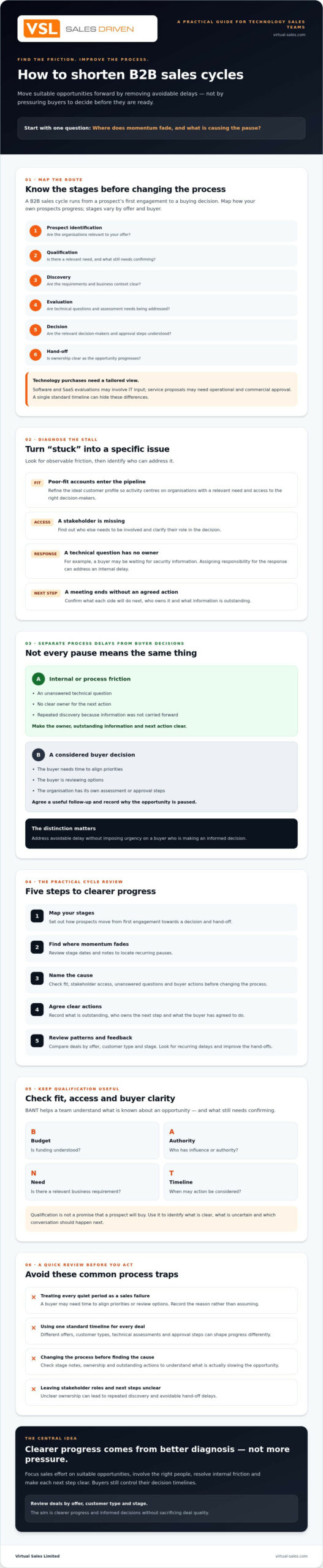
Map each step: prospect identification, qualification, discovery, evaluation, decision and hand-off. Then look for specific stalls, such as poor-fit accounts entering the pipeline, a missing stakeholder, an unanswered technical question or a meeting ending without an agreed action.
For example, an opportunity may appear to stall during evaluation when the prospect is waiting for security information. If nobody owns that response, the delay is internal and addressable. By contrast, a buyer may need time to align priorities or review options. Agree a useful follow-up and record the reason for the pause instead of treating every gap in activity as a sales failure.
Review stage dates alongside the notes. Who owns the next action? What information is outstanding? What has the buyer agreed to do? This turns a vague “stuck deal” into a specific issue your team can investigate and assign.
Why do technology sales cycles need a tailored approach?
Software, SaaS and IT services purchases can involve technical assessment, several stakeholders and procurement processes that differ from one organisation to another. A product evaluation may need input from IT, while a service proposal may require operational and commercial approval. A single standard timeline can hide these differences.
Compare your deals by offer, customer type and stage. If opportunities repeatedly pause between discovery and evaluation, check whether the technical requirements are clear. If they slow before a decision, confirm that the relevant stakeholders and approval steps are understood. The B2B sales pipeline stages guide can help you define and review those stages.
This diagnostic approach reflects Sales Process Engineering, the systematic design of sales processes to improve their efficiency and effectiveness. Use it to examine hand-offs and ownership, not to impose urgency on a buyer. The aim is clearer progress and informed decisions without sacrificing deal quality.
Why B2B Sales Cycle Length Depends on Fit, Access and Buyer Clarity
A deal is more likely to progress when the prospect’s needs match your offer, the right people are involved and both sides understand what happens next. A precise ideal customer profile (ICP) helps your team focus on relevant organisations and decision-makers, rather than spending time on accounts that are unlikely to benefit.
Cycle improvement starts with relevant opportunities and clear buyer actions. This is a practical way to think about how to shorten B2B sales cycles: improve the quality of the conversation and make progress easier to agree, rather than adding pressure.
How does qualification help a deal progress?
BANT stands for Budget, Authority, Need and Timeline. It helps a sales team understand whether there’s a relevant business requirement, who has influence or authority, whether funding is understood and when action may be considered. It isn’t a promise that the prospect will buy. It highlights what’s known and what still needs confirming.
A qualified BANT lead meets those criteria as a minimum. Qualification should also uncover gaps: perhaps the prospect has a clear need but hasn’t identified the decision-making group, or has a target date but no agreed evaluation process. Record those points and use them to shape the next discussion. HubSpot’s overview of the sales cycle offers further context on the stages prospects may move through.
How can sales and marketing reduce hand-off friction?
Agree what information makes an opportunity ready for direct sales follow-up. This might include the prospect’s stated need, relevant role, timing, current questions and a mutually agreed next action. Marketing and business development teams should pass on context, not just contact details. Without it, sales may repeat discovery and make the experience less useful for the buyer.
Keep a feedback loop open. If sales repeatedly hears questions about implementation, technical fit or internal approvals, share that insight with the people shaping outreach and supporting materials. The message can then address real buyer concerns earlier, while sales can prepare the right expertise for follow-up.
- Before hand-off: confirm the prospect fits the ICP and capture what they’ve said about need and timing.
- At hand-off: name the sales owner and agree who will take the next action.
- After follow-up: share what was confirmed, what remains open and whether the opportunity should progress.
To assess whether these steps are improving progress, review stage movement, time spent waiting and the reasons opportunities pause. The guide to sales pipeline review metrics that matter can help your team choose useful measures. If you’re considering appointment-setting support, you can also view VSL’s appointment-setting profile on Clutch.
Common B2B Sales Cycle Mistakes That Keep Technology Deals Waiting
More activity doesn’t necessarily mean more progress. Increasing outreach can fill a pipeline with conversations, but if the accounts aren’t a good fit or key questions remain unanswered, deals may still stall. Measure movement through meaningful stages, not just calls, emails or meetings booked.
A weak ideal customer profile (ICP) creates a similar problem. If your targeting criteria are broad, your team may spend time with organisations that lack the need, technical environment or priorities your offer addresses. Review stalled and closed-lost opportunities for patterns: which account characteristics recur, and where does fit become uncertain? Use those findings to sharpen your targeting.
What does poor qualification look like in a live pipeline?
Look for unanswered questions about Budget, Authority, Need and Timeline. A prospect may have attended a meeting, but that alone doesn’t show whether there’s an active requirement, who will assess the solution or when a decision might be considered. Treat these as information gaps, not reasons to push for a commitment.
Consultative questions can clarify the situation without pressure: “Who else will need to assess this?” or “What would need to be in place before you could consider a change?” If the prospect can’t answer yet, record what needs confirming and agree a sensible follow-up. Assign an owner to every next action, too. A note saying “follow up” without a named person or agreed timing can leave an opportunity untouched.
How can teams use prospect feedback as real insight?
Repeated questions can expose a problem in your proposition or qualification process. If prospects keep asking how implementation works, your initial explanation may not be clear enough. If conversations repeatedly uncover an unconsulted technical lead, your outreach may be reaching only one part of the buying group.
Hypothetical scenario, not a verified VSL result: a software provider sees several prospects pause after an introductory meeting. Notes show each asked about data migration, but nobody had been assigned to answer. The team prepares a clear response, identifies the right technical contact earlier and agrees who will provide the information. This won’t dictate a buyer’s decision, but it can remove a preventable gap.
Use prospect feedback to update qualification prompts, sales materials and hand-off notes. A recurring pattern matters more than a single objection. For a broader diagnostic, see these ways to fix a leaking B2B sales funnel. If you’re reviewing external appointment-setting support, you can also view VSL’s appointment-setting profile on Clutch. A practical answer to how to shorten B2B sales cycles is to use these signals to address the right delay, rather than simply adding activity.

A Practical Framework to Shorten B2B Sales Cycles Without Rushing Buyers
Use a repeatable process to spot preventable delays, while adapting each step to your offer, target decision-makers and the buyer’s approval process. This is a working method, not a claim of proven results. It helps teams decide what to capture and pass on, so the next person can act without restarting the conversation.
Practical summary: define fit, clarify value, engage the right people, qualify the opportunity and review what happened. Each step should make the buyer’s next decision clearer, not force it sooner.
How should teams define, engage and qualify target accounts?
Start with an ideal customer profile (ICP) that names the types of organisations, relevant roles and business needs your offer can address. Add campaign priorities, such as a target sector or use case, so teams can judge fit consistently.
- Define fit: record the account characteristics and decision-maker roles that match the ICP.
- Clarify the proposition: state the buyer problem you address and what a relevant conversation should establish.
- Engage: use consultative outreach to understand requirements, rather than delivering the same fixed pitch to every prospect.
- Qualify: capture BANT information, meaning Budget, Authority, Need and Timeline, and mark what remains unknown.
For each conversation, log the prospect’s stated need, relevant stakeholders, timing, questions or concerns, and agreed next action. Distinguish confirmed information from assumptions. If budget or authority isn’t yet clear, record that as an open question rather than treating it as a positive qualification signal.
How should teams review progress and remove friction?
Review stage outcomes, overdue actions and prospect feedback regularly. Look for patterns: are opportunities repeatedly pausing after a particular technical question, or do hand-offs lack an owner? Check the underlying records before drawing conclusions. A stage date without context can make a buyer-led pause look like an internal process failure, or hide a sales follow-up that never happened.
Use CRM records to identify recurring delays, but keep entries accurate and useful to the next owner. VSL uses a proprietary telemarketing-focused CRM, with CSV and Excel import and export and Salesforce integration. For more on planning pipeline activity with external support, see the guide to building a B2B sales pipeline with outsourced telemarketing.
Apply this review cycle to how to shorten B2B sales cycles: adjust the specific step causing friction, then check whether the change gives buyers and your team clearer information and ownership.
When Outsourced B2B Appointment Setting Can Support Faster Sales Progress
Additional prospect engagement may help when your technology business is entering a new market, testing a vertical or has limited internal capacity for consistent outreach. It can create more opportunities for relevant conversations and give your sales team clearer information about prospects’ needs and readiness.
Appointment setting supports qualified conversations; it can’t control how quickly a buyer makes a decision. If a deal is waiting on technical review, internal agreement or procurement, more meetings alone won’t remove that delay. Consider support when the gap is reaching suitable decision-makers or maintaining prospect engagement, and keep ownership of the later sales stages clear.
What happens in a VSL campaign?
Start by agreeing the campaign’s ideal customer profile, target roles, proposition and what qualifies as a relevant opportunity. Discuss the information your sales team needs at hand-off, including BANT details and any open questions. These shared expectations keep the campaign focused on useful conversations, rather than activity for its own sake.
VSL provides experienced UK-based callers and a dedicated campaign manager. Conversations are consultative and script-free, with leads qualified to BANT criteria as a minimum. Weekly reports and recorded campaign outcomes give your team a basis for reviewing progress and feeding market responses back into the approach. Calls are not recorded; call details and outcomes are transcribed and tracked in the CRM. VSL works as an extension of your sales and marketing team, not as a shortcut around the buyer’s decision process.
What evidence should buyers review before choosing support?
Separate verifiable information about a provider’s process from client outcomes. Ask how qualification is defined, what campaign reporting covers and how prospect feedback informs reviews. Treat testimonials, published Clutch reviews and case studies as evidence only for the specific claims they make, and check their attribution. One client’s experience does not predict the result of a different campaign.
VSL’s proprietary telemarketing-focused CRM supports CSV and Excel import and export, as well as Salesforce integration. Before choosing support, make sure the reporting and hand-off information will help your team act on each opportunity and review where prospects pause. See VSL’s UK technology appointment-setting service for details of its support for technology companies.
For UK technology companies weighing up how to shorten B2B sales cycles, outsourced appointment setting may help improve access to relevant prospects and the quality of early conversations. It won’t guarantee faster decisions or replace clear sales ownership. If you’d like to learn more about VSL, view its appointment-setting profile on Clutch.
Move Suitable Opportunities Forward with Greater Clarity
Shortening a sales cycle isn’t about rushing a buyer. It’s about finding where progress stalls, focusing on accounts that fit and making sure every conversation ends with a clear next action. Use qualification to identify what’s known, what still needs confirming and who should own the follow-up.
That’s a practical way to approach how to shorten B2B sales cycles while protecting opportunity quality. Virtual Sales Limited has supported technology companies since March 2001, with experienced UK-based callers who use consultative conversations and qualify leads to BANT criteria as a minimum.
If you’re considering appointment-setting support, view VSL’s appointment-setting profile on Clutch to learn more.
Frequently Asked Questions
How can a business shorten its B2B sales cycle?
To shorten a B2B sales cycle, identify where opportunities lose momentum and remove avoidable process delays. Review whether the account fits your ideal customer profile, the right stakeholders are involved, buyer questions have clear owners and every meeting ends with an agreed next step. Keep technical, procurement and approval checks in place. Track qualified progress through the pipeline, rather than relying on outreach volume alone.
What is the best way to identify a sales cycle bottleneck?
Review opportunities that have stalled or taken longer than expected at each sales stage. Check CRM notes and dates to see whether the delay stems from missing information, a late hand-off, unclear ownership or a buyer-led pause. Look for repeated patterns, then validate them against prospect conversations. This helps distinguish a process issue your team can address from a decision timeline outside its control.
Can better lead qualification shorten the sales cycle?
Yes, better qualification can help teams focus on suitable prospects and identify missing information earlier. Confirm the organisation’s need, relevant decision-makers and likely timing before treating an opportunity as ready for sales follow-up. Qualification won’t make a buyer decide faster, but it can reduce time spent on poor-fit accounts and prevent repeated discovery. Record what’s confirmed and what still needs checking.
How does BANT qualification help B2B sales teams?
BANT helps sales teams assess Budget, Authority, Need and Timeline. Use it to guide questions and record what the prospect has shared, including any gaps that need follow-up. A qualified BANT lead meets these criteria as a minimum, but that isn’t a promise of purchase. The framework gives sales a clearer starting point for deciding what to explore next with the prospect.
Does appointment setting guarantee a shorter sales cycle?
No. Appointment setting can support relevant conversations with business decision-makers, but it can’t control a buyer’s evaluation, internal approvals or decision speed. Its value depends on the quality of the fit, the information captured and the next steps agreed. Treat appointments as a way to develop qualified opportunities, not as a guarantee that a deal will close sooner.
When should a technology company consider outsourced appointment setting?
Consider it when entering a new market, testing a vertical or lacking internal capacity for consistent prospect engagement. Virtual Sales Limited, founded in March 2001, provides technology companies with experienced UK-based callers, a dedicated campaign manager and weekly reporting. Conversations are consultative and script-free, and leads are qualified to BANT criteria as a minimum. This support can extend your sales and marketing team, but buyers retain control of their decision timelines.


Disclaimer
Disclaimer: Content is for general information only and does not constitute professional advice. Results may vary. Virtual Sales Limited accepts no liability for actions taken based on this content.