SaaS Sales Pipeline: A Practical Guide for Tech Leaders in 2026
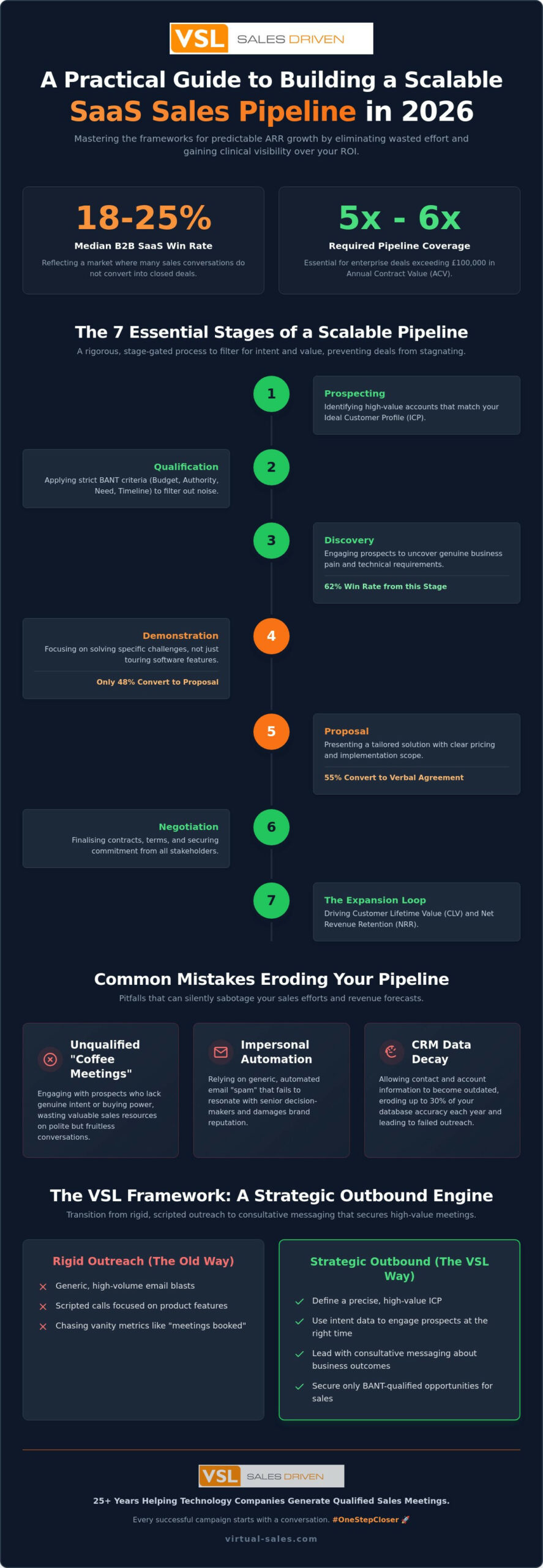
Did you know that the median win rate for B2B SaaS in 2026 sits between just 18% and 25%? For many tech leaders, this statistic reflects a painful reality where sales reps spend more time on polite “coffee meetings” than closing qualified deals. If your SaaS sales pipeline feels like a black hole of inconsistent lead flow and early-stage churn, you aren’t alone. Many ambitious businesses find it difficult to maintain the 5x to 6x coverage ratios required for enterprise deals exceeding £100,000 in ACV.
You likely recognise that “growth at all costs” is a relic of the past; today’s market rewards efficient, predictable revenue. We’ve designed this guide to help you master the art of building and scaling a pipeline that delivers sustainable ARR growth. You’ll learn how to eliminate wasted effort and gain clinical visibility over your ROI. We will break down the tactical frameworks used by high-performing teams to move from discovery to closed-won with precision, ensuring every stage of your sales cycle is optimised for maximum conversion.
Key Takeaways
- Learn why the modern SaaS sales pipeline must prioritise subscription-specific metrics like CLV and expansion revenue to drive sustainable ARR growth.
- Discover the seven essential stages of a scalable pipeline, from identifying high-value ICP accounts to securing BANT-qualified opportunities.
- Avoid common pitfalls such as automated email “spam” and CRM data decay that can erode up to 30% of your database accuracy every year.
- Implement the VSL Framework to transition from rigid scripted outreach to consultative messaging that resonates with senior IT and Finance decision-makers.
- Gain actionable insights on using expert appointment setting to break into enterprise markets and achieve predictable month-on-month growth.
What is a SaaS Sales Pipeline and Why Does it Matter in 2026?
The SaaS sales pipeline is the fundamental engine driving Annual Recurring Revenue (ARR). It isn’t merely a visual aid for tracking prospects; it’s a living ecosystem designed to fuel subscription growth. In 2026, the landscape has matured, moving past the “growth at all costs” era toward a model of clinical efficiency. This shift means your pipeline must be built on three non-negotiable pillars: Generation, Velocity, and Conversion. Without a consistent flow of qualified opportunities and a clear path to closing them, your revenue targets remain nothing more than wishful thinking.
The Anatomy of a Subscription-Based Pipeline
A SaaS pipeline differs from traditional B2B models because the initial transaction is just the start of the relationship. Modern tech leaders prioritise Customer Lifetime Value (CLV) and expansion revenue above one-off sales. With median Net Revenue Retention (NRR) for B2B SaaS currently at 102%, your pipeline’s health directly impacts investor confidence and overall valuation. You must distinguish between vanity metrics like raw lead volume and genuine revenue-driving opportunities. This requires a systematic design of sales processes that filters out noise and focuses on high-intent prospects. Implementing targeted lead generation for technology companies ensures that your reps spend their energy on accounts that actually contribute to long-term ARR.
Why Pipeline Velocity is Your Most Critical Metric
Velocity measures the speed at which revenue moves through your commercial engine. You calculate it by multiplying your number of opportunities by your win rate and average deal size, then dividing that figure by your sales cycle length. Research shows that for enterprise deals over £100,000, the median sales cycle is 118 days. Even a modest 10% reduction in this cycle length can dramatically increase your year-end revenue by allowing for more deal rotations within the same period. Optimising your SaaS sales pipeline for velocity involves identifying friction points in the demo-to-proposal stage, where research indicates 52% of deals are currently lost. Pipeline Velocity serves as the ultimate barometer for UK SaaS scaling by quantifying the momentum of your commercial engine against the reality of your burn rate.
The 7 Essential Stages of a Scalable SaaS Pipeline
Scaling a SaaS sales pipeline requires more than just filling a CRM with names; it demands a rigorous, stage-gated process that filters for intent and value. Maintaining a healthy sales pipeline involves managing seven specific stages: Prospecting, Qualification, Discovery, Demonstration, Proposal, Negotiation, and the Expansion Loop. Each stage must have clear entry and exit criteria to prevent deals from stagnating or inflating your forecast with false hope. By treating your sales process as a series of measurable conversions, you can identify exactly where friction occurs and deploy tactical fixes to maintain momentum.
From Prospecting to BANT Qualification
In 2026, the greatest threat to your pipeline isn’t a “no”, it’s the “polite maybe”. Sales reps often fall into the trap of “coffee meetings” with prospects who have no intention of buying, wasting valuable resources on unqualified leads. To scale effectively, you must apply strict BANT criteria (Budget, Authority, Need, Timeline) during the qualification phase. Research indicates that the transition from Discovery to Qualified carries a 62% win rate, but this only holds true if you filter for genuine business pain. Modern outbound strategies now rely on intent-based calling, where data signals indicate a prospect is actively searching for a solution, allowing your team to engage at the exact moment of need. If you’re struggling to secure these high-intent meetings, it may be time to evaluate expert appointment setting in the UK to ensure your reps only speak with decision-makers who have a verified requirement.
The Closing and Expansion Loop
The Demonstration stage is where most pipelines leak, with only 48% of deals typically converting to the proposal stage. To bridge this gap, your demos must focus on solving specific technical challenges identified during Discovery rather than just touring features. Once you move through Proposal (55% conversion to verbal) and Negotiation, the process doesn’t simply stop at “Closed Won”. In a subscription model, the pipeline is a continuous loop. Managing the transition from Sales to Customer Success is vital to protect your Net Revenue Retention (NRR). A successful handover ensures that the value promised during the sales cycle is realised, which in turn creates the foundation for future upsell and cross-sell opportunities. Identifying these expansion triggers early in the relationship allows you to treat existing accounts as a secondary, high-velocity pipeline that drives efficient ARR growth without the high cost of new customer acquisition.
Common Mistakes in SaaS Pipeline Management
Managing a SaaS sales pipeline is as much about what you stop doing as what you start. In 2026, many tech firms fall into the trap of assuming that automation can entirely replace human intuition. The most prevalent error is an over-reliance on automated email sequences. These “set and forget” campaigns frequently degenerate into digital noise, irritating senior decision-makers and damaging your brand reputation before a human ever makes contact. Instead of building trust, you are inadvertently constructing a barrier that your sales team will struggle to dismantle later.
Another critical failure occurs in the middle of the funnel. Whilst many leaders obsess over top-of-funnel lead generation, they ignore the stage where deals frequently stall. This stagnation often stems from a lack of strategic nurturing after the initial demo. If your team focuses only on the next “new” meeting, they lose sight of prospects who require further technical validation or multi-stakeholder consensus to move forward.
The “Volume Over Quality” Trap
Many organisations still set quotas based on raw activity metrics, such as the number of calls made, rather than outcomes like qualified meetings. This creates a volume-heavy environment where quantity is prioritised over quality. Low-quality leads increase the administrative burden on Account Executives (AEs) without providing a corresponding uplift in revenue. There is also a significant hidden cost to “cheap” outsourced telemarketing. These services often rely on rigid scripts and high-pressure tactics that alienate prospects in the IT and software sectors. A healthy pipeline requires consultative conversations where experienced professionals engage deeply with a prospect’s specific business challenges. Choosing an integrated partner who acts as a professional extension of your team is far more effective than hiring a disconnected, high-volume vendor.
Data Decay and CRM Neglect
Pipeline integrity relies entirely on the quality of your underlying data. Industry research confirms that CRM accuracy decays by 20% to 30% annually as professionals change roles and companies restructure. Failing to address this leads to wasted sales effort, as reps chase defunct contacts or outdated technical environments. Implementing a regular b2b data cleansing routine is essential to maintain a high-performing commercial engine. Beyond just correcting errors, this process allows you to gather real-time market intelligence (MI). When a caller discovers a shift in a prospect’s budget cycle or a change in their current vendor, that intelligence becomes a competitive advantage that automation simply cannot replicate.
The VSL Framework: A Strategic Outbound Engine
Building a predictable SaaS sales pipeline requires more than just a software stack; it requires a structured methodology that prioritises human intelligence. The VSL Framework is designed to act as an elite outbound engine, moving beyond the limitations of generic automation to deliver high-value opportunities. This five-step process ensures that every prospect entering your pipeline is vetted for both fit and intent, creating a reliable path to ARR growth.
- Step 1: Deep ICP Definition – We identify exact job titles and sectors, such as IT, HR, or Finance, to ensure outreach is laser-focused on those with decision-making power.
- Step 2: Consultative Messaging – We develop key messages that resonate with specific business pains. We never use scripts, preferring high-level, professional dialogue.
- Step 3: Multi-Channel Outreach – Our approach integrates telemarketing with LinkedIn and email, creating multiple touchpoints that build familiarity and trust.
- Step 4: Quality Control – Every meeting is BANT-qualified before it reaches your AE’s calendar. This eliminates the “coffee meeting” trap discussed earlier.
- Step 5: Weekly Optimisation – We use continuous feedback loops to refine our messaging and targeting based on real-world market responses.
Designing Your Outbound Architecture
We don’t believe in generalist callers. VSL employs dedicated professionals with genuine IT backgrounds who can navigate complex technical conversations with confidence. Every campaign is overseen by a dedicated Project Manager, ensuring that your outbound strategy remains aligned with your internal commercial goals. By choosing to integrate b2b appointment setting into your existing sales team, you gain a high-performing extension of your own workforce. This partnership model mitigates the risks associated with traditional outsourcing whilst delivering the professional maturity required to engage enterprise-level prospects. To see how this approach translates into measurable results, explore our verified UK appointment setting performance across the technology sector.
Technology and Integration
Precision in reporting is non-negotiable. We utilise a cloud-based CRM to track every interaction, providing you with full visibility over campaign momentum and outcome data. This system allows us to push qualified opportunity data seamlessly into your own platforms, such as Salesforce or HubSpot, maintaining a single source of truth for your sales team. VSL’s LinkedIn Add-On further enhances contact data, ensuring better reach and higher engagement rates with key stakeholders across your target accounts. This technical integration ensures that your SaaS sales pipeline remains accurate, enriched, and ready for your AEs to close.
Real Insight: Scaling Pipeline with Expert Appointment Setting
Consider the case of a UK-based software provider specialising in complex ERP solutions. They struggled to gain traction within the enterprise sector, often settling for small-scale deals that failed to move the needle on their ARR. Their internal team was capable but overstretched, leading to an inconsistent SaaS sales pipeline that relied heavily on sporadic referrals and low-intent inbound leads. By implementing a consultative lead generation for software campaign, they shifted their focus toward high-value accounts with verified business needs.
The outcome was transformative. Within the first quarter, the firm moved from securing 2-3 sporadic meetings to a consistent flow of 10-20 qualified appointments every month. This stability allowed their AEs to focus entirely on closing rather than prospecting. By targeting specific decision-makers in the £100,000+ ACV bracket, the campaign delivered a 3x to 5x ROI on the monthly subscription fee. This result proves that a quality-led outbound strategy is the most efficient route to enterprise growth in a competitive tech market.
What to Expect: Subscription and Outcomes
Transparency is the bedrock of our partnership. Unlike traditional agencies that demand rigid commitments, VSL subscriptions offer total flexibility with no long-term contracts. This allows you to scale your activity up or down based on your commercial requirements and budget cycles. A typical ramp-up period for a new campaign lasts between four and eight weeks. During this time, we refine the messaging and identify the most responsive segments of your ICP. Meeting outcomes vary depending on market complexity; however, most clients see a steady output of 10-20 meetings per month once the programme is fully optimised and the data is enriched.
The VSL Difference: Transparency and Reporting
We operate as an integrated component of your sales team, not a distant vendor. You gain 24/7 access to a dedicated Project Manager and receive comprehensive weekly reports that detail every interaction and market insight gathered. To ensure clinical efficiency and continuous improvement, we provide call recordings for internal review. This allows you to hear exactly how we represent your brand and ensures that every lead meets the BANT-qualified standard before it enters your SaaS sales pipeline. In a digital-first world, this human-to-human connection remains the most powerful tool for breaking through the noise and building lasting enterprise relationships.
Building Your High-Velocity Revenue Engine
Mastering your SaaS sales pipeline in 2026 requires a decisive shift from raw lead volume to clinical, high-intent qualification. You have seen how the VSL Framework eliminates the “coffee meeting” trap by prioritising BANT-qualified opportunities that contribute directly to ARR. By focusing on pipeline velocity and addressing the leaks in your demo-to-proposal stage, you can secure the predictable growth that modern investors and stakeholders demand.
We operate as an elite, integrated extension of your internal sales team. Backed by 25+ years of experience in the IT and software sectors, we deliver guaranteed BANT-qualified meetings whilst requiring no long-term contract. Our approach ensures that your AEs spend their time closing deals rather than navigating data decay or automated noise. It is time to stop chasing vanity metrics and start engaging with high-value decision-makers through a proven, tactical outbound engine.
Book a Consultative Call to Scale Your SaaS Pipeline and begin building a more resilient, revenue-focused commercial operation today. We are ready to help you turn your growth ambitions into measurable results.
25+ Years Helping Technology Companies Generate Qualified Sales Meetings. Every successful campaign starts with a conversation. #OneStepCloser 🚀
Frequently Asked Questions
What is the ideal SaaS sales pipeline length?
The length of a healthy SaaS sales pipeline varies significantly based on your Annual Contract Value (ACV). For deals under £10,000, you should expect a cycle of approximately 14 days. However, enterprise deals exceeding £100,000 typically require 118 days or more to reach a conclusion. Managing these expectations is vital for accurate forecasting and ensuring your sales team remains focused on the right activities at each stage of the buying journey.
How many opportunities do I need to hit my ARR targets?
To hit your ARR targets, you must maintain a specific pipeline coverage ratio based on your average deal size. For smaller contracts under £25,000, a 2.5x to 3x coverage is the industry standard. For enterprise deals over £100,000, you require a 5x to 6x coverage ratio to account for longer cycles and higher stakeholder complexity. Calculating these figures allows you to work backwards and determine the exact number of qualified meetings required each month.
Is telemarketing still effective for SaaS in 2026?
Consultative telemarketing remains one of the most effective ways to build a SaaS sales pipeline in 2026. Whilst automated emails often get ignored, a human-to-human conversation can navigate complex gatekeepers and uncover hidden business pain. The key is moving away from rigid scripts toward high-level dialogue led by professionals who understand the IT landscape. This approach builds the rapport necessary for enterprise-level engagement that digital tools simply cannot replicate.
How do you qualify a SaaS lead using BANT?
Qualifying a lead requires verifying four critical pillars: Budget, Authority, Need, and Timeline. In a SaaS context, we determine if a prospect has a specific project budget or the ability to reallocate funds. We identify if the contact is a genuine decision-maker or a key influencer within the hierarchy. We also uncover a verified business pain and a clear window for implementation, ensuring your AEs only spend time on high-probability opportunities.
Can VSL integrate with my existing CRM like Salesforce?
Yes, VSL uses a cloud-based CRM designed for seamless integration with popular platforms like Salesforce and HubSpot. We ensure that all lead data, call notes, and BANT-qualification details are pushed directly into your system in real-time. This creates a single source of truth for your commercial team and allows for transparent reporting on campaign performance. Our technical setup ensures that our activity feels like a natural, integrated extension of your internal workflow.
What is the difference between a lead and an opportunity in SaaS?
A lead is simply a contact who fits your Ideal Customer Profile (ICP) but has not yet been vetted for intent. An opportunity is a lead that has passed through a rigorous qualification process, such as BANT. In a high-performing SaaS sales pipeline, an opportunity represents a verified business requirement with a clear path to a demo. Distinguishing between the two prevents your forecast from being inflated by low-intent data that will never convert.
Why should I outsource my SaaS pipeline generation?
Outsourcing allows you to scale your outbound activity rapidly without the overhead of hiring and training an internal SDR team. By partnering with specialists who provide dedicated callers with IT backgrounds, you gain immediate access to professional maturity and industry expertise. This model provides the flexibility to adjust campaign intensity based on your current ARR targets whilst ensuring a consistent flow of qualified meetings for your senior closers to handle.
How do you handle objections during consultative sales calls?
We handle objections by treating them as requests for further information rather than a final rejection. Our experienced callers use active listening to understand the root cause of a prospect’s concern, whether it relates to budget constraints or current vendor satisfaction. We then provide a consultative reframe that connects your solution’s value to their specific business challenge. This professional approach maintains rapport and often uncovers the true requirements needed to move the deal forward.

Disclaimer
Disclaimer: Content is for general information only and does not constitute professional advice. Results may vary. Virtual Sales Limited accepts no liability for actions taken based on this content.
Tags: ARR growth, B2B Sales, enterprise sales, Lead generation, SaaS sales pipeline, sales pipeline management, Sales Strategy, Tech Sales, uk tech