B2B Sales Pipeline Strategy: A Practical Guide for Sales Leaders in 2026
Did you know that despite rising budgets, only 13% to 21% of Marketing Qualified Leads ever convert into genuine sales opportunities? This disconnect is why many sales leaders struggle with inaccurate forecasting and a CRM clogged with junk leads. You’ve likely watched your top reps waste hours on administrative tasks when they should be closing deals. It’s a frustrating cycle that stalls growth and obscures your actual ROI.
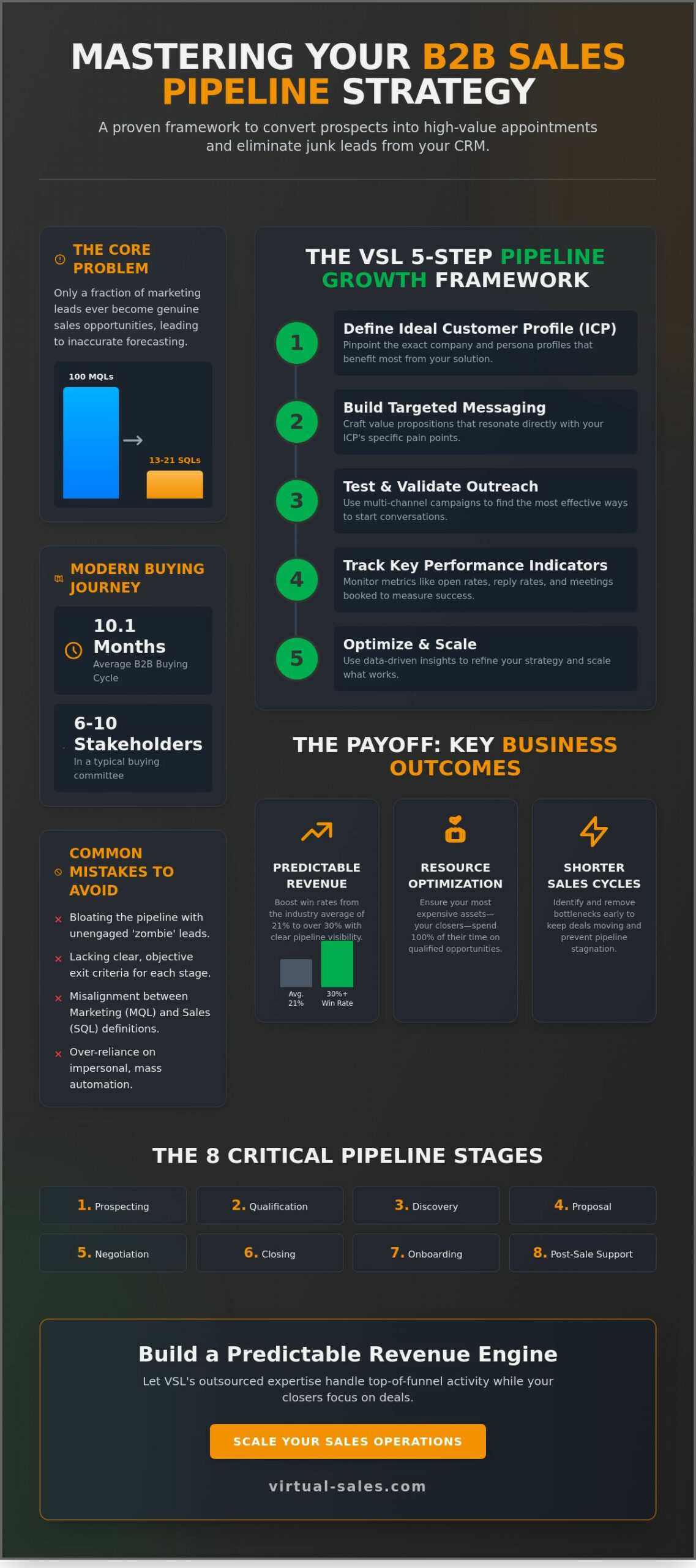
You can reclaim control of your revenue engine by mastering a clinical b2b sales pipeline strategy that prioritizes intent over volume. This guide provides a proven framework to convert cold prospects into high-value B2B appointments while ensuring your team focuses only on qualified opportunities. We will explore a repeatable 5-step method to increase your lead-to-meeting conversion rates and provide the granular visibility needed to manage today’s complex 10.1-month buying cycles with confidence.
Key Takeaways
- Identify the 8 critical pipeline stages necessary to manage complex sales cycles and ensure no high-value prospect falls through the cracks.
- Master a proven b2b sales pipeline strategy that filters out junk leads and focuses your team’s energy on sales-ready opportunities.
- Apply the VSL 5-step framework to build a repeatable engine for converting cold outreach into qualified B2B appointments.
- Navigate the modern buying landscape by addressing the needs of the 6-10 stakeholders typically found in enterprise buying committees.
- Scale your revenue operations efficiently by integrating outsourced expertise to handle top-of-funnel activity while your closers focus on deals.
Understanding the B2B Sales Pipeline Strategy
Inconsistent revenue is rarely a symptom of poor selling. It’s usually a direct result of a fragmented b2b sales pipeline strategy. Without clear visibility into where deals sit, sales leaders find themselves reacting to crises rather than orchestrating growth. A robust pipeline isn’t just a list of names; it is a systematic, chronological map of every action your team takes to move a prospect from initial awareness to a signed contract. It provides the structural integrity required to scale an ambitious business in a competitive market.
Gaining a deep Understanding B2B dynamics is the foundation of this approach. While many use the terms “funnel” and “pipeline” interchangeably, they represent different perspectives. The sales funnel describes the buyer’s internal journey and psychological shifts. Conversely, the pipeline tracks the seller’s tactical output. In 2026, the strategy has shifted from mass-automated outreach to clinical, intent-based precision. With 67% of the B2B buying journey now self-directed, your pipeline must account for the “dark funnel” where research happens long before your first sales call.
The Definition of a High-Performing Pipeline
A functional pipeline requires a structured sequence of sales activities that mirror the complexity of modern commerce. It isn’t enough to simply “prospect” or “demo.” Each stage must have defined exit criteria. This ensures that only high-intent leads progress through the system. High-performing teams integrate these stages directly into cloud-based CRM systems like HubSpot or Salesforce. At VSL, we use these platforms to maintain a single source of truth, ensuring that every interaction is logged and every metric is actionable. This level of technical integration prevents lead leakage and provides the data needed for strategic pivots.
Why It Matters: Key Business Outcomes
Implementing a rigorous b2b sales pipeline strategy transforms your commercial operation from a guessing game into a predictable engine. Consider these three primary outcomes:
- Predictable Revenue: When you understand your conversion rates at each stage, your forecasting accuracy improves. Industry data suggests that top performers with clear pipeline visibility achieve win rates of 30% or higher, compared to the 20% to 21% average.
- Shortened Sales Cycles: The average B2B buying cycle currently spans 10.1 months. Identifying bottlenecks early allows you to deploy targeted B2B Appointment Setting resources to keep deals moving and prevent stagnation.
- Resource Optimization: Your closers are your most expensive assets. A clean pipeline ensures they spend zero time on “junk” leads and 100% of their time on qualified opportunities that have a genuine chance of closing.
Designing Your Sales Pipeline Stages for 2026
A high-performing b2b sales pipeline strategy requires more than just a list of names. It demands a rigorous, 8-stage architecture that reflects the complexity of modern commerce. These stages include prospecting, qualification, discovery, proposal, negotiation, closing, onboarding, and post-sale support. While most leaders focus on the closing end of the spectrum, the health of your revenue engine is determined at the top of the funnel. If your entry points are weak, your forecasting will never be accurate.
One of the most critical filters in this process is the Lead Qualification stage. This is where you separate genuine intent from casual curiosity. To maintain a lean and efficient system, many high-growth firms invest in b2b data cleansing to ensure their CRM isn’t filled with outdated or incorrect contact information. Clean data is the prerequisite for effective managing complex sales pipelines, especially when dealing with the 11.2 stakeholders typically involved in enterprise deals over £50,000.
5 Common Pipeline Strategy Mistakes
Implementing a flawed b2b sales pipeline strategy often stems from specific operational errors that stall growth. Avoid these common pitfalls:
- Bloating the pipeline: Keeping zombie leads in the system creates a false sense of security. If a prospect hasn’t engaged in 60 days, they aren’t a lead; they’re a distraction.
- Lack of clear Exit Criteria: Every stage must have a specific trigger that allows a prospect to move forward. Without these, reps move deals based on gut feeling rather than objective progress.
- MQL and SQL misalignment: Only 13% to 21% of MQLs typically become SQLs. If your marketing and sales definitions don’t match, your pipeline will be clogged with junk.
- Over-reliance on automation: Automated email sequences are efficient but lack the human touch required to navigate complex objections. Success in 2026 requires human-led telemarketing follow-up to bridge the gap.
Stage-by-Stage Execution
Success begins with Prospecting. In 2026, this means using real-time intent data to identify buyers who are actively researching solutions. Rather than casting a wide net, focus on accounts showing specific signals that match your ICP. Once a connection is made, move immediately to Qualification. We recommend the BANT framework (Budget, Authority, Need, Timeline) to ensure the prospect has the capacity and the urgency to buy. If they don’t meet these criteria, they shouldn’t progress.
The Proposal stage should never be a generic document. It must be the culmination of a deep Needs Assessment phase. This is where you demonstrate a clinical understanding of the prospect’s pain points and present a tailored solution. By the time you reach this stage, your win rate should be significantly higher than the industry average of 20%. To see how top-tier UK firms structure these conversations, you can review our proven results on our Clutch profile.
The VSL Framework: A 5-Step Method for Pipeline Growth
Building a scalable revenue engine requires more than just a theoretical understanding of stages. It requires a tactical execution plan. At VSL, we’ve refined a proprietary 5-step method specifically designed for the UK market. This framework bridges the gap between raw lead generation and the high-value conversations that drive growth. By integrating professional b2b appointment setting into your b2b sales pipeline strategy, you accelerate the transition from cold prospect to qualified opportunity with clinical precision.
Our approach prioritizes the “human-in-the-loop” advantage, which is essential for high-ticket IT services. While AI can assist in the early stages, it cannot replicate the nuance of a peer-to-peer business conversation. We act as an elite, integrated component of your team, ensuring that every lead passed forward is thoroughly vetted. Our technical infrastructure allows us to output this data directly into your cloud-based CRM, whether you use HubSpot, Salesforce, or another major platform. This ensures your internal team has immediate, actionable insights without administrative friction.
Step 1 & 2: Define ICP and Build Targeted Messaging
Precision starts with your Ideal Customer Profile (ICP). In 2026, broad targeting is a recipe for wasted budget. We focus on clinical alignment with the accounts that offer the highest lifetime value. Once identified, we craft messaging that speaks directly to the priorities of the UK C-suite. Decision-makers are currently navigating complex economic shifts and longer buying cycles. Your messaging must move beyond features, it must articulate a clear, measurable impact on their bottom line. We integrate these value propositions into every touchpoint to ensure consistency and authority from the first interaction.
Step 3, 4 & 5: Execute, Track, and Optimize
Execution is where many strategies fail. VSL employs professional telemarketers who engage prospects in sophisticated dialogues. This human-led expertise is our primary differentiator. We don’t just book meetings; we qualify intent and build rapport. We track the metrics that actually matter, specifically the conversion rate from “Initial Contact” to “Qualified Meeting.” Industry benchmarks for intent-triggered outreach hover around 10% to 14%, and we aim to exceed these by constantly optimizing our approach. We use real-time feedback from the field to refine messaging and targeting. If a specific objection arises frequently, we pivot the strategy immediately. This proactive stance ensures your b2b sales pipeline strategy remains agile and results-oriented.
Measuring Pipeline Health with Real Insights
Managing a modern revenue engine requires more than just intuition. It demands a clinical analysis of data to ensure your b2b sales pipeline strategy remains viable. Gartner research indicates that the complexity of the B2B journey is increasing, with buying groups typically comprising 6 to 10 stakeholders. This multi-threaded environment means your pipeline health isn’t just about the volume of leads; it’s about the depth of engagement across an entire account. If you aren’t tracking how effectively you navigate these committees, you’re flying blind.
Real Insight: The SaaS Pipeline Turnaround
Consider the case of a UK-based software provider that approached VSL with a stagnant pipeline. They were generating a high volume of inbound interest, but their internal team only converted 2% of these leads into sales opportunities. The system was clogged with low-quality data that drained resources without delivering ROI.
We implemented a two-pronged approach. First, we conducted a rigorous database cleansing to remove obsolete records and focus on high-intent accounts. Second, we deployed an intent-based calling strategy to engage prospects showing active buying signals. The results were immediate. Within one quarter, the firm moved from sporadic bookings to 15+ qualified meetings every month. This shift added over £50,000 in new, high-probability opportunities to their pipeline. You can view similar verified performance data on the VSL Clutch profile.
Core Metrics for Sales Leaders
To maintain a high-standard output, you must track three non-negotiable metrics. First is Pipeline Velocity. This measures the speed at which a prospect moves from the initial contact to a closed deal. With the average B2B buying cycle now reaching 10.1 months, any stagnation can be fatal to your quarterly targets. Identifying bottlenecks early prevents deal decay.
Second is the Conversion Rate. You should target a 10% to 14% conversion from lead to qualified appointment when using intent-triggered outreach. If your rates fall below this range, it usually indicates a failure in your qualification criteria or a lack of persistent follow-up. Finally, monitor your Customer Acquisition Cost (CAC). Compare the cost of maintaining a large internal team against the efficiency of a strategic partnership. Often, an integrated outbound model provides a lower CAC by leveraging specialized expertise and established processes. To see how these metrics translate into real-world success, review our verified results and client reviews.
Scaling Your Strategy with Outsourced Sales Solutions
Software alone cannot fix a broken revenue engine. While many competitors suggest that more tools are the answer, we know that success in 2026 depends on the talent executing your b2b sales pipeline strategy. Positioning an external team as a strategic partner rather than a mere vendor allows you to bridge the execution gap without the overhead of a massive internal department. We act as an elite, integrated component of your workforce, maintaining the same high standards you expect from your own staff.
The primary advantage of outsourced appointment setting lies in its ability to scale your operations rapidly. By leveraging professional, UK-based telemarketers, you ensure that your brand is represented with maturity and technical expertise. This is a critical differentiator. Unlike lower-cost international alternatives, our staff understands the nuances of the UK corporate landscape. They possess the professional maturity required to engage C-suite decision-makers in meaningful, peer-to-peer dialogues that convert.
When to Outsource Your Pipeline Development
Deciding when to integrate an external partner into your sales process is a strategic pivot. We typically see the highest ROI in three specific scenarios:
- Internal focus on closing: Your most expensive sales assets should focus on negotiating and closing deals. If they spend 50% of their time prospecting, your pipeline velocity will inevitably drop.
- Market expansion: When launching a new IT product or entering a new vertical, you need immediate momentum. An established partner provides the database building and outreach capacity to hit the ground running.
- Persistent quality issues: If your current lead volume is high but your meeting-to-opportunity conversion rate is below 25%, your qualification process is failing. We provide the clinical filter needed to ensure only high-value prospects reach your closers.
Next Steps: Building Your 2026 Roadmap
To master your b2b sales pipeline strategy this year, start with a comprehensive audit of your current stages. Evaluate your exit criteria and identify where deals are stagnating. Consider the ROI of a dedicated telemarketing retainer versus the cost of a missed revenue target. A structured, human-led approach ensures that your pipeline remains healthy, predictable, and scalable. To further develop your team’s ability to execute these stages effectively, you can find out more about specialized sales training.
The path to commercial success in 2026 requires a balance of strategic high-level planning and tactical execution. By focusing on intent, qualifying with rigor, and partnering with experts, you can transform your sales operation into a high-performing engine. Ready to accelerate your growth? Book a strategy call with VSL to scale your pipeline and secure your market position today.
Future-Proofing Your Revenue Engine
Winning in the 2026 B2B landscape requires a shift from volume-heavy automation to clinical, human-led precision. You’ve seen how a structured b2b sales pipeline strategy eliminates “zombie” leads and focuses your team on high-intent opportunities. By implementing a rigorous 8-stage architecture and leveraging the VSL 5-step framework, you transform your sales operation into a predictable revenue engine.
Success isn’t just about the tools you use; it’s about the expertise behind the outreach. VSL provides the professional maturity and technical infrastructure needed to scale your pipeline without the risk of lead leakage. As a top-rated partner on Clutch for UK Appointment Setting, we’ve delivered proven results for leaders in the IT, SaaS, and Software industries. Our experienced staff integrates seamlessly with your cloud-based CRM to ensure every appointment is qualified and every metric is transparent.
Don’t let a fragmented process stall your growth. You can accelerate your sales growth with VSL’s expert appointment setting services and reclaim control of your commercial future. Your path to predictable revenue starts with a single strategic pivot.
Frequently Asked Questions
What is the ideal number of stages in a B2B sales pipeline?
The ideal pipeline typically consists of 7 to 8 stages to ensure granular visibility without creating excessive admin. These stages should range from initial prospecting and qualification to negotiation and post-sale support. Having too few stages makes it difficult to identify exactly where deals are stalling during the 10.1-month average buying cycle.
How does a B2B sales pipeline differ from a sales funnel?
A sales pipeline tracks the tactical actions of the seller, while the sales funnel illustrates the psychological journey of the buyer. The pipeline focuses on milestones like discovery calls and proposal submissions. Both are essential components of a robust b2b sales pipeline strategy, but they provide different perspectives on the path to revenue.
What are the best CRM tools for managing a B2B sales pipeline in 2026?
Salesforce and HubSpot remain the industry standards due to their advanced reporting and integration capabilities. These platforms easily handle the complexity of buying committees that now average 11.2 stakeholders for enterprise deals. VSL uses cloud-based CRM technology that outputs directly to these systems, ensuring your data remains synchronized and actionable.
How can I improve my sales pipeline forecasting accuracy?
You can improve accuracy by tracking conversion rates at every individual stage rather than just the final win rate. By analyzing the velocity of deals and historical stage-to-stage conversion data, you remove subjective bias from your reports. This clinical approach allows sales leaders to predict revenue with a much higher degree of certainty.
Is it better to build an internal sales team or outsource lead generation?
Many high-growth firms adopt a hybrid model, keeping closing expertise internal while outsourcing top-of-funnel prospecting. This allows your most expensive closers to focus on deals rather than cold outreach. Partnering with an expert team often results in higher quality appointments and a more efficient use of internal resources.
What is a healthy conversion rate from lead to qualified appointment?
A healthy conversion rate typically ranges from 10% to 14% when using intent-triggered outreach. Standard cold outbound averages are lower, usually sitting between 5% and 10%. If your conversion rates are consistently below these benchmarks, it is likely time to audit your lead qualification criteria or your initial messaging.
How often should I perform B2B data cleansing on my pipeline?
You should perform data cleansing at least once per quarter to account for the natural decay of contact information. In the B2B sector, approximately 30% of data becomes obsolete every year as professionals change roles or companies. Regular audits prevent your sales team from wasting time on incorrect or non-existent prospects.
What role does intent data play in a 2026 sales pipeline strategy?
Intent data serves as the primary trigger for outreach in a modern b2b sales pipeline strategy. It allows you to move beyond static buyer personas and engage with accounts that are actively researching solutions. This signal-led approach ensures your team prioritizes prospects who are already showing a high propensity to buy.

Disclaimer
Disclaimer: Content is for general information only and does not constitute professional advice. Results may vary. Virtual Sales Limited accepts no liability for actions taken based on this content.
Tags: B2B Sales, Conversion Rate Optimisation, Lead generation, Sales Forecasting, Sales Leadership, Sales Pipeline, Sales Strategy, VSL Framework