Getting Budget Approval for Sales Outsourcing: The 2026 ROI Framework
What if your internal recruitment strategy is actually a hidden “Turnover Tax” that is draining your 2026 growth budget? Most B2B leaders struggle with getting budget approval for sales outsourcing because the executive board often views external partnerships as an added expense rather than a calculated cost-mitigation strategy. You likely agree that the friction of hiring and the inevitable churn of internal staff makes consistent pipeline growth feel nearly impossible to maintain. When the average SDR tenure in the industry has dropped to just 18 months, your business is likely losing thousands in recruitment fees and lost momentum.
This article will teach you how to build a bulletproof business case that secures executive buy-in by shifting the internal conversation from “service cost” to “fully-loaded ROI.” We will provide a structured framework designed for the 2026 commercial landscape, focusing on how to reduce overheads and accelerate your speed-to-market. You will learn the exact data points your CFO needs to see, including how to compare the real costs of an in-house team against an integrated, tech-led partner that scales with your ambition.
Key Takeaways
- Identify the “Invisible Leak” in your sales budget by uncovering why base salaries typically represent only 50% of the true fully-loaded cost of an internal hire.
- Master the strategic framework for getting budget approval for sales outsourcing by using a 90-day pilot to prove concept and reduce executive perceived risk.
- Calculate the “Ramp-Up Gap” to demonstrate how internal hires often consume three to six months of budget before generating a single qualified lead.
- Evaluate industry-standard ROI projections, such as achieving 10–20 high-quality meetings per month for enterprise IT and SaaS sectors.
- Learn how to integrate expert prospecting as a natural extension of your team, syncing data directly into your HubSpot or Salesforce CRM for maximum efficiency.
The Hidden Costs of Internal Sales Scaling in 2026
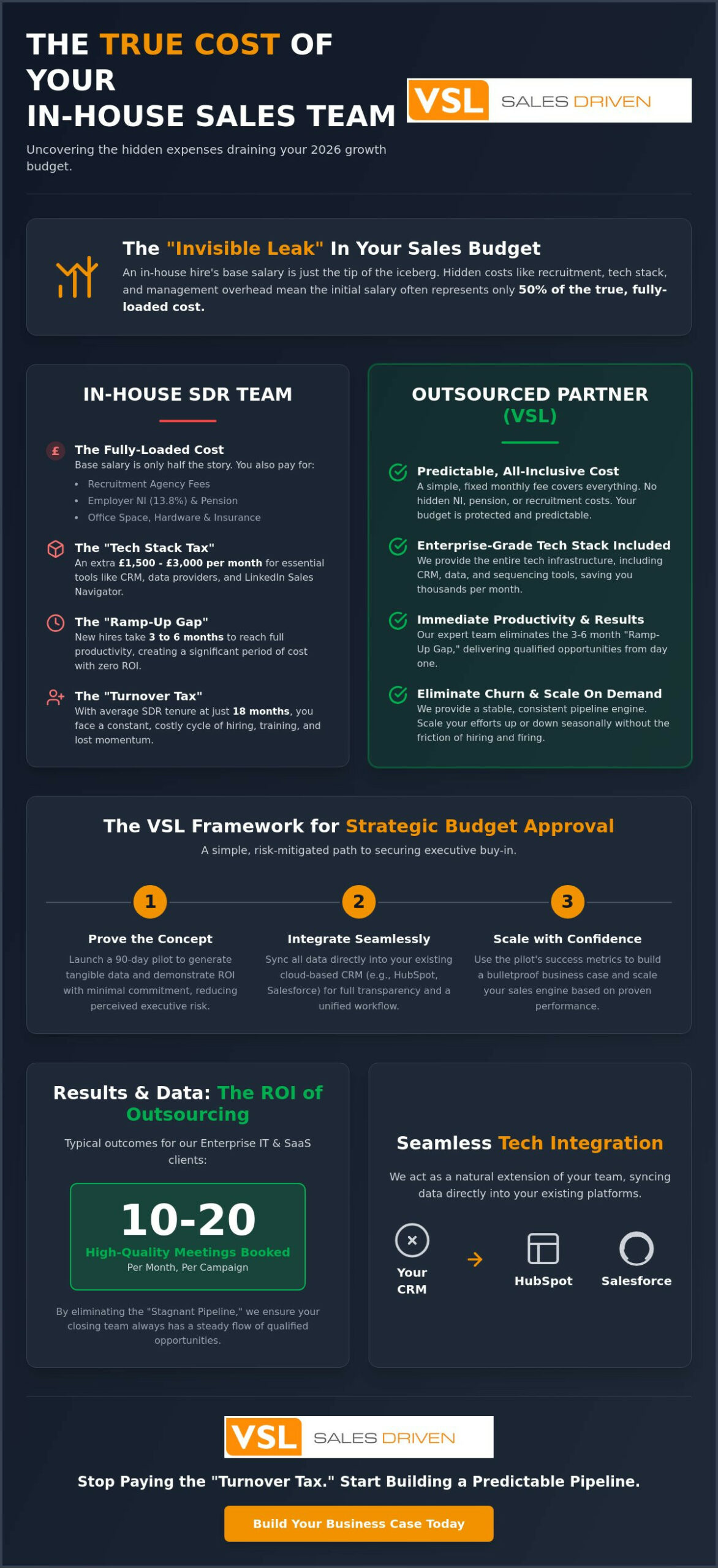
Scaling a B2B sales team in 2026 requires a deeper financial analysis than simply looking at headcount. When you begin the process of getting budget approval for sales outsourcing, you must first expose the “Invisible Leak” in traditional hiring. Most executive boards focus on base salaries, yet these typically represent only 50% of the true fully-loaded cost of an internal Sales Development Representative (SDR). Once you calculate employer National Insurance contributions, pension auto-enrolment, and the monthly cost of a high-performance tech stack, the financial burden shifts significantly. Maintaining a modern outbound operation requires an investment of £1,500 to £3,000 per month just for tools like cloud-based CRMs, intent data, and sequencing software.
The “Ramp-Up Gap” creates further fiscal strain. An internal hire typically requires three to six months to achieve full productivity. During this window, the business absorbs 100% of the costs while receiving 0% of the revenue-generating output. This lag is why Sales outsourcing has transitioned from a tactical choice to a strategic imperative for UK firms. In the current UK recruitment landscape, finding experienced B2B telemarketers is a significant challenge. The 2026 talent market is highly competitive, making it difficult for SMEs to attract and retain the level of expertise required for complex IT and SaaS prospecting. Traditional hiring models also lack the elasticity needed for seasonal scaling, leaving companies with high fixed overheads during market dips.
The “Turnover Tax” Explained
Staff churn in the sales sector is a silent profit killer. With average SDR tenures in the B2B SaaS industry now sitting at approximately 18 months, businesses are stuck in a perpetual cycle of the “Turnover Tax.” This includes recruitment agency fees, management time diverted to interviewing, and the inevitable loss of momentum. Every time a rep leaves, your CRM data integrity is at risk as leads go cold and relationships vanish. For many, a flexible VSL subscription provides a more stable alternative, ensuring that your lead generation for SMEs remains consistent regardless of individual staff transitions.
Opportunity Cost: The Price of a Stagnant Pipeline
The Fully-Loaded Cost Model: In-House vs. Outsourced
Presenting a business case to the board requires a shift from superficial salary figures to a rigorous Total Cost of Ownership (TCO) model. When getting budget approval for sales outsourcing, you must account for the secondary financial layers that an in-house hire necessitates. In the UK, a base salary is merely the starting point. Employer National Insurance contributions at 13.8% and mandatory pension contributions add immediate weight to the balance sheet. Add to this the cost of office space, hardware, and insurance, and the “visible” cost of a rep quickly doubles. These are rigid costs that don’t disappear if the hire fails to perform.
Then there’s the “Tech Stack Tax.” A high-performing SDR in 2026 can’t operate effectively without a suite of premium tools. Subscriptions for LinkedIn Sales Navigator, professional B2B data sets, and cloud-based CRM seats for platforms like HubSpot or Salesforce typically exceed £1,000 per month per user. You aren’t just paying for the person; you’re paying for the infrastructure they sit on. Additionally, you must factor in the “Management Overhead.” A senior Sales Manager usually spends at least 20% of their working week coaching, monitoring, and managing a single junior rep. This represents a significant drain on your most expensive internal resources, pulling them away from high-level strategy to handle tactical oversight.
The £150,000 Internal Rep Reality
While a £60,000 base salary might seem manageable on a spreadsheet, the TCO for a seasoned internal SDR often reaches £150,000 annually. This figure includes the “Ramp-Up Loss,” where you pay full salary and benefits for the first 90 days of zero productivity while the hire learns your product and market nuances. Internal teams also face the hidden burden of B2B data cleansing and list building. Without a dedicated operations team, your reps spend hours scrubbing data rather than booking meetings, further inflating your cost-per-lead. It’s a cycle of inefficiency that many businesses simply can’t afford to maintain in a volatile market.
Subscription-Based Sales: Predictable and Scalable
Transitioning to VSL Subscriptions allows businesses to convert these variable, high-risk expenses into a predictable monthly investment. CFOs generally prefer this OpEx model because it removes “Long-Tail Liabilities” such as redundancy pay, long-term sick leave, and expensive benefit packages. It provides the agility to scale up or down without the legal and financial friction of traditional hiring. By choosing an elite partner, you gain access to a fully ramped team and a pre-integrated tech stack from day one. You can verify how this model delivers consistent results by reviewing our top-rated appointment setting services on Clutch.
The VSL Framework for Strategic Budget Approval
Success in getting budget approval for sales outsourcing rests on a single principle: replacing ambiguity with evidence. Executive boards reject proposals that feel like “handing over the keys” to an unknown entity. The VSL Framework provides a five-step sequence to transform outsourcing from a perceived risk into a strategic asset that aligns with corporate growth targets.
- Step 1: The Audit. Document your current internal cost-per-lead and sales team capacity. You must establish a baseline to prove that the status quo is more expensive than the proposed alternative.
- Step 2: The Pilot Proposal. Pitch a 90-day project rather than a multi-year commitment. This lowers the barrier to entry and allows the board to see tangible results before committing a larger portion of the annual budget.
- Step 3: The Risk Mitigation Plan. Proactively address concerns regarding data security and brand voice. Detail how a UK-based, professional team maintains high-standard output that mirrors your internal culture.
- Step 4: The ROI Projection. Use Gartner-backed benchmarks to forecast pipeline growth. Gartner research indicates that B2B organisations transitioning to data-driven selling models can see a significant increase in pipeline quality and volume.
- Step 5: The Integration Roadmap. Demonstrate how the agency functions as an elite, integrated component of your workforce. Show the flow of data and the clear lines of communication between teams.
Addressing the “Control” Objection
Stakeholders often worry that external partners will damage the brand or operate in a vacuum. You can dismantle this objection by highlighting “Seamless Integration.” VSL functions as a natural extension of your team, providing transparent reporting and full visibility into every interaction. Our technical capability allows us to integrate directly with your existing Salesforce and HubSpot environments. This ensures that every lead, note, and call recording is owned by you, maintaining total data integrity and allowing your internal managers to monitor progress in real-time.
Building the Pilot Program
A 90-day window is the industry standard for proving outsourced sales ROI. It provides enough time to move through the initial ramp-up and deliver a consistent volume of qualified opportunities. During this phase, you should set “Held-Meeting” Service Level Agreements (SLAs). This prioritises quality over raw lead volume, ensuring that your closing team only spends time with prospects who meet your Ideal Customer Profile (ICP). Once the pilot proves successful, the data gathered serves as the primary evidence for a larger sales team outsourcing budget in the next fiscal quarter.
Results and Data: Proving the ROI of Outsourced Sales
Building a compelling case for getting budget approval for sales outsourcing requires hard data that speaks the language of the boardroom. While internal teams often struggle with inconsistent output due to the turnover and ramp-up issues previously discussed, an expert-led model delivers predictable benchmarks. For enterprise IT services, industry standards typically range between 10 and 20 high-quality meetings per month per representative. This consistency is driven by “Intent-Based Calling,” a methodology that prioritises prospects already showing active buying signals. It’s a surgical approach that eliminates the wasted effort of traditional cold calling.
Speed-to-Pipeline is the critical metric for 2026 growth strategies. An elite outsourced team can launch a fully operational, integrated campaign in as little as four weeks. Contrast this with the four-month timeline usually required to recruit, onboard, and ramp an internal hire. This three-month head start directly translates into a faster conversion from “Cold Lead” to “Qualified Opportunity.” It ensures your closing team isn’t left waiting for a pipeline that hasn’t materialised yet, effectively shortening your overall sales cycle from day one.
KPIs That Matter to the Board
Executive teams prioritise “Cost per Qualified Meeting” over “Cost per Call.” Raw activity levels are vanity metrics; the board cares about pipeline velocity and the quality of the opportunities created. Research from Gartner suggests that outsourced sales models often yield 30% higher efficiency compared to internal setups. This is because the management of these teams is handled by specialists who live and breathe lead generation. This expert oversight ensures every interaction is optimised for conversion, reducing the friction that typically slows down internal departments and leads to stagnant revenue growth.
Case Study Insights: IT and Software Success
We have seen significant success in IT appointment setting for UK firms looking to scale rapidly without the burden of fixed headcount. In one recent scenario, a fixed-fee project generated over £500,000 in pipeline value within just six months by targeting high-value decision-makers in the software sector. These results aren’t anecdotal. Our Clutch-verified reviews provide the objective social proof needed to convince even the most sceptical stakeholders. If you want to see how we deliver these results for your specific industry, you can view our verified client case studies today.
Real Insight: Navigating the “Internal vs. External” Hybrid Model
Consider a typical UK software firm with two internal sales representatives. These individuals are often highly skilled at closing deals but struggle to maintain the sheer volume of outbound activity required to fill the pipeline consistently. This friction leads to burnout and erratic revenue cycles. When getting budget approval for sales outsourcing, the most effective strategy is to present a hybrid model. This approach allows your internal staff to stop struggling with top-of-funnel “heavy lifting” and instead focus on what they do best: closing qualified opportunities and nurturing late-stage relationships.
VSL acts as the high-performance engine at the top of your funnel. We handle the repetitive, high-volume prospecting tasks that often distract internal teams from high-value closing activities. This hybrid structure creates a specialised division of labour that maximises the strengths of both parties. Your internal team gains the breathing room to focus on complex deal structures while our experts ensure the pipeline never runs dry. Beyond the immediate metrics, there is a distinct “Expert Mentor” effect. Our clinical approach to lead generation often elevates the internal sales culture, setting a higher standard for data management and outreach persistence across the entire organisation.
The VSL Partnership Approach
We position ourselves as an elite, integrated component of your workforce rather than a detached external vendor. This integration is supported by our professional maturity and geographic location. Being UK-based means our staff understands the nuances of the local market and can engage senior decision-makers with the sophistication they expect. A foundational element of our success is rigorous B2B data cleansing. We ensure that every campaign starts with verified, high-intent data, which protects your domain reputation and ensures your brand is never associated with stale or irrelevant outreach.
Taking the Next Step
The path to getting budget approval for sales outsourcing in 2026 is paved with specific, actionable data. You can request a tailored ROI projection from us that accounts for your specific industry benchmarks, average contract value, and sales cycle length. Before our initial discovery call, we recommend documenting your current conversion rates from lead to meeting. This transparency allows us to build a precise, bulletproof business case for your board of directors. To start building your custom ROI framework and secure the executive buy-in needed to scale, contact Virtual Sales Limited today.
Ultimately, 2026 is the year of the “Agile Sales Force.” Businesses that successfully combine their internal product expertise with elite outsourced prospecting will outpace competitors who remain tethered to rigid, high-overhead hiring models. By shifting to a results-oriented subscription, you eliminate the “Turnover Tax” and ensure your growth is limited only by your capacity to close.
Future-Proof Your Sales Pipeline with Strategic Outsourcing
Transitioning to an elite outbound model requires more than just a vendor shift; it demands a fundamental change in how you view commercial growth. By moving away from the “Turnover Tax” and “Ramp-Up Loss” associated with internal hiring, you create a leaner, more responsive sales organisation. We’ve demonstrated that getting budget approval for sales outsourcing is most successful when you present a data-driven business case focused on fully-loaded ROI and pipeline velocity. Using a structured pilot framework allows you to prove these outcomes with minimal risk to your existing operations.
With 20 years of B2B expertise and a specialist focus on IT and Software lead generation, VSL provides the professional maturity required to engage complex markets. We function as a natural extension of your team, ensuring every interaction reflects your brand’s standards while syncing directly with your CRM. It’s time to replace stagnant pipelines with a consistent, expert-led flow of qualified opportunities. As a Clutch-verified leader in UK appointment setting, we have the proven track record to help you scale your commercial reach.
Ready to scale your pipeline? Request a tailored ROI projection from Virtual Sales Limited today.
Frequently Asked Questions
Is sales outsourcing more expensive than hiring an in-house SDR?
No, it is typically more cost-effective when you consider the fully-loaded cost of an internal employee. An in-house SDR costs between £110,000 and £150,000 per year once you factor in salary, National Insurance, benefits, and the necessary tech stack. Outsourcing converts these high fixed costs into a predictable monthly investment while eliminating recruitment fees and training overheads.
How long does it take to get budget approval for sales outsourcing?
The approval timeline usually spans two to four weeks depending on your internal procurement processes. Securing getting budget approval for sales outsourcing is faster when you present a pilot-based proposal rather than a long-term commitment. This approach allows stakeholders to review a 90-day proof of concept, making the initial financial sign-off significantly easier for the executive board to justify.
What ROI can I expect from an outsourced B2B appointment setting campaign?
You should expect a consistent return based on high-quality meeting volume and pipeline growth. For complex IT and software services, a standard benchmark is 10 to 20 qualified meetings per month per representative. By focusing on intent-based calling, you can expect higher conversion rates from lead to opportunity compared to traditional, unmanaged internal cold calling efforts.
How do I address CFO concerns about data security and GDPR?
Emphasise that an elite UK-based partner operates under the same strict data protection regulations as your internal team. You should highlight that all outreach is conducted using compliant, high-quality B2B data sets and that your partner follows documented security protocols. Providing a clear data processing agreement as part of your business case helps mitigate perceived legal risks immediately.
Can an outsourced sales team integrate with our existing HubSpot or Salesforce CRM?
Yes, professional agencies use cloud-based technology to integrate directly with your HubSpot or Salesforce environments. This ensures that every lead, call note, and recording is captured in real-time within your own system. This technical integration maintains total data ownership and allows your internal managers to monitor campaign performance without needing to switch between different platforms.
What is the “Turnover Tax” in sales recruitment?
The “Turnover Tax” refers to the cumulative cost of hiring, training, and losing internal sales staff. With average SDR tenures sitting at roughly 18 months, companies lose thousands in recruitment fees and lost momentum every time a rep leaves. Outsourcing eliminates this tax by providing a stable, managed service that isn’t disrupted by individual staff transitions or the recruitment cycle.
What should be included in a business case for sales outsourcing?
Your business case should include a fully-loaded cost comparison, a clear ROI projection, and a risk mitigation plan. Focus on the “Ramp-Up Gap” and the speed-to-market advantages of a managed team. Getting budget approval for sales outsourcing requires showing the board how an external partnership reduces overheads while delivering a predictable volume of qualified meetings to support revenue targets.
How much does a 90-day sales outsourcing pilot cost in the UK?
Pilot costs vary based on the complexity of your target market and the seniority of the decision-makers you need to reach. While specific project fees are tailored to your requirements, they are generally structured as a fixed monthly investment. This predictability allows you to test the market and validate the outsourcing model without the long-term financial liabilities of permanent hiring.

Disclaimer
Disclaimer: Content is for general information only and does not constitute professional advice. Results may vary. Virtual Sales Limited accepts no liability for actions taken based on this content.
Tags: B2B Sales, Budget Approval, business case, cost reduction, Lead generation, ROI framework, Sales Outsourcing, Sales Strategy, SDR Outsourcing