How AI Reshapes the Modern B2B Sales Funnel
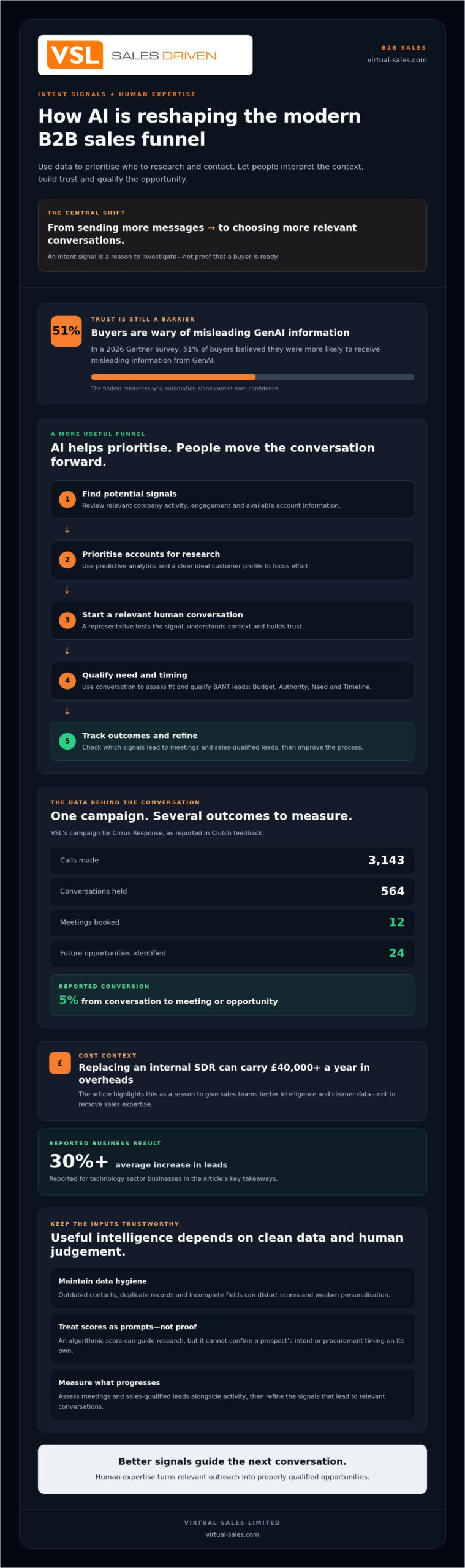
What if AI’s most valuable role in B2B sales isn’t sending more messages, but helping your team identify which prospects may be ready for a conversation? How AI Is Reshaping the Modern B2B Sales Funnel comes down to that shift: using intent signals to prioritise outreach, while experienced people build trust and qualify opportunities. A 2026 Gartner survey found that 51% of buyers believe they’re more likely to receive misleading information from GenAI. It’s a reminder that automation alone won’t earn confidence.
You may already be seeing the downside of generic automated outreach: low conversion, contacts who aren’t ready to buy and CRM records that undermine targeting. Replacing an internal SDR can also carry £40,000+ a year in overheads. The answer isn’t to remove sales expertise. It’s to give your team better intelligence and cleaner data.
In this guide, you’ll learn how to combine AI-driven intent signals with human-led conversation to build a more predictable revenue engine. We’ll cover practical ways to identify possible buying intent, improve data hygiene, qualify BANT leads and connect AI insights with a human sales team, so your outreach feels relevant and meetings have a clear commercial purpose.
Key Takeaways
- How AI Is Reshaping the Modern B2B Sales Funnel starts with using intent signals to prioritise relevant conversations, not simply increasing outreach volume.
- Learn how AI-enhanced data can help refine your ideal customer profile and focus sales effort on prospects with stronger buying signals.
- See why generic AI-written scripts and poor data hygiene can weaken targeting, and what to address before scaling automation.
- Explore a five-step approach to connecting market intelligence with consultative messaging and human-led sales expertise.
- Review the reported 30%+ average increase in leads for technology sector businesses and the campaign outcomes that help assess progress.
How AI Is Reshaping the Modern B2B Sales Funnel
An AI-reshaped B2B sales funnel uses available data and buying signals to help a team prioritise accounts, including prospects who haven’t yet made direct contact or visited the website. It shifts outreach from volume-first activity to more relevant conversations. AI can support research and prioritisation, while people interpret context, ask useful questions and build trust.
That changes the top of the funnel. Instead of treating every prospect as equally cold, your team can use credible indicators of interest to guide whom to contact and what to discuss. A signal is a reason to investigate, not proof that a buyer is ready. Human judgement keeps the first conversation grounded and prevents an algorithmic score from becoming an assumption.
The Transition from Linear to Intent-Driven Models
The “spray and pray” approach gives way to more targeted engagement. AI-powered sales intelligence can help surface potential in-market triggers, such as relevant company activity or engagement, so teams can prioritise accounts for research and outreach. Account-based marketing applies this focus to selected high-value organisations, coordinating relevant conversations across the people involved in a decision. For practical guidance on shaping your targeting, see this guide to market and competitor research.
There’s no fixed sequence that every buyer follows. A prospect may research independently, speak with colleagues, then respond to a call. How AI Is Reshaping the Modern B2B Sales Funnel is therefore less about automating every step and more about helping a human team choose the next useful action. This is closely related to guided selling, where technology supports representatives through complex sales conversations.
Key Technologies Reshaping the B2B Journey
Predictive analytics can help score and prioritise leads by assessing patterns in available data. Natural Language Processing (NLP) can analyse written or spoken language for indicators of sentiment, interest or concern. These tools can inform decisions, but they don’t replace a representative’s judgement or confirm a prospect’s intent on their own.
CRM integration connects insights with account records and activity. VSL uses a cloud-based CRM and can work with existing CRM systems, including Salesforce, so campaign information can fit into a team’s sales process. The value depends on data hygiene: outdated contacts, duplicate records and incomplete fields can distort scores and weaken personalisation. Keep records accurate, define which signals matter and review whether those signals lead to relevant conversations. AI can help organise better inputs, but it can’t make unreliable data trustworthy.
Why AI-Powered Intelligence Matters for Your Business Outcomes
AI-powered intelligence matters when it helps your team spend less time pursuing poor-fit prospects and more time on relevant conversations. Better targeting can improve cost per lead and customer acquisition cost (CAC), but the gains depend on accurate data and a clear ideal customer profile. There isn’t a universal 5% of every market that’s ready to buy now. Treat intent scores as a way to prioritise research, not proof that a prospect is in-market.
That focus can support sales pipeline growth. Representatives can direct their effort towards accounts showing stronger signals, qualify need and timing through conversation, and give sales teams a clearer view of potential opportunities. Track which signals lead to meetings and sales-qualified leads (SQLs), then use that evidence to refine the process and make it more repeatable.
Real Insight: A Software Sector Scenario
Imagine a SaaS firm that struggles to reach decision-makers in large businesses. Its team reviews public company updates and other relevant account information, then uses available intelligence to identify organisations whose stated priorities may align with its offer. That can suggest a timely reason to research and contact an account, but it doesn’t confirm a procurement window or a buyer’s readiness. A consultative conversation still needs to test the signal.
VSL’s Clutch feedback offers a campaign example. In a campaign for Cirrus Response, VSL made 3,143 calls, held 564 conversations, booked 12 meetings and identified 24 future opportunities. The reported conversion from conversation to meeting or opportunity was 5%. These figures illustrate why it’s useful to assess both activity and outcomes, rather than treating a single intent score as a result.
Achieving a Predictable Revenue Engine
A predictable revenue engine comes from a repeatable process, not a promise of perfect forecasting. AI can help organise account signals and historical pipeline information, while your team tracks how opportunities move between stages. Review forecast accuracy against actual results over time. Don’t assume any system can predict pipeline velocity with a fixed level of accuracy without evidence from your own sales data.
This discipline can reduce the “feast or famine” cycle. Use market and competitor research to check whether a signal reflects a genuine business priority, then adapt your message to the account instead of sending generic outreach. That keeps intelligence connected to practical sales decisions.
For a real-world view of appointment-setting outcomes, explore VSL’s Clutch appointment-setting reviews. Compare campaign measures such as qualified meetings, follow-up opportunities and progression through your sales pipeline to assess what is working.
Common Mistakes: Why Pure Sales Automation Often Fails
Automation can increase activity without improving the quality of your sales pipeline. Problems start when teams treat AI output as ready-to-send messaging, intent scores as confirmed buying interest, or a larger contact list as a stronger ideal customer profile. How AI Is Reshaping the Modern B2B Sales Funnel depends on connecting useful intelligence to human judgement, not removing people from the process.
The Personalisation Paradox
Adding a first name and company name doesn’t make a message relevant. A prospect can still receive a generic pitch that ignores their role, business priorities and reason for being contacted. If AI-generated copy repeats familiar phrases or makes assumptions based on weak signals, it can make your brand sound careless. The same applies to repeated, automated LinkedIn messages: more touches can create irritation rather than interest.
Use AI to help research an account and prepare a starting point, then have a person check the details and adapt the message. In a call, the representative needs to listen to the prospect, judge whether the reason for calling is relevant and adjust the conversation accordingly. A script can support consistency, but it shouldn’t override that judgement. VSL’s callers use consultative, conversational outreach based on agreed key messages rather than relying on scripts.
Automation also falls short when intent signals don’t lead to considered human follow-up. A score may suggest that an account deserves attention, but it can’t establish Budget, Authority, Need and Timeline. Ask focused questions, confirm the context and agree a useful next step before treating interest as a qualified opportunity.
The Cost of Poor Sales Targeting
AI can help your team reach the wrong people faster if your ideal customer profile is too broad or your CRM data is inaccurate. Incorrect job titles, duplicate records and outdated account details can direct outreach to people who lack influence or have no relevant need. Poor data hygiene feeds weak information into scoring and personalisation, making automated decisions less useful.
That mismatch can fill calendars with “coffee meetings” that don’t meet your commercial criteria, while senior salespeople spend time on prospects unlikely to progress. Define what makes a meeting valuable before launching a campaign. Set clear qualification standards, then review whether booked meetings become meaningful opportunities.
Lead scoring can help your team prioritise prospects against agreed criteria. Treat the score as a prompt for review, not a substitute for qualification. In complex, high-value B2B negotiations, human expertise remains essential for understanding concerns, aligning stakeholders and building confidence. Automation should make those conversations better informed, not less personal.
A Five-Step Method for AI-Powered Sales Growth
AI can help your team identify where to focus, but a repeatable sales process turns those insights into qualified conversations. This five-step approach connects data, intent and human follow-up, with clear measures to guide improvement.
- Define your ideal customer profile. Use AI-enhanced data to identify the company characteristics, roles and needs that fit your offer. Check the underlying records before relying on them, because poor data hygiene can distort your targeting.
- Build consultative messaging. Use market intelligence to shape a relevant reason for contact. Keep the message specific to the account, then have a person review it for accuracy and tone.
- Prioritise intent-based calling. Use available intent signals to decide which accounts to research and contact first. Treat signals as prompts for investigation, not confirmation that a prospect is ready to buy.
- Qualify through human-led outreach. Ask questions that establish Budget, Authority, Need and Timeline (BANT). Record the answers and agree an appropriate next step before passing a lead to sales.
- Track performance and optimise weekly. Review qualified meetings, conversion between stages, follow-up outcomes and sales pipeline progression. Use the findings to refine targeting and messaging, and assess campaign return on investment (ROI) against your objectives.
Implementing the Framework in Your Business
Start by agreeing which data belongs in your CRM, how campaign activity will be recorded and which outcomes define a qualified opportunity. VSL uses a cloud-based CRM and can work with client CRM systems such as Salesforce. A dedicated caller and Project Manager can support campaign delivery, while weekly reporting and feedback help refine targeting, messaging and follow-up with your team.
Why Experienced Callers Add Value
AI can prepare account insight, but it can’t replace a representative’s judgement in a live conversation. VSL’s callers have IT backgrounds and sales and marketing experience. They can adapt consultative, conversational discussions to a prospect’s responses, handle questions and navigate gatekeepers professionally. Before handoff, qualify leads against your agreed criteria so sales receives useful context, not just a meeting booking. Learn more about what makes a sales-qualified lead (SQL).
Measuring Success: Results and Data
Measure outcomes across the funnel, not just the number of calls or messages sent. For technology sector businesses, VSL reports an average increase in leads of 30%+. Treat this as a reported average, not a guaranteed result for every campaign. Your own performance will depend on factors such as your ideal customer profile, data quality, offer and qualification criteria.
Track how many accounts with relevant intent signals become conversations, how many conversations produce BANT-qualified meetings, and how many meetings progress to sales-qualified leads (SQLs) or opportunities. There’s no verified universal conversion rate from an intent signal to a booked BANT-qualified meeting. Establish your baseline and calculate each stage using your own campaign data. To assess cost per appointment, divide total campaign spend by the number of qualified meetings booked.
Compare that figure with the full cost of building internal capacity. An internal SDR can carry £40,000+ in annual overheads, but a fair comparison also considers management time, onboarding, data and the number and quality of opportunities generated. Review cost per lead, customer acquisition cost (CAC), meeting quality and pipeline progression together. A lower cost per appointment has limited value if meetings don’t fit your criteria or progress.
When to Deploy This Strategy
This approach can suit SMEs and enterprise firms across the UK seeking access to senior IT or Finance decision-makers, particularly when internal teams need more capacity to identify and qualify target accounts. A pilot campaign can help you test an audience, message and intent signals before deciding how to develop the process. Define your target market and qualification criteria at the outset, then assess results against those agreed parameters.
Verified Case Study Metrics
VSL’s Clutch reviews report that VSL booked an average of three new meetings per week for Mobex. A review for AI transcription platform Trint records 10 meetings booked in three months, with two progressing to later closing stages. These are outcomes from specific client campaigns, not a forecast for every business.
Strong results start with relevant targeting. Market and competitor research helps you understand account priorities and shape a credible reason to make contact. Combine that preparation with human qualification, then review campaign data regularly to see which signals and messages contribute to qualified meetings and pipeline progression.
Build a More Predictable B2B Sales Funnel
How AI Is Reshaping the Modern B2B Sales Funnel comes down to combining timely intent signals with accurate data and human-led conversations. AI can help your team prioritise accounts, but experienced sales professionals turn those signals into relevant discussions and properly qualified opportunities. A clear process, reviewed against campaign outcomes, keeps sales activity focused on pipeline quality rather than volume alone.
VSL works as an extension of your sales and marketing team, providing B2B appointment setting, lead generation and database development. Its flexible approach includes dedicated callers and Project Managers, consultative outreach and weekly reporting, so campaign activity and outcomes can be reviewed with your team.
Read client feedback on VSL’s appointment-setting work:
With the right blend of AI insight and human expertise, you can take the next step towards a more consistent, better-qualified sales pipeline.
Frequently Asked Questions
How does AI actually identify buying intent in B2B sales?
AI can help identify possible buying intent by analysing available account and engagement data for patterns that may signal relevance or interest. For example, a team might prioritise a company whose stated business priorities align with its offer. Treat these indicators as prompts for research, not confirmation that a prospect is ready to buy. A representative should verify the context through conversation before qualifying an opportunity or changing the account’s priority.
Will AI replace human SDRs and appointment setters by 2027?
There’s no reliable basis to predict that AI will replace human SDRs and appointment setters by 2027. AI can assist with research, prioritisation and administrative work, but complex B2B conversations still need people who can listen, respond to nuance and build trust. A practical approach is to use technology to inform sales activity while experienced professionals qualify prospects and handle conversations that need judgement.
What is the typical cost per appointment in the UK tech sector?
There isn’t a verified, standard UK tech-sector cost per appointment to quote here, and VSL hasn’t provided a published price. Calculate your campaign’s cost per appointment by dividing its total spend by the number of qualified meetings booked. Compare providers using the same definition of a qualified meeting, and consider meeting quality and progression as well as cost. Ask suppliers to explain what their fee covers.
How do you ensure AI-generated leads are GDPR-compliant?
AI doesn’t make a lead GDPR-compliant by itself. Before using personal data, check that you have an appropriate basis for processing, understand where the data came from and provide suitable transparency about its use. Set clear rules for data access, retention and correction, and review how automated scoring affects people. Requirements depend on your circumstances, so seek advice from a qualified data protection professional rather than relying on a tool’s settings.
Can VSL integrate with my existing Salesforce or HubSpot CRM?
VSL can work with existing CRM systems, including Salesforce, and can also use its cloud-based CRM. The team can import or export data and format CRM information to match client fields, supporting continuity with your sales process. Before a campaign starts, agree which fields, lead statuses and outcomes matter, and how updates will be shared, so your team can follow activity through the pipeline.
What is the difference between a ‘coffee meeting’ and a BANT-qualified lead?
A coffee meeting is a conversation without a defined qualification standard. A BANT-qualified lead has been assessed for Budget, Authority, Need and Timeline, giving your sales team useful context about commercial fit and readiness. BANT doesn’t guarantee a sale, but it can make handovers more focused. Agree what evidence your team needs for each BANT area, then record it consistently before passing a prospect on.
How long does it take to see results from an AI-powered sales campaign?
There’s no fixed timeframe for results from an AI-powered sales campaign. Timing depends on factors such as data quality, audience, offer, outreach approach and the time prospects need to respond. Set milestones with your provider, including when to review targeting, conversations and qualified meetings. VSL supports flexible pilot campaigns without long-term commitment, allowing you to assess progress against agreed measures before deciding how to proceed.
Why is data hygiene more important now than ever before?
Data hygiene matters because AI systems rely on the records and signals they’re given. Duplicated contacts, outdated job titles or incomplete account details can undermine prioritisation and lead to irrelevant outreach. Regularly check key fields, remove duplicates, update contact status and make sure your CRM reflects campaign outcomes. This gives both people and technology a more dependable view of each account, supporting better decisions across the sales process.

Ready for a pipeline that AI alone can’t build?
See how our AI SDR support combines intelligent automation with experienced SDRs based in the UK. You can also explore our appointment setting and lead generation services.
Get me more leadsDisclaimer
Disclaimer: Content is for general information only and does not constitute professional advice. Results may vary. Virtual Sales Limited accepts no liability for actions taken based on this content.
Tags: AI lead generation, Appointment Setting, B2B Sales, bant qualification, data hygiene, Intent Data, sales pipeline growth, Telemarketing