How to Decide Between SDRs: A Guide for UK Leaders
The most expensive outreach model isn’t necessarily the one with the highest upfront cost; it’s the one that delivers low-quality leads at high volume, wasting your closers’ time. Many UK leaders are currently trapped in a cycle of high staff turnover and inconsistent lead quality whilst trying to figure out How to Decide Between SDRs in an increasingly guarded market. It’s a common frustration to manage the significant overhead of a junior team only to see minimal ROI on the final balance sheet.
This guide serves as a practical guide for UK leaders in 2026, providing a strategic framework to evaluate your outreach options and choose the model that maximises your B2B pipeline growth. You’ll discover a clinical approach to lead generation that prioritises professional maturity and consultative conversations over raw call volume. We will preview the VSL 5-step method for evaluating effectiveness, explore benchmark ROI data, and reveal common insights from 25 years in the field. By the end of this article, you’ll have a clear roadmap to lower your cost-per-acquisition and secure a predictable flow of BANT-qualified meetings.
Key Takeaways
- Understand why transitioning to a consultative SDR model is essential for protecting your B2B revenue targets in 2026.
- Discover How to Decide Between SDRs by applying a strategic 5-step framework that balances internal capacity with market opportunity.
- Identify the critical difference between high-volume “smile-and-dial” metrics and high-value, BANT-qualified sales meetings.
- Learn how to avoid common pitfalls like high staff turnover and low-quality leads by prioritising professional maturity and technical expertise.
- Explore how seamless CRM integration and risk-free pilot campaigns can create a predictable, scalable sales pipeline for your business.
Defining the SDR Role: Why Your Choice Impacts 2026 Revenue
A Sales Development Representative (SDR) is a specialist focused exclusively on top-of-funnel pipeline construction. They aren’t just callers; they’re the architects of your sales momentum. In the context of modern corporate commerce, an SDR identifies, connects with, and qualifies potential prospects before passing them to Account Executives (AEs). It’s a role designed to ensure your closers spend every minute of their day in high-value conversations rather than cold prospecting. To be clear, we are discussing the strategic sales function, not the financial Special Drawing Rights issued by the IMF. Clearing this distinction is the first step in understanding How to Decide Between SDRs who can actually move the needle for your business.
The landscape for 2026 has shifted dramatically. Buyers are more guarded and sophisticated than ever. The old “smile-and-dial” approach, characterised by junior staff reading rigid scripts, no longer produces results. Modern SDRs must be consultative. They need to act as business development partners who understand complex buying cycles and technical pain points. This professional maturity is what separates a junior appointment setter from an elite partner who can navigate a C-suite conversation with confidence. For businesses that need to secure this level of leadership for their own internal teams, Persel Group provides specialised executive search for board and C-suite innovators. This shift ensures the role remains anchored as a critical driver within the B2B sales cycle.
SDR vs BDR: Clearing the Confusion for Sales Leaders
Many organisations use these terms interchangeably, but a subtle distinction exists. Traditionally, SDRs focus on qualifying inbound leads whilst Business Development Representatives (BDRs) focus on outbound prospecting. However, the most effective modern models integrate both functions. At VSL, we provide a holistic B2B lead generation service that combines inbound precision with proactive outbound reach. The specific title matters less than the ability to deliver BANT-qualified meetings. Whether you need inbound filtering or outbound hunting, the goal is a seamless transition of intelligence into your cloud-based CRM, whether that’s HubSpot or Salesforce.
When to Use This: Identifying Your Pipeline Gaps
You need to evaluate your current SDR model if your AEs are wasting more than 20% of their week on prospecting. This is a common drain on revenue. Other signs include a high volume of “coffee meetings” that fail to meet BANT criteria or a data cleansing process that is so inefficient it hinders outreach. If your lead quality is inconsistent, it’s time to reconsider How to Decide Between SDRs to fix these structural issues. A mature SDR function solves these gaps by providing a predictable, high-standard output that respects your team’s time and your brand’s reputation.
The VSL Framework: 5 Steps to Decide Between SDR Models
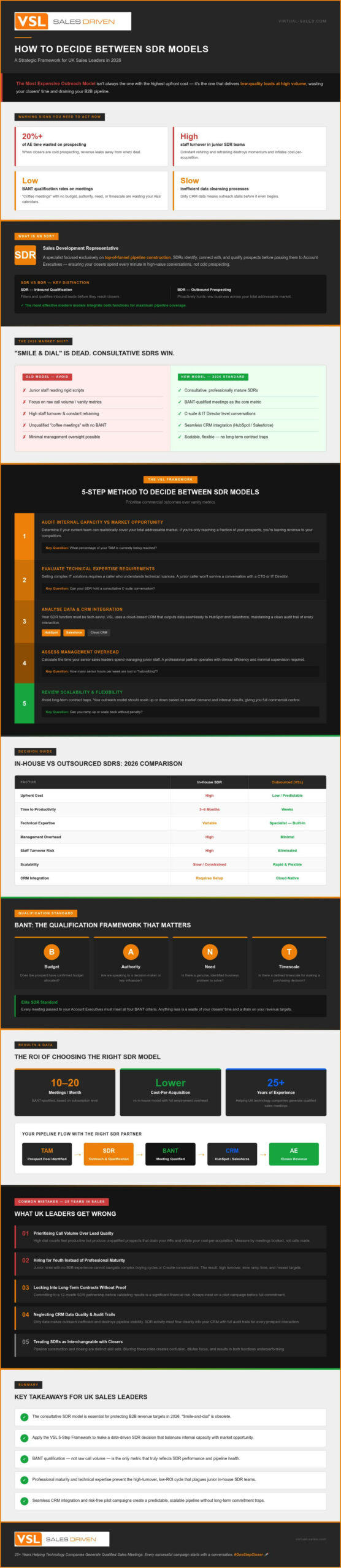
To build a resilient pipeline, you need a repeatable evaluation process. We developed the VSL 5-Step Method to help UK leaders navigate How to Decide Between SDRs without the guesswork. This framework prioritises commercial outcomes over vanity metrics, ensuring your choice aligns with your long-term growth strategy.
- Step 1: Audit Internal Capacity vs Market Opportunity. Determine if your current team can realistically cover your total addressable market. If you’re only reaching a fraction of your prospects, you’re leaving revenue to your competitors.
- Step 2: Evaluate Technical Expertise Requirements. Selling complex IT solutions requires a caller who understands the technical nuances. A junior caller won’t survive a conversation with a CTO or IT Director.
- Step 3: Analyse Data and CRM Integration. Your SDR function must be tech-savvy. VSL uses a cloud-based CRM that outputs data seamlessly to platforms like HubSpot and Salesforce, maintaining a clean audit trail.
- Step 4: Assess Management Overhead. Calculate the time your senior sales leaders spend “babysitting” junior staff. A professional partner should operate with clinical efficiency and minimal supervision.
- Step 5: Review Scalability and Flexibility. Avoid the trap of long-term contracts. Your outreach model should scale up or down based on market demand and internal results.
By following these steps, you can move away from emotional hiring decisions and towards a data-driven partnership. This structured approach is essential when considering How to Decide Between SDRs in a competitive B2B environment.
In-house vs Outsourced SDRs: The 2026 Comparison
Hiring internally involves significant costs beyond the basic salary. You must account for National Insurance, pension contributions, and the expensive tech stack required for modern prospecting. A flexible VSL subscription removes these hidden overheads whilst providing immediate access to a mature workforce. Internal junior roles often suffer from high turnover, which disrupts your pipeline momentum. VSL maintains high staff retention rates, ensuring your campaign benefits from consistent, seasoned expertise rather than a revolving door of trainees. This “speed to lead” advantage is amplified by our existing IT databases, allowing us to launch campaigns faster than an internal hire could be onboarded.
Evaluating Methodology: Consultative vs Scripted Outreach
Scripted outreach is largely ineffective in the complex IT and SaaS sectors. Senior decision-makers value their time; they’ll terminate a call the moment they sense a rigid script. You need ‘best-of-breed’ professionals who understand industry hierarchies and can handle complex objections in real-time. A consultative approach builds genuine rapport and uncovers deeper BANT criteria that a script simply cannot capture. When testing a potential partner, evaluate their ability to pivot the conversation based on prospect feedback. This level of human-led expertise is why many firms rely on verified UK appointment setters to represent their brand with authority.
Results and Data: The ROI of Choosing the Right SDR
Measuring the effectiveness of your sales function requires more than just counting dials. When you’re evaluating How to Decide Between SDRs, the primary metric must be sales velocity. Gartner research suggests that organisations using specialised lead generation functions see a marked improvement in pipeline movement because their closers aren’t bogged down by low-intent leads. Professional SDR campaigns in the technology sector should aim for high conversion rates from initial contact to qualified meeting, rather than simply chasing volume. Quality always trumps quantity when the goal is revenue, not just activity.
Our presence on Clutch for UK appointment setting highlights the importance of third-party verification. It’s not enough to claim results; you must demonstrate a consistent track record of delivering BANT-qualified opportunities. This data-driven approach ensures that every pound spent on outreach contributes directly to your bottom line. Clinical efficiency in lead qualification reduces the waste typically associated with junior, unmanaged teams.
The Cost of a Qualified Meeting in 2026
Depending on your chosen subscription level, you should expect a range of 10–20 high-quality meetings per month. Calculating the ROI of this model is straightforward. For many technology firms, the lifetime value of a single enterprise software deal can exceed £50,000. Closing just one of these deals often covers the entire annual cost of an outsourced SDR partnership. This makes the decision-making process less about cost and more about the potential pipeline value generated per campaign. When you look at the numbers, a mature, professional team pays for itself by securing the high-value contracts that junior callers often miss.
Data Integrity and CRM Output
Data is the lifeblood of a modern sales operation. VSL uses a bespoke cloud-based CRM to maintain tighter control over lead quality and prospect history. This system isn’t a silo; it allows for the seamless export of data directly into your existing tech stack, including popular platforms like Salesforce and HubSpot. We prioritise transparency through weekly reporting and 360-degree feedback loops. This ensures that your internal team always has a clinical view of the outreach progress and can adjust strategies based on real-world market responses. Knowing your data is secure and integrated is a vital factor in How to Decide Between SDRs for your long-term growth.
Common Mistakes and Real Insights from 25 Years in Sales
Volume is a vanity metric. The most significant mistake we’ve seen over the last quarter-century is leaders hiring for “smile-and-dial” activity rather than commercial outcomes. When evaluating How to Decide Between SDRs, many firms fixate on the number of calls made per day. This approach is fundamentally flawed in complex B2B markets. High-frequency, low-quality outreach poisons your total addressable market and damages your brand reputation before a genuine conversation can even begin. You don’t need more calls; you need better conversations.
Desperation is another silent killer of pipeline health. Commission-only models often lead to poor brand representation because the caller is incentivised to push for any meeting, regardless of fit. This results in “coffee meetings” that fail to meet basic BANT criteria, wasting your Account Executives’ time and demoralising your sales team. Before launching any activity, you must also prioritise data cleansing. Outreach based on stale or inaccurate data is a direct drain on your ROI and outreach efficiency.
Real Insight: Scaling a Fintech SaaS Pipeline
We recently partnered with a Fintech firm that was struggling with an internal junior team. They were making over 500 low-quality calls a week but failing to secure any meaningful traction with enterprise-level decision-makers. After switching to VSL, we shifted the focus from raw volume to strategic, consultative outreach. By refining their value proposition through a dedicated Project Manager, we delivered 15 high-quality, BANT-qualified enterprise meetings in the first month. This transition proved that professional maturity and a clinical approach to qualification outperform junior persistence every time.
The ‘Hidden’ Costs of In-house SDR Management
The true cost of an internal team is often obscured by basic salary figures. Sales Directors frequently spend 10–15 hours a week training and managing junior staff instead of focusing on high-level strategy or closing deals. When you factor in recruitment fees, National Insurance, and the cost of vacant desks during inevitable staff turnover, the financial burden scales rapidly. Contrast this with the “plug-and-play” nature of outsourced appointment setting. A professional partner removes the management overhead and provides immediate access to a seasoned workforce, allowing your internal leaders to focus on revenue-generating activities rather than basic operational training. Understanding these hidden drains is essential when considering How to Decide Between SDRs for your 2026 growth plan.
Implementing Your SDR Strategy with Virtual Sales Limited
Transitioning to a high-performance model shouldn’t feel like a leap of faith. Our Pilot Campaign is designed for leaders navigating How to Decide Between SDRs, offering a low-risk entry point without long-term contractual obligations. This initial phase proves our ability to deliver BANT-qualified results before you scale. We focus on clinical efficiency, ensuring that every opportunity we pass to your team is primed for conversion.
Our onboarding process is fast and precise. We refine your messaging and assign a dedicated caller with a technical background who functions as an integrated part of your own team. This ensures every interaction is grounded in professional maturity and technical accuracy. By the time we launch, your VSL representative is a proactive insider who understands your value proposition as well as your internal staff do.
Integrating AI-Powered Insights with Human Expertise
We utilise advanced technology to identify high-intent signals across the market. This AI-driven approach identifies the most promising prospects, whilst our mature human callers handle the nuanced C-suite engagement. Human-led telemarketing remains the most effective way to bypass gatekeepers and secure high-value meetings. This synergy between data-driven insights and human intelligence ensures your outreach is both targeted and personable.
Scale your pipeline with AI-powered insights combined with elite UK appointment setters.
Experience a clinical approach to lead generation that identifies intent and converts it into revenue. Our UK-based professionals use AI to find the right targets, ensuring your sales team only speaks with qualified decision-makers.
Discover our AI-powered SDR services here.
#AI #B2BLeadGeneration #SalesOutsourcing
Next Steps: Moving Your Sales Pipeline Forward
Every successful campaign starts with a conversation about your specific pipeline gaps. Book a strategic consultation to audit your current strategy and see how our consultative model can lower your cost-per-acquisition. Review our latest case studies for sector-specific proof of how we’ve scaled pipelines for other technology leaders. We’re ready to help you build a predictable, high-performing sales engine that delivers consistent results.
Securing Your B2B Pipeline Growth for 2026
Building a scalable sales engine requires a shift from chasing raw activity to securing high-value, BANT-qualified opportunities. You’ve seen how professional maturity and technical expertise outperform junior persistence every time. By applying the VSL 5-step framework, the process of How to Decide Between SDRs becomes a data-driven exercise rather than a hiring gamble. It’s about matching your market’s complexity with a team that functions as an elite, integrated component of your own workforce.
With over 25 years of experience as specialists in the IT and software sectors, VSL provides a clinical approach to lead generation that prioritises your ROI. We eliminate the risks typically associated with outsourcing by offering a BANT-qualified guarantee and no long-term contracts. This flexibility ensures your outreach remains agile whilst maintaining the highest standards of brand representation. It’s time to stop managing the overhead of junior teams and start focusing on the deals that drive your revenue forward.
Your next enterprise deal is waiting for the right conversation. We look forward to helping you build a predictable, high-performing pipeline that accelerates your commercial success.
Frequently Asked Questions
What is the difference between an SDR and a BDR in 2026?
SDRs typically focus on qualifying inbound leads whilst BDRs handle proactive outbound prospecting. By 2026, most elite teams have integrated these functions to create a hybrid model that covers the entire top-of-funnel pipeline. The specific title is less important than the representative’s ability to engage senior decision-makers and secure BANT-qualified opportunities for your closers.
How much does it cost to outsource SDR services in the UK?
Outsourcing costs vary based on the scale of your campaign and the level of expertise required. It’s generally more cost-effective than internal hiring because you remove the burden of National Insurance, recruitment fees, and expensive tech stacks. Most leaders find that closing just one or two enterprise deals covers the annual cost of a professional SDR subscription.
Can an outsourced SDR team understand my complex technical product?
Specialist agencies like VSL employ mature callers with specific IT backgrounds to ensure they can navigate technical conversations. We don’t use rigid scripts; instead, we apply a consultative approach to handle C-suite objections in real-time. This level of professional maturity is a critical factor in How to Decide Between SDRs for the technology and SaaS sectors.
What metrics should I use to evaluate an SDR provider?
Prioritise sales velocity and the quality of meetings over raw call volume or vanity metrics. You should track the conversion rate from initial contact to a BANT-qualified meeting to ensure your pipeline is healthy. High-quality providers focus on the commercial value of the opportunities they generate rather than simply hitting a daily dial quota.
Is it better to hire a junior SDR or use an experienced agency?
Experienced agencies offer immediate access to a seasoned workforce and remove the management overhead of training junior staff. Internal junior roles often suffer from high turnover, which disrupts your sales momentum and increases recruitment costs. Using a partner provides a “plug-and-play” solution with high staff retention and established IT databases.
How do VSL SDRs integrate with my existing Salesforce or HubSpot CRM?
Our team uses a bespoke cloud-based CRM designed to output data seamlessly into your existing tech stack. This ensures that every lead and interaction is recorded with a clean audit trail for your Account Executives. It allows your internal team to pick up the conversation immediately with all the necessary context from the qualification phase.
What is a BANT-qualified lead and why does it matter?
BANT stands for Budget, Authority, Need, and Timeline; it ensures that a lead has a genuine intent to purchase. Using these criteria prevents your sales team from wasting time on low-value “coffee meetings” that don’t result in revenue. It’s the most effective way to maintain a high-standard output and a predictable flow of sales opportunities.
How quickly can an outsourced SDR campaign start delivering results?
Most professional campaigns begin delivering qualified meetings within the first month of activity. Our onboarding process is designed for speed, allowing us to refine your messaging and assign a dedicated caller rapidly. This accelerated “speed to lead” is a vital consideration when evaluating How to Decide Between SDRs for your 2026 growth targets.

Ready for a pipeline that AI alone can’t build?
See how our AI sales development combines intelligent automation with experienced SDRs based in the UK. You can also explore our appointment setting and lead generation services.
Get me more leadsDisclaimer
Disclaimer: Content is for general information only and does not constitute professional advice. Results may vary. Virtual Sales Limited accepts no liability for actions taken based on this content.
Tags: Appointment Setting, B2B Lead Generation, BANT qualified leads, consultative selling, lead quality, Outbound Sales, Sales Outsourcing, Sales Pipeline, SDR strategy, UK sales leaders