Sales Pitch Examples: A Practical Guide for B2B Sales Leaders in 2026
In the competitive B2B landscape of 2026, a generic sales pitch is the fastest route to a stagnant pipeline. Decision-makers in the IT and software sectors are more informed and time-poor than ever, meaning the first few seconds of any interaction are critical. For ambitious sales leaders, mastering the art of the pitch is not just a skill—it is a strategic necessity for survival and growth.
This guide moves beyond outdated scripts to provide practical, high-conversion sales pitch examples and a proven framework for developing, testing, and optimising your outreach. We will explore how to structure a pitch that secures meetings with high-level decision-makers, articulates complex value propositions, and transforms your lead generation efforts into a predictable source of revenue.
The Stagnant Pipeline: Why Generic Pitching Fails in 2026
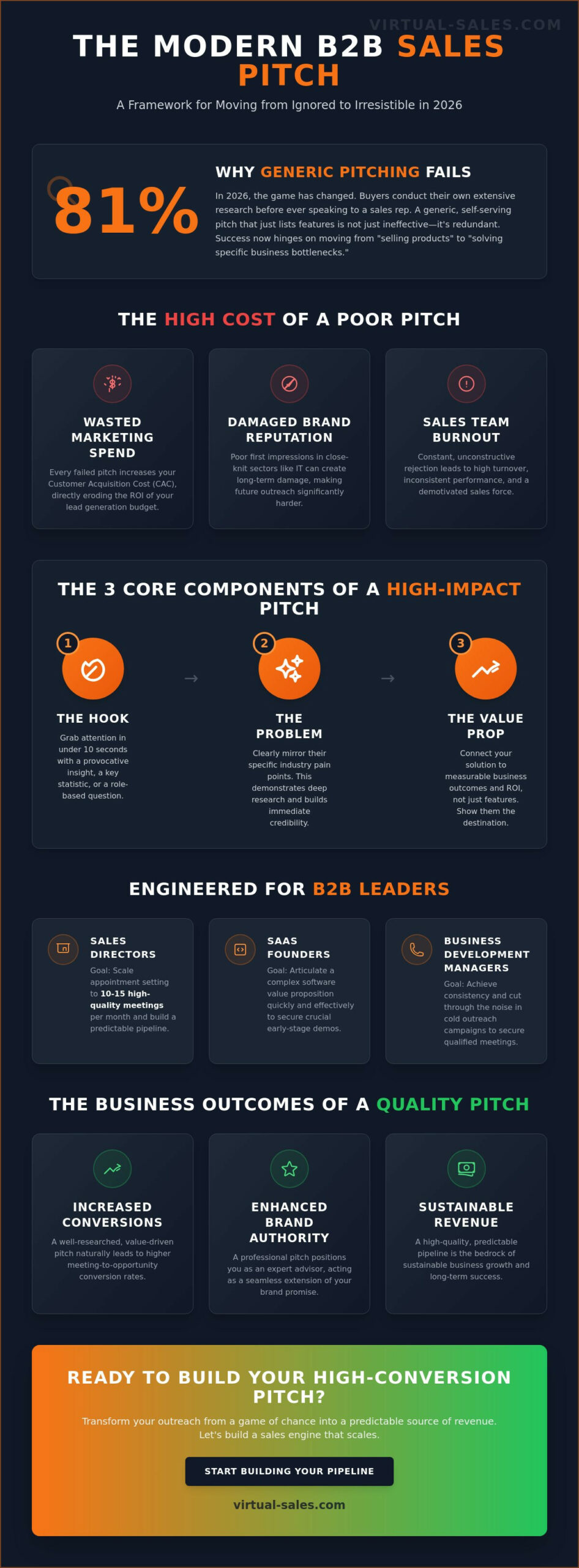
The core problem is simple: the vast majority of B2B pitches are ignored because they are self-serving, un-researched, and fail to connect with the prospect’s immediate business challenges. In an era where 81% of buyers conduct their own research before ever speaking to a sales representative, a pitch that merely lists features is redundant. This guide is specifically designed for sales leaders in IT, SaaS, and technology who understand that success now hinges on moving from “selling products” to “solving business bottlenecks” as a strategic partner.
The High Cost of an Ineffective Pitch
A poorly constructed pitch has consequences that extend far beyond a single lost opportunity. The financial and reputational costs can be significant:
According to sales presentation, this is a well-documented area of ongoing research and practical application.
- Wasted Marketing Spend: Every failed call or deleted email increases your customer acquisition cost (CAC), eroding the ROI of your lead generation budget.
- Damaged Brand Reputation: In the close-knit IT sector, poor first impressions can quickly damage your long-term reputation, making future outreach efforts even more difficult.
- Sales Team Burnout: Constant, unconstructive rejection takes a psychological toll on even the most resilient sales teams, leading to high turnover and inconsistent performance.
Who This Guide Is Specifically For
This practical guide is engineered for B2B leaders who are responsible for driving pipeline growth and need a scalable, professional approach. You will find it particularly valuable if you are a:
- Sales Director looking to scale b2b appointment setting results and build a predictable pipeline.
- SaaS Founder needing to articulate a complex software value proposition quickly and effectively to secure crucial early-stage demos.
- Business Development Manager struggling to achieve consistency and cut through the noise in cold outreach campaigns.
Defining the Modern B2B Sales Pitch and Its Strategic Value
In 2026, a B2B sales pitch is best defined as a concise, compelling, and personalised conversation-starter designed to secure a qualified meeting, not to close a deal on the spot. It is the strategic bridge between initial outreach and a deeper discovery call. It’s crucial to distinguish between an elevator pitch (a 30-second summary), a phone pitch (a 2-minute engagement tool), and a full presentation (a detailed solution walkthrough). A structured pitch is the foundational element of any successful b2b lead generation strategy, setting the tone for the entire sales cycle.
Core Components of a 2026 Sales Pitch
A high-impact pitch, particularly one delivered via telemarketing, is built on three non-negotiable components:
Research published by sales pitch examples that work shows that this is a well-documented area of ongoing research and practical application.
- The Hook: Grab the prospect’s attention in under 10 seconds with a provocative insight, a relevant statistic, or a question that directly addresses their likely role-based challenges.
- The Problem: Clearly and concisely mirror the specific industry pain points your prospect is facing. This demonstrates research and empathy.
- The Value Proposition: Explain how your solution creates measurable business outcomes and ROI, not just what it does. Connect your service to their strategic objectives.
Why Pitch Quality Dictates Growth
Investing time in refining your pitch is one of the highest-leverage activities a sales leader can undertake. The business outcomes are direct and measurable:
- Increased Conversions: A well-qualified pitch naturally leads to higher meeting-to-opportunity conversion rates.
- Enhanced Brand Authority: When delivered professionally, your pitch acts as a seamless extension of your brand, positioning you as an expert advisor.
- Sustainable Revenue: A predictable, high-quality pipeline driven by a consistent pitching methodology is the bedrock of sustainable business growth.
5 High-Conversion Sales Pitch Examples for B2B Outreach
Generic scripts are ineffective. The best approach is to use proven frameworks that can be adapted to your specific audience and value proposition. Here are four powerful examples, followed by a real-world scenario.
- The “Insight-Led” Pitch: Start with a compelling, non-obvious piece of data or an insight relevant to the prospect’s industry. Example: “Recent Gartner research shows CTOs in your sector are overspending on cloud storage by an average of 18%. I’m calling because we’ve helped similar firms reclaim that budget…”
- The “Competitor-Pivot” Pitch: Acknowledge a known competitor or incumbent solution and pivot to the specific gap your solution fills. Example: “Many finance directors we speak to use X for their reporting, but they often tell us it struggles with real-time data integration. We specialise in solving that specific bottleneck…”
- The “Referral-Lite” Pitch: Leverage social proof from a similar company or a shared connection to build instant credibility. Example: “I was just speaking with Jane at [Similar Company], and she mentioned you might also be grappling with scaling your cybersecurity protocols…”
- The “Direct-Value” Pitch: Forgo the extensive build-up and focus on a single, high-impact business outcome. Example: “My reason for calling is simple: we help SaaS companies like yours reduce customer churn by up to 15% in the first six months. Is improving retention a priority for you right now?”
Real Insight: The Software Appointment Setting Scenario
The fifth and most powerful example is the personalised, multi-touch approach. Here’s how a VSL professional secured a meeting for a new cybersecurity tool with a CTO:
- Scenario: Pitching a new AI-driven threat detection platform to a Chief Technology Officer at a mid-sized financial services firm.
- The Hook: “Hi [CTO Name], my name is [Caller Name] from [Client Name]. I’m calling because our research shows that financial firms using your current stack are often vulnerable to [Specific, new type of cyber-attack]. I have an insight on how to close that gap in under 10 minutes. Is now a bad time?”
- Result: This highly specific, insight-driven hook bypassed the usual “we’re not interested” response. It demonstrated research and an understanding of their technical environment, positioning the caller as a peer. This personalised approach led to a 15% increase in booked demos compared to the client’s previous, more generic outreach efforts.
Adapting Examples for Your Niche
These frameworks are starting points. True success in lead generation for technology companies requires careful adaptation. Tonality and delivery are paramount; our focus on “human intelligence” in telemarketing ensures the pitch sounds like a natural, unscripted conversation. This quality-over-quantity approach consistently outperforms high-volume, generic robocalling by building genuine rapport from the first sentence.
Avoiding Pitfalls: Common Mistakes and the VSL Framework
Even with great examples, it’s easy to make mistakes that derail an outreach campaign. The most frequent errors we see include “Me-Monster” pitching (talking only about yourself), using too much jargon, and failing to have a clear, singular call-to-action (CTA). The biggest danger is over-scripting, which destroys the authentic human-to-human connection required to engage a senior B2B decision-maker.
The VSL Framework for Pitch Mastery
To ensure consistency and drive results, we developed a proven 5-step method for outreach excellence. This framework provides the structure needed to build, test, and refine pitches for any B2B campaign.
- Step 1: Define ICP & Personas: Go beyond firmographics to identify exactly who experiences the problem you solve and what their specific business drivers are.
- Step 2: Build Messaging Matrix: Craft a series of bespoke hooks, value propositions, and objection handlers tailored to each persona based on industry triggers.
- Step 3: Test Outreach in Sprints: Run disciplined pilot campaigns with small data samples to gauge prospect resonance and gather initial feedback.
- Step 4: Track KPIs & Objections: Use our cloud-based CRM to monitor conversion rates, call outcomes, and common objection patterns in real-time.
- Step 5: Optimise Weekly: Hold weekly performance reviews to analyse the data and refine the pitch based on what the market is actually telling you.
Common Mistakes to Audit Today
Review your current outreach process against these common pitfalls. Are your teams:
- Pitching features instead of business outcomes? (e.g., “Our software has an AI engine” vs. “Our software reduces manual data entry by 40 hours per month.”)
- Failing to prepare for the “I’m too busy” objection? (A great response is: “I understand, that’s precisely why I called. I can show you how to get 5 hours back in your week in a 15-minute call.”)
- Neglecting the follow-up? The initial pitch is just the start. A structured follow-up process is essential for setting appointments and nurturing long-term interest.
Measuring Success: Key Sales Metrics and Scaling Your Pipeline
A world-class sales pitch is only valuable if its performance can be measured. Using data to validate your approach is essential for justifying ROI and making informed decisions about scaling your campaigns. At VSL, we focus relentlessly on the metrics that matter most to our clients: qualified appointments that convert into a real sales pipeline. The quality of your pitch has a direct, measurable impact on the length of your sales cycle and your overall cost of sale.
Data Metrics: What Does a Successful Pitch Achieve?
Based on our extensive campaign data, here are the benchmarks a well-executed B2B outreach strategy should aim for:
- Conversion Ranges: In specialised IT and SaaS niches, a strong pitch should achieve a 10–20% lead-to-appointment conversion rate from conversations with decision-makers.
- Volume Benchmarks: A focused campaign can scale to generate 10–15 high-quality, qualified meetings per month, per agent.
- Reference: You can see our verified performance metrics and client reviews on our case studies page and official Clutch profile.
Conclusion and Next Steps
To succeed in 2026, the B2B sales pitch must evolve. It needs to be personalised, insight-driven, and relentlessly focused on the prospect’s business outcomes. It is a strategic tool for starting valuable conversations, not a monologue for closing deals.
Developing and executing this level of sophisticated outreach requires specialist skills, time, and resources that many in-house teams lack. Partnering with a professional agency can provide the expertise and execution power needed to build a scalable pipeline. If you are ready to implement a professional b2b telemarketing strategy that delivers predictable results, we can help.
To learn how VSL’s expert appointment setters can accelerate your sales pipeline, book a no-obligation consultation today.

Disclaimer
Disclaimer: Content is for general information only and does not constitute professional advice. Results may vary. Virtual Sales Limited accepts no liability for actions taken based on this content.
Tags: B2B Sales, Lead generation, Sales Frameworks, Sales Leadership, Sales Messaging, Sales Pitch, Sales Strategy, VSL Framework