Telemarketing vs Lead Generation: The 2026 Strategic Guide for B2B Sales Leaders
What if the reason your sales pipeline stalled isn’t your team’s closing ability, but a fundamental misunderstanding of telemarketing vs lead generation? Many B2B sales leaders feel the burn of paying for high-volume outreach only to find their calendar filled with low-intent prospects who waste time. At VSL, we see ambitious businesses struggle to scale because they treat these two distinct functions as interchangeable. You likely agree that a busy phone line doesn’t always equate to a healthy bottom line, especially when research indicates that 79% of leads never convert due to a lack of strategic nurturing.
This guide promises to clarify the structural differences you need to master to build a high-performance sales pipeline in 2026. We’ll preview the shift toward an integrated “Digital Telesales” approach, backed by Gartner research showing that B2B companies now allocate up to 9.1% of revenue to marketing to combat lengthening sales cycles. You’ll learn how VSL integrates directly with your HubSpot or Salesforce CRM to transform raw data into qualified appointments. We’ll move from high-level strategy to the tactical execution required to navigate 2026’s complex regulatory environment and the self-directed buyer journeys that now define the modern enterprise landscape.
Key Takeaways
- Identify the core structural differences between tactical calling and strategic pipeline building to eliminate low-quality leads from your sales cycle.
- Navigate the telemarketing vs lead generation landscape to choose the right balance of volume and value for your specific 2026 growth objectives.
- Apply a proven 5-step framework that prioritizes data cleansing and ICP mapping to ensure your outreach reaches the right stakeholders every time.
- Benchmark your performance against industry data, targeting a 15–25% increase in conversion rates by integrating voice and digital channels.
- Understand why outsourcing your appointment setting provides a more scalable, cost-effective solution than building a complex internal team from scratch.
Defining the Divide: Telemarketing vs Lead Generation in 2026
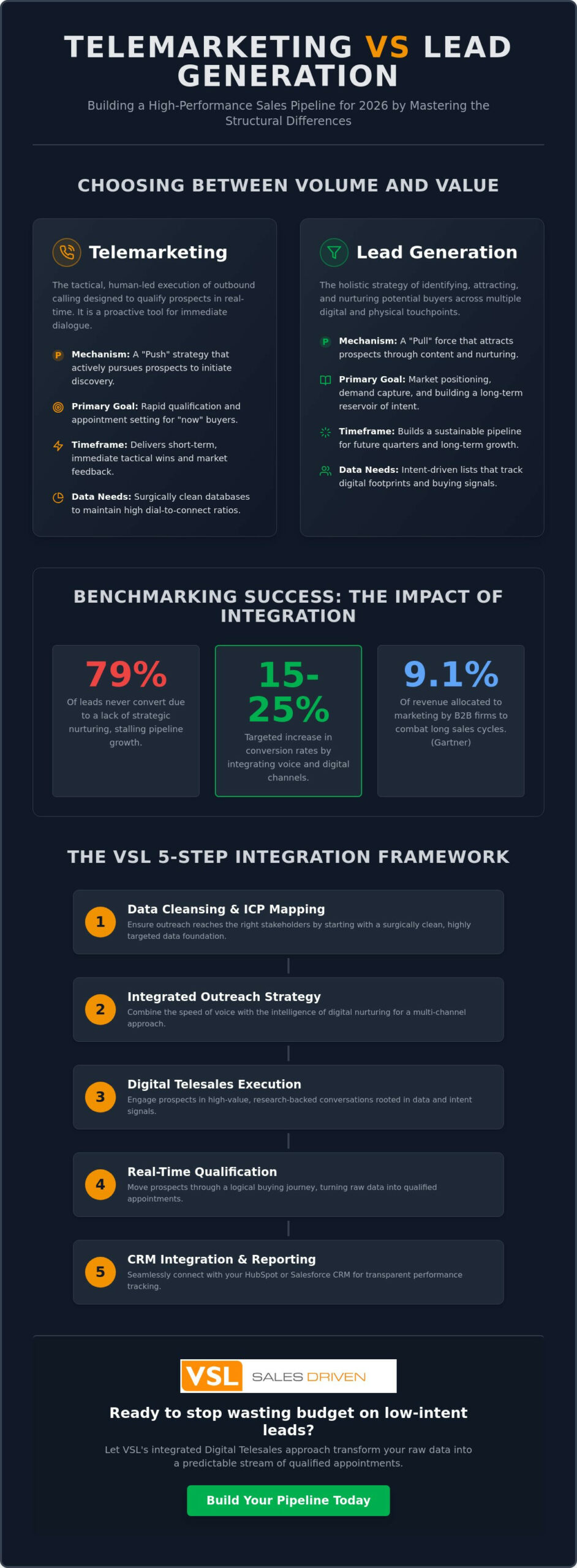
B2B sales leaders often conflate tactical outreach with strategic pipeline development. This confusion creates a friction point that stalls growth and leads to frustratingly low conversion rates. To scale effectively in 2026, you must understand the structural nuances of telemarketing vs lead generation. Telemarketing is the direct, human-led execution of outbound calling designed to qualify prospects in real time. It is a proactive tool used to initiate immediate dialogue. Conversely, a neutral definition of what is lead generation identifies it as the holistic strategy of identifying, attracting, and nurturing potential buyers across multiple digital and physical touchpoints.
Integrating these two functions is the only way to secure maximum ROI in the current fiscal year. While telemarketing provides the immediate pulse of the market, lead generation builds the long-term reservoir of intent. VSL bridges this gap by treating outreach not as an isolated task, but as a clinical component of your broader commercial engine. You don’t just need more calls; you need a structured approach that moves prospects through a logical buying journey.
The Evolution of Digital Telesales
Traditional “cold calling” has been replaced by a more sophisticated model known as digital telesales. This shift moves away from volume-based dialing and toward high-value, research-backed conversations. Modern outreach relies on cloud-based CRMs like Salesforce and HubSpot to track intent signals before a single number is dialed. By the time a VSL professional connects with a prospect, the engagement is rooted in data. This ensures every dial contributes to a verifiable B2B sales pipeline rather than just inflating call logs with dead-end conversations.
Why the Distinction Matters for Your Budget
Mislabeling these services leads to misallocated £ investment. If you fund a telemarketing campaign expecting a full-funnel lead generation result, you’ll see short-term tactical wins but a stagnant long-term pipeline. Telemarketing excels at rapid qualification and appointment setting. Lead generation excels at market positioning and demand capture. Both are essential, but they serve different masters within your P&L.
The 2026 standard is “Integrated Outreach.” This approach uses the tactical speed of voice engagement to validate the strategic assumptions of your lead generation framework. By separating these budgets, you can measure the specific CAC (Customer Acquisition Cost) for each channel. This clarity allows you to scale what works and cut what doesn’t with clinical efficiency. Stop letting semantic confusion drain your marketing budget. Distinguish the engine from the architecture to build a sales machine that actually delivers.
Structural Differences: Choosing Between Volume and Value
The structural differences between telemarketing vs lead generation dictate the velocity and health of your commercial engine. Telemarketing operates as a “push” mechanism. It actively pursues the prospect to initiate immediate discovery. Strategic lead generation acts as a “pull” force. It attracts prospects through targeted content and multi-channel nurturing. This distinction fundamentally alters the sales cycle. While telemarketing accelerates the identification of “now” buyers, lead generation builds a sustainable reservoir for future quarters. You need both, but you must deploy them for different objectives.
Data requirements differ significantly between these models. Telemarketing demands surgically clean databases to maintain high dial-to-connect ratios. Lead generation relies on intent-driven lists that track digital footprints before outreach begins. Some leaders worry that direct outreach is too intrusive. However, in 2026, intrusion is a symptom of poor targeting. When you adhere to strict telemarketing regulations and use intent signals, the call becomes a timely solution rather than an interruption. Check our verified UK performance metrics to see how professional outreach maintains brand integrity while driving results.
Telemarketing: The Tactical Precision Tool
Telemarketing excels at live qualification and immediate feedback loops. It is the most efficient way to handle event recruitment, database cleansing, and rapid appointment setting. Success in telemarketing is the conversion of raw data into a human conversation. This tactical tool provides an immediate pulse on market sentiment that digital-only channels cannot match. VSL professionals use cloud-based CRMs to ensure every live qualification is logged with clinical precision, giving your sales team the exact context they need to close deals without wasting time on administrative digging.
Lead Generation: The Strategic Pipeline Engine
Strategic lead generation serves as the long-term engine for your b2b sales strategy. It focuses on multi-channel positioning, which is critical for high-value contracts and complex SaaS environments. For example, lead generation for technology companies requires a longer nurturing phase to educate buying committees that now average 11.2 stakeholders for deals over £50,000. This approach ensures your brand remains top-of-mind during the 67% of the buyer journey that happens online before a salesperson is ever contacted.
- Telemarketing: Best for high-velocity qualification and immediate sales opportunities.
- Lead Generation: Best for brand positioning and nurturing long-term enterprise relationships.
- Combined Approach: Uses digital signals to trigger the right human conversation at the perfect time.
By understanding these structural divides, you can allocate your budget with greater confidence. Don’t force a tactical tool to do a strategic job. Instead, integrate them to create a seamless transition from initial interest to a booked meeting in your calendar.
The VSL 5-Step Integration Framework for 2026
Mastering the balance of telemarketing vs lead generation requires more than just hiring callers; it demands a structured architecture. VSL has developed a clinical 5-step framework designed to turn cold data into warm, qualified opportunities. This process ensures your outreach remains compliant while maximizing the efficiency of your internal sales team. Success in 2026 is reserved for leaders who move beyond “spray and pray” tactics and embrace a data-led, integrated methodology.
- Step 1: Data Audit & Cleansing. Every campaign begins with a rigorous scrub of your target list. We cross-reference data against the National Do Not Call Registry every 31 days to mitigate the risk of fines that can reach £50,000 per violation. Clean data is the foundation of high-performance outreach.
- Step 2: ICP Mapping. We define your Ideal Customer Profile with surgical precision. Given that modern buying committees now average 11.2 stakeholders, we map every relevant persona within your target accounts to ensure our messaging resonates across the entire decision-making unit.
- Step 3: Multi-Touch Orchestration. Relying on a single channel is a recipe for failure. We align email, LinkedIn outreach, and phone cadences to create a surround-sound effect. Since LinkedIn accounts for 80% of B2B social media leads, it serves as a critical touchpoint in our sequence.
- Step 4: Human-Led Qualification. We deploy mature, UK-based sales professionals to handle complex B2B objections. This isn’t script-reading; it’s a peer-to-peer conversation designed to uncover pain points and verify budget, authority, and timeline.
- Step 5: CRM Integration. We automate the hand-off process by integrating directly with your HubSpot or Salesforce instance. This ensures your sales team receives lead data in real time, complete with call recordings and discovery notes, for a seamless transition to the closing phase.
Applying the Framework to Software and IT
The IT and SaaS sectors demand a higher level of professional maturity. Technical buyers see through generic scripts instantly. This framework allows us to scale b2b appointment setting by focusing on “intent-based calling.” We use digital signals to identify which accounts are actively researching solutions before we pick up the phone. This approach respects the buyer’s self-directed journey, which now covers 67% of the process online. By the time VSL initiates a conversation, we aren’t just pitching; we’re providing a timely intervention that solves a documented business need. This clinical precision reduces friction and ensures your sales pipeline remains filled with high-intent prospects ready for a deep-dive demonstration.
Real Insight: Bridging the Gap in Professional Services
Consider a UK-based SaaS firm specializing in fintech. Despite high website traffic and significant spend on digital ads, their sales pipeline remained stagnant throughout early 2026. They initially relied on a high-volume outbound model, but the results were negligible. The core issue was a failure to distinguish between telemarketing vs lead generation. They were treating outreach as a numbers game rather than a strategic engagement. VSL intervened by shifting the focus from “spray and pray” telemarketing to a targeted lead generation campaign. We moved away from generic scripts and implemented a multi-touch sequence that prioritized the top 100 enterprise accounts in their sector.
By combining intent data with professional voice outreach, we identified decision-makers that digital algorithms had consistently missed. The result was a 22% increase in qualified appointments within the first 90 days. This success was not achieved through more calls, but through better ones. We leveraged the “pull” of targeted content and the “push” of professional discovery to surround the buying committee. This integrated approach ensures that no high-value prospect falls through the cracks of a purely digital strategy.
Expert Tip: Prioritize conversation quality over dial volume. High-volume, low-intent calling can damage your brand reputation in the tight-knit UK B2B market. A single high-value conversation with a C-suite executive is worth more than a thousand unqualified dials. You can view our verified UK client reviews to see how this quality-first approach transforms pipeline health.
The “Human-in-the-Loop” Advantage
Senior-level sales professionals consistently outperform entry-level call centres in the UK market. Enterprise software sales require a level of professional maturity that generic outsourcing cannot provide. In one specific engagement, our staff spent three weeks navigating a complex web of gatekeepers at a Tier 1 bank. An entry-level caller would have been blocked at the first hurdle. Our team used peer-to-peer dialogue to build trust with executive assistants, eventually securing a meeting with the Global Head of Operations. This level of persistence is only possible when you treat outreach as a professional discipline.
This “human-in-the-loop” model provides invaluable real-time market intelligence. During these calls, we uncover specific budget cycles and competitor weaknesses that digital tracking tools cannot detect. We don’t just book meetings; we provide the strategic context your internal team needs to enter the room with a competitive advantage. This intelligence ensures your sales pipeline is built on verified facts rather than hopeful assumptions.
Results and Data: Benchmarking Success in 2026
Success in the telemarketing vs lead generation debate is ultimately measured by the health of your P&L. Integrated campaigns don’t just increase activity; they radically improve efficiency. Data indicates that businesses moving from siloed outreach to an integrated model can expect a 15–25% increase in conversion rates from initial lead to booked meeting. This uplift occurs because the strategic “pull” of lead generation warms the prospect, while the tactical “push” of professional telemarketing secures the commitment. By aligning these functions, you eliminate the friction that typically stalls the B2B sales pipeline.
Cost management remains a primary driver for sales leaders. Choosing outsourced appointment setting services consistently delivers a lower Customer Acquisition Cost (CAC) than internal hiring. Internal teams carry significant overheads, including recruitment, training, and management time. VSL removes these barriers, providing an elite, integrated component of your team that scales with your needs. A typical VSL campaign for complex B2B services targets 10–20 high-quality meetings per month. This volume ensures your sales pipeline remains consistently fueled without the administrative burden of managing an in-house SDR team.
Transparency is the backbone of our results-oriented partnership. We provide real-time reporting and full CRM visibility within HubSpot or Salesforce. This allows sales leaders to track the £ value of the pipeline at every stage. You don’t have to guess the impact of your investment; you can see it in the data. Clinical reporting ensures that every pound spent is accounted for, moving your strategy from hopeful estimation to data-driven execution.
The Financial Impact of Data Quality
Every £1 invested in data cleansing can save £10 in wasted sales time. When your internal sales executives receive high-quality, verified leads, their close rate improves because they aren’t fighting through bad data or low-intent gatekeepers. In 2026, the benchmark for a healthy pipeline is a clear distinction between Marketing Qualified Leads (MQL) and Sales Qualified Leads (SQL). While 79% of leads often fail to convert due to poor nurturing, our framework ensures that only SQL-grade prospects reach your closers. This precision maximizes the ROI of your most expensive human resources and accelerates your journey toward 2026 revenue targets.
Building Your 2026 Revenue Engine
Mastering the nuances of telemarketing vs lead generation is no longer optional for B2B leaders looking to scale. It requires a clinical integration of tactical voice outreach and strategic digital nurturing. By applying a structured framework, you transform raw data into a verifiable sales pipeline that respects the modern buyer’s journey and maximizes your internal sales resources. Success depends on moving beyond siloed activities and embracing a results-oriented partnership that prioritizes high-intent outcomes.
Since 2001, VSL has operated as a high-performing insider for the IT and software sectors. Our UK-based senior sales professionals don’t just dial numbers; they navigate complex gatekeepers to uncover real-time market intelligence that digital tools miss. This expertise ensures your internal team focuses on closing deals rather than managing administrative friction. Ready to scale your pipeline? Explore our B2B Telemarketing and Lead Generation solutions. Your growth targets are within reach when you stop choosing between volume and value and start integrating both for maximum commercial impact.
Frequently Asked Questions
What is the main difference between telemarketing and lead generation?
Telemarketing is the tactical execution of outbound calling designed for immediate qualification and appointment setting. Lead generation is a broader strategic framework that identifies and attracts prospects through multi-channel nurturing. While telemarketing focuses on the human led “push” of a conversation, lead generation uses a “pull” strategy to build long term pipeline value across digital touchpoints. Understanding telemarketing vs lead generation is essential for allocating your commercial budget effectively.
Is telemarketing still effective for B2B sales in 2026?
Yes, telemarketing remains a high performance tool when integrated with digital intent signals. Professional outreach allows you to bypass crowded digital inboxes and engage directly with decision makers in real time. It is particularly effective for uncovering specific pain points that automated tracking tools cannot detect during the 67% of the buyer journey that happens online before a salesperson is contacted.
How much does a professional B2B lead generation campaign cost in the UK?
Industry averages for B2B lead generation retainers in 2026 typically range between £3,000 and £12,000 per month. This cost varies based on the complexity of your sector and the volume of outreach required. Most high end agencies operate on a monthly retainer model to ensure consistent pipeline quality and professional staff maturity rather than relying on low quality pay per lead models.
Can I integrate telemarketing with my existing HubSpot or Salesforce CRM?
Professional agencies treat CRM integration as a standard operational requirement in the modern sales landscape. VSL integrates directly with HubSpot and Salesforce to ensure all lead data, call notes, and recordings sync in real time with your internal sales environment. This automation eliminates manual data entry and provides total transparency into the £ value of your developing pipeline.
What are the most common mistakes in B2B telemarketing?
The most frequent error is treating outreach as a volume based numbers game rather than a value based discovery process. Failing to scrub data against the National Do Not Call Registry every 31 days or ignoring calling time curfews can also lead to significant legal penalties. High performance campaigns avoid generic scripts and instead focus on peer to peer dialogue rooted in deep account research.
How do you measure the ROI of a lead generation agency?
ROI is calculated by comparing the total campaign spend against the lifetime value of the closed deals generated. You should track the conversion rate from Sales Qualified Lead (SQL) to booked meeting and the final close rate of those appointments. A healthy campaign targets a 15–25% increase in lead to meeting conversion when voice and digital channels are properly integrated within a single framework.
Should I use telemarketing for complex IT and software sales?
Telemarketing is essential for complex IT sales because it allows for immediate objection handling and technical qualification. Senior level professionals can navigate buying committees that now average 11.2 stakeholders for enterprise deals over £50,000. This human led approach is the most effective way to educate prospects during complex SaaS sales cycles that require a high degree of professional maturity.
What is digital telesales and how does it differ from traditional calling?
Digital telesales is a data driven evolution of traditional calling that uses intent signals to trigger outreach at the perfect moment. Unlike traditional “cold” calling, this method focuses on prospects who have already demonstrated interest through digital behavior. It relies on cloud based technology to ensure every conversation is timely, relevant, and backed by specific research from your CRM.

Disclaimer
Disclaimer: Content is for general information only and does not constitute professional advice. Results may vary. Virtual Sales Limited accepts no liability for actions taken based on this content.
Tags: Appointment Setting, B2B Sales, CRM Integration, digital telesales, Lead generation, lead quality, Sales Pipeline, Sales Strategy, Telemarketing