Tools for Successful B2B Lead Generation
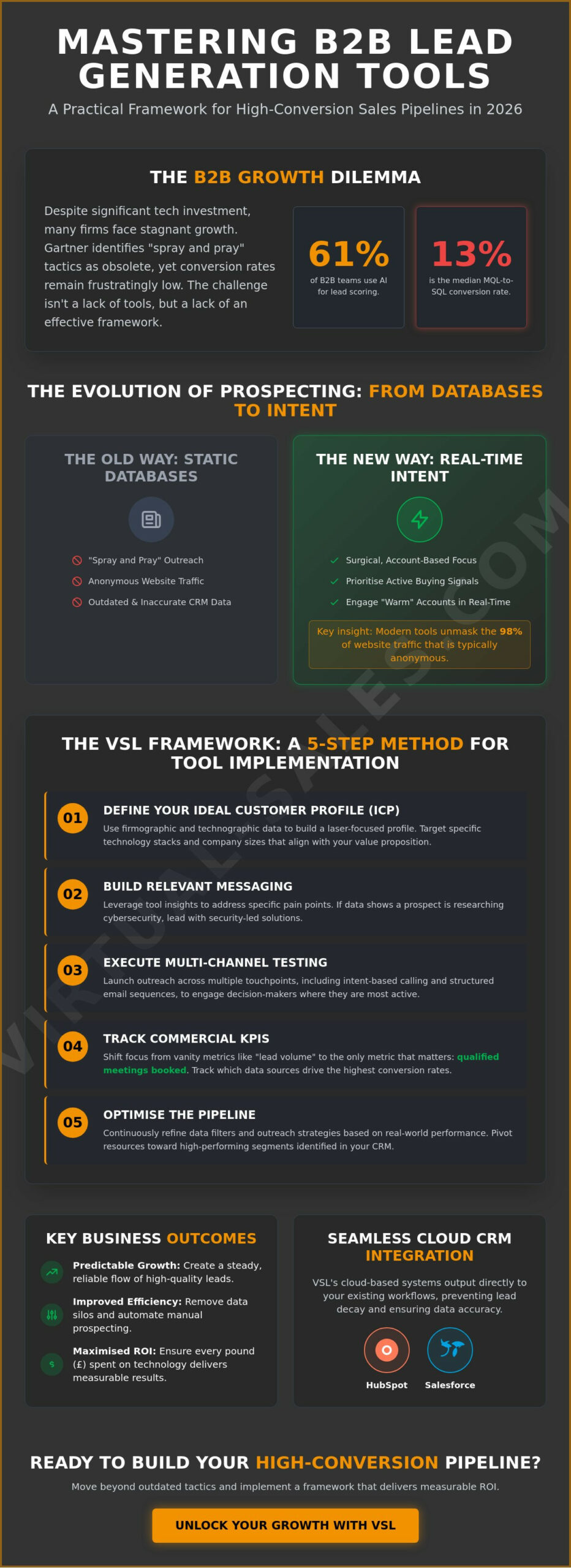
With 61% of B2B teams now deploying AI for lead scoring, why is the median MQL-to-SQL conversion rate still stuck at a stagnant 13%? It’s a frustrating reality for many growth-focused firms. You’ve likely invested in a B2B lead generation tool only to find your CRM cluttered with outdated prospect data and anonymous website traffic that never converts. We understand the friction caused when technology refuses to play nicely with your HubSpot or Salesforce workflows. This guide promises to help you master the selection and implementation of B2B technology to build a high-conversion sales pipeline. We’ll move beyond the “spray and pray” tactics that Gartner identifies as obsolete. You’ll discover the VSL framework for leveraging a cloud-based CRM that outputs directly to your existing systems, ensuring a consistent flow of qualified leads and a measurable ROI on every pound spent.
A B2B lead generation tool is a software solution designed to:
- Identify and capture contact data for potential business clients.
- Track intent signals to prioritise active buyers.
- Enrich CRM data to maintain accuracy and deliverability.
This matters because it creates predictable growth through a steady lead flow, improves operational efficiency by removing data silos, and maximises ROI on your commercial technology stack.
Key Takeaways
- Shift your strategy from static databases to real-time intent signals to identify prospects actively researching your solutions.
- Deploy the VSL 5-Step Method to ensure your chosen B2B lead generation tool aligns perfectly with your Ideal Customer Profile (ICP).
- Protect your brand by avoiding over-automation; don’t sacrifice personalised outreach for the sake of sheer volume.
- Discover how to integrate tool data with professional telemarketing to target “warm” accounts in real-time for higher conversion.
- Evaluate the Total Cost of Ownership between internal software management and partnering with an elite, integrated sales team.
Defining the B2B Lead Generation Tool Landscape in 2026
A B2B lead generation tool in 2026 is far more than a simple digital Rolodex. It is a sophisticated technological layer built to identify, qualify, and engage prospective corporate clients with clinical precision. While early software versions relied on static contact information, modern platforms prioritise live intent signals. This shift is vital because 98% of website traffic typically remains anonymous. These tools bridge that visibility gap by unmasking corporate visitors, allowing your team to see which specific companies are browsing your service pages. Essential categories in this landscape include prospecting databases, visitor identification software, and CRM-integrated outreach platforms that drive commercial momentum.
Why Lead Generation Technology Matters for Scalable Growth
Scalable growth demands a predictable, high-standard pipeline. Technology removes the friction from lead generation by automating the manual prospecting phase that often drains internal resources. This automation reduces your cost per lead (CPL) and compresses the sales cycle by surfacing high-intent accounts earlier in their journey. Beyond the financial metrics, it improves team performance. Providing your staff with warm, qualified opportunities instead of outdated lists boosts morale and focus. At VSL, we utilise a cloud-based CRM capable of outputting directly to HubSpot and Salesforce, ensuring your B2B lead generation efforts remain an integrated part of your commercial workflow.
The Evolution of Prospecting: From Databases to Intent
Static lists are dead. In 2026, real-time intent data is the primary driver of successful outreach. AI-driven tools now monitor digital footprints to predict exactly which companies are in an active buying window. This intelligence allows for a radical shift from volume-based “spray and pray” tactics to surgical, account-based marketing (ABM). Instead of wasting budget on broad campaigns, you can focus on the specific accounts showing high-value signals. This transition ensures your technology spend delivers a transparent ROI. It moves your operation from passive data collection to proactive, tactical execution, ensuring you engage the right decision-makers at the perfect moment. For SaaS businesses looking to build on this foundation, a signal-led approach to outbound B2B sales for SaaS growth provides the strategic framework to identify and engage high-propensity accounts before your competitors do.
The VSL Framework: A 5-Step Method for Tool Implementation
Deploying a B2B lead generation tool without a tactical framework is a recipe for wasted budget. Software provides the raw data; the framework provides the results. At VSL, we’ve refined a structured 5-step method to ensure technology translates directly into revenue. This approach moves beyond the simple “set and forget” mentality of most SaaS subscriptions, focusing instead on clinical execution and measurable outcomes.
- Step 1: Define your ICP. Use firmographic and technographic data to build a laser-focused Ideal Customer Profile. Don’t just target industries; target specific technology stacks and company sizes that align with your value proposition.
- Step 2: Build relevant messaging. Use the insights identified by your tool to address specific industry pain points. If the data shows a prospect is researching cybersecurity, your outreach must lead with security-led solutions.
- Step 3: Execute multi-channel testing. Launch outreach across multiple touchpoints, including intent-based calling and structured email sequences. This ensures you catch decision-makers where they’re most active.
- Step 4: Track commercial KPIs. Shift your focus from vanity metrics like “lead volume” to the only figure that matters: meetings booked. Meticulous tracking allows you to see exactly which data sources drive the highest conversion.
- Step 5: Optimise the pipeline. Refine your data filters based on actual performance. If specific sectors aren’t converting, pivot your resources toward the high-performing segments identified in your CRM.
Integrating Tools with HubSpot and Salesforce
Your lead generation technology must offer seamless bi-directional sync with your cloud-based CRM. At VSL, our systems ensure that “hot leads” flow directly into your sales reps’ daily task lists without manual intervention. This automation prevents lead decay and ensures data mapping remains accurate. When your tool and CRM talk to each other, you gain a transparent view of your ROI, allowing for better strategic decisions. You can see our proven results in this area by reviewing our verified B2B performance metrics.
Technical Requirements for High-Performance Sales Pipelines
High-performance pipelines require a robust, cloud-based infrastructure to ensure data accessibility for remote or hybrid teams. A critical component of this stack is b2b data cleansing. Without regular maintenance, even the best B2B lead generation tool will eventually suffer from data decay, leading to bounced emails and wasted dialling time. Ensure your stack also supports multi-channel outreach, including LinkedIn and SMS, to maintain a consistent presence in a competitive market.
Avoiding the Pitfalls: 5 Common Mistakes in B2B Tool Selection
Selecting a B2B lead generation tool based solely on a feature list often leads to operational friction. Many businesses fall into the trap of prioritising lead quantity over the precision of the “Ideal Customer” match. This results in a pipeline filled with noise rather than genuine opportunity. Another critical failure is over-automation. While efficiency is vital, generic outreach triggers brand erosion and alienates high-value prospects. In the UK, ignoring GDPR and data privacy regulations is a significant risk. Using international data providers without a documented Legitimate Interest Assessment (LIA) can lead to severe penalties. The new regulations that took effect on January 1, 2026, require even stricter risk assessments for automated decision-making technology. Failing to integrate technology with your b2b appointment setting workflow also creates data silos. Finally, relying on a single data source without verification or cleansing leaves you vulnerable to data decay.
The Real Cost of Dirty Data in Your Pipeline
Dirty data is a silent budget killer. Outdated contact information wastes up to 20% of a sales rep’s productive time, forcing them to chase ghosts instead of closing deals. High bounce rates from unverified lists damage your email sender reputation, making it harder to reach the inbox of legitimate prospects. With the average cost per lead in B2B sitting at £198.44, every dead-end prospect is a drain on your revenue. Cheap tools often lead to expensive failures when you factor in the lost opportunity cost of pursuing “dirty” data. VSL mitigates this risk by ensuring all data used in our campaigns undergoes rigorous human-led verification.
Why Software Alone is Not a Silver Bullet
Software identifies the “who” and “when,” but professional staff provide the “how.” A B2B lead generation tool can flag an active buyer, but it can’t navigate the nuances of a complex corporate hierarchy or handle the objections of a seasoned C-suite executive. Human-led qualification is essential to ensure that every meeting booked is worth a sales director’s time. You must balance clinical tool efficiency with emotionally intelligent, interpersonal communication. This hybrid approach ensures you don’t just reach a prospect, but you actually engage them in a meaningful commercial dialogue. We provide the professional maturity and human-led expertise required to turn raw tool data into high-value sales appointments. For a deeper understanding of how this works in practice, our guide on lead generation and appointment setting services outlines the practical framework for building a high-conversion sales engine.
Real Insight: Scaling a Software Pipeline with Intent-Based Tools
Consider the scenario of a mid-sized IT services firm struggling to break through the noise in the cybersecurity sector. They possessed a high-tier solution but lacked visibility into which accounts were actually in the market. By deploying a sophisticated B2B lead generation tool, they shifted from reactive guessing to proactive targeting. Gartner research indicates that B2B buyers are often 57% through their journey before they ever contact a supplier. Intent-based technology flips this script. It allows you to identify prospects when they’re only 10% into their research phase. By integrating this live data with our professional telemarketing team, the firm targeted “warm” accounts in real-time. The result was a 25% increase in high-quality meetings booked within the first three months of implementation.
Case Study: From Cold Outreach to Qualified Meetings
We recently managed a campaign that utilised advanced data tools to fuel a high-standard lead generation project for a software provider. The objective was to unmask anonymous website visitors and convert that interest into commercial dialogue. Our team achieved a 15% conversion rate from “identified visitor” to “qualified discovery call.” This wasn’t down to luck. It required the professional maturity of our UK-based staff to handle complex tech leads with the necessary nuance. When a tool flags a visitor, it’s the human-led follow-up that determines whether that data point becomes a revenue opportunity.
Benchmarking Conversion Rates and Meeting Metrics
Software companies using intent-based tools typically see a higher meeting-to-opportunity ratio compared to those relying on cold databases. While the median MQL-to-SQL conversion rate across the industry is 13%, firms that combine technology with expert qualification often see significantly higher engagement. VSL’s Clutch profile reflects this consistent delivery of high-standard sales output across various technology sectors. Depending on your subscription investment level, you can expect a pipeline value that scales predictably with your activity. Data is the catalyst. Human expertise is the closer. You can see how we deliver these results by viewing our verified B2B meeting metrics.
Beyond the Software: Choosing the Right Lead Generation Solution
Success in modern commerce requires you to evaluate whether your business needs just a B2B lead generation tool or a fully integrated outsourced sales team. While software provides the data foundation, it doesn’t close the “last mile” gap between an identified prospect and a committed meeting. You must consider the Total Cost of Ownership (TCO). Balancing software licenses, internal hiring, and management overhead often proves more expensive than partnering with a retainer-based agency. VSL acts as an elite, integrated component of your internal team, using high-tier tools on your behalf to ensure generated leads result in sustainable revenue and a transparent ROI.
When to Outsource Your Lead Generation Tool Management
Technology quickly becomes a burden if your staff lack the bandwidth for immediate follow-up. If your internal team is overwhelmed by tool output or if intent signals are sitting unaddressed in your CRM, it’s a clear sign to pivot. An agency partner already owns and masters the top-tier tech stack, saving you the time and capital required for internal training. This allows you to maintain a consistent sales presence without the friction of hiring and churn. We provide the professional maturity needed to engage high-value prospects immediately, ensuring no opportunity is lost to lead decay.
Building a Sustainable Revenue Engine for 2026
The strategic shift for 2026 is moving away from “buying leads” and toward “building a pipeline.” A sustainable revenue engine relies on the synergy between precise tool data and expert human qualification. Before you invest in a new B2B lead generation tool, use this final checklist for your sales leadership team:
- Integration: Does the tool offer bi-directional sync with your cloud-based CRM?
- Compliance: Is the data compliant with UK GDPR and current LIA requirements?
- Capacity: Do you have the human-led capacity to follow up on intent signals within 24 hours?
- Measurement: Can you track the meeting-to-opportunity ratio to verify ROI?
Mastering these elements transforms your sales operation from a cost centre into a growth driver. It ensures your technology spend translates into a high-conversion sales pipeline rather than just a list of names. If you’re ready to scale your commercial output with a proven, tactical framework, Contact VSL for a tactical consultation today.
Building Your High-Conversion Pipeline for 2026
The transition to an intent-driven sales model isn’t just about software; it’s about tactical alignment. You’ve seen how the VSL framework transforms raw data into high-value meetings by prioritising quality over noise. Selecting the right B2B lead generation tool is only half the battle. The real competitive advantage lies in how you deploy that technology within a human-led, professional sales environment. Clinical efficiency must be balanced with the emotionally intelligent communication that only a mature, UK-based team can provide.
As a top-rated UK agency on Clutch, we specialise in the IT and software sectors, ensuring your technology stack works as hard as your sales directors. We don’t just provide data; we provide seamless integration with Salesforce and HubSpot to maintain a clinical, high-standard output. It’s time to move beyond anonymous traffic and start building a predictable revenue engine that delivers a measurable ROI on every pound spent. Book a consultation to see how VSL integrates elite tools with professional appointment setting and take control of your commercial growth today. Your high-performance pipeline is within reach.
Frequently Asked Questions
What is the best B2B lead generation tool for SMEs in 2026?
Apollo.io and HubSpot are currently the most effective options for SMEs requiring a balance of database depth and CRM functionality. These platforms allow smaller teams to scale their outreach without the massive enterprise overhead of quote-based systems. Choosing a B2B lead generation tool for a smaller firm requires a focus on native integration and ease of use to ensure your sales staff actually adopt the technology.
How much does a professional B2B lead generation tool cost in the UK?
Subscription costs vary significantly based on your data requirements and seat count. Entry-level plans for platforms like Apollo start at approximately £40 per user per month. Enterprise solutions such as ZoomInfo often require annual commitments ranging from £11,000 to over £30,000. You should also account for one-time onboarding fees for professional-tier hubs, which typically range from £1,100 to £5,500 depending on the complexity of your setup.
Can I integrate lead generation tools with HubSpot or Salesforce?
Yes, bi-directional integration with HubSpot and Salesforce is a standard feature for high-tier prospecting technology. This ensures that intent signals and enriched data flow directly into your sales pipeline without manual intervention. VSL utilises a cloud-based CRM specifically designed to output high-quality, cleansed data into these popular platforms to maintain a clinical and efficient workflow.
What is the difference between a lead generation tool and an appointment setting service?
A tool provides the software and raw data to identify prospects, while an appointment setting service provides the human expertise to qualify and book them. Technology identifies the “who” and “when,” but professional staff handle the “how” by navigating corporate hierarchies and securing firm meeting commitments. VSL bridges this gap by acting as an integrated component of your team, combining elite tools with human-led outreach. Businesses looking to offload this entire process can explore how integrated lead generation and appointment setting services function as a seamless extension of an internal sales workforce.
Are B2B lead generation tools GDPR compliant?
Most reputable tools are compliant when used under the “legitimate interest” legal basis for B2B communication. You must ensure that your outreach is relevant to the recipient’s professional role and that you’ve documented a Legitimate Interest Assessment (LIA). New 2026 regulations also impose stricter rules around automated decision-making technology, requiring businesses to conduct regular risk assessments to remain fully compliant.
How do intent-based tools identify anonymous website visitors?
These tools use reverse IP lookup and tracking scripts to match digital footprints with corporate domains. This technology unmasks the 98% of website traffic that usually remains anonymous, allowing you to see which specific companies are researching your solutions. Once identified, your team can prioritise outreach to these “warm” accounts while they are still in the active buying window.
Do I need a dedicated team to manage my lead generation software?
Managing a sophisticated B2B lead generation tool effectively requires dedicated oversight to prevent lead decay and ensure data accuracy. If your internal staff is overwhelmed, intent signals often go cold before a rep can make contact. Partnering with an integrated agency provides you with a professional team that already masters the tech stack, ensuring a consistent sales presence without the overhead of internal hiring. SaaS companies in particular can benefit from reviewing proven outbound B2B sales strategies for SaaS growth to understand how a precision-led, multi-channel approach reduces cost per acquisition while maintaining pipeline quality.
What conversion rates should I expect from a B2B lead generation tool?
The median MQL-to-SQL conversion rate in the B2B sector currently sits at 13%. However, firms that combine high-tier technology with professional human qualification often see superior results. For instance, VSL has achieved conversion rates of 15% when moving from an identified website visitor to a qualified discovery call. Your specific results will depend on the alignment between your tool’s data and your team’s follow-up speed.

Disclaimer
Disclaimer: Content is for general information only and does not constitute professional advice. Results may vary. Virtual Sales Limited accepts no liability for actions taken based on this content.
Tags: B2B Lead Generation, B2B Marketing, CRM, Intent Data, marketing technology, qualified leads, Sales Pipeline, VSL