5 Critical Problems with Buying B2B Data Lists in 2026: A Strategic Warning
Did you know that 30% of your B2B email addresses will become outdated this year alone? When you invest in a static database, you aren’t buying a sales solution; you’re buying a ticking clock. Many sales leaders find that the core problems with buying B2B data lists stem from a 2.5% monthly decay rate that turns a “fresh” list into a liability within weeks. You’ve likely felt the frustration of high bounce rates and the sting of seeing your sales team waste hours on dead leads. It’s a cycle that doesn’t just drain your budget; it actively damages your domain reputation and stalls your growth.
We agree that a high-performing sales operation requires a steady stream of prospects, but relying on off-the-shelf data is a high-risk strategy in 2026. This article will show you how to move beyond generic lists to build a high-conversion sales pipeline that actually delivers appointments. We’ll preview the five critical pitfalls of the current data market and provide our professional framework for creating a clean, high-intent database that stays compliant with the latest UK data regulations.
Key Takeaways
- Understand why treating B2B data as a static purchase creates a “Short-Cut Fallacy” that compromises long-term lead quality.
- Identify the most damaging problems with buying B2B data lists, including escalating bounce rates and the risk of permanent domain blacklisting.
- Learn the VSL 5-Step Method to transition from purchasing unreliable lists to building a proprietary, high-intent database asset.
- Shift your strategic focus from Cost per Lead to Cost per Appointment to accurately measure the true ROI of your sales pipeline.
- Discover how integrating human-led expertise ensures compliance with 2026 UK data regulations while maintaining a predictable flow of qualified meetings.
The Reality of Buying B2B Data Lists in 2026
A B2B data list is a static snapshot of professional contact information. It captures a moment in time that immediately begins to fade. Many commercial leaders view these lists as a fast track to growth, falling for the ‘Short-Cut Fallacy’. This fallacy suggests that speed to market is more valuable than the integrity of the lead itself. In practice, the rush to acquire thousands of records often sacrifices the very quality required to close a deal. You aren’t just buying data; you’re buying the burden of verifying it.
The core problems with buying B2B data lists start with this lack of depth. While a list provides names, it lacks the context of current intent or recent organisational shifts. Professional B2B lead generation requires more than a spreadsheet. It demands a dynamic approach where data is treated as a living asset rather than a disposable commodity. VSL positions itself as an integrated component of your internal team to ensure this data is developed and nurtured, not just consumed and discarded.
The Hidden Decay Rate of Static Databases
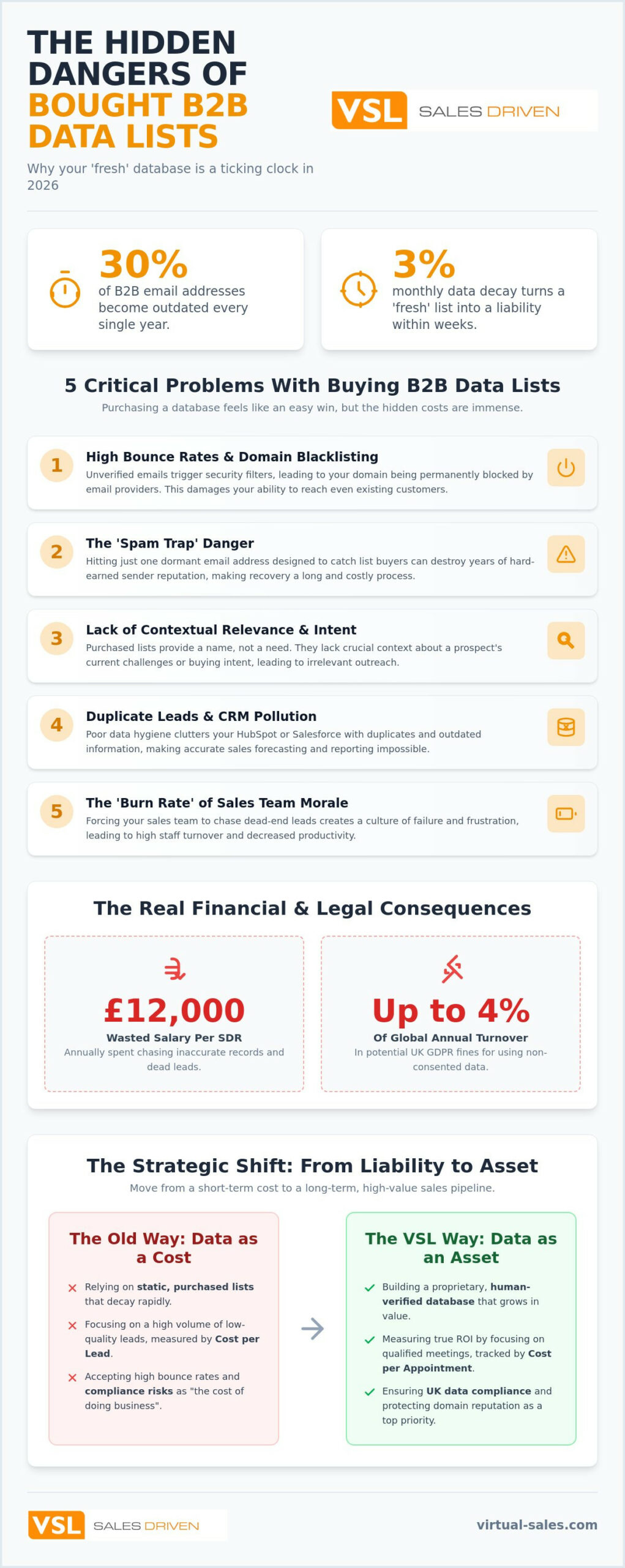
In the 2026 economy, company structures and job titles shift at an unprecedented pace. Gartner reports that B2B data degrades at roughly 3% per month. This means your “fresh” list is nearly one third inaccurate within a single year. Data decay is the natural erosion of accuracy in any non-verified database. When your sales staff spend their day chasing ‘ghost’ leads, their motivation plummets. They lose faith in your CRM, and your sales momentum stalls. Static lists simply cannot keep up with the reality of professional movement.
UK Compliance and GDPR Risks in 2026
Legal liabilities for using non-consented data have never been higher. The latest UK Data Protection updates place the burden of proof firmly on the sender. If you use purchased lists for cold outreach without a rigorous Legitimate Interest Assessment, you risk significant brand damage. Compliance failures now carry heavy fines of up to 4% of global annual turnover. Relying on an external vendor’s generic “compliance guarantee” is a dangerous gamble. VSL prioritises human-led verification to ensure your outreach meets the highest standards of UK regulation, protecting your reputation and your bottom line.
5 Critical Problems with Buying B2B Data Lists
Purchasing a database often feels like an easy win, but the hidden technical and cultural costs are immense. The most immediate problems with buying B2B data lists manifest as technical roadblocks that can paralyse your entire outreach strategy. When you load unverified data into your CRM, you aren’t just adding names; you’re injecting risk into your digital infrastructure. These problems generally fall into five critical categories:
- Problem 1: High Bounce Rates and Domain Blacklisting. Unverified emails trigger security filters, leading to permanent blocks.
- Problem 2: The ‘Spam Trap’ Danger. Dormant accounts used by providers to catch list buyers can destroy your sender reputation.
- Problem 3: Lack of Contextual Relevance and Intent. Purchased lists tell you who someone is, but never if they’re actually looking to buy.
- Problem 4: Duplicate Leads and CRM Pollution. Poor data hygiene clutters HubSpot or Salesforce, making accurate reporting impossible.
- Problem 5: The ‘Burn Rate’ of your Sales Team’s Morale. Chasing dead leads creates a culture of failure and high staff turnover.
Technical Failures: Bounce Rates and Reputation
Email Service Providers (ESPs) use sophisticated algorithms to monitor sender behaviour. If your campaigns hit a high volume of invalid addresses, they flag your account as a high-risk source. This leads to domain blacklisting, where even your legitimate business emails end up in junk folders. Recovering from a blacklist event requires a months-long process of “domain warming” that few businesses can afford. To mitigate this, many leaders invest in B2B Data Cleansing: The Strategic How-To Guide to scrub their existing records. Beyond bounces, spam traps pose a lethal threat. These are dormant email addresses specifically designed to catch people using purchased lists. One hit can destroy years of hard-earned sender reputation.
Operational Failures: The High Cost of ‘Cheap’ Leads
The financial drain of poor data extends far beyond the initial purchase price. If an SDR earns £30,000 and spends 40% of their day calling through inaccurate records, you’re effectively throwing away £12,000 in salary per year. This operational friction creates a toxic divide between Marketing and Sales, as teams blame each other for the lack of results. CRM pollution is another consequence; duplicate and inaccurate leads clutter your systems, making it impossible to track genuine prospect journeys.
Consider a London-based software firm that recently spent £5,000 on a targeted B2B list. They expected a surge in bookings. Instead, they faced a 15% bounce rate and zeroed their ROI because the leads lacked any signal of intent. Their sales team spent three weeks chasing contacts who had already left their roles or had no authority to buy. The “cheap” list ended up costing them nearly £15,000 in total when factoring in lost time and domain repair. Sustainable growth requires a more mature approach. Leading firms now look for high-standard B2B appointment setting in the UK to ensure every conversation is backed by human-led verification and genuine intent.
The VSL Framework: From Raw Data to Qualified Appointments
The transition from purchasing a list to generating revenue requires a shift in mindset. You must stop viewing data as a one-time purchase and start treating it as a proprietary asset that requires cultivation. The core problems with buying B2B data lists are solved only when you replace the “buy and blast” model with a structured, human-led methodology. VSL implements a 5-Step Method designed to turn raw contact information into high-value sales appointments, moving your focus from quantity to conversion.
We don’t operate as an external vendor. Instead, VSL acts as an elite, integrated component of your internal team. This partnership approach ensures that the data we build for you is perfectly aligned with your commercial goals. By focusing on building rather than buying, you create a sustainable B2B lead generation pipeline that remains accurate and compliant long after a purchased list would have decayed.
Steps 1-3: Intelligence and Verification
Everything begins with a precise definition of your Ideal Customer Profile (ICP). Generic SIC codes are far too broad for the IT and software sectors. We look deeper into technographics and specific departmental structures to ensure we target decision-makers with the actual authority to sign off on your solution. Once the target list is identified, we move to multi-channel verification. This isn’t just an automated ping to an email server. Our UK-based staff use LinkedIn, professional telemarketing, and direct email to confirm that the contact is still in the role and holds budget authority.
Human-led cleansing is the final layer of this intelligence phase. Automated tools often fail to navigate the complex “gatekeeper” structures found in large corporate environments. Our mature sales professionals understand how to navigate these hurdles, ensuring that the data in your B2B appointment setting campaign is accurate, reachable, and relevant. This manual intervention removes the friction that typically stalls automated outreach.
Steps 4-5: Engagement and Integration
With a verified foundation, we pivot to engagement. Step 4 focuses on intent-based outreach. We don’t just ask for a meeting; we gauge the prospect’s readiness to buy by identifying specific pain points and timing signals. This ensures your sales team only spends time on “warm” leads that have a high probability of conversion. It shifts the dynamic from a cold pitch to a relevant business conversation.
Step 5 is the seamless integration of this intelligence into your existing workflow. VSL syncs directly with cloud-based CRMs like Salesforce and HubSpot. This real-time handover means your internal sales staff can pick up the conversation exactly where we left off, with full visibility into the prospect’s history and intent signals. You gain a living database that grows in value every day, rather than a static list that loses value every minute.
Results and Data: The ROI of Managed Databases
The true measure of a sales strategy isn’t the volume of records in your CRM. It’s the velocity of qualified appointments entering your pipeline. Many commercial directors focus on Cost per Lead (CPL), but this is a vanity metric when those leads are sourced from static databases. The inherent problems with buying B2B data lists become clear when you analyse the conversion data. A list might be “cheap” to acquire, but it’s exceptionally expensive to process. When you factor in the human and technical resources required to verify purchased data, the ROI often turns negative before the first call is even made.
VSL prioritises Cost per Appointment (CPA) as the primary KPI. This focus ensures that your budget is allocated toward outcomes rather than raw material. By acting as an elite, integrated component of your team, we remove the burden of data verification from your internal staff. This allows your senior sales people to focus on closing deals rather than scrubbing spreadsheets. Our methodology turns your database into a living asset that appreciates in value over time.
Benchmarking Conversion Rates in 2026
Purchased lists typically yield a conversion-to-meeting rate of less than 1%. This means for every 1,000 contacts, you might secure 10 conversations, many of which will fail to meet your qualification criteria. VSL shifts this paradigm entirely. For our retainer clients, we target 10–20 high-quality meetings per month through human-led database development. We call this the ‘Quality Multiplier’. One meeting with a decision-maker who has verified intent is worth more than 50 raw leads from a generic spreadsheet. Clutch-verified data confirms that human-led appointment setting consistently outperforms automated outreach by a factor of five in the UK IT and SaaS sectors.
The True Cost of Lead Acquisition
Consider the Total Cost of Ownership (TCO) of your sales pipeline. You might pay £2,000 for a one-off B2B list. Once you factor in the salary of an SDR to call it, the technical cost of domain repair, and the opportunity cost of missed deals, that £2,000 investment quickly balloons. In contrast, a £2,000 monthly retainer for professional b2b appointment setting services delivers a living, verified pipeline. You aren’t just buying data; you’re buying a predictable flow of revenue opportunities. Our approach ensures that every £1 spent is an investment in a clean, high-intent database that stays within your business as a permanent asset. To see how we deliver these results for technology firms across the UK, review our Clutch-verified B2B appointment setting success rates.
Building a Sustainable Sales Pipeline for 2026
A sustainable sales pipeline is a living asset. It isn’t a static file you buy and discard; it’s a dynamic ecosystem of verified contacts and active conversations. The core problems with buying B2B data lists arise because these lists are dead on arrival. They lack the momentum of real-world business change. In 2026, the gold standard for growth is intent-based calling. This approach moves beyond simple demographics to target prospects based on their actual readiness to engage. It ensures your sales efforts are directed where they have the highest probability of conversion.
VSL acts as an elite, integrated component of your internal team. We don’t just hand over a spreadsheet; we deliver a functional sales machine. This transition from buying problems to outsourcing solutions allows you to bypass the technical and operational failures of off-the-shelf data. Much like how property owners might consult BuyVacantLand.com to determine the true value of their holdings, building a proprietary database creates a permanent business asset that appreciates in value as you add layers of intelligence and intent signals. You move from a cycle of “buy and blast” to a strategy of “nurture and close”.
Scaling with Professional Appointment Setters
Scaling a sales operation often stalls due to the overhead of internal hiring and training. Our UK-based professionals provide the maturity required to handle complex B2B pitches in the IT and software sectors. They navigate gatekeepers and build rapport with C-suite decision-makers with a level of skill that automated systems cannot replicate. For a deeper look at this methodology, consult The Definitive Guide to B2B Appointment Setting in 2026. These outsourced sales solutions provide the flexibility to scale your pipeline without the long-term liability of fixed internal hiring costs.
Next Steps: Auditing Your Current Data Strategy
Sustainable revenue requires a move away from the “quick win” mentality of purchased lists. If you’re still struggling with the problems with buying B2B data lists, use this 3-point checklist to audit your current strategy:
- Verify the decay rate: Has more than 10% of your database moved roles or changed companies in the last quarter?
- Assess compliance: Do you have a documented Legitimate Interest Assessment (LIA) for every cold contact in your CRM?
- Measure intent: Can you identify which 5% of your database is currently showing active signals of a buying cycle?
If your current strategy fails these tests, it’s time to pivot. Stop managing data failures and start building a high-intent pipeline. We invite you to view our VSL Case Studies to see how we’ve helped technology firms transform their outreach into a predictable revenue engine. Transitioning to a managed database model isn’t just about better data; it’s about better business outcomes.
Secure Your Sales Growth in 2026
The shift from purchasing static data to building a dynamic, human-verified database is no longer optional for IT and software firms. As we have explored, the core problems with buying B2B data lists range from technical domain damage to the erosion of sales morale. Relying on outdated spreadsheets in a fast-moving market creates a ceiling on your growth that no amount of automated outreach can break. You need a pipeline that lives and breathes alongside your business.
By adopting a framework that prioritises human intelligence and real-time CRM integration, you transform your database from a cost centre into a high-yield asset. This transition ensures your senior sales staff spend their time closing deals with qualified prospects rather than navigating gatekeepers or correcting bounce errors. VSL acts as an integrated component of your team, providing the professional maturity required to handle complex sales cycles.
It is time to move beyond the limitations of off-the-shelf lists. As a Clutch-verified B2B agency specialising in IT and software lead generation, our UK-based expert sales professionals deliver the results your ambition demands. Stop buying data and start booking meetings with VSL’s professional appointment setting. Your future revenue depends on the integrity of your pipeline; let’s build a foundation for sustainable success.
Frequently Asked Questions
Is buying B2B email lists illegal under UK GDPR in 2026?
It isn’t strictly illegal, but it carries significant compliance risks. Under UK GDPR, you must have a lawful basis for processing data, which for B2B marketing is usually “Legitimate Interest”. This requires you to conduct and document a Legitimate Interest Assessment (LIA) and provide a clear, easy way for contacts to opt-out. Using non-consented data without these rigorous safeguards can expose your business to fines of up to 4% of global annual turnover.
How much does a high-quality B2B data list cost in the UK?
The investment for B2B data varies based on the depth of targeting and the level of verification provided. While basic lists might seem affordable on a per-contact basis, the true cost includes the high rate of data decay and the human hours your team will waste on inaccurate records. Professional database building prioritises the value of a verified appointment over the volume of raw, unverified names.
What is the average bounce rate for purchased B2B data?
Average bounce rates for off-the-shelf lists often exceed 15%. This is largely due to a 2.5% monthly data decay rate as professionals change roles or companies restructure. These high bounce rates are among the most damaging problems with buying B2B data lists because they trigger security filters that can lead to your domain being blacklisted by major email providers.
Can I use purchased lists in my CRM like HubSpot or Salesforce?
You can, but you risk account suspension. Platforms like HubSpot and Salesforce have strict anti-spam policies and can freeze your sending capabilities if your bounce rates exceed 1%. VSL solves this by only syncing human-verified, high-intent prospects directly into your cloud-based CRM. This ensures your system stays clean and your sender reputation remains intact.
What is the difference between lead generation and buying a data list?
Buying a list is a transactional purchase of a static, often outdated spreadsheet. Lead generation is a proactive, human-led process. It involves identifying your Ideal Customer Profile, verifying contact details through multiple channels, and engaging prospects to confirm a genuine readiness to buy. Lead generation turns raw information into a functional sales pipeline.
How can I clean a purchased B2B list before using it?
Cleaning a list requires a combination of automated validation tools and manual research. You should first run the data through a verification service to remove “hard bounces”. Then, a professional team should confirm job titles and company status via LinkedIn or phone. VSL handles this through human-led cleansing to remove gatekeeper friction before your sales team begins their outreach.
Why do my cold emails from purchased lists go to spam?
Your emails go to spam because Email Service Providers (ESPs) flag your domain for high-risk patterns. If you send to “spam traps” or invalid addresses common in purchased lists, your sender reputation plummets. ESPs like Gmail and Outlook prioritise mail from senders who have a history of high engagement and very low bounce rates.
What is a better alternative to buying B2B data lists for my sales team?
The superior alternative is managed B2B Database Building paired with professional appointment setting. Instead of purchasing a static list that loses value daily, you build a proprietary asset of high-intent prospects. This approach ensures full compliance with UK regulations while delivering a predictable flow of qualified meetings for your sales team to close.

Disclaimer
Disclaimer: Content is for general information only and does not constitute professional advice. Results may vary. Virtual Sales Limited accepts no liability for actions taken based on this content.
Tags: B2B data, B2B Sales, data decay, data quality, Lead generation, Sales Pipeline, Sales Strategy, UK data regulations