Outsourced vs In-House SDRs: Cost & ROI Compared
The cheaper-looking sales development model can become the more demanding choice once the full work involved is considered. Deciding between outsourced B2B appointment setting and an in-house SDR team means looking beyond a salary or monthly campaign charge. You need to assess management capacity, qualification standards, sales handovers and the quality of opportunities entering your pipeline.
Key Takeaways
- Compare the complete investment, not just an SDR’s salary or an outsourced programme’s headline charge.
- Include recruitment, onboarding, management time, tools and ramp-up when assessing the true cost of an in-house team.
- Measure cost per qualified appointment alongside customer acquisition cost and the quality of opportunities entering your pipeline.
- Assess how each pricing model allocates responsibility and how clearly it defines a qualified meeting.
- Choose outsourced, in-house or hybrid support according to the control, capacity and internal expertise your team needs.
How Much Does B2B Appointment Setting Cost in 2026?
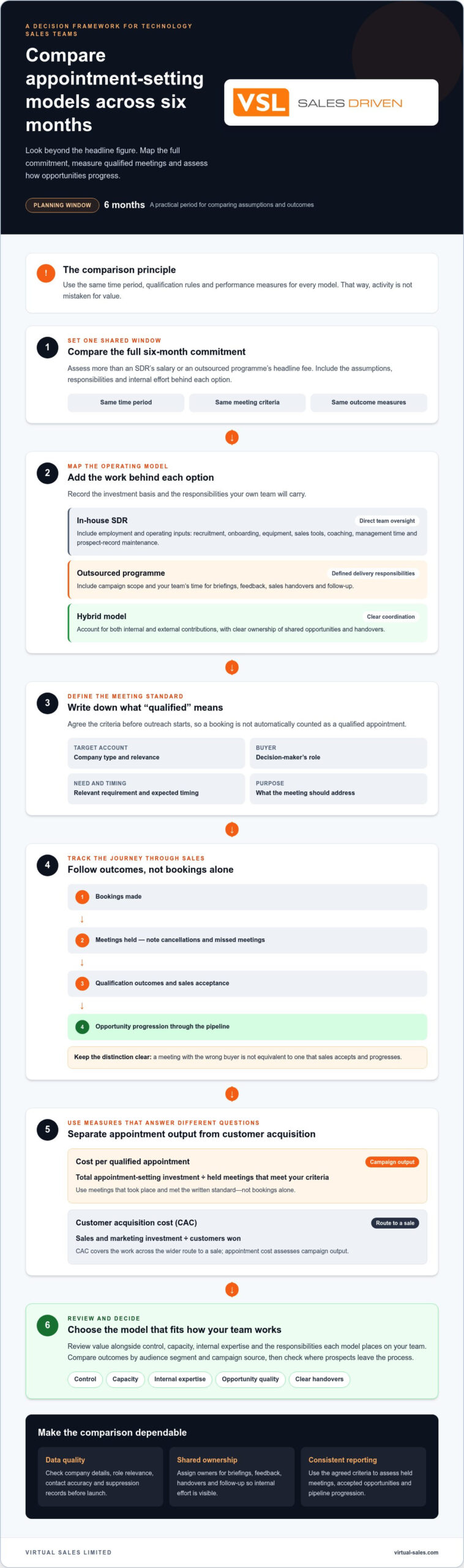
There is no single figure that fairly compares appointment-setting approaches. Assess the full campaign investment against held meetings, qualification and pipeline contribution. Divide the investment by meetings that took place and met your written criteria to calculate cost per qualified appointment. This differs from cost per booking, which may include cancelled, missed or unsuitable meetings. Use the same calculation for internal and outsourced activity.
Before outreach begins, define what a qualified meeting means for your business. Record the target account type, decision-maker’s role, relevant need, expected timing and meeting purpose. Then track bookings, meetings held, qualification outcomes, sales acceptance and progression. A meeting with the wrong buyer, for example, should not count as equivalent to one that sales accepts and progresses. Review outcomes by audience segment and campaign source.
Employer costs also affect an in-house comparison. According to HM Revenue & Customs, from 6 April 2026, UK employer National Insurance is 15% on earnings above the £5,000 annual secondary threshold. Include this employment cost alongside salary, pension, recruitment, tools and management time in your internal model.
| Option | Investment basis | Performance measure | Primary consideration |
|---|---|---|---|
| In-house SDR | Employment and operating inputs | Qualified meetings and accepted opportunities | Direct team oversight |
| Outsourced programme | Campaign scope and internal support | Held meetings and pipeline progression | Defined delivery responsibilities |
| Hybrid model | Internal and external contributions | Shared opportunities and handovers | Clear coordination |
Choose an investment measure that matches the work and outcomes you need. Set qualification criteria, track held meetings and accepted opportunities, then review where prospects leave the process. To assess return, compare the total investment with the value of opportunities created and customers won, using the same period and definitions for internal and outsourced activity. This prevents activity levels from being mistaken for commercial return.
The UK GDPR and PECR apply to personal-data handling and direct marketing. The Information Commissioner’s Office (ICO) explains that organisations must consider their lawful basis, transparency and people’s objections under data protection law. PECR rules vary by channel and recipient type. For outsourced outreach, agree who determines the purposes and means of processing, who processes the data, what information is shared, and how objections and opt-outs are passed on. Apply the relevant rules to live calls and email rather than treating all business contacts alike.
What Are the Hidden Costs of Appointment Setting?
Campaign spend is only part of the calculation. Include the work required to recruit, brief, manage and support sales development, then compare the complete investment with qualified opportunities, pipeline progression and customers won.
Fully Loaded In-house SDR Costs
For an internal SDR, add salary and employer costs to recruitment, onboarding, equipment, sales tools and management time. Include coaching, performance reviews and time spent maintaining prospect records. These inputs may sit across different budgets, so sales and finance leaders should agree which departments contribute to the role.
Outsourced SDR Cost Calculations
For an outsourced programme, include campaign expenditure and your team’s time for briefings, feedback, sales handovers and follow-up. These internal inputs remain part of the acquisition effort, even if they are outside the campaign scope. Assign an owner to record them so the comparison captures work absorbed by sales or marketing managers.
Conversion, Acquisition Cost and Return
Calculate cost per qualified appointment by dividing total appointment-setting investment by the held meetings that meet your criteria. Customer acquisition cost (CAC) answers a broader question: divide sales and marketing investment by the number of customers won. Appointment cost evaluates campaign output; CAC captures the work required across the route to a sale.
For technology businesses weighing external capacity, UK technology appointment setting can be assessed against internal resources, agreed qualification standards and the sales outcomes your team tracks.
What Does Outsourced Appointment Setting Cost Compared with an In-House SDR?
When comparing an in-house Sales Development Representative (SDR) with an outsourced appointment-setting service, businesses should consider the total cost of delivery rather than salary alone.
An internal SDR typically involves recruitment, salary, employer National Insurance, pension contributions, training, management, software and ongoing supervision.
Outsourcing offers a different cost structure, with defined monthly expenditure and fewer internal management requirements.
For example, Virtual Sales Limited offers three monthly B2B appointment-setting subscriptions:
| VSL Service | Monthly Cost | Dedicated Calling Hours |
|---|---|---|
| Professional | £2,495 | 40 hours |
| Platinum | £3,995 | 75 hours |
| Enterprise | £5,995 | 140 hours |
All three subscriptions include an experienced UK-based caller, campaign management, BANT qualification and reporting.
There are no setup fees or commissions. Clients can cancel after the first month without notice periods or penalties.
These packages are not directly equivalent to employing a full-time SDR, as the dedicated calling hours differ. However, they provide a predictable monthly investment without the additional recruitment and employment overheads.
The most useful ROI comparison is not simply cost per hour, but the cost of generating qualified sales opportunities that progress through the pipeline. Results depend on the target market, proposition, campaign quality and sales follow-up.
Costs and pricing models for appointment-setting services
Pricing structures distribute campaign work and financial risk differently. Compare what each model covers, how success is measured and what your sales development team must handle.
Outsourced Appointment-setting Pricing
A monthly subscription or retainer groups campaign delivery under an agreed scope rather than tying payment to individual outcomes. It can cover ongoing outreach and campaign management, while your team provides product knowledge and sales feedback. A fixed project model defines a specific audience, activity and delivery period. Compare the models by included work, reporting, flexibility and how changes to targeting affect the scope.
Lead-generation Pricing Models
Hybrid and co-managed models divide responsibilities between an external campaign team and internal sales staff. The external team may engage prospects, while internal representatives provide product expertise, approve target segments and follow up opportunities. This can preserve internal control over positioning while adding capacity. Before launch, agree who owns list changes, qualification decisions and sales handovers.
Is It Cheaper to Outsource Appointment Setting or Hire an In-House SDR?
Neither model is automatically cheaper. Compare recruitment, management, delivery and the quality of opportunities created. An in-house SDR offers closer control and product knowledge; outsourcing can add specialist capacity without building the same internal function.
Outsourcing, Recruitment and Management Overhead
Outsourcing shifts day-to-day prospect engagement to an external team, reducing the internal recruitment and onboarding work needed to establish sales development. Your managers still need to brief the team, agree target accounts and review campaign feedback. For example, a software business entering a new sector can set its ideal customer profile and qualification criteria before outreach begins.
In-house Control and Product Knowledge
An in-house SDR learns product details, customer objections and company culture through direct contact with colleagues. This can help when prospects need detailed answers about a technical product or changing offer. The SDR can also share feedback quickly with marketing and account executives, supporting sharper messaging and closer sales-team alignment.
Choose according to the work your team can sustain. An internal model suits businesses with managers who can coach SDRs and preserve product expertise. Outsourcing can suit teams that need more prospect engagement capacity but lack recruitment bandwidth or dedicated management time. A hybrid approach keeps account strategy and sales follow-up internal while external specialists support outreach.
Six-month costs of outsourced and in-house appointment setting
Six-month Outsourced Appointment-setting Costs
For an outsourced programme, total campaign charges across six months, then add internal time spent briefing, reviewing prospects and handling sales handovers. Separate onboarding from ongoing delivery so the comparison reflects when each task occurs. Record who prepares account criteria, approves messaging and follows up each qualified meeting.
Six-month In-house Appointment-setting Costs
For an internal SDR, calculate six months of salary and employment costs, then add recruitment, onboarding, equipment, sales tools and management time. Include the manager’s coaching and review hours. If the SDR spends the opening part of the period learning product details and the target market, record that ramp-up time rather than assuming equal output throughout.
Next, compare what the six-month investment produced. Count only meetings that took place and met your written qualification standard. Track which became sales-accepted opportunities, progressed through the pipeline and reached a revenue decision. If a campaign created activity but few accepted opportunities, investigate account fit, prospect role and handover quality before extending it.
Your decision should reflect more than the final total. Compare the work your team must handle, the control it needs and the quality of pipeline created within the same six-month window. This gives sales and finance leaders a clearer basis for choosing a model.
Virtual Sales Limited: B2B Appointment Setting
Virtual Sales Limited provides B2B Appointment Setting and Lead Generation for technology companies that need qualified conversations with relevant decision-makers. Experienced UK-based callers use consultative conversations rather than scripts, with leads qualified to BANT criteria as a minimum: Budget, Authority, Need and Timeline. This gives sales teams a practical framework for deciding whether a meeting represents a relevant opportunity.
Each campaign has a dedicated caller and campaign manager, with weekly reporting, 360-degree feedback and tracked outcomes to help your team refine targeting. VSL works as an extension of your sales and marketing team, using a cloud-based CRM that can output campaign data for use with popular CRM platforms such as HubSpot and Salesforce. Flexible monthly subscriptions have no long-term commitment, and clients can cancel at any time. Explore B2B appointment-setting support, read our guide to outsourced appointment setting services or see how to build a business case for outsourced sales.
Frequently Asked Questions
Outsourced Appointment Setters vs In-House SDRs: What’s Best for Your B2B Sales Pipeline?
The right fit depends on where your pipeline needs support and what your team can manage. Choose in-house SDRs when ongoing product learning and close coordination matter most. Consider outsourced support when prospecting capacity is the constraint. A hybrid arrangement can split responsibilities: internal staff own account strategy and sales follow-up, while external specialists support initial prospect engagement.
How Do I Choose a B2B Appointment Setting Provider?
Assess a provider’s campaign approach against your market, buyer roles and qualification standards. Look for a clear explanation of its targeting process, how it records prospect feedback and how your sales team receives handovers. A SaaS business selling to IT leaders, for example, should define relevant company types, buyer responsibilities and meeting purpose before outreach begins.
What Is the Fully Loaded Annual Cost of an In-House SDR in the UK, Including Salary, Employer National Insurance, Pension and Tools?
There is no fixed total because package design and operating requirements differ. Build an annual calculation from salary, employer National Insurance, pension contributions, recruitment and onboarding, equipment, software licences and management overhead. Separate recurring employment costs from one-off hiring and set-up work. Finance teams can then model the role using actual employment terms and existing technology costs.
How Do Outsourced Appointment-setting Costs Compare with In-house SDR Team Costs?
Compare equivalent work over the same period, including internal time in both models. Outsourced support may have a defined campaign scope, while an internal SDR brings employment, training and management responsibilities. The fairest comparison asks what each approach contributes to qualified opportunities and what sales leaders must do to support it. Use identical target-account and meeting-acceptance criteria for both.
What Are Typical UK B2B Appointment-setting Pricing Models: Monthly Subscription, Per Appointment or Blended?
Common structures include a monthly subscription, a charge linked to qualified appointments, or a blend of both. Clarify what triggers payment and how meeting quality is assessed. Virtual Sales Limited uses flexible monthly subscriptions, so compare the scope, reporting and qualification definition rather than treating pricing models as interchangeable.
What Appointment Volumes and Meeting Quality Can UK Businesses Expect from Outsourced Providers Versus In-house SDRs?
No single volume figure applies across campaigns. Results depend on the target market, data quality, offer, buyer access and qualification criteria. Set expectations using indicators such as relevant prospect engagement and accepted meetings, then assess whether those meetings progress. An in-house team may have deeper product familiarity; outsourced delivery depends on the quality of briefing and feedback.
What Are the Benefits of Outsourced B2B Appointment Setting for UK SMEs and Growing Companies?
Outsourcing can give a growing business additional prospecting capacity without requiring it to build every sales development function internally. It can also help a team test a defined audience before committing more management attention to that segment. For example, an IT services firm could focus internal sales staff on discovery and proposals while external support opens conversations with selected business decision-makers.
Make your next sales development decision with clarity
Choose a model that fits the sales operation you want to build, not just the work you need covered today. The choice between outsourced B2B appointment setting and an in-house SDR team can also be staged: keep account strategy and sales follow-up internal, while adding external capacity where prospect engagement needs support. Set clear ownership, qualification standards and review points before activity begins.
If you would like to talk through your target market and qualification criteria, you are welcome to get in touch with Virtual Sales Limited for an informal conversation about how qualified opportunities could move into your pipeline.

Disclaimer
Disclaimer: Content is for general information only and does not constitute professional advice. Results may vary. Virtual Sales Limited accepts no liability for actions taken based on this content.
Tags: Appointment Setting, B2B Sales, in-house SDRs, outsourced SDRs, sales development, sales ROI, technology companies