How to Sell to Enterprise Customers in Europe: A Guide for Technology Companies
A strong product doesn’t make enterprise sales repeatable across Europe. For UK technology companies, the challenge is choosing which accounts to pursue, reaching the right decision-makers and understanding the criteria that shape each opportunity. Different markets and buying groups call for a focused approach, not a single message sent to every prospect.
You already know that enterprise deals take time and rarely rest with one contact. The difference comes from selecting accounts with a credible fit, opening informed conversations and checking whether a genuine business need exists. This guide sets out practical ways to prioritise target accounts, engage relevant stakeholders, adapt your proposition and assess opportunity progress. It also explains how to use prospect feedback and clear next steps to give your team a better view of pipeline development across European markets.
Key Takeaways
- Build an ideal customer profile around sector, business need and technology context to focus on accounts with a credible use case.
- Map the decision-maker roles involved in each opportunity, then shape conversations around their distinct priorities and buying criteria.
- Use prospect feedback to refine your message and agree relevant next steps, rather than treating outreach as a one-off pitch.
- For how to sell to enterprise customers in Europe a guide for technology companies, use a structured process to improve qualification and make pipeline progress clearer.
- Consider external support when testing a market or extending prospecting capacity, while keeping strategy and complex deal ownership with your internal team.
What selling to enterprise customers in Europe involves for technology companies
Enterprise selling is a considered, multi-stage B2B process for engaging suitable organisations and the people who influence or approve a purchase. Unlike a transactional sale, it rarely ends with one product demonstration or a decision from a single contact. The sales team needs to understand the organisation’s needs, establish how the technology fits its environment and build a case that relevant stakeholders can assess.
For technology companies, the process combines distinct activities. B2B lead generation identifies and engages prospective business customers. B2B appointment setting develops qualified sales conversations with relevant decision-makers. Those conversations can help a sales team assess fit and agree a useful next step, but they don’t replace the team’s role in managing the opportunity and progressing a complex deal.
Europe isn’t one uniform market. A plan that treats every target organisation and buyer as interchangeable risks missing differences in language, business context and expectations. Start by defining the sales motion, then make it relevant to the accounts and markets in scope.
How enterprise technology buying differs from simpler B2B sales
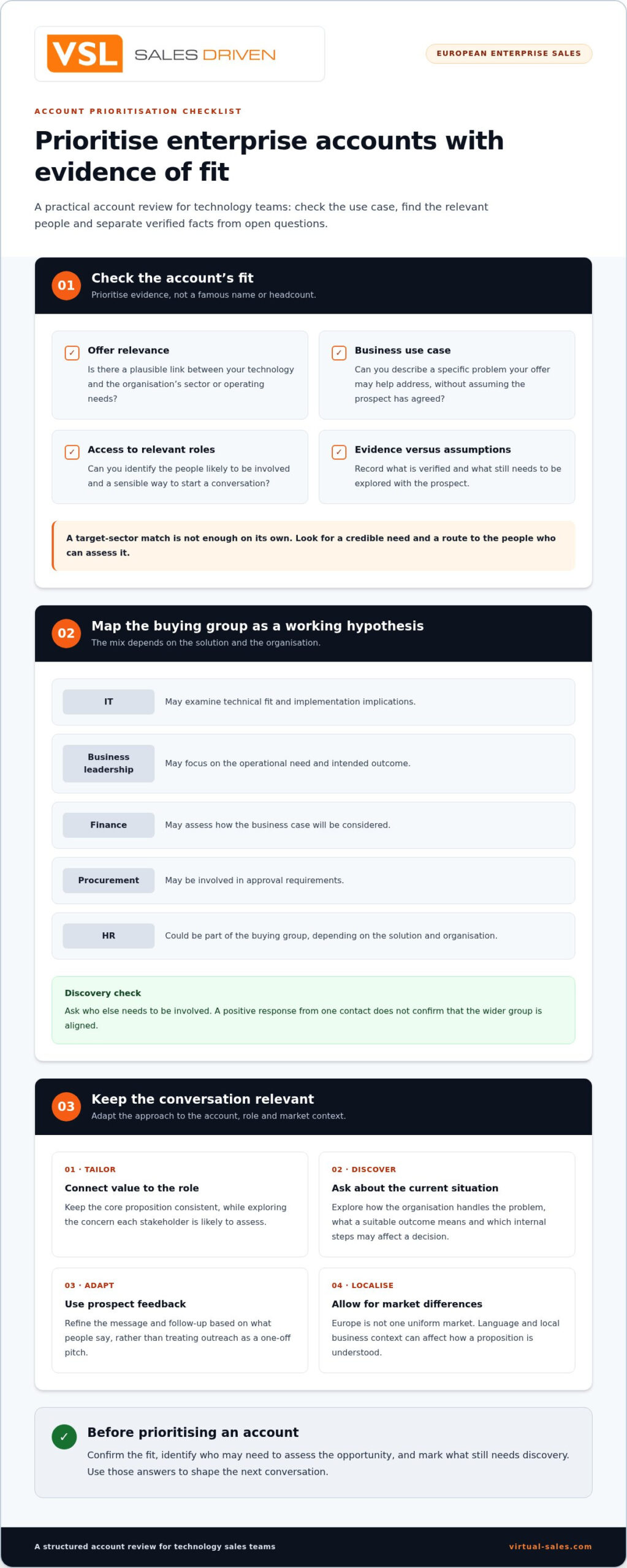
A potential buying group might include IT, Finance, HR, Procurement and business leadership. The mix depends on the solution and organisation, so treat it as a working hypothesis rather than a fixed model. IT may examine technical fit, a business leader may focus on the operational need, and Finance or Procurement may assess the case and approval requirements. Early conversations should reveal who else needs to be involved.
That discovery keeps outreach grounded in the prospect’s situation. Ask how the organisation handles the problem today, what a suitable outcome would look like and what internal steps could affect a decision. Use the answers to shape follow-up, rather than assuming that a positive response from one contact means the wider buying group is aligned.
Why a European sales plan needs market-level relevance
Language and local business context can affect how a proposition is understood. VSL callers speak French, German, Italian and Spanish, supporting conversations in those languages without assuming the same approach will suit every market. For broader context on resources for organisations expanding across Europe, the Enterprise Europe Network offers an overview of an EU initiative supporting SMEs with international growth.
Make relevance practical: adapt the conversation to the prospect’s role, sector and stated business need, and use feedback to refine your approach. Technology lead generation for technology companies can support that work by identifying and engaging prospective business customers. The aim is to open informed conversations, not to apply one message unchanged across Europe.
Build a European enterprise sales case around the right accounts
Enterprise account selection should start with evidence of fit, not a famous name or a large headcount. Define an ideal customer profile (ICP) that describes the organisations and decision-makers most relevant to your offer. An ideal customer profile is a practical description of the companies most likely to have a need your technology can address.
For each potential account, assess three things: strategic fit, access to relevant roles and a credible business use case. A company may match your target sector but have no clear reason to consider your solution. Another may have a visible operational need, yet no clear route to the people responsible for evaluating it. Record these distinctions before prioritising outreach.
Map likely stakeholders as a starting point, not a fixed buying committee. Depending on the product and organisation, conversations might involve IT, Finance, HR, Procurement or senior business leaders. Note each role’s likely questions, then validate those assumptions through research and prospect conversations.
Prioritise enterprise accounts with a clear fit model
Keep confirmed account facts separate from open questions. For example, a company’s published technology environment may be a confirmed signal; whether its leadership has prioritised a related project may still need to be explored. Marking the difference stops assumptions from becoming sales claims.
Sales and marketing should agree the account criteria before outreach begins. Compare each target against the same practical tests:
- Offer relevance: Is there a plausible connection between the technology and the organisation’s sector or operating needs?
- Business use case: Can the team describe a specific problem the offer may help address, without assuming the prospect has already agreed?
- Access: Can the team identify relevant roles and a sensible way to begin a conversation?
- Evidence: Which details are verified, and which need discovery?
This shared view helps teams distinguish genuine fit from brand recognition. It also gives marketing a clearer basis for account-specific material and helps sales focus on prospects where a relevant conversation is possible.
Adapt the proposition without losing its core value
Keep the central value proposition consistent, but connect it to the concern each stakeholder is likely to explore. IT may want to understand technical fit and implementation implications. Finance may ask how the business case will be assessed. A business leader may focus on the operational outcome. Treat these as prompts for discovery, not assumptions about an individual’s priorities.
Prepare market-relevant wording and language support where appropriate, while keeping the underlying claim accurate. Use prospect feedback to identify unclear terms, objections and stronger ways to describe the business need. For SaaS teams refining this work, SaaS lead generation for scalable growth offers related guidance.
A disciplined ICP and account plan give your team a stronger basis for prioritising European enterprise prospects. If you’re considering external support for prospect conversations, you can also review VSL’s published Clutch profile as part of your research.
Real insight: keep enterprise outreach relevant, qualified and evidence-led
Illustrative scenario: A technology firm wants to sell a new data management platform to large organisations across several European markets. Its first ideal customer profile (ICP) is too broad: it includes organisations from different sectors, with varied technology environments and no shared indication of a pressing need. Initial conversations produce mixed feedback, which makes it difficult to tell whether the issue is the target account, the proposition or the way it is explained.
The team reviews what prospects actually said and separates account facts from assumptions. It narrows the ICP to organisations where the platform has a credible use case, then adjusts the opening message to focus on the relevant business problem rather than a list of product features. In consultative, script-free conversations, the caller explores how the prospect handles that problem, what requirements matter and who else may need to assess a solution.
A prospect might explain that a technical review would be useful, but that Finance or Procurement would need to be involved before a decision. That is a relevant next step, not evidence that a sale is imminent. The sales team can follow up with the right context, while campaign feedback informs the next account and message refinements. This is the practical discipline behind how to sell to enterprise customers in Europe a guide for technology companies: learn from evidence, qualify carefully and agree a specific next action.
Common enterprise outreach mistakes and their consequences
Broad targeting often combines accounts with different needs, making prospect feedback hard to interpret. Generic messages add to the problem by describing capabilities without connecting them to a business issue. Treating one contact as the whole buying group can also leave technical, financial or operational requirements unexplored. Each weakens the team’s ability to judge fit and plan useful follow-up.
Activity counts alone don’t show whether conversations are progressing. Track what was learned and whether the prospect meets qualification criteria. BANT assesses Budget, Authority, Need and Timeline. It gives sales teams a consistent basis for judging whether an opportunity merits follow-up, without promising a particular conversion or outcome.
What evidence should a technology sales team review?
Review qualified meetings, campaign outcomes, prospect feedback and pipeline contribution where available. Look beyond totals: note which account types engage, which roles participate, what needs recur and why prospects decline or defer. These details can expose a mismatch between the ICP and offer, or show where the message needs clarification.
VSL provides weekly campaign reporting and manages campaign activity through a cloud-based CRM. Campaign data can be output for use with platforms such as HubSpot and Salesforce. These are reporting and data-management processes, not proof of specific client results. Assess their value alongside outcomes recorded by your own sales team. For related guidance on B2B sales pipeline development, focus on the quality and progression of opportunities, not activity in isolation.
VSL’s published Clutch profile and client reviews offer another source to consider when assessing its work. Keep client evidence distinct from illustrative scenarios and your own campaign data.
A five-step framework for selling to enterprise customers in Europe
Enterprise sales need a process that can adapt to the account, the market and what prospects reveal. This framework gives sales and marketing teams a shared way to move from account research to qualified conversations and clear follow-up. It supports decision-making; it doesn’t guarantee meetings or sales. For technology teams, it makes how to sell to enterprise customers in Europe a guide for technology companies more practical: turn account fit into evidence-led activity.
- Define the ICP and select target accounts. Set out the sectors, business needs and technology contexts that indicate a plausible fit. Identify relevant roles in each organisation, treating the stakeholder map as a hypothesis to check through research and conversations.
- Develop a proposition for each audience. Keep the core value consistent, then explain its relevance to the business issue a particular role may care about. Prepare discovery prompts that invite prospects to describe their requirements, current processes and priorities.
- Brief the campaign before outreach begins. Align the offer, account criteria, target roles, conversation approach and desired outcomes. Agree what should count as a qualified opportunity and what information sales needs for follow-up. A clear brief helps internal teams and external support work to the same priorities.
- Engage prospects and qualify opportunities. Experienced UK-based callers can support your sales and marketing team through consultative, script-free business conversations. Qualify leads to BANT as a minimum: Budget, the prospect’s ability to fund a solution; Authority, their role in the decision; Need, the business requirement; and Timeline, the expected timeframe for action.
- Review evidence and refine the approach. Compare campaign outcomes with the original account assumptions. Use prospect feedback to adjust targeting, messaging or qualification criteria, then agree the next action with the relevant sales owner.
Turn account research into relevant conversations
A useful campaign briefing gives callers more than a list of names. It explains why each account is in scope, which roles may be relevant, what the technology does and what the conversation should establish. VSL assigns each campaign a dedicated caller and campaign manager, working as an extension of the client’s team. This gives internal sales leaders room to retain ownership of strategy, complex opportunities and deal progression, while prospect conversations help surface requirements and timely next steps. B2B appointment setting for technology companies can support this early engagement.
Close the loop with qualification and reporting
VSL provides weekly campaign reporting, with campaign analysis and recommendations to inform refinement. VSL uses a cloud-based CRM to manage campaign activity and can output campaign data for use with platforms such as HubSpot or Salesforce. These processes support visibility and follow-up; they aren’t a promise of particular outcomes.
Use this approach when you need a clearer link between account selection, prospect feedback and sales action. Explore VSL’s technology appointment setting service as a way to add experienced outreach support to your team.
When to use external support for European enterprise sales
External support can help when your sales team has a clear growth priority but limited capacity to start enough relevant conversations. It’s most useful when you can define what a suitable account looks like and have internal people ready to follow up on qualified opportunities. In practice, support may fit when you’re:
- Entering a European market and need to test whether your proposition resonates with target organisations.
- Launching a technology offer and want to start conversations with relevant business decision-makers.
- Testing or refining an ideal customer profile before widening account selection.
- Extending prospecting capacity while your internal team focuses on strategy and active opportunities.
External campaign support shouldn’t take ownership away from your sales leaders. Your team remains responsible for the account strategy, technical discussions, complex deal management and opportunity progression. A useful working arrangement connects prospecting activity to those internal owners, with clear criteria for when a conversation should move into the sales pipeline.
How Virtual Sales Limited supports technology-company campaigns
Virtual Sales Limited works as an extension of your sales and marketing team. Each campaign has a dedicated caller and campaign manager. Experienced UK-based callers use consultative, script-free conversations to understand a prospect’s requirements and identify relevant next steps. Leads are qualified to BANT criteria as a minimum: Budget, Authority, Need and Timeline. This gives your sales team a consistent basis for deciding what to follow up.
Campaigns include weekly reporting, and Virtual Sales Limited offers flexible monthly subscriptions without a long-term commitment. Reporting supports review and discussion; it doesn’t promise a particular volume of meetings, leads or sales. The approach behind how to sell to enterprise customers in Europe a guide for technology companies still depends on your account choices, proposition and internal follow-up. External support adds campaign capacity, while your team retains ownership of enterprise relationships.
Decide whether the approach fits your sales priorities
Before adding support, consider three questions. Is your ideal customer profile specific enough to guide account selection? Can your team respond promptly and progress a relevant opportunity once a prospect is qualified? Do the target accounts have a credible use case for your offer, rather than simply fitting a broad sector description?
If the answers are clear, define the campaign scope around the accounts, roles and business needs you want to explore. If they aren’t, refine those priorities first. Campaign activity can generate useful market feedback, but it can’t replace a clear offer or sales ownership. Scope should be tailored to the project, with progress reviewed against qualification, feedback and agreed next steps rather than assumed outcomes.
If you’re considering additional prospecting support, explore Virtual Sales Limited’s technology appointment setting for UK teams and how it could complement your sales and marketing activity.
25+ Years Helping Technology Companies Generate Qualified Sales Meetings
Every successful campaign starts with a conversation.
Turn your European sales plan into focused action
Enterprise growth depends on more than reaching a large number of organisations. It calls for a clear view of which accounts merit attention, what each conversation needs to establish and how your team will act on a qualified opportunity. Treat “how to sell to enterprise customers in Europe a guide for technology companies” as a practical question: which market and accounts should you test first, and what evidence would justify the next step?
Start with a focused campaign scope and clear ownership for follow-up. As your team learns from conversations, use that insight to refine account priorities and sharpen the proposition. VSL, founded in 2001, can support this work as an extension of your sales and marketing team, with experienced UK-based callers, dedicated campaign management, BANT qualification as a minimum and weekly reporting.
A considered first step can help you assess how external support might fit your sales priorities and internal capacity.
Keep the focus on relevant conversations and clear next steps. Your European enterprise sales plan can grow through evidence, discipline and steady progress.
Frequently Asked Questions
How do you sell technology to enterprise customers in Europe?
Start by selecting a market and a narrow set of organisations with a plausible need for your technology. The central question, how to sell to enterprise customers in Europe a guide for technology companies, is best answered through focused research, relevant conversations and clear follow-up. Before expanding outreach, test whether your proposition makes sense to the people you reach and whether your team can support the next stage of evaluation.
What is the best way to reach enterprise decision-makers?
Lead with a relevant business issue, not a feature list. Research the organisation, identify roles likely to be connected to the problem and prepare a specific reason for opening a conversation. For example, if your software helps improve a particular process, ask how the prospect manages that process today. Use the response to decide whether to explore further, involve another stakeholder or close the conversation respectfully.
How do you qualify an enterprise sales lead?
Establish whether the opportunity has a real business need, a decision-making route and a plausible timeframe, then record what the prospect has actually confirmed. Don’t treat interest in a demonstration as proof of a funded project or organisational agreement. Note gaps as questions for follow-up, assign an internal owner and agree the next action. This gives sales a clearer basis for deciding whether the lead merits further attention.
How long does it take to sell to an enterprise customer in Europe?
There’s no reliable single timetable for every enterprise sale. Timing depends on the organisation’s requirements, evaluation process, stakeholder involvement and internal approvals. Rather than forecast from an assumed average, map the next known milestones: discovery, technical assessment, business-case review and a decision point, where these apply. Update the forecast when the prospect confirms new information, and distinguish an agreed date from an estimate your team has made.
Should a technology company outsource enterprise lead generation?
It may suit a company that has a defined target profile and proposition but needs more capacity to open relevant conversations. External support can contribute prospecting and qualification activity; your internal leaders should retain control of market strategy, technical discussions and complex deal progression. Before starting, agree what qualifies as an opportunity, who follows up and how campaign feedback will inform account priorities. Without those owners, additional outreach may not translate into useful pipeline activity.
What does BANT mean in enterprise sales?
BANT stands for Budget, Authority, Need and Timeline. It prompts the sales team to establish whether funding is available or being considered, understand the contact’s role in the decision, clarify the business requirement and explore when the organisation may act. Treat it as a qualification framework, not a checklist that proves a deal will close. If an answer is unknown, record it as an open point rather than making an assumption.
How should a company measure enterprise lead-generation activity?
Track activity alongside evidence of opportunity quality. Useful measures include qualified meetings, campaign outcomes, prospect feedback, progression into sales follow-up and pipeline contribution where your CRM records it. Review why conversations advance, pause or stop, and compare outcomes by account type or audience. These measures help teams improve targeting and messaging; activity totals alone can’t show whether prospects fit your offer or whether sales has a viable next step.

Disclaimer
Disclaimer: Content is for general information only and does not constitute professional advice. Results may vary. Virtual Sales Limited accepts no liability for actions taken based on this content.
Tags: B2B Appointment Setting, bant qualification, consultative outreach, enterprise sales, European Expansion, pipeline development, SaaS Sales, technology lead generation