AI and Human-Led Prospecting for B2B Growth
For many UK technology businesses, the challenge is not finding more company records. It is deciding which accounts deserve attention, understanding what matters to the people involved and creating useful sales conversations. AI can make research and prioritisation more efficient, but it cannot replace commercial judgement. The strongest approach combines AI-supported preparation with experienced people who can qualify, adapt and build trust.
Key Takeaways
- Use AI to organise research and prioritise accounts, while keeping people responsible for commercial decisions.
- Define your ideal customer profile and BANT qualification criteria before introducing automated scoring.
- Build human review into account selection, message approval and prospect conversations.
- Measure qualified opportunities and sales progression, not just the volume of activity.
- Choose technology that fits your data, workflow and team, then improve the process through regular feedback.
1. What are AI agents for B2B lead generation?
AI agents are software systems that carry out defined research or sales-support tasks. They can gather company information, organise account records, identify possible buying signals or prepare a first draft for review. For example, an agent could summarise a software company’s published business priorities and highlight information for a salesperson to check.
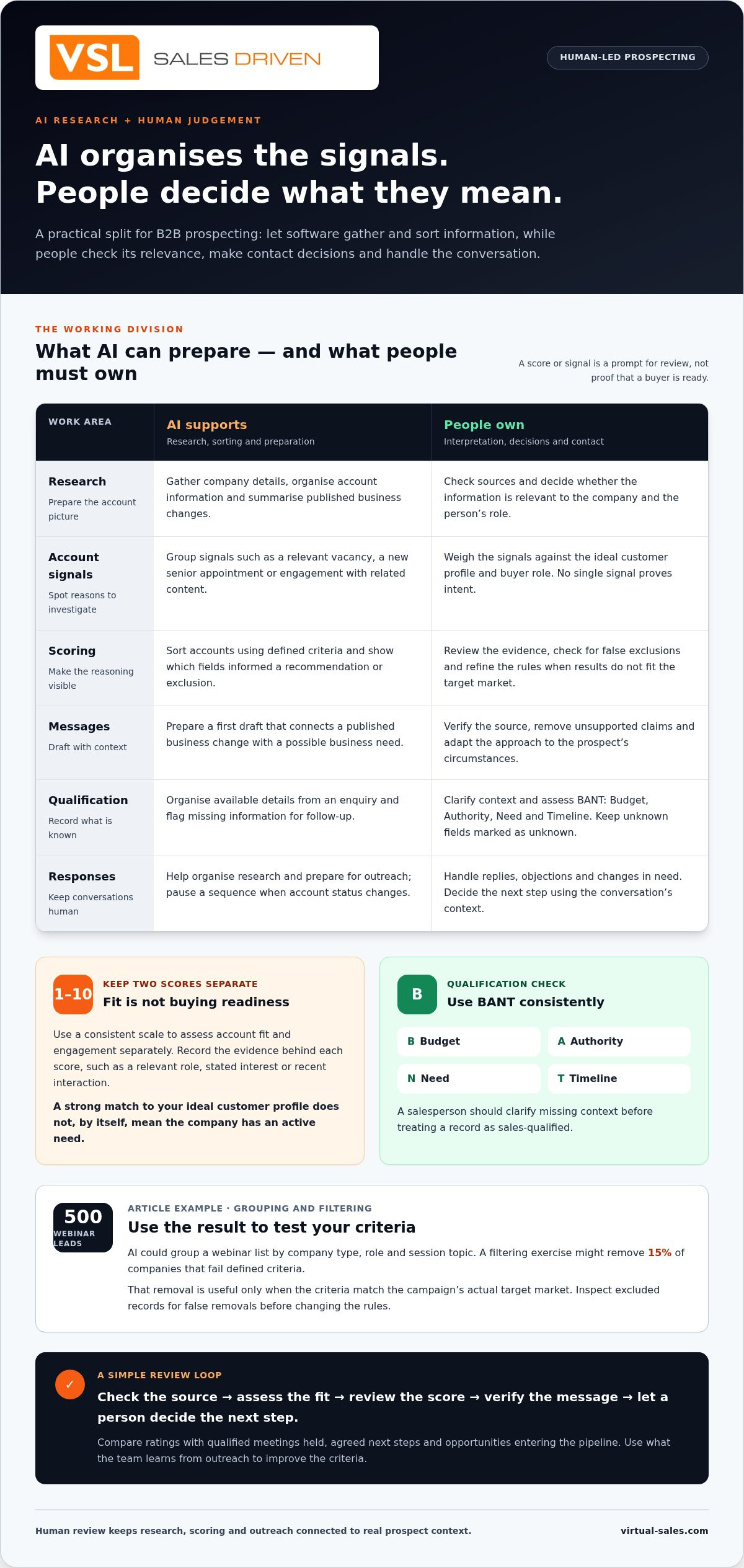
Human-led prospecting remains responsible for interpreting that information and deciding how to approach a prospect. A practical division of work is straightforward: AI gathers and sorts evidence, while a salesperson checks its relevance, selects the right accounts and adapts the conversation to the person’s situation. This keeps efficiency without treating an automated recommendation as proof of buying intent.
UK businesses also need a clear approach to data and communications. UK GDPR applies when personal data is processed, while PECR covers electronic marketing and certain communications. The Information Commissioner’s Office distinguishes between corporate subscribers and individuals, so teams should consider the recipient, channel and purpose before using AI-supported outreach.
2. AI research, qualification and prospect scoring
Start with an ideal customer profile before asking AI to rank accounts. Define the sectors, organisation characteristics, buyer roles and business needs that matter to your proposition. For a UK SaaS company, this might include a target industry, a relevant operational challenge and access to a decision-maker in IT, Finance or Procurement. Clear criteria make automated recommendations easier to review.
Separate account fit from buying readiness. A company may match your ideal customer profile without having an active project. Ask AI to organise evidence for each dimension rather than produce an unexplained overall score. Record why an account was prioritised, including the source and date of important information, so a seller can challenge or update the recommendation.
Qualification requires a conversation as well as an account score. Use BANT consistently by assessing Budget, Authority, Need and Timeline. AI can organise information from research or an enquiry, but a salesperson should clarify missing context before treating a record as qualified. Unknown fields should remain unknown rather than being inferred.
Data quality is equally important. Deduplicate records, update outdated roles and standardise fields such as sector and company size before using automated prioritisation. VSL uses a cloud-based CRM to track campaign activity and outcomes, with campaign data that can be exported for use with platforms such as HubSpot and Salesforce. This supports handover without assuming an unverified direct integration.
Once your criteria are clear, UK technology appointment setting can provide a human-led route to relevant decision-makers and help test whether account assumptions stand up in real conversations.
3. Sales prospecting adoption and productivity statistics
AI adoption alone is not a measure of sales effectiveness. A tool may help a team research more accounts, but that activity only matters if it produces relevant conversations and qualified opportunities. Review the complete path from account selection to meeting quality, sales progression and useful feedback from sellers.
Capacity is a sensible reason to assess automation. Research and drafting can consume time that would otherwise support account conversations and follow-up. If AI reduces preparation time, decide in advance how the team will reinvest that capacity: for example, by checking more relevant accounts, improving qualification or following up promptly with suitable prospects.
How does AI prospecting affect B2B conversion rates, pipeline growth and sales productivity? It can improve research efficiency and help sellers focus their attention, but it does not guarantee higher conversion. Track qualified meetings, progression into sales opportunities and time saved together. For SaaS teams, the wider process behind scalable SaaS lead generation remains just as important as the technology.
Assess tools against a defined use case, data quality, workflow fit, adoption and reporting. A focused pilot is more useful than buying several platforms at once. Agree what success means, assign an owner and compare the results with your existing process. This shows whether AI is improving prospecting or simply adding another layer of administration.
4. AI adoption barriers and seller training
Adoption often stalls when sellers do not trust the output or do not know how it fits their daily work. Inaccurate data, unclear ownership and disconnected systems can send a representative towards the wrong contact or create unnecessary checking. Training should therefore cover the tool, the qualification standards and the point at which a person must review or override its recommendation.
5. Building a practical hybrid prospecting workflow
A mid-market workflow should connect research, prioritisation, outreach and measurement without scattering ownership across disconnected tools. Start with the sales task creating the most friction, such as researching target accounts or routing enquiries. Add technology only when it improves that task and has a clear owner. The aim is a dependable process, not the largest possible stack.
A useful VSL framework is Target, Qualify, Learn and Act:
- Target: define the ideal customer profile and use AI-supported research to identify suitable accounts.
- Qualify: apply BANT criteria and check the evidence with a person before progressing an opportunity.
- Learn: capture what prospects say, including objections, timing and changes in their priorities.
- Act: agree the next step, update the CRM and use the learning to improve targeting and messaging.
This framework keeps automation connected to commercial judgement. Teams exploring the role of relevance in automated outreach may also find AI-driven relevance in B2B outreach useful when reviewing their process.
Build the workflow around a small number of functional layers. Your CRM should hold account records and activity; data sources should support research and enrichment; engagement tools should organise approved outreach; and reporting should connect activity with pipeline progress. AI and human-led prospecting works when these layers support one shared sales process and clear handover between marketing, sales and delivery.
How VSL combines technology with human-led appointment setting
Unlike automated outreach platforms, VSL focuses on genuine conversations with relevant decision-makers. Our experienced UK-based callers work as an extension of each client’s sales team, using consultative questioning and BANT qualification to identify opportunities worth progressing
Put human judgement at the centre of your next AI decision
AI and human-led prospecting is most effective when each has a clear role. Technology can organise information and support prioritisation, while people remain accountable for relevance, qualification and the quality of each conversation. Start with one prospecting task, define the review points and measure whether the change improves qualified opportunities rather than activity alone.
AI can help identify promising accounts, but experienced people turn research into meaningful sales conversations. Virtual Sales Limited combines intelligent targeting with experienced UK-based callers to help technology businesses engage decision-makers, qualify opportunities and build stronger sales pipelines
Discover how our UK Technology Appointment Setting service can help your business build a more qualified sales pipeline, or book an initial discovery call with our team.
Frequently Asked Questions
Can AI replace experienced B2B appointment setters?
AI can accelerate account research, improve data organisation and support prospect prioritisation, but it cannot reliably replace the commercial judgement, adaptability and relationship-building skills of experienced appointment setters. For complex B2B technology sales, combining AI-supported research with human-led conversations provides a practical approach to identifying and qualifying opportunities
What are AI agents for B2B lead generation?
AI agents are software systems that perform defined research or sales-support tasks with limited human prompting. They might sort technology firms by sector, organise account information or prepare research for a salesperson. Their output is a starting point for review, not proof that a company has a current need or intends to buy.
How do you scale a B2B pipeline with AI agents?
Scale by using agents to help the team assess suitable accounts, not simply send more messages. Choose a repeatable task, such as preparing account research, and measure whether it helps sellers identify worthwhile conversations. Expand only when account quality and follow-up remain manageable. People should review priorities, handle replies and update the process when circumstances change.
What is AI-led prospecting in B2B lead generation?
AI-led prospecting uses artificial intelligence to support parts of the process for finding and engaging business prospects. AI may sort records, recommend accounts or prepare drafts, while people decide what is appropriate and lead the conversation. AI and human-led prospecting is therefore a collaborative operating model, whose value depends on how well it supports the sales process.
What are the risks of AI-generated outreach, including bias, inaccurate data and reputational harm?
AI-generated outreach can reflect biased source data, misstate company details or make irrelevant assumptions about a prospect. An incorrect role or organisation reference can undermine trust. Reduce these problems by checking important claims, reviewing messages before use and maintaining a clear process for correcting records and stopping unsuitable outreach.
How can UK businesses measure the ROI of AI and human-led prospecting?
Compare tool and implementation spend, staff time and campaign results against a defined baseline. Track qualified meetings, progression into sales opportunities, stage conversion and time spent on research or administration. Review lead quality as well as volume: more activity is useful only when relevant prospects progress. Combine CRM records with feedback from the people handling conversations.
EXPLORE B2B APPOINTMENT SETTING →

Ready for a pipeline that AI alone can’t build?
See how our AI SDR support combines intelligent automation with experienced SDRs based in the UK. You can also explore our appointment setting and lead generation services.
Get me more leadsDisclaimer
Disclaimer: Content is for general information only and does not constitute professional advice. Results may vary. Virtual Sales Limited accepts no liability for actions taken based on this content.
Tags: AI prospecting, B2B Lead Generation, human-led prospecting, Lead Qualification, prospect research, Sales Pipeline, Sales Technology, technology sales