How AI Reveals Hidden Sales Pipeline Opportunities
Could an overlooked account be closer to a buying decision than the deals topping your forecast? Understanding How AI Can Reveal Hidden Opportunities in Your Sales Pipeline starts with looking beyond headline scores to changes in engagement, account activity and deal momentum.
If you manage sales for a UK technology, SaaS or IT services business, you’ll know the challenge: a crowded CRM can hide promising prospects, while a stalled opportunity report doesn’t always show what to do next. AI can scan pipeline data for patterns that are easy to miss, but a score alone doesn’t prove that an account is ready to talk. Inconsistent records and missing context can produce false signals.
This article explains how to use AI to flag overlooked accounts, stalled deals and meaningful shifts in activity, then test those signals against your team’s knowledge and sales judgement. You’ll learn how to prioritise follow-up using evidence, identify a relevant reason to make contact and turn validated insight into a useful business conversation. The aim isn’t more activity for its own sake. It’s clearer decisions and qualified pipeline opportunities.
Key Takeaways
- Use AI to spot patterns across account fit, deal movement and engagement, but treat each alert as a lead to investigate, not a verdict.
- How AI Can Reveal Hidden Opportunities in Your Sales Pipeline depends on the quality and consistency of the CRM data behind its signals.
- Check each signal against account fit, deal history, source and recency before changing a forecast or starting outreach.
- Assign a sales owner to validate signals and record whether the next step is follow-up, further research or no action.
- Turn confirmed needs into relevant conversations, with qualified outreach helping assess Budget, Authority, Need and Timeline.
What AI can reveal about overlooked sales pipeline opportunities
A hidden opportunity isn’t necessarily a brand-new prospect. It may be a relevant account, a change in an active deal or a useful next step that routine pipeline reviews haven’t brought to the surface. AI can help identify patterns across the CRM and available engagement data, giving sales teams a prompt to investigate. It can’t confirm that a buyer is ready to act.
An AI-identified pipeline opportunity is an account, deal signal or possible next step flagged in available data for a salesperson to review and validate.
That distinction matters. A cluster of activity might be worth checking, but it doesn’t establish need, authority, budget or timing. Treat AI as a pattern-finding aid, not an automatic buyer-intent verdict. Its usefulness depends on having relevant records to analyse and a clear sales process for reviewing what it finds. The principles of sales process engineering offer useful context for designing that review into your existing stages and team responsibilities.
Which pipeline records can AI help bring into view?
AI can flag deals that have stopped progressing, a change in engagement or follow-up that appears incomplete. It may also highlight an existing account showing signs of a new need, if the available records support that possibility. These are review prompts, not proof of intent: a gap in activity could reflect a delayed project, incomplete CRM updates or an interaction captured elsewhere.
Check data quality before acting. Missing dates, inconsistent deal stages or outdated contact details can hide meaningful patterns or create misleading ones. A lead-scoring approach to building a sales pipeline can help frame prioritisation, but the score should lead to investigation, not replace it.
What counts as a real sales opportunity?
A real opportunity fits your ideal customer profile and has a credible place in your sales stages, supported by evidence of a relevant business need and a sensible next step. Qualification should reflect your company’s criteria, not simply a model’s ranking. For a qualified BANT lead, assess Budget, Authority, Need and Timeline through appropriate sales conversations.
A high score alone doesn’t establish a qualified opportunity. Assign a salesperson to check the account context, confirm what the signal means and decide whether to follow up, gather more information or take no action. That human review turns a data flag into a considered sales decision.
Which AI signals can expose overlooked pipeline opportunities?
AI can sort available sales information into patterns that deserve a closer look. For UK technology businesses, useful signals often fall into four groups: account fit, deal progression, changes in engagement and records that appear to need follow-up. The precise signals depend on what your CRM captures and what the AI tool can access.
A signal should trigger investigation, not be treated as evidence of buyer intent. A change in recorded activity may have several explanations. Check the surrounding account history and what the prospect has actually said before deciding what it means.
Account fit and changes in engagement
Start by comparing company and decision-maker records with your ideal customer profile. Relevant fields might include sector, organisation size, role and existing relationship history, if your CRM holds them. AI may help surface accounts that match your criteria but have received little attention.
It can also flag a change in documented engagement or a stated requirement. But one isolated interaction doesn’t confirm buying intent. Look for corroborating context, such as a relevant business need recorded by a salesperson or a meaningful change in the prospect’s own communications.
Stalled deals, pipeline movement and follow-up gaps
Review opportunities that have stayed in a stage longer than your team’s expected process, or where the recorded next step has passed without an outcome being added. AI can help draw attention to these records, but it won’t know whether a delay reflects a genuine obstacle, an agreed pause or an update that was never entered.
Assign an owner to check the deal history, confirm the next step and update the record. Practical sales pipeline management guidance can help teams establish consistent stages and review habits, giving AI more useful information to work with.
Separate CRM signals from tool-specific capabilities
Basic prompts can come from fields many teams already record: account fit, deal stage, last activity, next-step date and meeting outcomes. Other signals, such as patterns across website behaviour or activity held outside the CRM, depend on whether the relevant data is available to the AI tool. Don’t assume a system can see information it hasn’t been given access to.
Data gaps matter. If one salesperson records meeting outcomes and another doesn’t, an apparent engagement drop may reflect inconsistent data entry rather than a change in prospect interest. Before acting on a pattern, check field completeness, date accuracy and stage definitions. How AI Can Reveal Hidden Opportunities in Your Sales Pipeline depends partly on whether the underlying records are relevant and consistently maintained.
How to tell a genuine opportunity from an AI-generated false signal
An AI score can help your team decide which records to inspect first. It can’t confirm a buyer’s requirements on its own. Before changing a forecast, treating a record as qualified or contacting a prospect, check the evidence and ask a named sales owner to confirm that the signal is relevant.
Use this comparison to guide the review:
Signal
Supporting evidence
Missing context to check
Appropriate next action
Engagement rises
Several recent, relevant interactions are recorded.
Are the contacts relevant, and is the activity current?
Ask the owner to review the account history before outreach.
Deal appears stalled
The stage and next-step dates show no recorded progress.
Was a delay agreed, or has an update been missed?
Confirm the status with the owner and update the record.
Account scores highly
Recorded company and decision-maker details match the ideal customer profile.
Are the details accurate, complete and recent?
Check data hygiene and account fit before prioritising follow-up.
A simple validation checklist for AI pipeline signals
Keep the review consistent. Confirm the account and decision-maker fit your ideal customer profile, then compare the alert with CRM records, deal-stage history and the source and recency of the signal. Note any missing or inconsistent fields. A recent activity alert based on an outdated contact record needs a different response from a documented change in requirements.
- Owner: Name the person responsible for checking the signal.
- Next action: Record whether to follow up, gather more context or take no action.
- Outcome: Log what the review confirmed, so future decisions have better context.
Why a score is not the same as qualification
A score ranks records using available inputs and the assumptions built into a model. Missing data, inconsistent stage updates or an unsuitable scoring rule can affect that ranking. It doesn’t confirm Budget, Authority, Need or Timeline. Those require appropriate qualification, including direct confirmation where needed.
That’s why guidance on AI leads and sales outcomes should sit alongside a clear human review process. How AI Can Reveal Hidden Opportunities in Your Sales Pipeline is by prioritising investigation; a sales owner must establish whether there’s a genuine, qualified opportunity.
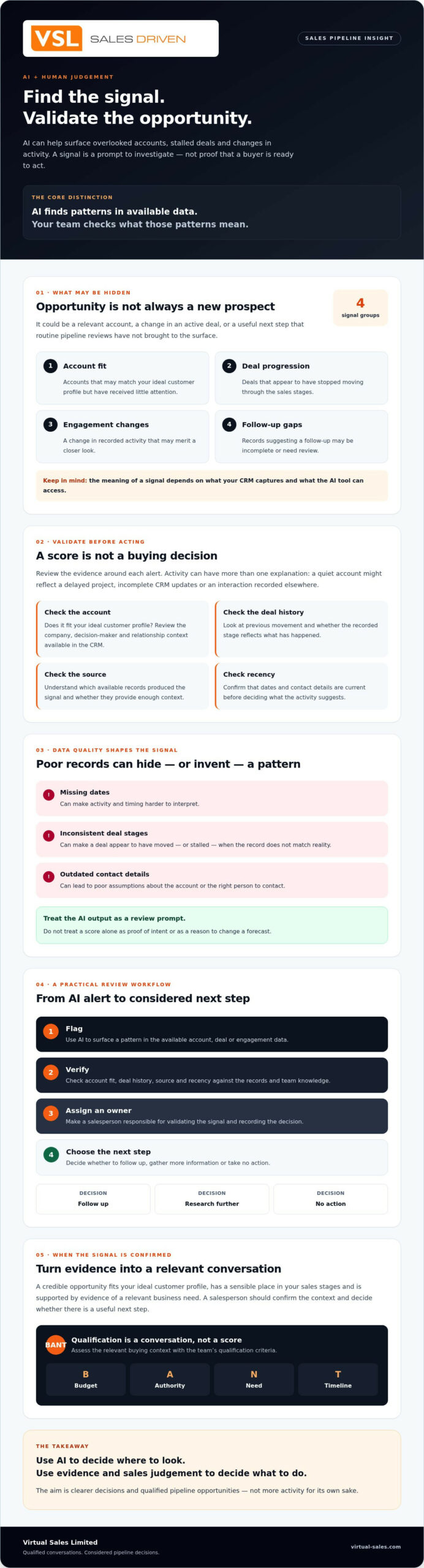
A practical workflow for turning AI pipeline signals into action
AI can flag records for review, but your team needs a clear process to decide what happens next. The following VSL framework connects a signal to a human-checked sales action. Assign a named sales owner to each record before outreach or forecast changes.
The VSL signal-to-conversation framework
- Define: Set your ideal customer profile, sales stages and the signals worth reviewing.
- Inspect: Check the relevant CRM records, data quality, stage history and related activity.
- Validate: Ask the account owner to confirm the signal fits the known prospect context.
- Engage: Where appropriate, use consultative, script-free conversations to explore the prospect’s requirements and qualify to BANT criteria as a minimum.
- Review: Record the outcome and feedback, then use them to inform future reviews.
Real Insight: hypothetical software-company scenario
This is a hypothetical example, not a VSL client result. A software company’s AI flags an existing account after a change in recorded engagement. The sales owner checks the CRM and finds that the main contact and next step may be out of date. Before reaching out, the owner verifies the right contact and reviews the account history. A relevant conversation can then establish whether there’s a current need. The AI signal starts the investigation; it doesn’t qualify the opportunity.
What to capture after a prospect conversation
Record the prospect’s stated need, their role, timing and any agreed next step, but only where confirmed. Mark unknown details as unconfirmed, and classify the outcome accurately rather than upgrading a record because of its score. Preparing relevant questions can help the owner test a signal; see how AI can support preparation before a sales call.
That’s how AI can reveal hidden opportunities in your sales pipeline: it directs attention, while accountable owners and prospect feedback guide the next decision.
🚀 Want to discover how AI-powered insight combined with experienced UK appointment setters can generate more qualified B2B sales opportunities? Learn more: AI-powered B2B lead generation and appointment setting.
Where VSL’s qualified outreach fits after AI identifies a signal
AI can help your team decide which account records deserve attention. A relevant business conversation can then establish whether a signal reflects a genuine need. Virtual Sales Limited provides B2B Appointment Setting and Lead Generation for technology companies. It doesn’t provide AI services; its role is to support qualified conversations after your team has reviewed an account.
When a technology business may need human follow-up
Human-led follow-up may suit your team when it needs qualified conversations with relevant business decision-makers. Possible scenarios include entering a market, testing an ideal customer profile or reviewing an underused prospect database. These are situations to assess, not promised outcomes. The right approach depends on your proposition, target accounts and available evidence.
Virtual Sales Limited assigns a dedicated caller and campaign manager to each campaign. Experienced UK-based callers use consultative conversations without scripts and qualify leads to BANT criteria as a minimum: Budget, Authority, Need and Timeline. Virtual Sales Limited works as an extension of your sales and marketing team, with weekly reporting to support campaign review.
Results, Evidence & Data
Virtual Sales Limited was founded in March 2001 and serves technology companies in the UK and USA. These are company facts, not evidence of a particular campaign outcome. No campaign results, client case studies or performance statistics are claimed in this section. Assess results using verified campaign data or published evidence, and attribute any third-party research to its source.
Evidence, CRM handling and next steps
Virtual Sales Limited uses a cloud-based CRM to manage campaign activity and can output campaign data for use with platforms such as HubSpot and Salesforce. This does not imply a direct integration. AI may help identify records to review, while human-led conversations help establish whether a prospect’s requirements support further follow-up.
If you want to discover how AI-powered insight combined with experienced UK appointment setters can generate more qualified B2B sales opportunities, you can learn more about AI-powered B2B lead generation and appointment setting with Virtual Sales Limited.
Turn pipeline signals into confident next steps
AI can help your team spot patterns across account and deal records, but a signal is a prompt to investigate, not proof of buying intent. Check the account context, data quality and deal history, then give a named sales owner responsibility for deciding what happens next.
That’s the practical answer to How AI Can Reveal Hidden Opportunities in Your Sales Pipeline: use AI to focus attention, then validate the opportunity through sales judgement and relevant conversations. Clear records of prospect feedback and agreed next steps help your team make better-informed reviews over time.
Founded in March 2001, VSL supports technology companies in the UK and USA with B2B Appointment Setting and Lead Generation. Experienced UK-based callers use consultative, script-free conversations and qualify leads to BANT criteria as a minimum. A dedicated campaign manager and weekly reporting support transparent review.
With a clear process and the right human follow-up, your team can turn overlooked signals into more relevant sales conversations.
Frequently Asked Questions
Can AI identify hidden opportunities in a sales pipeline?
Yes, AI can flag patterns in available pipeline and engagement data, such as stalled records or changes in recorded activity. Treat these as prompts for review, not proof that a prospect intends to buy. Check the account’s fit, data quality and deal context, then ask the sales owner to validate the signal before changing priorities or contacting the prospect. How AI Can Reveal Hidden Opportunities in Your Sales Pipeline depends on that human check.
How does AI find sales opportunities in CRM data?
Depending on the tool and information available, AI can compare CRM records, activity and pipeline history to surface patterns for review. Its findings depend on the quality and relevance of those inputs. Check which data the tool uses and whether records are current. Then ask the account owner to verify any suggested opportunity against the prospect’s history and known requirements before deciding on a next step.
Can AI predict which sales deals will close?
AI may help assess patterns linked to pipeline movement, but a prediction can’t guarantee that a deal will close. Its value depends on the data, assumptions and sales process behind the analysis. Review the evidence and buyer context, including the prospect’s stated requirements and agreed next steps. Use the output to inform your assessment, not replace professional judgement or clear qualification.
What data does AI need to analyse a sales pipeline?
Useful inputs may include accurate account and contact details, opportunity stages, recorded activity and documented next steps, depending on the tool. There’s no universal data requirement across platforms. Before relying on an analysis, check that records are up to date, access is appropriate and CRM fields reflect how your team actually sells. Incomplete or inconsistent information can make a pattern harder to interpret.
How can sales teams check whether an AI-identified lead is qualified?
First, check that the account fits your ideal customer profile. Then validate the prospect’s needs and circumstances through suitable research or a business conversation. For a qualified BANT lead, assess Budget, Authority, Need and Timeline. A model score or engagement signal isn’t qualification. Record what the prospect has confirmed, what remains unknown and who owns the next action, so the team can make a considered decision.
Does AI replace human judgement in pipeline management?
No. AI can help your team inspect records and spot patterns, but people still need to interpret context, confirm prospect requirements and choose an appropriate next step. Human review is particularly useful when records are incomplete or a signal conflicts with the account owner’s knowledge. Use AI to focus attention, then apply informed sales judgement before contacting a prospect, qualifying an opportunity or changing a forecast.

Ready for a pipeline that AI alone can’t build?
See how our B2B appointment setting with AI combines intelligent automation with experienced SDRs based in the UK. You can also explore our appointment setting and lead generation services.
Get me more leadsDisclaimer
Disclaimer: Content is for general information only and does not constitute professional advice. Results may vary. Virtual Sales Limited accepts no liability for actions taken based on this content.
Tags: AI in Sales, Appointment Setting, B2B Lead Generation, pipeline management, SaaS Sales, Sales Pipeline, technology sales, UK technology