How MSPs Start Conversations Before IT Renewals
This guide is for sales leaders and business development teams at UK managed service providers (MSPs) looking to win new business from organisations that already have an IT provider. The objective is to start relevant conversations before those prospects review their contracts, identify genuine review triggers and decision-makers, and qualify meetings that are worth a senior MSP representative’s time.
Key Takeaways
- Identify contract review windows and notice requirements so prospects have time to evaluate alternative providers when the timing is relevant.
- Distinguish between day-to-day administrative contacts and commercial decision-makers such as Managing Directors, Finance Directors and Operations Heads.
- Uncover practical review triggers such as slow ticket resolution, recurring outages or upcoming office expansions rather than assuming the incumbent has failed.
- Use script-free, consultative qualification questions to establish contract terms, service priorities and commercial decision criteria.
- Qualification criteria should be agreed individually with each client before outreach begins, with BANT applied where campaign requirements dictate.
- Experienced, UK-based B2B appointment setters can help MSPs create new-business conversations with organisations approaching a provider review.
Why Contract Reviews Create Prospecting Opportunities
Many commercial organisations operate under fixed-term agreements for managed IT support. For MSP sales leaders, contacting a prospect while it is committed to an existing provider can lead to rejection if the conversation focuses on an immediate changeover. When outreach aligns with an upcoming contract review or another relevant business trigger, the prospect has a clearer reason to discuss its current arrangements and future requirements.
A prospect may review its supplier base when there is a clear commercial or operational prompt. Its agreement may include renewal, rollover and written-notice provisions that affect when a change can be considered. Identifying those terms during an early conversation helps an MSP understand the prospect’s buying process without assuming a standard contract structure.
Engaging a prospect before its review date gives the commercial team an opportunity to understand requirements, compare service expectations and identify the people involved in the decision. It also gives the prospect time to consider recurring service frustrations without the immediate pressure of an emergency supplier handover. By focusing outbound prospecting on the prospect’s own commercial timetable, MSPs can turn cold calls into structured business conversations.
Identifying Practical Review Triggers and Pain Points Before Expiry
Price may be one consideration, but review triggers often relate to the gap between an organisation’s changing requirements and its incumbent provider’s responsiveness. Successful MSP prospecting explores these practical operational issues during initial conversations rather than assuming that the incumbent has failed.
Illustrative examples of review triggers include:
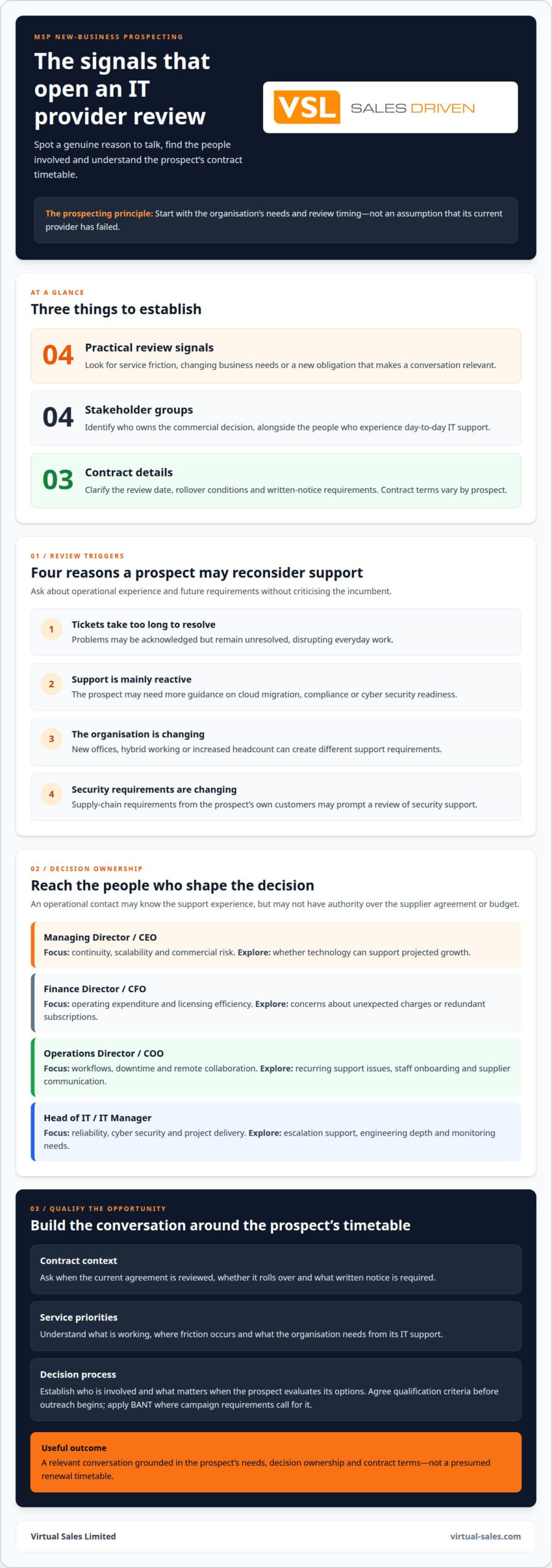
- Response and resolution latency: Helpdesk tickets may be acknowledged promptly but take too long to resolve, particularly when recurring software, network or access problems disrupt daily operations.
- Strategic stagnation: The incumbent provider operates mainly as a reactive helpdesk and does not provide the guidance the prospect needs on cloud migration, compliance or cyber security readiness.
- Organisational expansion: The prospect has opened new offices, introduced hybrid working or increased headcount, creating new demands that its current supplier may not be equipped to support.
- Billing surprises: Out-of-scope invoices for onboarding, hardware configuration or remote-access setup create dissatisfaction with the current pricing model.
- Cyber security uncertainty: The prospect faces stricter supply-chain requirements from its own customers and is reviewing whether its current provider can support its security obligations.
When conducting consultative sales outreach, the goal is not to aggressively criticise the incumbent. Instead, professional callers ask objective questions that allow the prospect to reflect on whether their current technology setup actively supports their upcoming commercial plans.
Finding and Engaging Key Decision-Makers in Contracted Businesses
A contact who works with the incumbent’s helpdesk every day may not have authority to cancel an existing supplier agreement or reallocate IT budget. MSP sales teams should therefore establish whether they are speaking with an operational contact, a commercial decision-maker or someone who can introduce the relevant stakeholder.
To establish meaningful commercial dialogue ahead of a contract review, sales teams should identify the people responsible for operational risk, profitability, productivity and technology delivery. Depending on the prospect’s structure, this may include the Managing Director, Finance Director, Operations Director, Head of IT or IT Manager.
| Stakeholder | Likely priorities | Useful discussion areas |
|---|---|---|
| Managing Director / CEO | Business continuity, scalability and commercial risk. | Whether the current IT arrangement supports business plans and acceptable levels of risk. |
| Finance Director / CFO | Predictable expenditure, value and licensing efficiency. | Contract costs, out-of-scope charges and the criteria used to compare providers. |
| Operations Director / COO | Workflow efficiency, user downtime and collaboration. | Helpdesk performance, onboarding requirements and supplier communication. |
| Head of IT / IT Manager | Infrastructure reliability, cyber security and project delivery. | Technical capability, escalation support, monitoring and upcoming technology projects. |
Engaging these commercial leaders requires an outreach tone focused on the prospect’s business priorities rather than technical specifications. Explore operational risk, data protection, service continuity and efficiency, then connect those concerns to the prospect’s plans and supplier-review process. For example, a Managing Director may prioritise continuity during expansion, while a Head of IT may want confidence that the provider can support security and infrastructure projects.
Usable Qualifying Questions to Uncover Renewal Timelines and Notice Periods
To assess whether a conversation is worth progressing, business development professionals need factual information without making the prospect feel interrogated. Experienced callers use a conversational, consultative approach to explore review timing, notice requirements, service priorities and the decision process. The aim is to understand the prospect’s position, not to force an immediate change of provider.
Uncovering the Contract Expiry Date and Rollover Conditions
Illustrative questions: Begin by establishing the current contractual timeline so the MSP can understand when commercial discussions may become relevant:
- "When does your existing IT support agreement come up for formal commercial review?"
- "Does your current agreement operate on an annual rollover, or do you have a multi-year commitment in place?"
- "What notice does your current provider require if your organisation decides to review the market?"
- "When do internal budget discussions begin ahead of that review or notification deadline?"
Evaluating Service Alignment and Identifying Subtle Friction
Illustrative questions: Once the timeline is established, explore whether the incumbent’s service model continues to meet the prospect’s operating requirements:
- "When your team logs a high-priority ticket, what is your realistic turnaround time for a complete fix, rather than just an automated receipt?"
- "How often does your provider sit down with you for a formal technology review to map out upcoming projects and security updates?"
- "Are you currently seeing any unexpected invoices for items you assumed were covered under your core monthly user fee?"
- "If your company expands or adds remote locations over the next 12 months, does your current support structure easily adapt to that change?"
Confirming Commercial Decision-Making Authority
Illustrative questions: Clarify how supplier reviews are evaluated and approved within the prospect’s organisation:
- "Aside from yourself, who else participates in evaluating technology partnerships when contracts approach renewal?"
- "What specific criteria will your executive team use to determine whether to renew with the incumbent or benchmark external providers?"
- "What would a prospective MSP need to demonstrate for the organisation to consider a change of provider?"
Documenting these details gives the MSP sales team a clear basis for a relevant follow-up. Rather than calling blindly, representatives can return to the prospect with verified review information, stated service priorities and the names or roles of the decision-makers involved.
Structuring Pre-Renewal Sales Conversations Without Rigid Scripts
Commercial decision-makers are more likely to engage when the caller understands the prospect’s business context and adapts the discussion accordingly. A consultative, script-free approach allows experienced professionals to explore subjects such as network resilience, multi-site operations, compliance or cloud projects without forcing the conversation into a fixed pitch. The objective is a useful business discussion that establishes whether a future review conversation is appropriate.
A natural pre-renewal sales conversation follows a deliberate structure that focuses on dialogue rather than pitch delivery:
- Set the context: Acknowledge that the prospect is likely to have an existing IT support arrangement. Explain that the purpose of the call is to understand when that arrangement may be reviewed and whether the organisation expects to compare providers.
- Explore operational priorities: Ask about upcoming initiatives such as software roll-outs, mergers, acquisitions, office moves or changes to hybrid working. Discuss whether the current support model is equipped to meet those requirements.
- Identify relevant friction: Explore areas where the current arrangement may not be meeting expectations. If the prospect mentions slow resolution, limited account management or recurring service issues, ask how those issues affect the organisation.
- Understand the review process: Clarify the criteria the prospect will use, the people involved and any procurement or notice requirements. Keep the conversation focused on the prospect’s needs rather than criticising its incumbent provider.
- Agree a suitable next step: If the prospect has a relevant review trigger, appropriate decision-maker involvement and interest in comparing options, agree a suitable meeting with an MSP representative. If the review is not active, record the agreed timing for a future conversation.
This conversational structure helps MSPs distinguish between a general enquiry and a relevant new-business opportunity. For guidance on creating these conversations with organisations that already have an IT provider, see VSL’s MSP appointment-setting service.
Qualifying Pre-Renewal Opportunities for an MSP Sales Pipeline
Not every prospect with an existing IT provider is ready to discuss an alternative. A useful qualification process helps MSP sales teams prioritise prospects whose requirements, authority, budget and timing fit the service they provide, while avoiding unnecessary demands on senior technical and commercial resources.
Qualification criteria should be established and agreed individually with each client before an outbound campaign begins. BANT—Budget, Authority, Need and Timeline—may then be applied where it suits the campaign requirements, helping the MSP and its appointment-setting partner assess whether a meeting matches the agreed definition of a qualified opportunity:
- Budget: What budget has the prospect allocated for managed IT support, and how will costs be assessed during the review?
- Authority: Who owns the supplier decision, who contributes to the evaluation and who provides final approval?
- Need: What operational, service or security requirements are prompting the prospect to consider its options?
- Timeline: When is the agreement due for review, what notice requirements apply and when will the prospect begin evaluating providers?
Recording these points gives the MSP a practical basis for deciding whether a meeting is appropriate and what the follow-up should cover. For more detail on applying BANT lead qualification, see VSL’s guidance. Accurate notes on review timing, stated requirements and decision-makers can also support a more informed MSP sales pipeline and better prioritisation in B2B sales.
Virtual Sales Limited
Virtual Sales Limited (VSL) is a UK-based B2B appointment-setting and lead-generation specialist. VSL helps managed service providers, software vendors and technology companies open relevant new-business conversations.
Operating across the United Kingdom, Europe and the USA, VSL acts as an integrated extension of an internal sales and marketing team. B2B appointment-setting and lead-generation campaigns are delivered by experienced UK-based callers using a consultative, script-free approach. Callers engage relevant decision-makers and explore review triggers, requirements and contract timing.
Every campaign is managed by a dedicated campaign manager, providing transparent weekly reporting and tracking of prospect outcomes. Qualification criteria are agreed individually with each client before outreach begins, with BANT applied where the campaign requirements dictate. VSL operates on flexible monthly subscriptions with no long-term contracts, no set-up fees and no commission structures. For broader context, see this practical guide to outsourced business development.
Book a 15-minute discovery call
To discuss your requirements, contact Virtual Sales Limited.
Making Pre-Renewal Outreach a Consistent MSP Sales Activity
MSPs seeking new business can use pre-renewal outreach to engage organisations that already have an IT provider. The purpose is not to pressure a prospect into changing supplier immediately, but to identify when its requirements, contract position or business plans may create an appropriate reason to review support.
Tracking relevant business changes, review dates and decision-makers across target organisations gives an MSP useful context for future conversations. A prospect that is satisfied with its incumbent today may still review its arrangements when requirements change, a contract milestone approaches or a service issue affects operations. A professional early conversation allows the MSP to understand the prospect’s process and agree when contact would be relevant.
By treating pre-review outreach as a planned business-development activity, MSPs can keep their prospecting focused on identifiable triggers, appropriate stakeholders and qualified next steps rather than relying only on reactive enquiries.
Frequently Asked Questions
How can an MSP build a sustainable new-business pipeline?
Focus outbound activity on prospects whose organisation, sector and technology requirements fit the MSP’s ideal customer profile. Identify a relevant review trigger, establish who contributes to the supplier decision and understand the prospect’s contract timing before proposing a meeting. Illustrative example: a prospect planning an office move may be willing to discuss support requirements even if its current agreement remains in place, provided the conversation is relevant and the timing is recorded for follow-up.
What if a prospect says they are locked into an existing contract?
Acknowledge the prospect’s existing commitment and avoid pressuring them to change provider immediately. Ask when the agreement is due for review, whether notice requirements apply and how supplier decisions are made. Record the information and agree an appropriate point for a future conversation, rather than treating the objection as a permanent refusal.
What questions should an MSP ask before an IT support contract review?
Ask questions that connect contract timing with business needs, such as: “When is your agreement due for commercial review?”, “Are there any service issues or recurring disruptions you want addressed?”, “What technology projects or organisational changes are planned?”, and “Who else will be involved in evaluating support providers?” These questions help establish the prospect’s priorities, decision-makers and next steps without assuming the incumbent has failed.
What outreach approach can an MSP use to start a pre-renewal conversation?
Use a consultative, script-free telephone approach delivered by experienced UK-based callers. Recognise that the prospect is likely to have an IT provider, explain that the purpose is to understand future support requirements, and ask permission to explore the organisation’s review process. Keep the discussion centred on the prospect’s priorities rather than criticising the incumbent or promising a particular outcome.
What should happen when a prospect agrees to continue the conversation?
Agree a clear next step with the prospect, such as a discovery meeting involving the relevant commercial and technical stakeholders. Before outreach begins, the MSP and its appointment-setting partner should agree the criteria for a qualified meeting with the client. BANT—Budget, Authority, Need and Timeline—may be used where applicable, alongside any sector, service or timing requirements. The meeting should then reflect the prospect’s stated priorities and decision process.
Helping UK MSPs Start New-Business Conversations Before IT Support Renewals
Every successful campaign starts with a relevant conversation.
Book a 15-minute discovery call

Disclaimer
Disclaimer: Content is for general information only and does not constitute professional advice. Results may vary. Virtual Sales Limited accepts no liability for actions taken based on this content.
Tags: contract renewals, IT support contracts, IT support risks, Lead Qualification, MSP prospecting, MSP sales, sales conversations