How IT MSPs Build a Consistent Sales Pipeline
For many managed service providers (MSPs), the challenge is not delivering excellent IT services. It is maintaining a consistent flow of new business opportunities while existing customers demand attention. When business development depends on technical directors, account managers or senior leadership finding spare time to prospect, pipeline activity becomes unpredictable. Building a sustainable MSP sales pipeline requires a structured approach to identifying prospects, engaging decision-makers and developing qualified opportunities.
A full diary can still leave an MSP with an empty future pipeline. How IT managed service providers can build a consistent sales pipeline comes down to a repeatable system: define the right customer profile, create opportunities through several prospecting routes, and move each prospect through clear stages with a recorded next action. Forecast from evidence of deal progress, not optimism, and keep prospecting active while live opportunities advance.
It’s easy to focus on current deals and postpone prospecting until the pipeline looks thin. That creates gaps later, because new opportunities need time to progress through conversations, discovery, proposals and decisions.
This article explains how to build a pipeline from scratch, track opportunities, forecast revenue and connect prospecting activity to sales targets. You’ll also learn which stages and measures help an MSP spot stalled deals early and keep future opportunities moving.
Key Takeaways
- Use relevant business trigger events to focus prospecting, then qualify opportunities against your ideal customer profile.
- Give every pipeline stage clear entry criteria, required information and a defined next action.
- Forecast from verified deal progress and review pipeline creation alongside revenue projections.
- Connect prospecting activity to sales targets with focused prospect lists and a consistent review routine.
1. How to Build a Sales Pipeline from Scratch?
Start with a defined ideal customer profile and a prospect list built around genuine buying signals. For MSPs, cybersecurity incidents, compliance audits, rapid growth and IT staff turnover can prompt a timely conversation. Log the signal and why it matters to that organisation. AI-powered lead scoring can rank prospects using fit and engagement data, while predictive analytics can help identify characteristics common to opportunities that progress. Treat scores as prioritisation aids, not proof of buying intent.
Which lead generation channels work best for UK MSPs? Combine focused outbound activity with referrals, vendor relationships, useful content and relevant events. Compare channels by the quality of conversations and opportunities they create.
Which CRM and sales automation tools are best for small UK MSPs? Choose a CRM that fits your team’s workflow and makes ownership, follow-up and outcomes easy to record. HubSpot and Salesforce are examples. Use automation for reminders and record-keeping, and keep sales conversations personal.
What UK GDPR and PECR rules apply to MSP prospecting and email marketing? UK prospecting must account for data protection and electronic marketing requirements. The Information Commissioner’s Office (ICO) publishes guidance on UK GDPR and PECR. Use it to assess your specific activity rather than assuming one approach fits every prospect.
How should MSPs price managed services and calculate customer acquisition costs? Base service pricing on delivery scope, support requirements, risk and value. Calculate acquisition cost by dividing relevant sales and marketing spend by the number of new customers won in the same period.
How can MSPs use content marketing, SEO and events to generate leads? Publish practical answers to buyers’ questions, make them easy to find through search, and use events to start relevant follow-up conversations.
How can MSPs build referral partnerships with IT vendors and complementary providers? Agree which customer needs each partner serves and make introductions straightforward. Review referred opportunities together to improve fit.
What common risks cause MSP sales pipelines to become inconsistent, and how can they be addressed? Stop-start prospecting, stale data and missed follow-ups create gaps. Protect time for outreach, maintain accurate records and assign a clear owner to every next action.
For MSPs looking to establish a more consistent outbound sales pipeline, specialist UK technology appointment setting services can provide dedicated prospecting resources and structured engagement with relevant decision-makers.
2. Sales pipeline stages and opportunity tracking
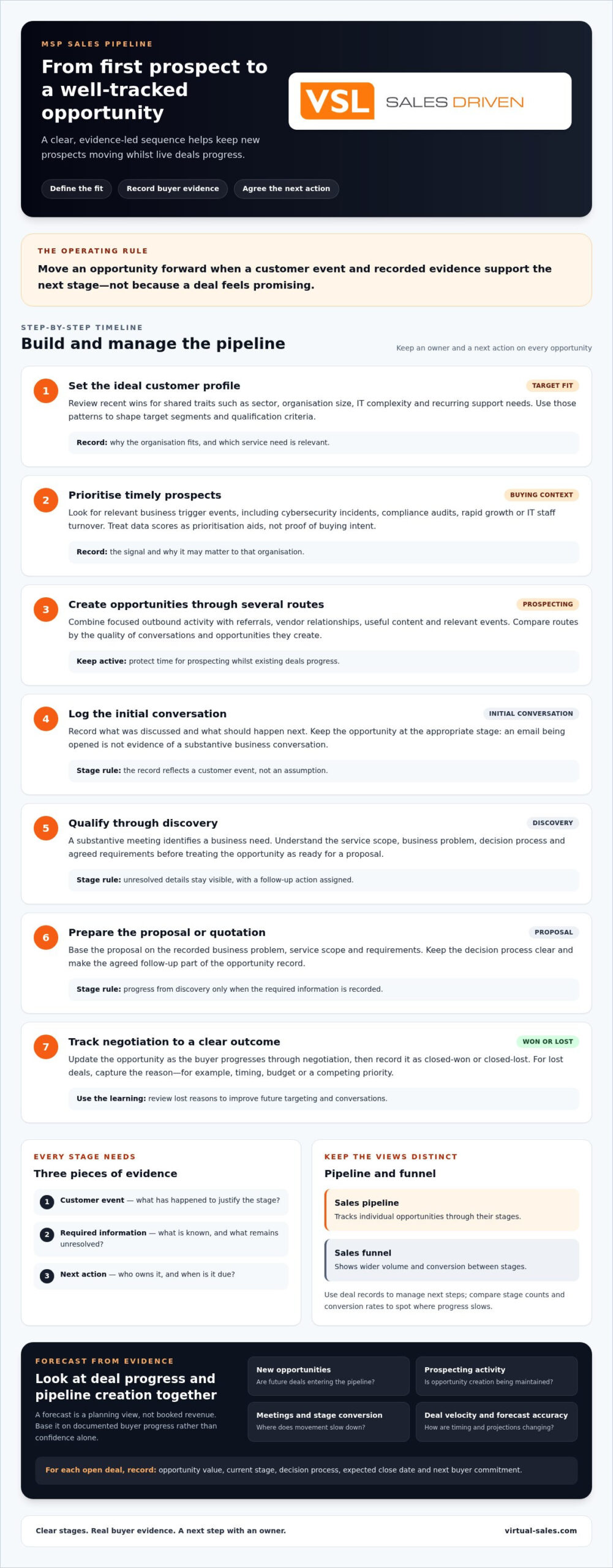
Map the sales cycle as prospecting, initial conversation, discovery, proposal or quotation, negotiation, then closed-won or closed-lost. Treat these as shared stages, not labels for a salesperson’s optimism. A prospect belongs in discovery after a substantive meeting identifies a business need, not merely because someone opened an email. This distinction gives managers clearer visibility into each opportunity.
Set three rules for every stage: the customer event that has occurred, the information needed to progress, and the next action with an owner and date. For example, move from discovery to proposal only after recording the service scope, business problem, decision process and agreed requirements. If any detail remains unresolved, keep the opportunity in discovery and assign a follow-up action.
A sales pipeline tracks individual opportunities through these stages; a sales funnel shows the wider volume and conversion between them. Use pipeline tracking to manage specific deals, then compare stage counts and conversion rates to find where progress slows. Keep closed-lost records with a reason, such as timing, budget or a competing priority, so future reviews yield useful insights.
How can UK MSPs define ideal customer profiles and target sectors? Review recent wins and identify shared traits, such as sector, organisation size, IT complexity and recurring support needs. Build target segments around those patterns, then adapt qualification criteria to each niche. A regulated firm may prioritise audit readiness, while a growing business may need scalable support.
Standardise stage names and evidence requirements across the team, but adapt questions to the service and buyer. An MSP selling managed security should track security priorities; a provider focused on cloud support should record the relevant environment and migration needs. Review exceptions in regular pipeline meetings rather than creating informal stages. For more on prospecting specifically for providers like yours, see this guide to MSP appointment setting.
3. Pipeline metrics and forecasting
A useful forecast connects opportunity value, stage and evidence of buyer progress. Track new opportunities, prospecting activity, meetings, stage conversions, deal velocity and forecast accuracy. These measures show whether future revenue depends on a healthy flow of new deals or a few late-stage prospects. For leaders considering how IT managed service providers can build a consistent sales pipeline, these metrics reveal whether prospecting and deal progression are working together.
What are typical UK MSP sales conversion rates and pipeline benchmarks? There is no single conversion rate that suits every MSP, because service scope, buyer needs and sales stages differ. Build your own benchmarks from your stage conversions and pipeline coverage against target, and compare them period by period.
Build the forecast from documented customer actions, not a salesperson’s confidence alone. Record the opportunity value, current stage, decision process, expected close date and next buyer commitment. Apply a probability only when stage criteria support it, then compare the weighted forecast with the target. Treat the result as a planning view, not booked revenue.
Long sales cycles need closer attention to timing and movement. For each open deal, note the last meaningful buyer interaction and the next agreed milestone. If a close date slips repeatedly, investigate whether the prospect is engaged or whether too few new opportunities are entering the pipeline. This article on the B2B sales cycle and how to keep deals moving covers common causes of delay.
Leaders should review forecast accuracy alongside pipeline creation. Compare projected and actual outcomes by stage, service type and source; investigate differences rather than changing probabilities to fit the desired result. A discovery opportunity should carry less confidence than a deal in negotiation, where scope, decision-makers and commercial terms have advanced.
During monthly reviews, ask the sales team to explain material changes with specific evidence: a confirmed meeting, a revised requirement or a delayed decision. Keep separate views for committed revenue and earlier-stage potential. This discipline gives teams a clearer basis for resource planning and highlights where qualification, follow-up or stage progression needs attention.
4. Prospect lists, sales processes and revenue targets
Successful MSP prospecting is not about making the highest number of calls. It is about reaching the right organisations, understanding their existing IT arrangements and identifying genuine opportunities for a commercial conversation. Experienced, consultative callers can engage IT directors, managing directors and other decision-makers without relying on rigid scripts or generic sales pitches. This approach helps MSPs build relationships with potential customers long before an immediate purchasing requirement emerge.
A prospect list becomes useful when it connects target organisations to a clear sales process. Segment firms by service fit, sector, size and buying trigger, then prioritise those showing active need. For example, an MSP might prioritise a growing firm reviewing its IT support over a poor-fit organisation with no relevant requirement. Record the reason for each priority so the sales team can review it consistently.
Work backwards from the revenue goal. Compare the pipeline value needed to hit target with the value and stage of live opportunities, then identify the gap in new prospecting activity. Treat this as a planning measure, not a promise of sales; actual results depend on deal progression and conversion.
Use a structured process to turn prospecting into qualified opportunities. Log the source, relevant trigger, decision-maker, business need and next action. Prioritise high-intent prospects, but don’t ignore a strong-fit organisation simply because its buying window is later. A scheduled follow-up tied to a known review date keeps the opportunity visible without pushing for an immediate decision.
Help prospects understand risk through specific, relevant questions. If a business is concerned about service disruption, explore the operational effect of unresolved support issues and the response it needs. Share useful information that clarifies the decision, then connect any proposal to the requirements the prospect has described. Build trust through evidence and relevance, not alarmist claims.
Monitor activity and outcomes together. Track new organisations added, meaningful conversations, qualified opportunities, follow-up completion and stage movement. If activity remains high but opportunities don’t progress, examine list quality, message relevance and qualification. If the list is strong but outreach pauses during proposal work, protect regular prospecting time. This keeps pipeline creation part of the sales process, rather than an occasional response to a shortfall.
Virtual Sales Limited: B2B Appointment Setting
Virtual Sales Limited (VSL) specialises in B2B appointment setting and lead generation for UK technology businesses, including managed service providers, IT consultancies and software companies.
Unlike traditional call centres, VSL uses experienced, UK-based callers who conduct consultative, script-free conversations with relevant decision-makers. Each campaign is supported by a dedicated caller and campaign manager, with prospects qualified using BANT principles: Budget, Authority, Need and Timescale.
VSL’s flexible monthly campaigns allow MSPs to maintain structured outbound prospecting activity without the overhead of recruiting, training and managing an internal sales development team. The focus is on identifying genuine business opportunities and arranging relevant conversations, rather than simply generating appointment volume.
Building a consistent MSP sales pipeline requires more than occasional prospecting or relying on referrals. Sustainable growth depends on identifying suitable organisations, maintaining regular contact with decision-makers and developing qualified opportunities through relevant, professional conversations.
For MSPs whose technical and leadership teams are already focused on customer delivery, outsourcing appointment setting can provide the dedicated business development capacity needed to maintain momentum.
Virtual Sales Limited helps UK managed service providers and other technology businesses develop qualified sales opportunities through experienced, UK-based callers and structured, consultative outreach.
Ready to build a more consistent MSP sales pipeline?
Book a 15-minute discovery call with Virtual Sales Limited to discuss your target market, prospecting challenges and business development objectives.
Make pipeline discipline part of the way you grow
Frequently Asked Questions
How to Build a Sales Pipeline from Scratch?
Begin by choosing a specific service and buyer problem, such as helping growing firms manage IT support more effectively. Build a small, relevant prospect list, then test your message through direct conversations and referrals. Capture the objections prospects raise and use them to refine your targeting. This gives an MSP a practical starting point before expanding into additional sectors or services.
How does automation streamline pipeline management for professional services?
Automation can keep records tidy, such as creating a follow-up task after a meeting or reminding an account owner about an agreed review date. Set rules around clear events, not assumptions: sending a proposal can trigger a check-in task, but it should not automatically mark a deal as progressing. Judgement and relationship-building remain with your sales team.
What is an MSP sales strategy?
An MSP sales strategy sets out which organisations the business wants to serve, what IT problems it addresses, and how it will turn suitable prospects into clients. It connects the service proposition with targeting, qualification, sales conversations and account development. For example, an MSP focused on cloud support can build its messaging around the operational needs of firms planning a cloud migration.
What are the typical stages of a sales pipeline?
A typical pipeline moves through prospecting, initial conversations, discovery, proposal or quotation, negotiation, and a closed-won or closed-lost outcome. Some MSPs add an onboarding stage after a sale, since service handover affects the customer’s first experience. Keep onboarding distinct from sales forecasting so signed business and delivery progress remain visible without confusing sales opportunities.
What should an MSP’s sales pipeline stages and qualification criteria include?
Each stage needs a clear entry condition, required evidence and next action. Qualification should establish whether the organisation fits the MSP’s service model, has a relevant business need, and involves people able to shape or approve a decision. Record unresolved points too. For example, if a prospect has a support issue but no agreed review process, note that gap before forecasting the opportunity.
How can MSPs improve sales follow-up, proposals and recurring revenue conversions?
Agree on the next contact during each prospect conversation, then make the follow-up useful: answer an outstanding question, clarify scope or share a relevant example. A proposal should connect service components to the prospect’s stated requirements and explain responsibilities clearly. After a client signs, schedule account reviews around service priorities and changing needs. This creates a sound basis for discussing renewals or additional support.

Disclaimer
Disclaimer: Content is for general information only and does not constitute professional advice. Results may vary. Virtual Sales Limited accepts no liability for actions taken based on this content.
Tags: it services, Lead generation, MSP sales, opportunity tracking, Sales Forecasting, Sales Pipeline, sales prospecting