BANT Lead Qualification: Spot Genuine B2B Deals
A promising SaaS lead can still be a poor sales opportunity. BANT lead qualification helps identify genuine B2B sales opportunities by assessing Budget, Authority, Need and Timeline, rather than treating initial interest as buying intent. A prospect may have a clear problem but no agreed budget, or be ready to act without having the authority to approve a purchase.
That’s why BANT works best as a guide to a meaningful conversation, not as a rigid checklist. It gives marketing and sales a shared way to record what they know, uncover what’s missing and agree on the next step.
This article explains how each BANT element applies to SaaS sales, how to assess decision-makers and partial fit, and when a lead needs nurturing rather than immediate sales follow-up. You’ll also learn how marketing and sales can align on qualification criteria, so promising prospects aren’t dismissed too early and poor-fit leads don’t take up valuable sales time.
Key Takeaways
- Treat an unconfirmed budget as a point to explore, not an automatic reason to reject a promising prospect.
- Map the people involved in a purchase, including who approves the decision and who will use the solution.
- Set shared qualification criteria so marketing can identify early fit and sales can assess real opportunities.
- Use Budget, Authority, Need and Timeline to guide SaaS conversations, while recording what is known and what still needs discovery.
How should B2B sellers handle buyers that only meet partial BANT fit?
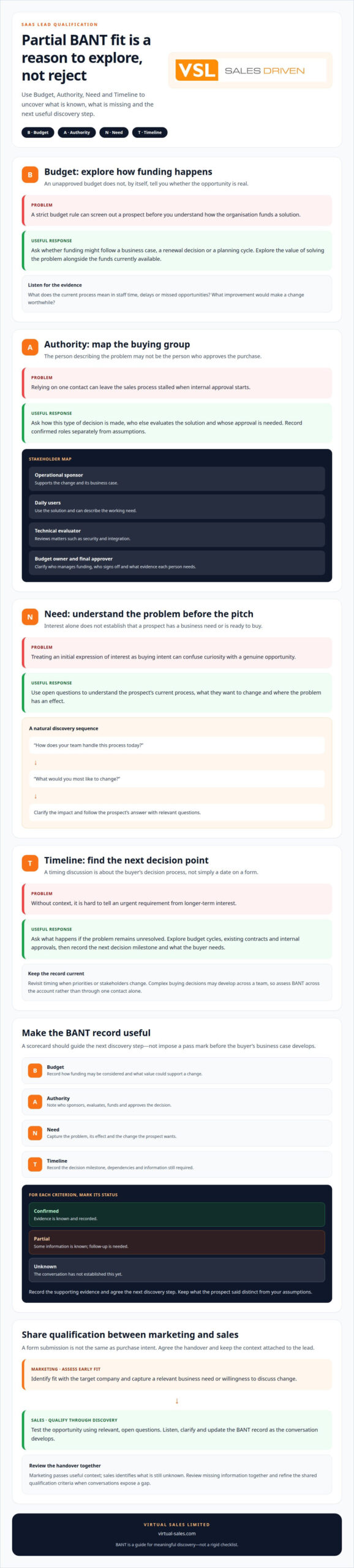
Partial fit is a reason to explore further, not to reject a prospect automatically. Assess Budget, Authority, Need and Timeline together, and record the evidence for each criterion.
Relaxing Rigid Budget Criteria
A strict budget rule can rule out prospects before sellers understand how funding decisions are made. In SaaS, a buyer may face a clear operational problem but lack an approved budget line. Ask whether funding could follow a business case, renewal decision or planning cycle. This helps distinguish a genuine constraint from an untested assumption, while recognising that interest alone doesn’t qualify an opportunity.
Assessing Budget Through Expected Value
Assess budget by weighing the value of solving the problem against the investment required. Ask what the current process costs in staff time, delays or missed opportunities, then explore what improvement would justify a change. For example, a team describing repeated manual work may see value in a SaaS tool that reduces that burden. Expected outcomes and decision criteria matter alongside available funds.
Evaluating Timing and Urgency
Timeline means understanding when the prospect expects to decide and what could affect that date. Ask what happens if the problem remains unresolved, then explore budget cycles, existing contracts and internal approvals. This helps distinguish an urgent requirement from longer-term interest. Record the next decision milestone and the information the buyer needs, then revisit timing if priorities or stakeholders change.
Adapting BANT to Longer Sales Cycles
For complex B2B buying teams, apply BANT across the account rather than judging one contact. Map each stakeholder’s role, authority, needs and influence on timing; update the record as the buying group evolves. MEDDIC adds detailed deal qualification, CHAMP starts with challenges, while GPCTBA/C&I explores goals, plans, challenges, timeline, budget, authority and consequences.
A practical scorecard lists Budget, Authority, Need and Timeline, marking each as confirmed, partial or unknown and noting the supporting evidence. Use it to agree on the next discovery step, not to impose a pass mark that excludes buyers before their business case develops.
Authority – Who is the decision maker?
Authority means identifying who can approve a purchase and who influences its evaluation. In a SaaS sale, the person describing a problem may be a user, not the budget holder. Treating that contact as the sole decision-maker can stall the process when internal approval begins. Establish their role early, then ask how the organisation makes this type of decision.
Map the buying group by responsibility, not just by name. Identify the operational sponsor, daily users, technical evaluator, budget owner and final approver. For example, a finance lead may manage funding while an IT director assesses security and integration. Ask your contact who else will evaluate the solution, whose approval is required and who may raise concerns.
The number of contacts doesn’t determine who has authority. Clarify each person’s influence, priorities and role in the approval process. A sales director might support a CRM tool, while IT reviews data requirements and finance approves the business case. Ask which teams need to contribute and what each needs to support a decision.
Record the approval process: who sponsors the change, who evaluates options, who signs off and what evidence each person needs. Find out whether your contact can introduce these stakeholders or explain how the team will involve them. This helps distinguish a developing internal process from an opportunity reliant on one advocate. Separate confirmed roles from assumptions.
Update the stakeholder map as the buying process develops. A new technical reviewer, a changed approval route or an absent budget owner can alter the next action. For teams seeking to engage relevant buying contacts, B2B appointment-setting support for technology teams can help create informed sales conversations.
Should marketing or sales own lead qualification?
Marketing should assess initial fit, while sales qualifies live opportunities through discovery. Agree on shared definitions of a qualified lead, such as fit with the target company, a relevant business need and willingness to discuss change. Then define the handover: marketing passes useful context, and sales tests the opportunity against the qualification framework. This prevents a form submission from being mistaken for purchase intent.
Use open questions to understand the prospect’s situation before discussing a solution. Ask, “How does your team handle this process today?” or “What would you most like to change?” A SaaS prospect might describe duplicated work across teams; follow up with, “Where does that cause the biggest delay?” These questions uncover problems and desired outcomes without steering the prospect towards a yes-or-no answer.
Listen actively so each follow-up question is relevant. Reflect the prospect’s answer, then clarify: “You mentioned the handover slows down. Which teams are involved, and what happens next?” Don’t rush through BANT in a fixed order. If the prospect raises an implementation concern, explore how it affects the sales process before returning to other criteria. Record what they say, not your assumptions.
Regular practice helps sales teams apply this approach consistently. Use role-play based on real scenarios, such as a marketing lead who is interested but has no agreed project, or a technical contact who needs to involve finance. After each exercise, review whether the representative asked neutral questions, listened fully and followed the prospect’s answers. Marketing and sales should also review handovers together, identify missing context and refine qualification criteria when conversations reveal a gap. Make ownership clear: marketing improves early-fit information; sales assesses opportunity readiness and agrees on next steps.
BANT qualification in a SaaS sales scenario
For SaaS teams, BANT lead qualification helps identify genuine B2B sales opportunities by testing buying intent against evidence. Imagine a prospect exploring workflow software because manual processes slow internal work. A positive response signals interest, but discovery should clarify the business issue, decision route and next steps before the sales team treats it as an active opportunity.
Record each criterion separately. For Budget, note whether funding is approved, under consideration or unplanned. For Authority, establish the contact’s role and which colleagues will evaluate or approve the purchase. Need should describe the process problem and its effect on the team. Timeline should capture the expected decision point and any dependency, such as a contract review or internal planning cycle.
If the prospect describes repeated delays but has no agreed project date, record both facts. Note the confirmed need, mark timing as unresolved and agree on a follow-up around the prospect’s planning milestone. If a technical stakeholder needs to assess the software, record that requirement too. This gives the next conversation a clear purpose without overstating the prospect’s readiness.
CRM data can help assess whether BANT lead qualification identifies genuine B2B sales opportunities. Track how leads with documented criteria progress through pipeline stages, become sales-qualified leads and convert into opportunities. Compare records using consistent definitions and time periods, then review stalled deals and recorded loss reasons. These SaaS lead generation practices can help teams review how qualification supports pipeline development. Conversion rates provide a way to assess the process, but don’t prove that BANT alone caused the outcome.
The practical test is whether qualification records support a useful next action. Keep evidence distinct from assumptions, and use later conversations to update the account as buying needs change. Clear prioritisation can help sales teams focus on the prospects most relevant to their sales process.
Virtual Sales Limited: B2B Appointment Setting
Virtual Sales Limited supports technology companies that need qualified conversations with relevant business decision-makers. Its B2B Appointment Setting and B2B Lead generation use consultative conversations to explore Budget, Authority, Need and Timeline, recording what is confirmed and what remains unknown.
Virtual Sales Limited can help when your sales team needs support engaging suitable prospects or lacks the capacity for consistent outreach. Each campaign has a dedicated caller and campaign manager, and VSL works as an extension of your sales and marketing team. Weekly reporting helps you review campaign activity and prospect feedback against your qualification criteria.
If you’re assessing whether this approach fits your sales process, contact Virtual Sales Limited to discuss your requirements.
Make qualification part of your sales rhythm
Make qualification an ongoing practice, not a form completed once and forgotten. Schedule regular reviews between marketing and sales to identify assumptions that need testing, prospects who have gone quiet and new information that could change the next action. This keeps the process responsive as priorities shift and buying groups evolve.
Use BANT lead qualification to identify genuine B2B sales opportunities as a shared decision tool: agree what evidence is enough to progress, nurture or pause an opportunity. That gives your team a consistent basis for action without reducing every prospect to a score. With clearer qualification conversations, your sales team can focus its time and build stronger relationships with the right buyers.
Take the next step when you’re ready to put that approach into practice.
Frequently Asked Questions
What is the BANT Sales Framework?
The BANT sales framework structures discovery around four areas: Budget, Authority, Need and Timeline. Its practical value is consistency: representatives can capture comparable information across accounts and identify what still needs discussion. Use it to guide the conversation, adapting the order of topics to the prospect’s priorities rather than completing a fixed form.
How do you qualify leads without being pushy?
Explain why you’re asking each question and let the prospect guide the conversation. Say you want to understand whether a follow-up discussion would be useful, then ask permission to explore a specific point. If the prospect isn’t ready to answer, note what they’re comfortable sharing and agree whether to return to it later. Don’t imply that every conversation needs to lead to a meeting.
What does BANT stand for?
BANT stands for Budget, Authority, Need and Timeline. Use these four labels to review discovery notes, but keep the evidence behind each one. “Budget unknown” is more useful than a blank field because it shows that the question remains open, rather than suggesting the representative forgot to record the answer.
What does BANT stand for in B2B sales qualification?
In B2B sales qualification, the letters still stand for Budget, Authority, Need and Timeline. The distinction is practical: assess them in the context of the business account, not just the individual contact. A buyer may know the operational requirement but not the organisation’s approval route. Recording that nuance helps colleagues prepare for the next conversation without overstating the contact’s readiness.
How does the BANT lead qualification framework work?
BANT provides shared prompts for discovery notes, lead reviews and sales handovers. A team can define what counts as evidence for each area and apply those definitions consistently. For example, “interested in a demo” shows engagement, but doesn’t establish a business requirement or buying authority on its own. Clear evidence standards help representatives make better follow-up decisions.
What questions should sales reps ask to assess a lead using BANT?
Ask questions that reveal how the prospect will make a decision: “How will you evaluate options?”, “What would make a solution worthwhile?” and “What needs to happen before you can move forward?” Use the answers to identify what’s known and what needs follow-up. Don’t ask every question at once; choose the one that best responds to what the prospect has just said.

Disclaimer
Disclaimer: Content is for general information only and does not constitute professional advice. Results may vary. Virtual Sales Limited accepts no liability for actions taken based on this content.
Tags: B2B Sales, bant qualification, decision-makers, Lead Nurturing, Lead Qualification, SaaS Sales, sales opportunities