Data Append Services for UK Companies: How to Fill Gaps in Your B2B Database
A fuller prospect record isn’t necessarily a better one. Data append services for UK companies can add missing contact and company details, but a complete-looking record may still point your sales team towards the wrong person or an unsuitable business.
If you lead sales, marketing or business development at a UK technology, SaaS, software or IT services company, you’ll know that outdated details make outreach harder. Appending information can help, but it won’t automatically confirm that a prospect fits your ideal customer profile or is ready for a useful sales conversation.
This guide explains how data appending differs from data cleansing, what to assess in enriched records and how to connect better data with qualification and follow-up. You’ll also see how targeted data sourcing, consultative outreach and BANT qualification can help your team focus on relevant decision-makers, rather than treating a filled-in database as the end goal.
Key Takeaways
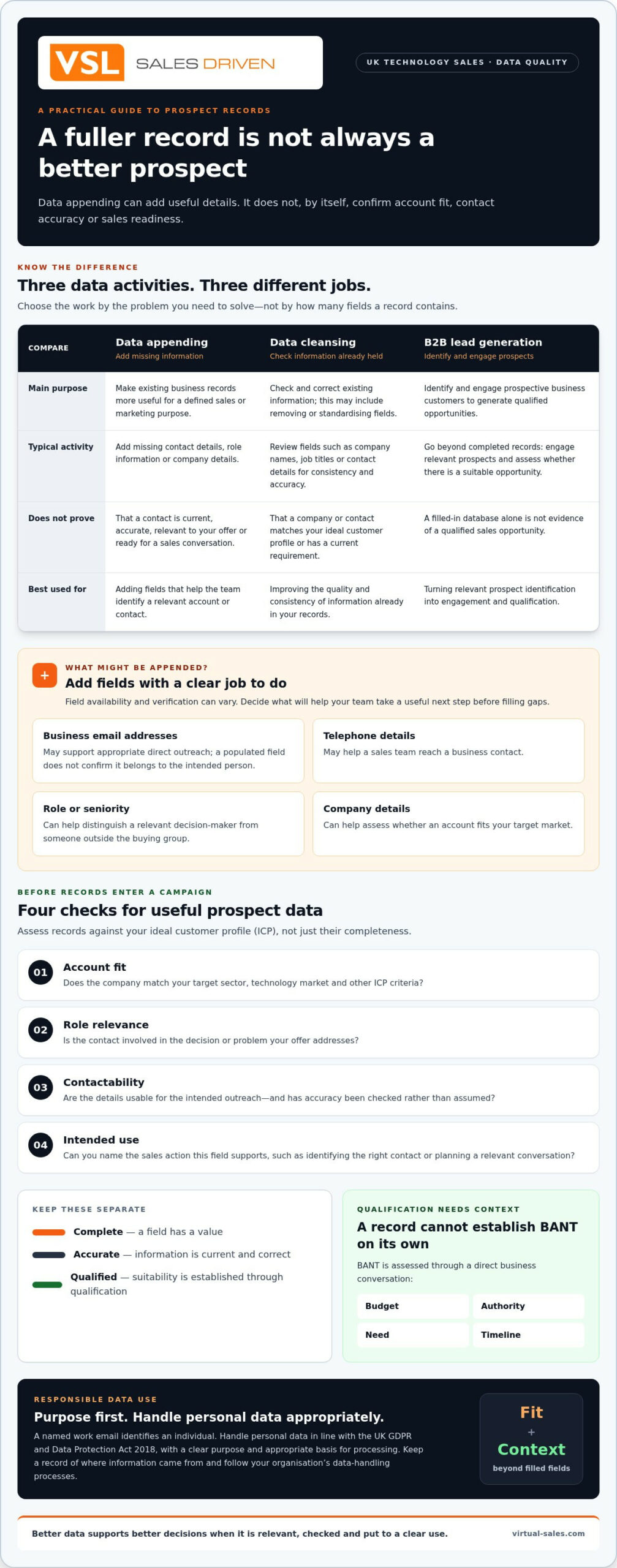
- Data appending adds missing details to existing business records; data cleansing checks and corrects the information already held.
- Assess appended records against your ideal customer profile, checking account fit, role relevance, contactability and intended use.
- More contact fields don’t guarantee a useful prospect: check whether each record identifies the right decision-maker and buying context.
- Use data append services for UK companies as part of a wider process that connects relevant sourcing with prospect engagement and qualification.
- When records alone can’t build pipeline, consultative outreach and BANT qualification can help establish whether a prospect is a suitable sales opportunity.
What do UK data append services actually do?
A prospect record can sit in your CRM with a company name and little else your sales team can act on. A missing work email, telephone number or relevant job role makes it harder to identify and reach the right person.
Data appending is the process of adding missing information to existing business records, such as contact details or role information, to make those records more useful for a defined sales or marketing purpose. For data append services for UK companies, the value lies not in filling every blank, but in adding information that helps identify relevant accounts and decision-makers.
Which information might business data appending add?
Depending on the records, available sources and campaign requirements, appended fields may include:
- Business email addresses to support appropriate direct outreach.
- Telephone details to help a sales team reach a business contact.
- Role or seniority information to distinguish a relevant decision-maker from someone outside the buying group.
- Company details that help assess whether an account fits the target market.
Field availability and verification can vary. A populated email field, for example, doesn’t by itself establish that the address belongs to the intended person or that the contact is relevant to your offer. Set the target account and campaign purpose first, then decide which fields will help the team take a useful next step.
How does appending differ from data cleansing and lead generation?
These activities solve related but distinct problems. Appending adds missing information. Data cleansing checks existing records and may correct, remove or standardise fields such as inconsistent company names, job titles or contact details. In practice, you may need both: added data can still be inaccurate or inconsistent with what your CRM already holds.
B2B lead generation is the process of identifying and engaging prospective business customers to generate qualified opportunities. It goes beyond completing records. A contact can have a name, role and telephone number without being a suitable prospect or having a current requirement.
Nor does completed data establish BANT: Budget, Authority, Need and Timeline. Those points require qualification, usually through a direct business conversation. For technology companies, data sourcing is most useful when it supports a defined ideal customer profile and a clear plan for engaging the right people. VSL’s technology lead generation connects relevant prospect identification with consultative outreach, so record completion can contribute to qualified conversations rather than stand alone as a database task.
How should UK technology companies assess appended data?
Judge enriched records by whether they help your team identify and approach the right prospects, not by how many fields are filled. A record can look complete and still be inaccurate, out of date or irrelevant to your offer. Harvard Business Review has highlighted the scale of data-quality problems in its report on basic quality standards for data.
Use this field-by-field checklist before adding records to a campaign:
- Account fit: Does the company match your target sector, technology market and other ICP criteria?
- Role relevance: Is the contact involved in the decision or problem your offer addresses?
- Contactability: Are the details usable for the intended outreach, and has their accuracy been checked rather than assumed?
- Intended use: Can you name the sales action this field supports, such as identifying the right contact or planning a relevant conversation?
Keep completeness and accuracy separate in your assessment. A populated job-title field is complete; it isn’t automatically current or correct. Record the source and any verification status your process provides, and treat uncertain details accordingly.
Does the data match your ideal customer profile?
Your ideal customer profile (ICP) should guide both account selection and contact selection. For a technology campaign, define the types of companies you want to reach, then identify relevant decision-making roles across Sales, Marketing, Business Development or company leadership. A correctly named contact at an account outside your target market may still be a poor prospect. Relevance depends on the fit between the company, the person’s role and your proposition.
Can your team use the enriched fields responsibly?
Collect fields for a defined purpose, not simply because they’re available. If a named work email identifies an individual, it is personal data. Handle it in line with the UK GDPR and Data Protection Act 2018, with a clear purpose and appropriate basis for processing. Keep records of where information came from and ensure your team follows your organisation’s data-handling processes.
Also consider how campaign information will reach your sales workflow. VSL uses a cloud-based CRM to manage campaign activity and can output campaign data for use with platforms such as HubSpot and Salesforce; this does not mean a direct integration. If you’re assessing how data can support sales conversations, explore VSL’s UK appointment-setting reviews.
What can go wrong when companies append prospect data?
Adding fields can make a CRM record look more useful without making it a better sales prospect. If data appending isn’t tied to the ideal customer profile (ICP), teams may spend time contacting people at unsuitable accounts, or reaching someone whose role has changed. The risk is treating more information as proof of stronger sales potential.
Why can complete contact records still fail to produce opportunities?
Illustrative scenario: A UK software company adds a named contact, job title and telephone number to a record for a business outside its target company profile. The contact details appear complete, but the account is a poor fit. At another company, the contact’s title suggests influence, yet they no longer hold that role. In either case, the added fields don’t establish a relevant buying conversation.
Even accurate contact information can’t confirm Budget, Authority, Need or Timeline. Those points require qualification, not inference from a job title or a filled-in CRM field.
A completed record contains contact information; a qualified BANT lead has also been assessed for Budget, Authority, Need and Timeline.
Use prospect feedback to refine the campaign. If conversations reveal that a role sits outside the buying group, or that a particular account type rarely has the need being addressed, review the targeting criteria and data fields. Feedback can guide adjustments; it doesn’t guarantee a particular outcome.
Which data-appending mistakes should teams avoid?
- Using broad targeting: Adding contacts across a wide range of businesses may grow the database while drawing attention away from accounts that match the ICP.
- Assuming fields are current or verified: A populated phone number or job title isn’t evidence by itself that it’s accurate. Treat verification status and source information as separate checks.
- Measuring database size: A higher record count says little about whether the data supports useful sales activity. Review fit, contactability, conversations and qualified opportunities instead.
For teams using data append services for UK companies, judge the work by whether it helps sales focus on relevant accounts and decision-makers. Track which records lead to meaningful engagement, which fail the ICP checks, and what prospects say about their needs or buying process. That evidence can inform future sourcing and campaign decisions without confusing completed fields with qualified demand.
How can a practical data append process support B2B outreach?
Appended records become more useful when they feed a managed sales process, rather than sitting in a CRM as extra fields. For technology companies, that means connecting target-account choices with prospect conversations, qualification and regular review. Data append services for UK companies can support this process when sourcing starts with a clear campaign purpose.
A practical five-step framework keeps the work focused:
- Define the ICP: Agree which company types, technology markets and decision-making roles fit the campaign.
- Source relevant records: Add or identify contact details that support reaching those accounts and roles.
- Engage prospects: Start consultative, script-free business conversations that explore whether the offer is relevant.
- Qualify: Assess Budget, Authority, Need and Timeline (BANT) as a minimum, rather than treating contactability as qualification.
- Review: Use campaign outcomes and prospect feedback to refine targeting, messaging and future data sourcing.
How does VSL connect data sourcing with campaign activity?
VSL campaign managers handle campaign set-up, data sourcing, reporting and results analysis. Each campaign has a dedicated caller and campaign manager, giving your team clear ownership as activity moves from selecting relevant records to engaging decision-makers. Experienced UK-based callers work as an extension of your sales and marketing team, using consultative conversations to understand business needs, not just confirm that contact details work.
That distinction matters. A prospect may answer and still have no relevant requirement, authority or suitable buying timeline. VSL qualifies leads to BANT criteria as a minimum. Find out how technology lead generation supports targeted prospecting.
How can teams review campaign data and feedback?
Weekly reporting and campaign outcome tracking help your team see what happened across the activity, including where contacts engaged, where records proved unsuitable and what prospects said about their needs. Use those signals to adjust the account criteria or conversation approach, rather than judging progress by the number of completed fields alone.
VSL uses a cloud-based CRM to manage campaign activity and can output campaign data for use with platforms such as HubSpot and Salesforce. This provides a route for campaign information to be used in your sales workflow, without implying a direct integration. For a related perspective on focusing effort, see how to prioritise sales focus over data volume.
When should UK companies use data appending to support sales growth?
Data appending is most useful when you know which records are incomplete and what sales activity the missing information should support. The right next step depends on the gap:
- Entering a market: Identify relevant organisations and decision-makers in the target market.
- Targeting a new vertical: Build records around companies and roles that fit its ideal customer profile.
- Refreshing records: Review existing contact details before relying on them for outreach.
- Building pipeline: Source relevant prospects when your team has a clear offer but needs more qualified conversations.
Data appending can improve record usefulness, but it can’t create sales opportunities by itself. If the priority is qualified conversations, connect data work with prospect engagement and qualification. This guide to outsourced lead-generation services explores how external support can contribute to business development.
Is data appending enough when the sales pipeline needs qualified opportunities?
Appending improves the information available about a prospect. B2B lead generation identifies and engages prospective business customers, whilst B2B appointment setting engages business decision-makers to generate qualified sales appointments. VSL connects technology-sector prospect sourcing with consultative, script-free conversations and qualifies leads to BANT criteria as a minimum: Budget, Authority, Need and Timeline.
Results, Evidence & Data
Assess data quality and campaign outcomes separately. The UK Government’s Data Quality Hub identifies dimensions including accuracy, completeness, uniqueness, timeliness, consistency and validity. These provide useful checks for enriched records, but they don’t establish whether a prospect is qualified or guarantee a sales result.
For campaign review, track whether records fit the target profile, whether the right contacts are reached, and what qualification and campaign outcomes follow. VSL provides weekly campaign reporting and tracks outcomes. These reports support review and refinement; they aren’t a promise of a particular number of leads or appointments.
What should a buyer expect from a VSL campaign?
A campaign starts with a briefing, a project set-up discussion, a kick-off and proposition training. Each campaign has a dedicated caller and campaign manager. Campaign managers handle data sourcing, campaign management and reporting, while experienced UK-based callers work as an extension of your sales and marketing team.
25+ Years Helping Technology Companies Generate Qualified Sales Meetings
Every successful campaign starts with a conversation.
#OneStepCloser 🚀
uk technology appointment setting
Turn better data into better sales conversations
Appending contact details is only a starting point. For data append services for UK companies to support sales growth, assess whether records fit your ideal customer profile, help your team reach relevant decision-makers and lead to meaningful qualification. A complete database is useful only when it supports the next sales action.
Virtual Sales Limited was founded in March 2001. Campaign managers bring over 20 years of experience, and every campaign has a dedicated caller and campaign manager, with weekly reporting to help you review activity and outcomes. Consultative outreach and BANT qualification connect relevant prospect data with conversations your sales team can act on.
25+ Years Helping Technology Companies Generate Qualified Sales Meetings
Every successful campaign starts with a conversation.
#OneStepCloser 🚀
uk technology appointment setting
Start with the right records, then build towards more relevant business conversations.
Frequently Asked Questions
What are data append services for UK companies?
Data append services for UK companies add missing information to existing business records, such as work email addresses, telephone details or job roles. The aim is to make records more useful for a defined sales purpose. Appended fields still need to be assessed for account fit, relevance and accuracy before your team uses them to approach prospects.
How is data appending different from data cleansing?
Data appending adds missing information to a record. Data cleansing checks and improves information already held, for example by correcting errors, standardising formats or reviewing duplicate entries. A record may need both. Adding a contact detail won’t correct an outdated job title or inconsistent company name, so assess the added fields and existing information as separate parts of your data hygiene process.
Can appended business data guarantee qualified sales leads?
No. Contact details can help your team identify or reach a prospect, but they don’t establish Budget, Authority, Need or Timeline. Those points require qualification through engagement. VSL qualifies leads to BANT criteria as a minimum, using consultative business conversations. Assess data by its relevance and usefulness to outreach, rather than assuming that a completed record represents a qualified sales opportunity.
How do UK technology companies assess the quality of appended data?
Check each record against your ideal customer profile. Confirm that the company fits your target market, the contact’s role is relevant, the details support an intended sales action and any available verification information is clear. Keep completeness separate from accuracy: a populated job-title field isn’t automatically current or correct. Review campaign feedback to identify records that need further attention.
Does data appending integrate directly with HubSpot or Salesforce?
VSL uses a cloud-based CRM to manage campaign activity and can output campaign data for use with platforms such as HubSpot and Salesforce. This allows campaign information to be prepared for use in those platforms, but shouldn’t be described as a direct integration. Your team can establish how the campaign output fits its own sales workflow and data-management process.
When should a business use data appending for prospect records?
Use data appending when relevant prospect records lack information your team needs for a defined sales action. It may support market entry, targeting a new vertical, refreshing existing records or sourcing prospects for pipeline development. Set account and role criteria first. If the goal is qualified sales conversations, data work may need to be supported by prospect engagement and qualification.
How does VSL use data sourcing in a lead-generation campaign?
VSL campaign managers handle data sourcing as part of campaign set-up and management, aligning prospect records with the target market and campaign purpose. Each campaign has a dedicated caller and campaign manager, with weekly reporting and tracked outcomes. Experienced UK-based callers hold consultative, script-free conversations to understand prospect requirements and qualify leads to BANT criteria as a minimum.
If you’re considering how to connect relevant prospect data with qualified technology sales conversations, explore VSL’s UK technology appointment setting.

Disclaimer
Disclaimer: Content is for general information only and does not constitute professional advice. Results may vary. Virtual Sales Limited accepts no liability for actions taken based on this content.
Tags: B2B Lead Generation, bant qualification, consultative outreach, data append, data enrichment, Database Development, prospect data, UK technology sales